 Jō Asakura
Or finally some toying around with RAM, at least.
Why didn’t I think of that!? Yeah, you’re absolutely right. Static testing of structural RAM- which means far more extensive & fundamental utilisation than ‘FibreMat’ on the F-35.
A certain quarter is gonna be a tad miffed.
Jō AsakuraYeah, given that the composites around the F-135 are having heat delamination problems, maybe LM will revert to metal cowlings!!:D….that’s concurrency for ya.
A high performance, high temperature Russian PCM is due for development completion @ the end of this year :cool:.
Jō AsakuraThose numbers may include at least 2 FGFAs. Another four prototypes/preserials solely for the domestic programme (including a static tester) would indicate a significant refinement to the design-probably a structural evolution given the cracks encountered on the earlier machines and the somewhat rushed (and temporary?) solution of additional titanium reinforcements witnessed on ’54’.
My guess is bye-bye to the metal cowlings too, note the model on Pogosyan’s desk @ 02:40 on Peregrinefalcon’s vid above.
Also, as the RuAF commences state validation trials with both prototype and preserial machines, means true serial production will probably not start until around 2018. Which bodes well for the stage 2 engine being installed from the outset.
Eitherway, more prototypes tested to destruction is definitely the right way to run a flight test programme.
Jō Asakura[QUOTE=Scooter;2039636]
All of that is not to say the PAK-FA couldn’t match or even beat the F-22 in say Super Cruise or another aspect of its Flight Performance. Yet, we’re or at least I am talking about the combination of the two. (i.e. Stealth & High Speed) So, while it’s possible the former could match the F-22 in pure performance. It would likely have to pay a high price in Stealth! ……
I wouldn’t bang the *stealth compromises* drum too loudly if I were you. It transpires my calculations for 4mm averaging -22dB absorption in the 8-12GHz range were quite accurate.
The developers of the CNT RAM have since made data available that shows >-30dB for 6mm, which will easily address certain areas regarded as ‘hot spots’ such as beam aspect.
The RAM (de facto RAS) solutions for the PAK-FA are a generation apart from those utilised on the F-22- a considerable weight saving in itself (amounting to under 4.5kg per m^2).
You will have to come to terms with the fact that the F-22 design is showing its age. There are certain design, materials & sensor solutions on the PAK-FA that the US would consider 6G, as exemplified in some of their renditions.
Jō AsakuraRussian specific Paris news. According to an article (pg.15) Irkut’s Su-30SM for the RuAF has several avionics pieces sourced from abroad, including an Israeli HUD:
http://issuu.com/abe_media/docs/observer_37_paris_2013-low
All Russkii:
http://russianplanes.net/id110648
http://russianplanes.net/id110557
Jō AsakuraThe development of the ‘Super Hornet’ from the C/D was very nearly a disaster with the increased area wing resulting in ‘wing drop’, released bombs colliding with each other and near misses with the airframe, seals and RAM ripping off in-flight, thermal issues- to name a few of the ‘teething troubles’.
By contrast the transition from MiG-29 (9.12) to 29M (9.15) and 29K (9.31) and now the so-called MiG-35 was far smoother; despite involving significant structural and design changes from the 9.12. Hence, there’s very little comparison with the SH programme, notwithstanding the fact that 9.15 & 9.31 precede the SH by several years.
Martinez, despite Flanker_man providing the correct answer, aren’t Al-Li alloys thermally stable up to 260°C? How hot do missile plumes get? I ask because of your considerable experience with the ‘Fulcrum’.
http://www.youtube.com/watch?v=r3h2PIo0tt0&feature=youtube_gdata_player
Jō AsakuraPrivateer, most probably an Aluminium-Lithium alloy, long since pioneered by the Soviets.
http://knaapo.ru/rus/popup-100×100.wbp?picpath=/media/rus/gallery/aircrafts/combat/3rd_ser_su-35s/serial_su-35-3_01_hires.jpg
http://www.defencetalk.com/alcoa-expanding-aluminum-lithium-capabilities-to-meet-growing-aerospace-demand-40088/
You were right about those strips, Berkut, just looks like an unusual place to have TACAN.
http://www.youtube.com/watch?v=y1mBidj3kPQ
B. Sweetman drools over the Su-35S:
http://www.youtube.com/watch?feature=player_embedded&v=ddQ-OoUraqs
Jō AsakuraYeah, PARS 3-LR. I was gonna suggest 9M123 but ‘Khrizantema’s launch tubes are much more compact.
It may nothing and/or a trick of the light, but there appears to be a golden antenna array on Su-35S’ the tail-boom sensor suite:
http://www.airteamimages.com/sukhoi-su-35_07RED_russia—russian-air-force_178592_large.html
http://www.airteamimages.com/p1url-su-35_t76-2144.html
Jō AsakuraSerial Su-35S arrives @ Le Bourget:
http://fotografersha.livejournal.com/404475.html
http://fotografersha.livejournal.com/403982.html
Jō AsakuraNPO “Saturn” a list of critical technologies for the competitiveness of enterprises in the future
Austin, that ‘critical technologies’ list is a tad misleading regarding the PAK-FA stage 2 engine. Although NPO Saturn has the status of ‘Chief Integrator’ of the engine’s components (developed by several firms), it’s particular, in-house developed contribution is confirmed thus far as the HP compressor and HP turbine (though there will be several other components co-developed with other concerns).
In an interview given in April, Yuri Shmotin states:
“From 2006 to the present, the design bureau [NPO Saturn] has made significant technological advances as regards the PAK-FA stage 2 engine. This has allowed an agreement to be reached this year with [ODK’s] military engine management division, that [NPO] Saturn will be responsible for the high-pressure compressor and high pressure turbine. These stages are actually the ‘heart’ of an aircraft engine. Achieving such a solution is thanks to the fact that we’ve already created demonstrator engine components that fully meet the stated specifications. We have experimentally verified them…”
The production facility (UMPO) has already exhibited NPO Saturn’s intermetallic compound (Ti & Al) HP compressor blades @ a recent expo:
http://www.umpo.ru/News118_743.aspx
Interestingly, the list is the second time this phrase has been stated (the first was from Yurii Shmotin himself):
Composite materials consisting of a polymer matrix for the cold section of the engine (композиционные материалы на полимерной матрице для холодной части двигателя).
A phrase distinct from: Fan’s [polymer] composite nacelle/shroud (композитные корпуса вентилятора). As used to describe the parts for the PD-14 (and PS-90A2):
http://www.avid.ru/perspective-development/pd/
Which can only mean one thing for the engine’s cold section (для холодной части двигателя). Incidentally, the very technology primarily & specifically developed by OAO NIAT (ОАО НИАТ) for their PCM fan blade in 2009- namely the manufacturing method of 3D multiplanar shell fabric (способа изготовления трехмерных многоплоскостных оболочек из ткани) is used by several Russian aero-composites manufacturers, including ONPP’ Technologiya’ on the MS-21:
ФГУП “ОНПП “Технология” приступило к отработке технологий высоконагруженных деталей из углепластика хвостового оперения пассажирского самолета МС-21. Введенный в эксплуатацию новый участок формования с крупногабаритным газовым автоклавом позволяет вести автоматизированное формование длинномерных высококачественных панелей и лонжеронов из углепластика без механических стыков длиной до 12,5 и шириной до 5,5 м для крыла и хвостового оперения самолета. Совместно с ОАО “НИАТ” проводятся научно-исследовательские работы для создания перспективного задела по соединениям в этих конструкциях.
ONPP’ Technologiya’ has begun to develop technologies for the heavily loaded parts of the carbon fibre tail of the MS-21 passenger airliner. A new piece of moulding tooling has been commissioned with a large gas autoclave that allows automated moulding of long, high quality panels and the spars from CFRP without mechanical joins of up to 12.5m in length and a width of 5.5m for the wings and tail of the plane. Together with OAO “NIAT” research was conducted to create the future groundwork for compounds in these structures.
http://portalnano.ru/read/iInfrastructure/russia/nns/technologiya/new_tech_for_aerospace
it is lighter but can flight to greater distances. But the most important about T-50 is its equipment,
Hmm, actually the most important new should be that is lighter, how lighter? I dont know.
It will be significantly lighter. For starters the engine is using all-new generation light-weight/high strength materials compared to the F119, and hence will deliver a higher T/Wr. Also the T-50’s structural component RAM (de facto RAS) with broad X-band (8-12GHz) amounts to under 4.5kg per m^2 (for > -30dB absorption). The F-22’s post production, glued-on RAM and paints will probably weigh more than twice that figure per comparable treated area.
It also has a smaller frontal cross section area. Combine that with the VG inlets and the PAK-FA has definitely made more design compromises with the aim of high-speed flight than the F-22.
Compromises in this case being:
Frontal CSA – less internal volume (less fuel or weapons)
VG inlets – more weight, more actuators (reliability), more complexity to VLO treatment
Valid points but need to be reconciled with the fact that ginormous S-ducks not only add weight but result in a less aerodynamically efficient frontal area Cd.
Jō AsakuraA nice view of the pod(s):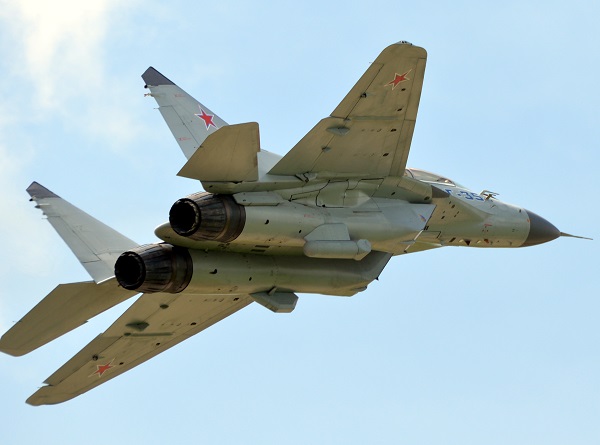
Jō AsakuraNot quite, Amiga. Russia will require a strong blue water navy in the future not to project geopolitical power as during the Soviet era, but to protect it’s economic interests (including exploration, extraction & logistics) and their respective seaways.
Due to economic growth Russia will become a net importer of oil sometime by the end of this decade and will probably have to assist the Chinese and Indian navies in policing the Arabian Gulf to secure oil transit, especially as the USN winds down it’s presence in the coming decades as the US economy becomes less reliant on the crude of the middle east.
The Russian government is claiming in excess of 60% of the hydrocarbon reserves of the entire Arctic Ocean, and more recently has expressed interest in mining the mineral rich hydrothermal vents not only on the sea bed of the Arctic, but as far afield as the Atlantic and Indian Oceans.
Hence, they should be looking @ 3-4 CBGs by the mid-2030s.
Btw, great pics of Su-35S!!
Jō AsakuraThat pic above gives a misleading impression regarding the sensor’s coverage angle, probably because of aerodynamic shaping of the pod. Here is a more representative image:
http://forumimage.ru/show/8382937
It’s certainly not a DIRCM and is too big to be a MAWS. Agreed that the [starboard] targeting pod is compact by any standards. Look forward to seeing it on the Su-34, I wonder if they’ll integrate it into the fuselage in place of ‘Platan’.
Jō Asakura[ATTACH=CONFIG]217222[/ATTACH]
EA-18G/NF500 of VAQ-141, Atsugi, Japan, 27/04/13.
Jō AsakuraFurther to the pod under the 29M2/35’s port intake:
[ATTACH=CONFIG]217217[/ATTACH][ATTACH=CONFIG]217218[/ATTACH][ATTACH=CONFIG]217219[/ATTACH]
For comparison 2nd pic is NAVFLIR component of AN/ASQ-228 ATFLIR, 3rd pic is NAVFLIR & ‘Damocles’.
It’s incredulous that anyone would think the Su-35S order won’t go through given that state Chinese media broke the story that negotiations were advanced and @ the intergovernmental level. Even the likes of Goldydust and ZhenPaoPoa wouldn’t deny that. If anything it is the Russian Duma that is very sensitive about this deal- one MP quipped “we’re selling them the rope to hang us with“. So ‘RosoboronExport’ with it’s close affiliation to the Russian government is not the right place to look for such breaking news on such deals. Instead try here:
I don’t see KnAAPO having capacity problems to supply 2 customers simultaneously- this isn’t Irkut’s full Su-30MKx order book we’re talking about. Infact, just so long as they haven’t converted most of their facilities for SSJ assembly, KnAAPO is likely to have considerable spare capacity in military production.


 Sign In







