 Pinko
PinkoWell my personal pick is the below image for illustrating the upcoming J-XX(J-20?)
The only thing I don’t agree on the above J-xx picture is the vertical tail in the picture is too tall. Otherwise, the image duly reflects the following J-XX characteristics:
Canard, lERX, DSI, lifting body with short vertical tail.
Besides: the frontal view of the plane really looks like a “FROG”
Probably it’s the reason that J-xx is nicknamed as ” FROG” among Chinese fans.
PinkoNothing new here, the J-10 incident was discussed way back in 2007 in this forum:
http://forum.keypublishing.co.uk/showpost.php?p=1196598&postcount=280
we already known the pilot is safe then 🙂
http://forum.keypublishing.co.uk/showthread.php?t=72226&highlight=plaaf&page=9
starting from post #247, image posted by Deino
PinkoThanks … are there some more pictures of the aircarft involved in that ceremony ??
Deino
Here,
http://www.fyjs.cn/bbs/htm_data/27/1002/237283.html
and here
PinkoOK, nobody can predict the future. But we can at least count on solid facts to make conclusions.
:rolleyes:
Oh, but of course the eurocanards have >0,1rcs. Especially that Rafale with that permenantly attached refueling probe is quite stealthy. Or the typhoon with the fan blades in public view. Or the Gripen, with all those antennas hanging around. Sure, no question about that. How stupid the american are, they spent tons of billions of $$$ in designing clean configurations.
Actually, at the end of the day, the X-36 is neither in production, nor operational and you are still speculating.
To begin with, the second picture you posted does not appear, you should upload it to imageshack or attach it.
]There are hundreds of thousands of such drawings and plastic models. Sadly for your rhetoric, none of them has been approved for production. If and when this changes, we will, hopefully, still be here to resume the conversation. For the time being, all stealth aircraft lack canards: F-117, F-22, F-35, B-2. Even the new PAK FA does only use movable LERXs, not canards.
1. The re-loaded drawing is from the technical paper presented by the chief designer of J-10, who worked in the 611 Institute which happened to win the Chinese J-XX design,
2. You can enumerate 1000 examples to give your opinion that canard doesn’t co-exist with stealth. Enumeration doesn’t make phenomena a fact, however, existing demos like X-36 has already established that stealth and agility is co- achievable with the Canard. The X-36 is in real production or not is another matter, the significance of X-36 demo is it has proven the fundamental of your belief that Canard and stealth can’t be co-existing is flawed. Some members and I have already enumerated number of cases that current stealthy 5G fighters under development, like J-XX or SAAB proposed “stealthy Gripen” all can have canards, the responsible design institutes for those canarded fighters have published relevant technical papers on such features as well as impact on aerodynamic and stealth. So you ask me to believe what the literature I read or a genius’ opinion who can’t separate a common fact and self-believing?!
Of course it could. With the same rational, in 5 billion years, the sun could freeze. This is not a joke and I ‘m not being sarcastic. It’s a scientific theory based on data and solid arguments. BUT for the time being, we can sleep in peace: The sun is not going to freeze in the forseeable future just like canards are not going to be used in stealth or low RCS aircraft.
Typical petulant response when someone’s inability to debate on points is obvious.
A further proof for that? The canards on the Su-35BM were removed. Also, a new Typhoon concept was studied with low RCS in mind. Guess what. That, too, had its canards removed. I ‘ll let you guess why.
See, over confident self-believing leads to only ignorance, Su-35BM’s canard issue is more related to the initial overweight radar than what you thought stealth. Once Irbis-E’s weight is able to be reduced much then the original planed BARS the additional lift is not required to balance the head.
PinkoLook at my post and read it again. Do you see any “…or experimental or technology demonstrators”???
No because it ain’t there. :rolleyes:
As for X-36… http://forum.keypublishing.co.uk/showthread.php?p=1516789#post1516789
have a nice day.
Lol, by rolling your eyes doesn’t make you an instant aero-expert. End of the day, you still can’t solve the plain fact I present here: the X-36 demonstrated as far as the stealth is concerned, the canard isn’t an absolute adversary to the stealth. So, now look at your original post again: “As far as stealth is concerned, no it’s not. And the obvious proof is that no existing stealth aircraft, either operational or under developement has canards.” Haven’t I answered your ” as far as stealth…” part?
What X-36 can do couples of years ago of course other design development can achieve the same. Look at the designs currently under development,

The next upcoming 5th g fighter could well be with canard, oh, btw, the fact is the blueprint is already frozen last aug and by all accounts it means the prototype is in the making.
Pinko:rolleyes:
As far as stealth is concerned, no it’s not. And the obvious proof is that no existing stealth aircraft, either operational or under developement has canards.
Prove otherwise or you are just speculating.
Look at X-36
PinkoThe empty weight is often claimed at 9,730 kg with a thrust of up to 130kN, Gripen NG will weigh 7100Kg at a thrust of 98kN and both have a delta-canard design, which should make them pretty close in terms of maneuverability or?
The B version will use a Chinese AESA radar, PAF might have the option to customise it with western techs, but that is not clear yet.
Claimed by who? Some J-10 official data is already out and you can find it in Chinese Aviation Museum , the empty weight is 8840kgs, MTOW: 19277kgs

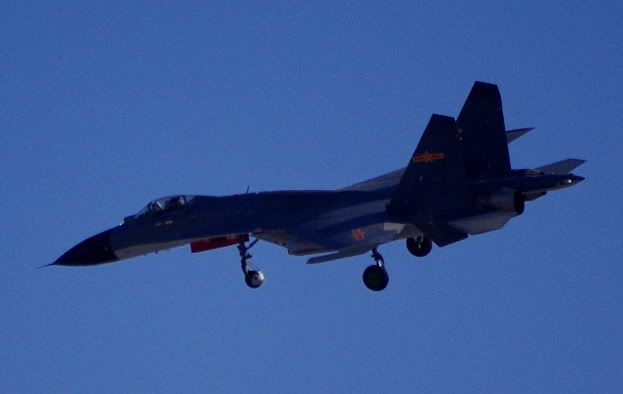
PinkoWhere is the front landing gear?
PinkoYes it is in general to your surprise. All the newer series built of that are an evolution or upgrade. From a certain time-scale it is a mix of old and new technology and the last series of F110/F100 are something different, because parts and technology from the F136/F135 f.e. did replace older technology, when worth the related cost. To put something new into a proven engine has to run to the whole certification process, which is very time-consuming and costly by that. That in mind not all technical gains were incorporated in that engine. When a proven balance in stress-loads was find even better materials were not used to alter the balance to something unknown. No airforce is intrested to ground its fleet equipped with that, when a new problem from that does show up. “Never change a running system” without considerably performance gains from a real tested one. The F110/F100 will not pass the 8:1 thrust-weight-ratio related to their core-technlogy, when in the thrust-behavior it is something new and no longer comparable to that decades ago.
http://www.geae.com/engines/military/f110/f110-132.html
With the WS10 China will learn to get the best thrust-behavior from that and what has to be obeyed by a more advanced future engine. New technical specifications will not result in such engine without the learning from the real thing.
Like an “ordinary car/engine” every fighter/engine does differ from production lot or year of building. Some fighter/engine were refitted with better parts during service life in a constant way like your weekly software upgrades from Microsoft, but that does differ from airforce to airforce and what upgrade service or packages were bought for that. Even the USAF has just a collection of different standard F-22A to give a prominent example.My intention is not to downplay the Chinese achievements, just to keep a more realitic view the difficult way to the top in mind.
That was launched in 1985:
http://en.wikipedia.org/wiki/Saturn_AL-41WS10 has matured and developed enough to give similar if not better performance the the latest Russian engines.
My intention is not to argue WS-10 is to” give similar if not better performance the latest Russian engines” or not. Because, your real intention here is not that mocked one either.
By keep mentioning WS-10 just developed to a level of design by US or Russia achieved in 1970s or 80s, every body here can see you actually are selling the WS-10 is out of date like what Type 59 being misled by your way of laying words.
But a reality check finding you agree that even the latest model of F110’s TWR can not be better than 8, which essentially put the majority of big thrust fighter turbofan engine now available in the market in a class of technology level of 1980s, see your own difination of technology level just several posts ago:
…
The best designs from the 70s did offer a 7:1 ratio and in the 80s a 8:1 ratio.
…
Of course that 1980s impression is just associated with WS-10. Once it comes to F110, even under manufactured today, the story is somehow different now, now your answer is a big YES, to the question whether an F110 is a up to date advanced engine or not, although the F110/F100 by your own words : “… will not pass the 8:1 thrust-weight-ratio related to their core-technology”, so where’s your 1980s technology now?
Ws-10 even developed much later, still relevant to the 21st century reality of world today. How many F135/F119 are deployed? How many 117S’ are deployed as well? As maya mentioned, if you want to compare that frontline, China is in the intensive stage to develop Ws-15 TWR 10 engine with brand new core to address the new challenge. The 1st prototype of WS-15 probably is out for test in near future. When the majority of big thrust fighter engines like F110/F100/AL31 is dominated by 1970-80s technology core limits, even today, what’s wrong only you want to single out Ws-10 to label 1970/80S?
Pinko… but I know it is not possible to conviently label WS 10 with vague references to 1970s or 1980s technology, it is more complex then that. I am not saying your wrong, because no right or wrong answer to alot military related technology because of secrecy around projects.
If so, F110/F100 series turbofan engines all still using the same core developed in 1970s, which is CFM56 core, the same level hot section technologies WS-10 series based on, I guess nobody is going to claim that latest models of F110/F100 series, which are still produced and widely used, a 70, 80 era technologies, including SENS as well?
PinkoFor those can’t see the 1st image with ultra large size, attached is the backup picture
PinkoHappy 2010!
As expected, more images emerged to suggest that WS-10 is now powering Chinese latest fighters in service:
J-11B with WS-10 Taihang turbofan engine

Compared to a J-10B still powered by Russian made AL31FN

Note the nozzle difference, it’s quite obvious.
Pinko2 more …
PinkoFor comparison:


PinkoFinally, we see the J-11B flying with WS-10 turbofan engine.



 Sign In







