Pinko
PinkoOh come on Pinko this is just a rehash of old news you have to see that?.
Skywave radar that is ‘under development’ yet the whole ASBM missile system is nearly ready to field?. Its gibberish. The US commentators are trying to re-use the ‘missile gap’ strategy from the Cold War days!. No more no less.
‘Oh look China is introducing fearsome new weapons that will stop our navy dead in its tracks – we must surely need more money for the navy to offset this’
Its hardly a subtle or sophisticated approach!
So 11 satellites that are ‘capable’ of conducting ocean surveillance…..claptrap. A realtime-transmission optical imaging bird is ‘capable’ of performing ocean surveillance it doesnt mean its very useful at it. An ELINT bird is ‘capable’ of performing ocean surveillance but you aren’t targetting an ASBM off the output from one!.
Sloppy article to put it mildly!.
Aha, here comes Jonesy again, so judged from your wording, it seems Admiral Gary Roughead, chief of U.S. naval operations’s 2008 decision to cut the DDG-1000 destroyer program from eight ships to three because the vessels lack a missile-defense capability, which factored in the ASBM, is rather “sloppy”, and the reaction towards such a cut should be mildly even billions bucks invested in the RnD of the machine?
So the US military intel is sloppy as well, but do you believe PLA’s ASAT test because it is also 1st revealed to the world by US intel?
PinkoHere you go. It’s just as I was saying.
Originally posted by Tango III on Aviation news thread
Chinese Air Force official: China’s fourth-generation fighters refer to modified J-10 fighters
China’s fourth-generation fighters reported by media recently refer to a series of modified J-10 fighters, a Chinese Air Force official said November 23, 2009.
As to the classification of fighter generations, the world’s military powers are varied. The U.S. defines F-15, F-16 fighters with the characteristics of transonic speed in medium-low altitude as third generation fighters and F-22, F-35 fighters with good performance in stealth, super sonic cruise and super maneuverability as fourth generation fighters.
Russia defines MiG-29, Su-27/30 fighters as third generation fighters and defines Su-35, the modified third generation fighters as fourth generation. The new generation of fighters with good performance in stealth, super sonic cruise and super maneuverability are defined as fifth generation.
The official said that China’s fighters were independently created on the basis of introduction and imitation of Russian-made equipment and the fourth-generation fighters referred to the modified J-10 fighters.
Rather funny, it looks like people don’t take PLAAF’s No 2 ranking general’s word but rather prefer what a no mane “official” ‘s opinion on what the China’s 5th generation fighter is.
Well, I can show who the official is: his name is prof zhang who works in PLA academics ( not in the core operation of PLAAF). He always appears in CCTV defence related programs as an “ expert” and nicknamed “big mouth zhang”.
This is the screenshot of what Prof Zhang ( or major general zhang) talking to CCTV host.

PinkoASBM, it seems almost official:
China’s New Missile May Create a ‘No-Go Zone’ for U.S. Fleet
Share Business ExchangeTwitterFacebook| Email | Print | A A A
By Tony Capaccio
http://www.bloomberg.com/apps/news?pid=20601080&sid=annrZr9ybk7A
Nov. 17 (Bloomberg) — China’s military is close to fielding the world’s first anti-ship ballistic missile, according to U.S. Navy intelligence.
The missile, with a range of almost 900 miles (1,500 kilometers), would be fired from mobile, land-based launchers and is “specifically designed to defeat U.S. carrier strike groups,” the Office of Naval Intelligence reported.
Five of the U.S. Navy’s 11 carriers are based in the Pacific and operate freely in international waters near China. Their mission includes defending Taiwan should China seek to exercise by force its claim to the island democracy, which it considers a breakaway province.
The missile could turn this region into a “no-go zone” for U.S. carriers, said Andrew Krepinevich, president of the Center for Strategic and Budget Assessments in Washington.
Scott Bray, who wrote the ONI report on China’s Navy, said China has made “remarkable progress” on the missile. “In little over a decade, China has taken the program from the conceptual phase” to “near fielding a combat-ready missile,” he said. Bray’s report, issued in July, was provided to Bloomberg News on request.
China also is developing an over-the-horizon radar network to spot U.S. ships at great distances from its mainland, and its navy since 2000 has tripled to 36 from 12 the number of vessels carrying anti-ship weapons, Bray, the ONI’s senior officer for intelligence on China, said in an e-mail.
China’s Strategy
The new missile would support China’s “anti-access” strategy to detect and if necessary attack U.S. warships “at progressively greater distances” from its mainland, Krepinevich said.
Defense Secretary Robert Gates, in a Sept. 16 speech, said China’s “investments in anti-ship weaponry and ballistic missiles could threaten America’s primary way to project power and help allies in the Pacific — particularly our forward bases and carrier strike groups.”
Admiral Gary Roughead, chief of U.S. naval operations, says the new Chinese missile was one factor in his 2008 decision to cut the DDG-1000 destroyer program from eight ships to three because the vessels lack a missile-defense capability.
The Navy instead plans to build up to seven more Lockheed Martin Corp. Aegis-class DDG-51 destroyers and equip them with the newest radar and missiles.
China’s ballistic missile “portends the sophistication of the threats that we’re going to see,” Roughead said in an interview earlier this year.
China has ground-tested the missile three times since 2006 and conducted no flight tests yet, Navy officials said.
‘Limited Capability’
General Xu Caihou, China’s No. 2 military official, played down the weapon’s significance.
“It is a limited capability” to meet “the minimum requirement of” China’s national security, Xu, vice chairman of China’s Central Military Commission, said in response to a question following an Oct. 26 speech in Washington.
Mark Stokes, an analyst who has studied the missile program, said the Navy’s assessment indicates China started to develop the weapon after the March 1996 Taiwan “crisis.” That’s when the Clinton administration sent two aircraft carriers and escort warships into the Taiwan Strait and the surrounding area after China fired missiles near the island before its presidential election, Stokes said.
Stokes just published a study of the weapon for the non- profit Project 2049 Institute in Arlington, Virginia, that studies Asia security issues.
Alter Rules
An article in the May 2009 edition of Proceedings, a magazine published by the U.S. Naval Institute, said the missile “could alter the rules in the Pacific and place U.S. Navy carrier strike groups in jeopardy.”
“The mere perception that China might have an anti-ship ballistic missile capability could be a game-changer, with profound consequences for deterrence, military operations and the balance of power in the Western Pacific,” the article said.
Paul Giarra, a defense consultant who studies China’s weapons, called the missile “a remarkably asymmetric Chinese attempt to control the sea from the shore.”
“No American military operations — air or ground — are feasible in a region where the U.S. Navy cannot operate,” Giarra, president of Global Strategies and Transformation, based in Herndon, Virginia, said in an e-mail.
The missiles are intended for launch to a general location where their guidance systems take over and spot carriers for attack with warheads intended to neutralize the ships’ threat by destroying aircraft on decks, launching gear and control towers, Giarra said.
The Pentagon, in its latest annual report on China’s military, for the first time included a sketch of the notional flight profile of the new Chinese missile but gave little additional detail.
Sky Wave
Bray said China has the initial elements of its new over- the-horizon radar that can provide the general location of U.S. vessels before launching the new missile.
Stokes said the so-called Sky Wave radar can spot U.S. vessels as far away as 1,860 miles (3,000 kilometers).
Unlike traditional radar that fires radio waves off objects straight ahead, over-the-horizon radar bounces signals off the ionosphere, the uppermost layer of the atmosphere, which can pick up objects at greater distances.
The radar is supplemented by reconnaissance satellites, another Navy official said, requesting anonymity. There are 33 in orbit and that number may grow to 65 by 2014, 11 of which would be capable of conducting ocean surveillance, he said.
To contact the reporters on this story: Tony Capaccio in Washington at [email]acapaccio@bloomberg.net[/email]
Last Updated: November 16, 2009 16:11 EST
PinkoPakistan signs deal for Chinese J-10 fighters
By Siva Govindasamy
Pakistan has reportedly reached a deal with China to buy 36 Chengdu J-10B fighters in a deal worth around $1.4 billion.
If confirmed, this would form the first phase of a purchase that includes options for several dozen more aircraft and result in Islamabad eventually acquiring around 150 of the multirole fighters.
To be designated as FC-20s in Pakistan, the aircraft will be upgraded versions of the J-10 fighter that officially entered Chinese air force service in early 2007. The type is China’s most advanced indigenously developed military aircraft.
Deliveries to Pakistan are likely to begin from 2014-15, but the country is unlikely to have any workshare in the programme.
China has been a major supplier of aircraft to Pakistan’s armed forces for more than 30 years, supplementing purchases of Dassault Mirage fighters in the 1970s and Lockheed Martin F-16A/Bs in the 1980s.
Relations with the West cooled in the 1990s, when Washington imposed an arms embargo after Pakistan tested a nuclear bomb. Relations improved earlier this decade, when Islamabad emerged as a key ally in the war in Afghanistan.
Last year, Pakistan confirmed an order for 18 new F-16C/D Block 52 fighters, with options for another 18. It is also buying several refurbished F-16s, and Lockheed is also under contract to upgrade 34 F-16A/B Block 15s.
However, Islamabad has also maintained its close relationship with China. The partners have jointly developed the Chengdu/Pakistan Aeronautical Complex (PAC) FC-1/JF-17 fighter, with Islamabad having received its first two Chinese-built examples in March 2007. It has since taken delivery of around a dozen JF-17s.
The first example to be manufactured by PAC will fly before year-end, and Islamabad will eventually buy at least 150 domestically produced fighters. These will replace its air force’s ageing fleets of Nanchang A-5s, Chengdu F-7s and Mirage IIIs and Mirage Vs.
The JF-17 will be capable of carrying a variety of conventional and precision-guided bombs, plus air-to-air and anti-shipping missiles of both short- and beyond-visual ranges.
Pinko1st official indication of Chinese new generation ( 4th as Chinese classifcation, 5th as intenational standard) fighter jet after J-10,
New generation of fighter jets on horizon
Source: Global Times [02:36 November 10 2009] Comments By Deng Jingyin
A senior military officer said Monday China’s military pilots could expect to jump into the most advanced fighter jets in 8 to 10 years, while President Hu Jintao called for a “new chapter” in the development of China’s air force.
Hu made the remarks while he met senior officers, experts, role models and pilots with representatives from People’s Liberation Army Air Force Sunday, one of the events held to mark the 60th anniversary of the air force.China’s national defense and its army’s modernization are confronted with new situations and tasks. In accordance with the requirements of both offensive and defensive operations, the air force is urged to strengthen the development of military system, Hu said.
The same day, He Weirong, deputy commander of the air force told China Central Television that military pilots could expect to jump into the most advanced fighter jets in 8 to 10 years that will have stealth capability. He said that the planes are in development and will match or exceed the capability of similar jets in existence today. Worldwide, the 4th generation jet fighters, with the US-made F-22 raptor as the bench mark, is also known as the 5th generation fighter planes based on Russian standard.
They will have the 4S ability, which are stealth, super cruise, super maneuverability and short take-off.
“Compared with the 3rd and the improved 3.5 generation, the 4th generation fighters have overwhelming technological advantages. Its most striking characteristic is the capability of invisibility, which also could be called low detectability,” Dai Xu, an air force colonel and military strategist, told the Global Times Monday.
Currently, the F-22 is the only in-service 4th generation fighter in the world. The F-35 and Russia’s T-50 are in the development process.
Chinese 4th generation fighter is the 4th one entering into the actual development process.
http://www.globaltimes.cn/www/english/military/china/2009-11/483864.html
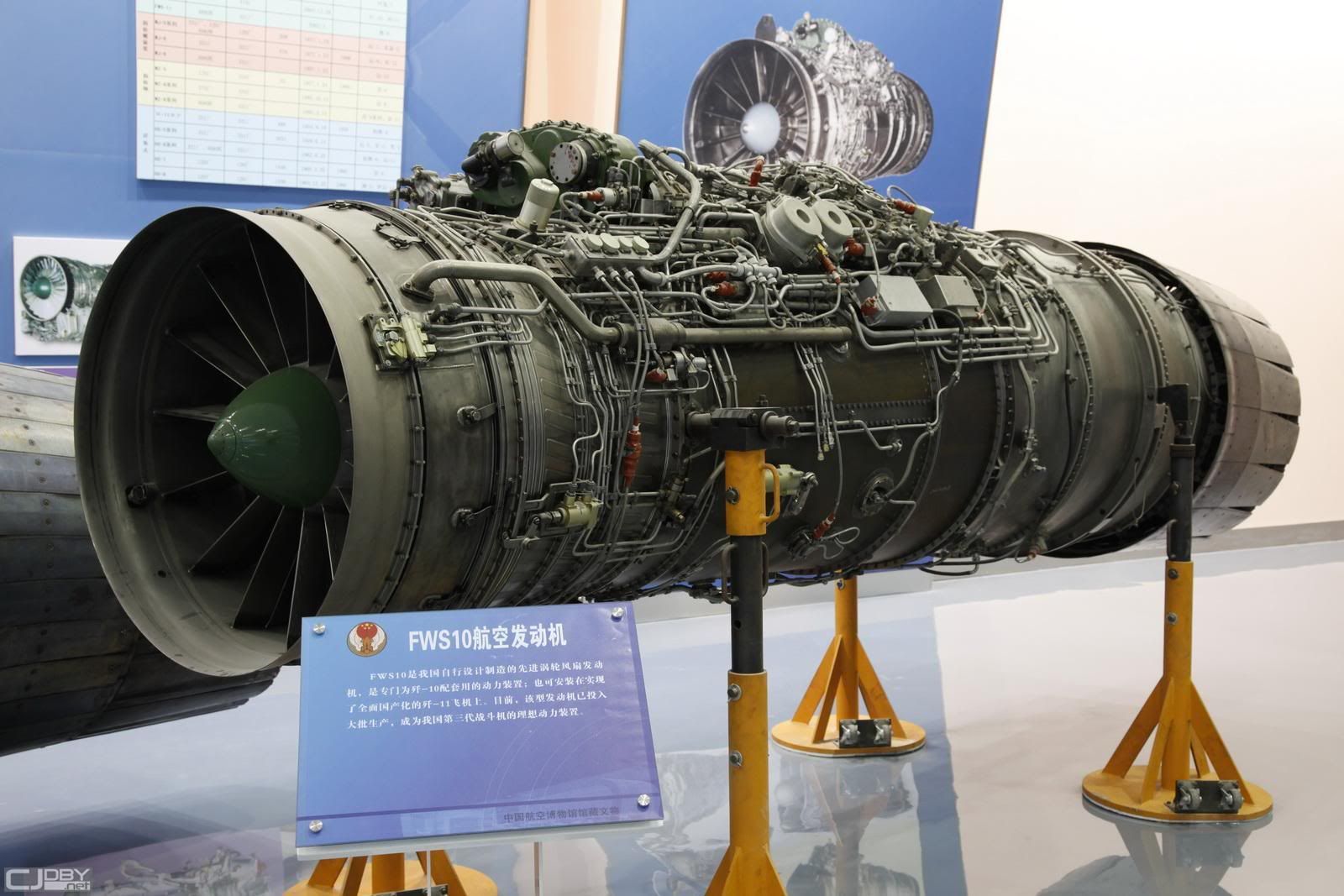
PinkoJust hoping to see J-11B, J-10 flying-off with WS-10 based engines. There seem to be several differences between the FWS-10 displayed at the aviation museum and the WS-10A displayed at Zhuhai 2008
Posted it at SDF – Link
Any comments on this Pinko?
PS: Yeah I saw the photos of the AL-31F and FWS-10 side by side – Link
The one displayed at zhuhai 2008 had its gearbox at bottom, while the one FWS-10 displayed at China aviation museum is with its gear box at top, we know, AL31FN’s gearbox is at bottom, different from that of AL31F for Su27, the dimeter of Al31FN is also slightly different from that of AL31F, AL31FN is custom made for J-10. so it’s not strange to see two different WS-10s
PinkoPosted by maya @ SDF:
FWS10 engine on display at the China Aviation Museum
But, sadly NO good news regarding it serious reliability issues. Other than that they are working ‘full-throttle’, no specifics.
Any aviation engine strictly follows bathtube curve for its reliability issue, a newborn baby in a turbofan family surely got “ serious reliability issue” according to bathtube curve. However, as the signboard description in your image said: the FWS10 now already entered mass production stage, according to previous Chinese defense industries practice, if a machine is not mature and before any newly one in the making, it will not be revealed to pubic, J-10 is such a good example, it IOCed in 2003, but only revealed officially in the end of 2006. WS-10 turbofan 1st DESIGN certificated in 2005, after 4 years, it seems the WS-10 is also reaching its final production certification. The display of the WS-10 in a public place ( Aviaiton museum )is a good news. It shows people are confident to show their work.
Russians won’t supply anymore engines alone for any new J-11 that is not included in that 200 Su27SK kits contract, the only way out is WS-10, not matter is J-11B or future shipborne fighter jets aka J-15.
FWS-10 side by side with AL-31F. note the WZ-9 turboshaft engine in the picutre ( picture in picture 😉 )for WZ-10 copter.

PinkoOne thing, if Russians do help Taiwan develop something, does the ROC AF dare to use or not?
😉
PinkoNew J10B images with 3 sides view:
Front:

Back:

Side:

another J10 out from production line and by passing the J10B:

J7

PinkoIt’s fresh and hot~
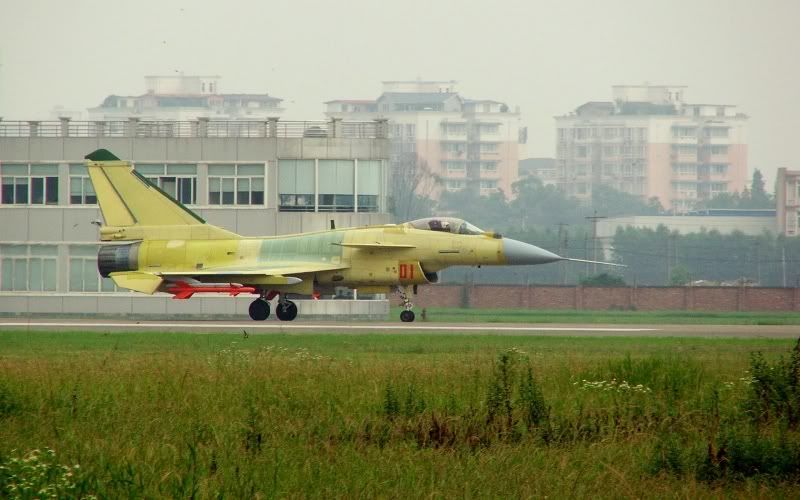
PinkoWhats the 10S for? Seems to carry an awful lot of weapons for just being a trainer?
Two-seater does not necessarily mean “trainer” only. S in the J10S is the short form for Chinese meaning of” two seat”.
PinkoIt’s not a mock-up, it’s a real J-10S with mock munitions
PinkoNavigation satellite deployed in Chinese launch
http://www.spaceflightnow.com/news/n0904/14china/
BY STEPHEN CLARK
SPACEFLIGHT NOW
Posted: April 14, 2009
China launched a new member of its budding satellite navigation system Tuesday, the first of up to 10 such spacecraft scheduled to be added by the end of next year.
The Compass G2 satellite blasted off at 1616 GMT (12:16 p.m. EDT) from the Xichang launch base in southwestern China’s Sichuan province, the state-run Xinhua news agency reported.
A Long March 3C booster deployed the navigation satellite into a geostationary transfer orbit with a high point of about 22,250 miles, a low point of about 125 miles and an inclination of 20.5 degrees, according to tracking data.
Compass G2 will soon use its own propulsion system to reach a circular orbit along the equator at an altitude of about 22,300 miles.
The new spacecraft is the second satellite of China’s second-generation navigation fleet, which will eventually include more than 30 satellites parked in geostationary and medium-altitude orbits, according to Xinhua.
China launched the first Compass satellite bound for a medium-altitude orbit two years ago. Compass G2 is the first geostationary satellite of the group.
The fleet will beam precise position, altitude and time information to users on the ground.
Up to 10 more Compass satellites could be launched by the end of next year, according to Xinhua.
Officials predict the Compass system will be completed by 2015 to provide global navigation coverage, supplanting the U.S. Global Positioning System in Chinese cars, cell phones and other commercial applications.
Other applications for the system include transportation, meteorology, petroleum prospecting, forest fire monitoring, disaster response, telecommunications and public security, according to Xinhua.
The first-generation Beidou constellation provides only regional coverage over China, according to Xinhua.
Tuesday’s flight was China’s first space launch of 2009 and the 18th launch worldwide to reach orbit this year.
PinkoJonesy, as I said, I was here then to just show you it’s possible, with last intention to convince you to buy the story, I know your belief is based on that you should know every detail of a systematic and complicate system, which is no any individual is cable to fully understand it even he can research solely on the ASBM from detection to tracking to guiding for his whole life. However, because the scale of such a system, China is impossible to hide such a project, so there’re tons of research papers on this project only written in Chinese.
So how to different UAVs from manned planes? More detailed techniques can take care of more detailed scenarios. Those are payrolls’ job to take care of those details. At least I would bother myself into it further.
PinkoSo Pinko. This all distills down to the fact that you see a 150knt plus target on OTH from a cell thats 400km sq. at 1500km downrange and is shared with a 20knt surface contact?. Thats it for you then is it…..there is an aircraft carrier in that cell and you would be willing to report up your chain of command that your space assets should be requeued to that area.?
I wouldn’t boil down to those details. I was here to show a feasible way to solve the “impossibility” of contact identification.
At 1500km off a carrier is not launching a fighter every 5 minutes. More like a CAP pair every couple of hours and an E-2 at longer intervals. You have a contact plotted thats travelling at 20knts, rough minimum, to blend in with all the other 20knt merchie traffic.
The OTH radars are designed to work continuously, if an area is clear of any civic aviation activities, and a signal returns do show a sudden emerging of a high speed contact identical to aircraft and some old low speed contacts, how you would make a judgment? If an E-2 is in air, are you sure there’s no F-18s activities?
You have a space imaging asset that might get a 40km strip depth at the resolution necessary to posID a CVN from a 100,000ton supertanker of which there are plenty in those waters. If a satellite is oriented correctly for an overhead that is. Even if a satellite is just an orbit away, say a 90 minute interval, the carrier has moved 55km and is back to being just another contact in the pack until there is another flight deck event.
There’re also passive ground based listening stations, airborn/space based Elint/Sigint assets, not only the optical images u get, since you get aviation activities, certain L/s band radio signal will transfer far far away, those passive Elint/Sigint assets once know rough direction, could easily pick up the communicaiton and navigation signals between the planes and mothership, which is impossible for a supertanker to perform the same.
That is giving you perfect operation of the OTH platform and a very dumb USN who just steam straight on in and dont take advantage of the glaring weakness of the OTH platform. That being that any air target pretty much looks like any other.
Well, I enjoy the one you say about USN, let them dance all the well to Asia.:D
Look at the above photo and think about it!. Lets see if you can connect the dots as to the implications
Well, well, glad we finally got some accords, although it’s fireworks instead of smoking bomb you used to throw in. So likewise an even more dumb USN not only need dance, but also singing and fireworking to reach the scene supposed to be in a sneak-in mode?
Jonesy, OMG! keep joking~~

I like it~ 😀


 Sign In