 Pinko
PinkoThe most important factor in determining which target is time critical is its time to impact, upon which velocity determination is critical. The radars do this at all ranges. With this, the target engagement priority can be established. With that, the target illuminators can then independantly illuminate the priority targets, with 3D designation capability for the trackers incorporated in phase III of the Mk92 upgrades. Before all this though, the target has to be detected and reliably tracked, which is where the IADT system beats individual radars of the 054A. A high altitude, high speed target closing in on the OHP will be detected a long distance away with the SPS-49. In a sense, it is less-time critical than a moderate speed target just crossing the radar horizon, as the high-speed, high-E target would have been detected and tracked long before the same could be done for a low-E target. .
That’s why people develop passive guided ARM on pair with active guided AshM, a vivid example is KH-31A & KH-31P, People are smarter than you I have to say. Chinese are smarter than you as well, that’s why they develop KD-88 both with active & passive seeker which make your legacy equipment simply can’t take the advantage of velocity determination, no short cut, boy, keep growing. True 3D capability is the way
And how have you proved that the 054A, if its radars are working individually to compile the air picture, is more capable?
Sea eagle radar is the direct replacement of MAE-5 “Top Plate” in PLAN service. The top plate is with a normal rotation rate of 6rpm and in combat state, the rotation rate briefs up to 12 rpm. Considering Sea eagle is akin to the top plate, it must keep the same rotation rate of Top plate, which means Sea eagle 3D radar has an update rate of 24/min.
Are you a total idiot? Show me where is it that the 054A combat systems have a radar output integration function? I have already shown such for the ADAC
You’d better watch your mouth boy, especially your performance so far here is far from good. Where did you back up your lip service “I have already shown such for the ADAC”? I’m not questioning such a integration function, simply, sense fusion is within every sensor systems including radar, taking the fighter as example, the integration function is within the avionics and for combat ship, it can resident in the CDS or anyway else depending on the design.
The integrator console which directly guides the firing unit. Do deny the Chinese CDS doesn’t have radar integration system now.

PinkoI suggest you read through my earlier statements one more time, as all your blatherings here has been addressed earlier. If you cannot get them, then any further conversation is limited by your intellect.
What has been addressed earlier? Is this one: at range these targets are not time critical? Even apply your 25 nm range for your CAS to detect a RCS 0.1 grade missile, from where your IADT starts to get elevation update, taking the update rate of every 4-5 seconds by CAS, you need 2-3 updates at least to build up the missile’s flying profile. It’s in a handful seconds the supersonic AshM or ARM will cover your 25nms range , meanwhile your IADT to build up the missile’s flying profile along needs 10-15 seconds. Every second counts yet you address not time critical?
Yes, the SPY-1 is likely more capable than the IADT. But how does that help your case for the 054A when 054A doesn’t have AEGIS/SPY-1? :rolleyes:
As long as it’s more capable than your SPS-55 and SPS-49 combo.
CAE was provided with a contract to specifically produce radar integration software for the ADACs. Pinko, I suggest you stop making yourself look silly
Did I deny the FFG’s CDS doesn’t have radar integration function, see who is denying 054A futures a same open architect CDS doesn’t have radar integration function? The rest people can judge who’s silly?
PinkoAs said, at range these targets are not time critical, hence the drawback is not much of a handicap. While the CAS provides elevation data only 14.5 times a minute, that’s still comparable to what the Sea Eagle can provide. Notice that track updates are still vastly superior to what the Sea Eagle or even the SR-64 provides individually.
Then I was surprised to see how a situational awareness people saying that. Even in a range, you still need to discriminate the signature in your radar screen is composite of only 1 or 2 or more targets. Only a realtime 3D radar can tell you that by revealing their altitude. Only by observing their trajectory precisely would you identify the incoming missiles are made of descending AshM, “Zenith” approaching ARM or both, otherwise, your 2D radar only shows you a slightly enlarged dot of all these missiles. If your CAS at this crucial moment is engaged with a sea skimming target and can’t provide elevation data to your IDAT? I even not mentioned how your CAS can provide 360 deg coverage?! You did mention how important the early warning that SAAR V’s 3D radar should give in another debate with Tphuang, but here is “ not time critical’?
Impossible? The early CAS provided a range of 25nm. I’m sorry, but provide evidence if you intend to discount the performance of the CAS. Why don’t you discount the claimed performance of the Sea Eagle instead? The CAS was integrated to enhance the performance of the system. The MPU itself already had the ability to detect and track low level targets.
Try finding out more about the CAS. :rolleyes: Like Tphuang, you assumed that CAS was one radar.
Well, I think currently you are in debate of that claimed range of finding AshM with another gentleman so I’d better not challenge by myself. I’m not discount CAS performance I’m only discount your overly claim of the capability of normal, less power output FCR like CAS. Your CAS has to do horizon search at low angel, provide high angel elevation data of a “high flyer” target at the same time and fire control:rolleyes: . Essentially, you are putting your CAS do basically what the sea eagle 3D radar, sea skimmer tracking SR64 radar and FCR of Orekh copy. Such a claim need I produce any Sea eagle’s performance before the bubble self busted?
So as to better enhance system performance. How does bringing up the SPY-1 time and again help your case?
It doesn’t have IDAT before CDS but yet more capable than your IDATed FFG-7.
How? It doesn’t do horizon search the way the STIR and CAS does.
Somehow, your almighty CAS can provide 3D data for volume air search while doing horizon search but a C-band, 360 degree rotating with pencil beam is not able to track low fly surface targets?
The radar integration capability was upgraded with a data-fusion system provided by CAE. The system resides within the ADACs CDS. So the IADT function never went away, the function still exists, but is handled by another system. 😀
See the double standard at the best display:rolleyes: , the FFG UP, the IDATed FFG-7’s direct upgrade, is with its MK92 being directly plugged into an open structure/high FDDI bused CDS, you so automatically assume the radar integrating is resident inside the CDS but meanwhile denying the same structured/high FDDI bus linked 054A CDS is without radar integrating ability?
PinkoYou do realise that the Mk92 mk 6 CORT provides twice the range over the mk 2, bringing range to >50nm? That’s more than adequate in the low altitude anti-ship missile role or against high flyers. Fade charts can also be used to determine the rough height of targets further away than the CAS can determine. This is not optimal, but acceptable, since tracks far away enough to not be trackable by the CAS would not be time-critical. As a matter of fact, algorithms to give a good estimate of height for the SPS-49 exists (through the use of multipath effects), and an unconfirmed source stated that the MPU radars delivered to Taiwan on her Cheng Kungs have just such a mode.
So you do realize the IADT suite is in incapable to match phased arrayed Sea eagle’s ability in resoluting the elevation right? Fade charts is hardly efficient in elevation performance compared to Sea eagle’s electronic scan in the elevation. APS-145 using exactly the same technique to exploit altitude information of the target and E-2 AEWS is not famous to provide target’s altitude information, by applying such a technique doesn’t come unconditioned, it will affect the 2D radar’s detection range and update rate. CAS being designed as part of FCR, its X-band and narrow beam scan have determined it’s incompetent to act as a volume search role which naturally requires multi target detection & tracking, in order to draw elevation data from the CAS’s scan, the search radar beam is stepped up 4 beamwidths over 3 scans and then back down in half a scan. Target height thus is found by using this spiral scan technique. Now, you see, in such a mode, only 4.5 scans can roughly determine a target’s altitude so you see your really promoted 60rpm is actually watered down. And working in such a narrow beam elevation finding and being the nature of X-band, it’s impossible for your CAS still has your claimed 50nm detection of a incoming missile, even a more powerful, S/C band Sea eagle only can roughly detect a missile 75kms away although it has a max air search range over 300kms. So I say, in a high angel volume search, IADT will still not be able to bring in elevation data from CAS. The main purpose of bring the Fire control CAS into IADT is to brief up the updating rate and most importantly, to track sea skimming AshM in low angel. Today’s war is totally 3D, low flying air strikers with navigation pods can approach really low, and your CAS still has its role in a beam rider like SM-1. in a total way, your CAS may have to cue SM-1 thus will definitely limits its role of altitude data providing. A Striker like Su30 can shoot multiple missiles either AshM or ARM. Only the radar with true 3D resolution is effective to engage multiple air targets. Being a situation awareness advocator, I think you should have your answer in which radar or radar suite detects better.
So? The matter is if the SR-64 has its outputs integrated with the other radars with an IADT like system.
Why must integrate into an IADT which essentially is a software approach to bring some less capable radar into a “synthetic radar” by combining & weighing the individual radar’s data into a single file? You don’t see SPY-1 combined with SPS-49 by such an IADT before being plugged into CDS.
If the Sea Eagle was a MFR, it would not require the SR-64 to do horizon search, nor the Orekh-copys to do target illumination. Notice the APAR, a true MFR, does all this. Sorry to burst your fantasy, but the Sea Eagle is NOT a MFR.
Of course, Sea eagle being a system only electronically scanning in elevation, it’s way behind true phased array system like Sampson & SPY-1, but my main intention to say the Sea eagle a “Multi-role” only means the phased array radar can basically accomplish several radars role in your IADT. You still don’t get the meaning, with or without FCR is not the compulsory condition to determine the radar is MFR or not. The intended type45 DDG upgrade is to use Sampson to guide SM2/ESSM, in this case, Sampson , a ftrue MFR, still needs dedicate FCR like Sea eagle needs Orekh copy.
SPY-1 is capable of doing horizon search itself. But even it will use the SPQ-9B concurrently in the horizon search role in future. It is the degree of capability. Anyway, trying to put up the SPY-1 as a strawman won’t help your case. The SPY-1 as a phased array system is far more capable than the Sea Eagle.
Individual radars/EO like these working independantly are not likely to be as capable as them having their outputs combined through a radar integration system
Do you understand the difference between CDS and a radar integrator? .
Referring to the diagram I posted in the Greece FFG thread. All the system being integrated by an open structure( Open architecture), high speed data bus CDS on board 054A doesn’t mean it’s less capable than you having an additional Radar integration layer before the CDS. Explain why FFG UP which sees MK92 Mod12 being integrated into an open structure, high speed CDS without IADT a upgrading from IADTed FFG-7?
PinkoDoes the Sea Eagle do surface tracking and horizon search? The Sampson doesn’t need to do terminal guidance since the system it is part of uses Aster missiles. The OHP gets elevation information through its CAS.
But the data refresh rate is lower than that of the CAS from which the IADT can derive altitude information. IADT may add another layer, but the number of layers is not relevant. It is the time saved from faster target detection and transition to track that matters, and here is where IADT gives an advantage. SYS-2 even has a special quick reaction mode where track data is passed directly to the WDS for immediate target prosecution, bypassing the CDS.
You mean a big horse like FFG-7 makes the 3D data available only when the CAS comes into range?! That’s a far cry compared to Sea eagle’s radar which will have the target’s elevation info far more away then FFG-7. what a better detection stands for of course not only inclusive of a better scanning rate right, obviously the better detection also speaks for better situation awareness. Your enemy will exactly capitalize such an incompetence of your 2D radar by flying the strikers low or you won’t be able to tell the incoming missile whether is an AshM in descending stage or a “zenith” approach of an ARM early enough.
Of course sea eagle is supposed to do horizon search but not necessary it will be the only platform to do so, after I reviewed the 054A’s photos, I indeed found that the SR-64 radar with 1rpm/s rotating rate for low flying target tracking is still there. Judged from the fact that one of the sea eagle’s 2 face antenna is in C-band, sea eagle will be the main horse to tract the surface targets and provide midcourse guidance for HQ-16 to incept them. HQ-16 is SARH missile that requires terminal guidance that’s why there’re separate FCR on board 054A. The presenting of FCR got nothing to do with Sea eagle is multirole or not as you previously claimed.
What does that have to do with what I said – the SPS-49 and the SPQ-9B is (in some cases, will be) an integral part of the AEGIS. Which throughly debunks your assertion that “Aegis never relies so many individual systems to accomplish the same role”. The SPQ-9B is to be part of the system dedicated to horizon search in the ASCM defense role.
You still seem do not understand, the SPY-1 is capable to do the horizon search itself, the SPS-49’s role is just a backup of that of SPY-1. nobody wants turn on an expensive SPY-1( 4 faces in total) in order just to do horizon search?
There is no problem with synchronisation. The IADT is able to handle up to 1500 track updates per sec. Look at the number of radars in the IADT capable of horizon search. The SPS-49, the STIR and the CAS. With RAIDS, even the Phalanx radars and the SLQ-32 will be integrated to formulation of the ship’s response to an ASCM threat.
Certainly IADT has its limit as it’s designed to be a legacy equipment booster:
“ When radars are employed with different scan rates, a separate external timing reference must be employed, which becomes the scan rate for the IADT and the synthetic video display. Track updating and smoothing occur as previously described, except updates are considered relative to narrow sectors of the search volume — typically a few degrees in width. System software updates tracks a few sectors behind the azimuth position of the synthetic scan.”
OHP cannot compete with the 054A in terms of number of channels, but it may (and is likely to) be more capable in terms of detection and tracking of low altitude, heavily maneuvering targets in clutter. And in those cases, ability to detect early and maintain track matters just as much as number of FC channels.
So something like the ability to detect and maintain track is now lame to someone who cannot quite substantiate their claim that the 054A is definitely better at detection and engagement of low altitude targets.
Well, the 054A also has other means for low altitude targets. 1st, the SR64 will boost much fast update rate for sea skimming target and cure type 730 CIWS to intercept it, also, there’s IR surveillance device in supplement of radar system in case the latter is in clutter & heavy ECM environment. The IR-17 system has a reaction time of 3s and tracking of sea skimming AshM up to 8kms. see the below specifications:

All the sensors no matter it’s 3D radar or IR tracking system are integrated by a combat command system similar to JRSCCS, the JRSCCS is an export version which features a double redundant 100M databus and FDDI high speed LAN in an fully open structure.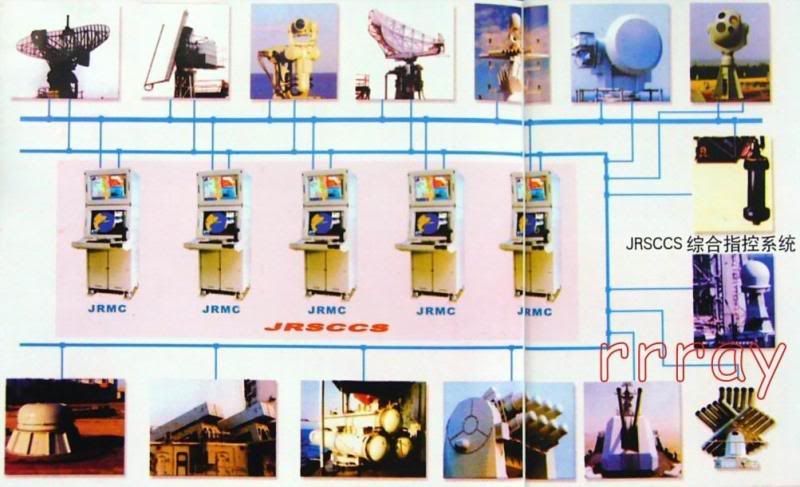
PinkoIf the Sea Eagle was a MFR, why the need for the SR-64 and Orekh radars? The Sea Eagle simply doesn’t provide the required refresh rate to provide low level tracking. MFRs like APAR and SPY-3 are indeed the future, but sorry, Sea Eagle isn’t a MFR. Calling it a MFR is a joke on yourself. .
1st, I need to check whether there’s any Type 364 Seagull C ( SP64) onboard 054A in the 1st place or not, yes, older 054 FFG does have this radar but older generation 054 doesn’t have Sea Eagle.
If you can accept Sampson as a MFR, you will notice Sampson also can’t guide a semi-active radar homing missile like SM-2, it still needs another dedicate fire control radar to do the terminal guidance. HQ-16 is semi-active guided. The benefits of Sea eagle is it features 2 antenna in S & C band respectively, although the sea eagle features 2 phased array antennas working in different bandwidth, its single signal processing is still able to integrate different & massive volume of signals from both phase arrayed panel by rotating simultaneously, the Sea eagle can detect and track multiple targets simultaneously, thanks to its phase array antenna which is multiple beam forming capable, and it’s nature a phased array radar can engage more targets than your mechanically scanned SPS-49, SPS-55 by its power output and design is still not a capable volume search option. the Sea eagle’s capability to find a target farther with better situational awareness by knowing the targets’ not only bearing and range but also altitude. Being a phase arrayed, it can engage more targets simultaneously and the dedicate fire control radar only need guide the SARH HQ-16 in the final kill thus greatly enhance the latter’s capability to switch to new target for next illumination fast enough. Do you mean the saying of Sampson a MFR a joke as well? This time is not me, but Britons.
SPS-55, like the other radars, feeds its plots to the IADT, resulting in a much higher data rate than relying on any single radar. This ensures far less false alarms, high probability of detection, and much more robust holding of track against a violently maneuvering low altitude target in clutter, especially compared to a combat system relying on independant radars (with a comparatively lower update rate like the Sea Eagle, or even the SR-64) to hold a track.
Can you deny IADT is still an additional layer? Do the SPS-55 & SPS-49 combine their individual signal processing units into one or still separately? Do mind, the sea eagle does combine the different signal from different antenna panel by processing them in one unit. Do those individual signal processing work synchronized or still in different pace, think about, their rotating rate are still different. Yet you still don’t understand 2D & 3D, when you have no good enough altitude data via SPS-49, your IADT has to wait such feed from another capable SPS-55 while Sea eagle can have altitude and other 2D information at the same time. No time lagging,
What’s your point?
The point is when no phased arrayed radar like SPY-1 available, the SPS-49 plays main role in volume search, but since, there’s SPY-1, the SPS-49 has to be in the back seat. SPY-1 is high cost in operation, so does the phased array radar on PLAN 052C, nobody will turn on such high power, expensive radar in normal surveillance
That still doesn’t provide a comparable data-rate to the SPS-49, SPS-55 and CAS fed IADT
As I said, phase arrayed Sea eagle can provide one more dimension of data simultaneously, it need no time lagging IADT process. All in one radar eliminates synchronization issue of your different radars. Phased array radar provide true multi target capability over your aged SPS-49, it can do from detection to tracking simultaneously, greatly enhanced radar’s efficiency and your FCRs therefore spend shorter time to engage targets.
PinkoWhat makes you assume that the 054A has a radar integrator? just because it is newer? Or because you wish it to have one? Show us proof. And the OHP is able to handle 2 air targets simultaneously, not one.
You might want to find out what a radar integrator like IADT actually does, and what bearing that has on ship-self defense capability. The constant comparisons of radar vs radar shows a lack of understanding of the contributions of a radar integrator to ship self defense. And Pinko does not seem to understand how RPM affects data-update rate, as well as how IADT dramatically increases update rate as a result of integrating plots from almost every onboard radar.
IADT in FFG-7 case is just a compromise when you don’t have a multi-role radar. Already shown here is that the Sea Eagle Double band, double antenna 3D radar can do your SPS49/55 jobs all in one, what you showed to us is the speed upgrade on the SYS 2 Integrated Action Data System which 054A FFG doesn’t need , instead 054A FFG benefits zero time lagging on such a system by using all-in-one detecting & tracking 3D radar. IADT in FFG7 is just a layer of processing you need when you bring multiple radars into a more competence system. No matter how fast the IADT system can be, it still consumes time to go through this layer when the single multi-functional radar can accomplish and skip this layer and directly cue Fire control radar for missile’s terminal interception. Such a SYS 2 Integrated Action Data System only needed when you want to combine data from different radar platforms for the same function, either SPS55 or SPS49 or any other. Sea eagle radar is just a all in one, what you get is what you want, you no need Sys2 to integrate anymore. The multiple function Radar represents the trend in the new age ship airdefense, which is centered on Phased array radar, rotated type like Sampson or non rotated type like SPY-1.
Prior to IADT installation and the MPU upgrade to the SPS-49, the FFGs required the SPS-55 and CAS. With both IADT and MPU, the ability to detect, form and maintain track of low flying, violently maneuvering targets in clutter has been dramatically increased.
But you mean after IADT/MPU, the FFG no longer needs SPS-55?
edit: The SPY-1 of the AEGIS has a far higher data rate, hence it performs better than the Perry class. But even the Aegis combines radar data input. It combines information from the SPS-49V(7) and the SPS-67. Right back at you, Pinko. :rolleyes:
SPS49 is just a cheap and reliable backup of SPY-1, to use SPY-1 doing daily surveillance is totally overkill, when you can find a low cost, cheap but reliable search radar, SPS49 comes into play, PLAN 052C has similar arrangement where you can find round dome alike search radar on top of the mast. BTW, how slow do you think the solid state phase shifter of Sea eagle will be if compared to really faster SPY-1? Sea eagle has 2 antennas in a back to back arrangement which means every half round there will be an antenna facing the target instead of SPS49’s per round.
PinkoSure? The OHP’s SYS-2 IADT track correlation system serves to integrate all the radars aboard the OHP. This greatly reduces track initiation time and increases the target update rate. The Sea Eagle’s scan rate of 5 RPM is woeful compared to the IADT system on the OHP which combines all inputs from the CAS (60RPM), SPS-55 (16RPM) and SPS-49 (12RPM). Even the Phalanx’s radar is theoretically able to be integrated into the system, and with the Field Change upgrade bringing it up to the TMS system as on Taiwan’s OHPs, even ESM, IFF and EO/IR data can be integrated. The IADT as a system served to cut reaction time by more than half, and the SPS-49 MPU specifically greatly enhanced small, low altitude target detection. .
No, Radar technology is never as simple as just comparing RPM. Sea eagle is truly a 3D radar that not only mechanically scans at azimuth but also more importantly, it electronically scans at elevation, show me which radar for the volume search role in your SYS-2 can do this? In a whopping scan round of Sea eagle will have much more profound and précised information than your 2D SPS49, no matter it’s 12 RPM than the Seaeagle’s 6 RPM. The electronically scanned narrow beam that seaeagle used for elevation will not only give much faster update on altitude and also much better resolution,the slower rotating rate of Seaeagle also let the radar has a longer average detection time in every direction thus better detection, it’s not the faster the better, Even the new E-3 does not rotate that fast. Now, talking about low fly, sea skimming targets or early warning, see which one performs better, 2D @12RPM or 3D@6rpm?
The incompetence of 2D SPS49 force they to bring in SPS55 for dedicate low altitude target tracking & detection. But Aegis never relies so many individual systems to accomplish the same role. Does it mean the SPY-1 radar is less capable than the SYS2?
PinkoSo i want to ask you why then they say the J-11B has Russian engine becasue they say the J-11B has a Russian AL-31
see this you did not post it eh? new Chinese fighter with Russian engine?
在質量上﹐J11B的改良將是劃時代的﹐除了發動機依然是俄羅斯生產的AL31F之外﹐J11B的其他各個分系統都大幅度實現了國產化﹐而且能夠發射中國產的主動雷達誘導空對空導彈以及其他精確制導武器。
So they continue the production buying AL-31s 😀 or are not talking of an upgrade?see this they say that in 2007 prior to the end of production of the J-11s they will continue to improve the production
裝根據生產計劃﹐200根據生產計劃﹐2007年之前將完成105架J11﹑J11A的組裝工作。因此﹐2007年對於中國空軍而言是非常重要的一年﹐漢和防務評論總編輯平可夫首次透露中國將繼續生產根據生產計劃﹐2007年之前將完成105架J11﹑J11A的組裝工作。因此﹐2007年對於中國空軍而言是非常重要的一年﹐漢和防務評論總編輯平可夫首次透露中國將繼續生產J11B改良型戰鬥機。J11B改良型戰鬥機。
with a fighter that has AL-31s?:D 😉
The interview of Sukhoi’s vice president occurred in Nov 2006 in the China airshow. When the CCTV reported WS-10A & J11B footage is yet to be released and only recent in this year of 2007, especially with more J11B images and that CFTE video available recently, people start to accept J11B is powered by WS-10A turbofan engine, I already said J11B is powered by WS-10A backed in 2006 in that WS-10A thread but how many people believed then? People’s view is evolving. Kanwa is a reliable source on Russian arm export related to China. Out of that scope, its information related to the China only stuff like J11B is just its own speculation. As you have seen, you quoted Kanwa’s description on J11B was made in 2006 at Kanwa’s own capacity and not part of the interview,
Miggie, I still remember you said as long as I can show Russian’s source confirmed the kits were finished. You are going to admit it, now I have shown you the Sukhoi vice president’ confirmation SAC has finished all 105 kits by end of 2006. and you also see photo of Kanwa’s editor posted with Sukhoi’s vice president. Now how you going to do? Give your opinion on J11B currently produced in SAC which is produced without signing the contract and not part of the licensed 105 kits .
PinkoFlogger/Mig-23MLLD
Now you know SAC is building J11B in 2007 without signing new contract and the last batch of Su27 kits were completed in 2006 as confirmed by no other but Sukhoi’s vice president, now what are you going to do? Are you in the position ready to say J11B is illegal product or copy right violated? or come from an illegal production?
PinkoThis is from Sukhoi it self
Как известно, сборочное производство Су-27СК по лицензии ведется на авиазаводе в Шеньяне с темпом производства 15 машин в год. Всего предусмотрено изготовить 200 самолетов Су-27СК. На текущий момент по первому этапу контракта КнААПО поставило 105 самолето-комплектов. По второй этапу программы, предусматривающему поставку еще 95 самолето-комплектов, контракт еще не подписан.
As it is known, the assembly-line and production of the licensed Su-27SK is conducted on the aircraft factory in Shenyang with a rate of the production of 15 machines a year. In all it is provided to prepare 200 aircraft Su-27SK. At the current moment in the first stage of contract KnAAPO delivered 105 aircraft- complete sets. In the second stage of program, which foresees the delivery of 95 additional aircraft- complete sets, the contract is not yet signed.
http://www.sukhoi.org/exhibitions/airshowchina2004/
See by 2002 that was the production line reported and as TASS and Jane`s defence weekly said by 2006 they were still assembling aircraft
in fact see this detail the only way china could had built up all the Su-27s by 2006 at a rate of 15 aircraft a year is if China in 1999 started production at a 15 aircraft a year since 105=7 times 15 however China had a set back and it was reported that the first J-11s were not well built and the first three years they built Su-27s at a rate of 6-7 and that justifies that the still will build J-11Bs without breaking the license
see this other source
К числу крупнейших контрактов последних лет можно отнести соглашение от 1996 года на поставки и лицензионное производство (без права реэкспорта) 200 истребителей «Су-27СК» и его учебно-боевого варианта «Су-27УБ» на сумму порядка $ 2,2 млрд (в КНР самолет получил обозначение «J-11»). Их поставки в войска рассчитаны на срок до 2008 годаOne of largest contracts of the last years can be attributed to the agreement from 1996 for the deliveries and license production (without the right of reexport) of 200 “Su-27SK” fighters and its combat training version “Su-27UB” for the total sum of order of 2,2 billion (in the CHINESE PEOPLES’ REPUBLIC this aircraft obtained the designation “J -11”). Their deliveries into the air force are calculated for the period up to 2008
Man, I think it’s time to be the game over, your performance is just fully demonstrated here
We have seen enough your Russian stuff which ended conflicting with each other, now I will show you the Kanwa’s interview with Sukhoi vice President Mr Alexander N Klementiev during the Zhuhai Airshow 2006. Do you still have dispute with an authorized people like Sukhoi vice president?:rolleyes:
http://www.kanwa.com/mrdt/showpl.php?id=362
This’s google translation of the report of interview on Alexander N Klementiev:
The last batch of fighters J11A finished product this year(2006),
Kanwa report says that the last batch of J11 assembled by Shenyang Aircraft company will to complete this year(2006). J11 aircraft is based on Su27SK fighters with improvements. Shenyang Aircraft Corporation produces Su27SK under permits. According to the aircraft company vice president Alexander Klementiev N by Kanwa in an exclusive interview revealed J11 production plan is very smooth, is a model of successful cooperation. Kanwa disclosed last batch J11A fighter production is 17. sukhoi hopes China will be ordering additional new Su27/J11 fighter parts, “But we still have not signed a new phase of the contract. “China is entirely independent production markers, Sometimes we just give them some technical assistance, “stressed Alexander Klementiev N. According to the production plan, 105 kits will be completed before 2007. .
PinkoSo the how can you explain this
СИНГАН, 16 марта. (Корр.АРМС-ТАСС). Китай по-прежнему ориентируется на Россию в программе лицензионного производства истребителя завоевания превосходства в воздухе J-11 (китайский вариант Су-27СК). Однако в 2006 г. китайской авиапромышленностью будет построено не более 17 машин этого типа, сообщил еженедельник “Джейнс дифенс уикли”.
SINGAN, on 16 March. (Korr.ARMS- TASS). China as before is oriented in Russia in the program of the license production of the air-superiority fighter J -11 (Chinese version Su-27SK). However, in 2006 Chinese aircraft industry will built not more than 17 machines of this type, reported the JANE`s defence weekly
According to the data of the experts of this publication, during October 2005 with the Ural optical-mechanical plant (UOMZ) was signed the agreement to the delivery to the new party of optical-electronic locating stations IRST systems
Contradictory is not it? TASS is publishing that http://www.arms-tass.su/?page=article&aid=24029&cid=25You forgot this detail of Kommersant
China has also purchased four Il-78MK refueling planes, four A-50 long-distance radar planes and a large number of Mi-8/Mi-17 helicopters. In 2005, 34 Il-76MD military transport planes and four Il78-MK planes were contracted for. China also buys airplane engines from Russia in large numbers.So the crappy source got it right they bought A-50U:D
That fully demonstrated your beloved sources conflicting with each other and you just fool yourself by keeping posting them. You are not able to get a correct/convincible answer that’s why we seldom quote such source like you do.
PinkoThat is not true, you simply can not prove the webpage is wrong, and you use a tactic to prove it wrong that does not work and you claim i change the meaning, what happens i understand the meaning better than you
The table has several information, first they say Поставщик(S)/ Продавец лицензии (L) that means the supplier or garantor of the license in this case Russia, later they say Кол-во заказанных единиц how many have been ordered Обозначение вооружения the weapon`s designation Описание вооружения type of weapon Год поставки/ лицензии year of delivery or license granted Сроки поставок date of delivery Кол-во произведенных/ поставленных единиц how many have been supplied and delivered
заказаны после отказа Израиля (из-за давления США) в поставке самолетов раннего предупреждения и управления, статус не известен this means they were order but later under US preassure to Israel the status of the delivery is unknow in the case of the A-50U
in the case of the J-11, they specified that the date for the delivery was 1998-2007/2008, that the license was granted in 1996 and during the period from 1998 to 2003 only 47 were delivered
китайское обозначение “J-11”, поставка в 1998-2007/2008 гг.
Man, if you like to quote Russian source, of course you have to quote some more decent & repute source like Kommersant than your crapped no name:
How Russia Has Armed China
http://www.kommersant.com/p763776/r_529/military-technical_cooperation_China
The export of aviation equipment and weaponry make up the basis of Russian-Chinese military technical cooperation. Between 1992 and 2003, the Chinese Air Force received 36 Su-27SK fighter jets, 76 multipurpose Su-30MKK fighters and 40 Su-27UBK training jets. Simultaneously, between 1998 and 2005, another 105 Su-27Sk planes were manufactured in Shenyang under Russian license and mainly from Russian parts. In addition, the Chinese Navy acquired 28 multipurpose Su-30MK2 craft from Russia in 2003 and 2004. Experts estimate the value of the deliveries and licenses for the Sukhoi aircraft at $9.3 billion. Along with the aircraft, Kh-35 air-to-surface missiles, Kh-31A anti-ship missiles and Kh-31P antiradar missiles were supplied to China.
PinkoIt looks well you can not even read Russian, they are saying the Il-76 were going to be purchase as the result of Israel refusal of making the IL-76 AWACs under US pressure it says the status of the program is unknown it does not say when they are going to be delivered or niether if any has been delivered it is blanks
…
source http://www.sinodefence.com/airforce/specialaircraft/kj2000.asp
заказаны is ordered or were going to order?
в поставке самолетов раннего предупреждения и управления, is in the delivery of an early-warning and control or are going to be delivered or niether if any has been delivered
Man, your are just good at tinkering the original words to suit your need
PinkoYeah yeah Pinko of course if you can not prove it wrong you have to rely in things like the Russian sources are wrong yeah yeah yeah, if you can understand well 47 is a very good number it fits very well becasue according to the Russians the first three years China built 6 or 7 aircraft a year, that gives you either 18-21 aircraft, you still have 27-30 aircraft left for 2002 and 2003 so China could have built 14 aircratf in 2002 and 13 in 2003;)
Did I say it wrong?!
Your crap website lists China also purchased 4 A-50U mainstay AWACS from Russia, now tell us all louadly, flooggy’s bible site stated China has purchased 4 A-50U AWACS, So the KJ2000 is also license built Russian A50U.:diablo:
A-50U Mainstay самолет раннего предупреждения и управления :
Кол-во заказанных единиц: 4
заказаны после отказа Израиля (из-за давления США) в поставке самолетов раннего предупреждения и управления, статус не известен
http://www.pwgs.org/countries/china.htm
:rolleyes: :rolleyes:


 Sign In







