 Mirko_Filipovic
to anyone but the most rabid lover of pakdef, the Bakhtar Shikan is a license made Red Arrow ATGM.
this has been well known for around a decade now.same for the Anza-xxx. ToT from PRC.
Baktar Shikan is a copy of the Red Arrow ATGM system. There are no licences involved.
Same for the Anza-xx. Anza has even proved itself in battle by downing a Mig-21 during the Kargil conflict.
God Bless.
Mirko_FilipovicUnmanned PAF aircraft crashes in Chakwal
Staff Report
CHAKWAL: An unmanned aircraft of the Pakistan Air Force (PAF) crashed on Wednesday evening in the outskirts of village Marjaan, around 70 kilometers from Chakwal.
The aircraft was totally damaged, however no loss of life was reported. Police sources said that the aircraft crashed at about 4pm. A large contingent of police rushed to the scene and cordoned the area. Later, a PAF team also reached the scene.
The cause of the crash was not known yet but it is speculated that the aircraft lost control and direction.
http://www.dailytimes.com.pk/default.asp?page=story_3-3-2005_pg7_37
Mirko_Filipovichttp://www.dawn.com/2003/12/18/top10.htm
PAF adds new bombs to its arsenal
By Arshad Sharif
ISLAMABAD, Dec 17: Pakistan Air Force has integrated the H-4 out-of-sight target bombs in its arsenal of fighter aircraft, official sources said. The incorporation of H-4 bombs have added to the capability of the PAF to hit out-of-sight targets from a distance of up to 120 kilometres to evade enemy radars during air strikes. A lighter version of the bomb, H-2 model, can hit the out-of-sight targets from a range of up to 60 kilometres.
“It is a step towards adding the Beyond Visual Range (BVR) missiles to our arsenal for defensive purposes and to address the strategic imbalance in the region,” sources said.
The indigenously produced H-4 bombs is an achievement of the National Engineering and Scientific Commission (NESCOM), which works in close collaboration with Pakistan Missile Organizationand the Air Weapons Complex.
“Three successful tests of H-4, with the latest conducted this year, produced satisfactory results leading to addition of arsenal in the fighter jets,” the sources said.
The H-4 bombs have been made through indigenous efforts by modifying the technological design of South African T-Darter BVR missiles. Till the induction of JF-17 Thunder in 2006, with a provision for BVRs, the H-2 and H-4 bombs could be carried by Mirage fighter jets. The H-4 infrared device is said to be comparable to that of the AA11, AA12 and Python 4 in the Indian arsenal.
Moreover, the sources said, fighter aircraft in PAF’s arsenal have the “provision” to be fitted with precision-guided munitions and BVR missiles. When asked about advantages of BVR in Indian arsenal, PAF spokesperson Air Commodore Sarfaraz said: “We are aggressively trying to utilize whatever equipment we have to its optimum operational limits through professional training and by pursuing high standards of maintenance.”
Mr Sarfaraz said: “We are aware of our technological needs and are vigorously trying to meet those requirements either through procurements or indigenous developments.”
The European and the US suppliers were currently not willing to share the technology with Pakistan. However, contacts were being established with China, defence sources said, adding that JF-17 Thunder (to be inducted in 2006), F-16s and the Mirage aircraft in Pakistan’s fleet all had the provision to be fitted with BVRs once the technology and the missiles would be acquired.
————————————————————————
JANE’S DEFENCE WEEKLY – JANUARY 07, 2004
Pakistan conducts second test firing of H-4 missile
ROBERT HEWSON Editor, Jane’s Air-Launched Weapons
London
Pakistan is believed to have successfully completed a second test firing of its clandestine H-4 missile system, according to December regional media reports.
Reports of a first test emerged in April 2003, stating that the missile was fired from a Mirage III fighter aircraft and successfully destroyed a target drone.
In the April reports, the H-4 was described as an active-radar air-to-air missile (AAM) and most observers saw it as no coincidence that reports of Pakistan’s programme emerged immediately following the first test of India’s Astra AAM.
The latest reports describe the H-4 as an air-to-surface weapon and refer to two variants, H-4 and H-2, with a stand-off range of 120km and 60km respectively.
While it is not possible to confirm all details of the H-4 programme, Pakistan is long thought to have fielded a standoff precision-guided weapon system akin to the Raptor series of powered glide bombs developed in South Africa. Sources in Pakistan also suggest a South African connection to other Pakistan Air Force weapon programmes.
The Raptor family was developed by Denel (Kentron) under the codenames H-1, H-2 and H-3 from the late 1970s onwards. It is known that Denel has undertaken integration studies for the Raptor with the F-16 and Mirage aircraft. Pakistan’s F-16s have a primary air defence tasking, while its upgraded Mirage IIIs are allocated a precision-guided munition delivery role.
Pakistan Air Force Chief of Staff ACM Kaleem Saadat said in October 2003 that a beyond-visual-range air-to-air missile (BVRAAM) capability was a near-term priority for the air force (JDW 8 October 2003). He said discussions were under way with China for the development of the SD-10 BVRAAM
————————————————————————
Mirko_FilipovicBaktar Shikan ATGM
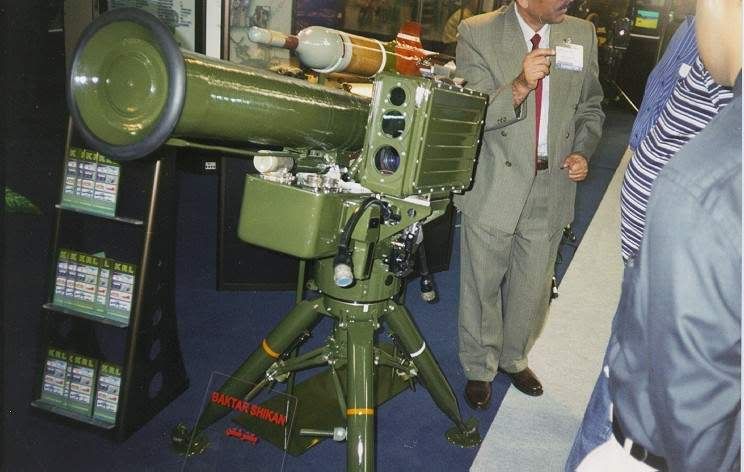


DESCRIPTION
This missile consists of four parts. The encased missile consists of the main missile firmly locked inside a special launch tube fitted with devices and harness for initial launch of the missile and its contained connection with the Guidance System. The IR Goniometer apart from serving as day sight, this equipment receive and modulates IR signals from missile and feeds resulting deviation signals to the Guidance Unit. The Guidance Unit provides steering commands to the missile corresponding to deviation signals received from Goniometer and missile. The Tripod Assembly equipped with traversing and elevating mechanism, adjustable at three firing positions, provides a stable support to the weapons systems.
OBJECTIVES
The “Baktar Shikan” is a second-generation anti-tank missile weapon system, which uses the principle of optical aiming, IR tracking and automatically generated remote controlled and wire transmitted guidance signals. With its long range, it has a greater penetration power and has a powerful anti-jamming capability. It is easy to operate and is capable of destroying all known tank targets at ranges up to 3000 meters with more than 90% hit and penetration probability. Aiming at the target through 12 magnification sight of Goniometer, all that firer has to do is to press the firing trigger and keep the cross hairs of the sight on the target. The rest is done by the systems itself, which automatically guides the missile to fly along the line of sight till it hits the target and a powerful warhead enables its destruction.
Mirko_FilipovicI take it you like Pride fighting too 😉
My right kick will take you to the hospital, my left kick …to the cemetry. :p 😀
Mirko_FilipovicMirko – great posts.. nice pictures.
The pleasure’s all mine. 🙂
Mirko_Filipovic8. GHAURI-III
System: Ghauri-III
Series Name: Hatf
Alternative Name: Hatf-VII
Type: IRBM
Range: 3000-3,500 km
Payload: 1,000/700 kg
Warhead: Nuclear
Stage(s): 2
Height:
Diametre:
Weight:
Developer: KRL
Test Date(s): Not Flight Tested, 29.09.1999 (static engine test)
Launch Location(s): Static engine test was carried out at Kahuta, District Rawalpindi, Punjab, flight test was postponed after being scheduled for launch from Mankera, District Mianwali, Punjab on 28.05.2002,
Status: Not flight tested yet.
Note : If any knowledgeable members would like to make a correction, or add more info please PM me and I will edit these posts. God Bless
Mirko_Filipovic


7. SHAHEEN 2
System: Shaheen-2
Series Name: Shaheen (Eagle)
Alternative Name: Hatf-VI
Type: IRBM
Range: 2,500 km (1,500 miles)
Payload: 1,000 kg
Warhead: Nuclear
Propellant Fuel: Solid
Stage(s): 2
Height: 18m
Diametre: 1.4m
Weight:
Developer: NDC
Test Date(s): 9 March 2004, 19 March 2005
Launch Location(s): Tested to Pakistan’s water limits.
Status: Deployed. Under Production.
Note : If any knowledgeable members would like to make a correction, or add more info please PM me and I will edit these posts. God Bless
Mirko_Filipovic


5. GHAURI-I
System: Ghauri-I
Series Name: Hatf
Alternative Name: Hatf-V
Type: MRBM
Range: 1,500 km (930 miles)
Payload: 700 kg (1,547 lbs.)
Warhead: Nuclear
Propellant Fuel: Liquid – TM 185 (20% High Octane Jet Fuel, 80% Kerosene), AK-27I Oxidizer (27% N2O4, 73% HNO3), Iodium Inhibitor
Stage(s): 1
Height: 15.852-16.000 m
Diametre: 1.320-1.350 m
Weight: 16,000 kg (16 tonnes), 14,000 kg (14 tonnes) (fuel)
Developer: KRL
Test Date(s): 06.04.1998 (at 0723 hrs covering 1,100 km/682 miles in 9 minutes, 58 seconds), 25.05.2002
Launch Location(s): 06.04.1998 Test: Malute, Tilla Jogian, District Jhelum, Punjab; 25.05.2002 Test: Dallana, District Dera Ghazi Khan, Punjab near the Suleiman Range, monitoring station was set up at Basti Jarh, 6 km from the the launch site on the D.G. Khan-Quetta Road
Status: Deployed, Under Production
6. GHAURI-II
System: Ghauri-II
Series Name: Hatf
Alternative Name: Hatf-VI
Type: MRBM
Range: 2,000/2,300 km (1,240/1,440 miles)
Payload: 1,000/700 kg
Warhead: Nuclear
Propellant Fuel: Liquid
Stage(s): 1
Height: –
Diametre: 1.320-1.350 m
Weight:
Developer: KRL
Test Date(s): 14.04.1999 (covering 1,150 km)
Launch Location(s): Malute, Tilla Jogian, District Jhelum, Punjab
Status: Deployed, Under Production
Note : If any knowledgeable members would like to make a correction, or add more info please PM me and I will edit these posts. God Bless
Mirko_Filipovic


4. SHAHEEN-1
System: Shaheen-1
Series Name: Shaheen (Eagle)
Alternative Name: None
Type: MRBM
Range: 750 km
Payload: 1,000 kg
Warhead: Nuclear
Propellant Fuel: Solid
Stage(s): 1
Height: 9.100 m
Diametre: 1.000 m
Weight: 6,200 kg (lift-off)
Developer: NDC
Test Date(s): 15.04.1999 (at 0958 hrs PST or 0458 hrs GMT ), flight time was 6 minutes, 8th Dec. 2004
Launch Location(s): Sonmiani, District Lasbela, Balochistan
Status: Deployed, Under Production
Note : If any knowledgeable members would like to make a correction, or add more info please PM me and I will edit these posts. God Bless
Mirko_Filipovic


3. GHAZNAVI-1
System: Ghaznavi-1
Series Name: Hatf
Alternative Name: Hatf-III
Type: SRBM
Range: 290 km-320km (Ghaznavi ER)
Payload: 500 kg
Warhead: Conventional/Nuclear
Propellant Fuel: Solid
Stage(s): 1
Height: 8.5 m
Diametre: 0.8 m
Weight: 4,000 kg (launch)
Developer: PMO
Test Date(s): 26.05.2002, 29 Dec. 2004
Launch Location(s): Sonmiani, District Lasbela, Balochistan
Status: Deployed, Under Production
Note : If any knowledgeable members would like to make a correction, or add more info please PM me and I will edit these posts. God Bless
Mirko_Filipovic
2. ABDALI-1
System: Abdali-1
Series Name: Hatf
Alternative Name: Hatf-II
Type: SRBM
Range: 180 km (108 miles)
Payload: 500 kg
Warhead: Conventional
Propellant Fuel: Solid
Stage(s): 1
Height: 9.750 m
Diametre: 0.550 m
Weight: 2,520 kg (lift-off)
Developer: NDC
Test Date(s): 03.07.1997, 28.05.2002
Launch Location(s): Sonmiani, District Lasbela, Balochistan
Status: Deployed, Under Production
Note : If any knowledgeable members would like to make a correction, or add more info please PM me and I will edit these posts. God Bless
Mirko_Filipovic

1. HATF-I/IA
System: Hatf-I/IA
Series Name: Hatf (Prophet’s Lance)
Alternative Name: –
Type: BSRBM
Range: 80/100 km (50/62 miles)
Payload: 500 kg
Warhead: Conventional/Nuclear
Propellant Fuel: Solid
Stage(s): 1
Height: 6.000 m
Diametre: 0.550 m
Weight: 1,500 kg (lift-off)
Developer: KRL
Test Dates: (?).01.1989 (Hatf-I), 1992?, (?).02.2000 (Hatf-IA)
Launch Location(s): Unknown
Status: Deployed
Note : If any knowledgeable members would like to make a correction, or add more info please PM me and I will edit these posts. God Bless.
Mirko_FilipovicSpeaking of the Mig-19 (F-6)…….
(Taken from the book “The Story of Pakistan Air Force 1948-1988)
Foreign Encounter – PAF Vs IIAF
In 1977, the PAF had a rare opportunity to demonstrate its marksmanship prowess in a competitive encounter with another air force. Group Captain Safdar who was then commanding No 23 Squadron narrates the story:
“While visiting our base Masroor in September 77, the CAS mentioned that during his recent visit to Iran, the Shah had inquired whether the PAF would be interested in hosting an armament competition with an Iranian Air Force fighter squadron. The CAS asked me if I would take on the Iranian squadron. Needless to say I was excited by the prospect. As a side issue the CAS promised a reward of Rs. 10,000/- to 23 Squadron if we won, and God help us if we lost!
“He instructed the ACAS (Ops) to extend all possible facilities to us in preparing an 8-member team which comprised myself, Squadron Leaders Javed Latif, Javed Qazi, Tahir Hussain, Imtiaz and Shams, and Flight Lieutenants Farhad and Khalid. Every F-6 Squadron was asked to lend 2 aircraft to 23 Squadron for the exercise and very soon we had nearly 30 F-6s at our disposal. I allotted two aeroplanes to each team member and instructed them to harmonize their aircraft themselves. Somiani range was reserved for us and each pilot was scheduled to fly two ground attack and two air-to-air missions per day. Within a month our performance improved significantly and we began to average 90% scores in strafing and over 50% direct hits in rocketry. Our air combat scores also improved proportionately.
“In October the Iranians flew into Masroor with their beautiful F-5Es. Compared to the F-6 the Northrop F-5E was a pretty sight, and incorporated the latest American technology of that time. I could sense that my pilots were a little apprehensive, but their urge to ‘have a go’ was stronger. The competition started and I led the first ground attack mission, followed by one of the Iranians; and thus we alternated through all the events. When final scores were declared we were delighted, for we had beaten the Iranians hands down both in air combat and ground attack.
“The next day we received a signal from the CAS congratulating the squadron and saying that we could collect Rs.10,000/- from the base accounts officer. But the base commander told me that since the competition had been a collective effort, the money would be claimed by the base. I was quite disappointed, as I had been planning to purchase some new furniture and rugs for the squadron for our forthcoming move to Samungli. I mentioned this to the ADC to the CAS, and told him what my base commander had said. Next day the accounts officer came and handed over Rs. 10,000/- to our squadron adjutant!”
Scoresheet

Mirko_Filipovic😀 Lol!!
Thanks i really “enjoyed” that. 😉
I already have this terrible picture. I was wondering if people have any more :confused:


 Sign In







