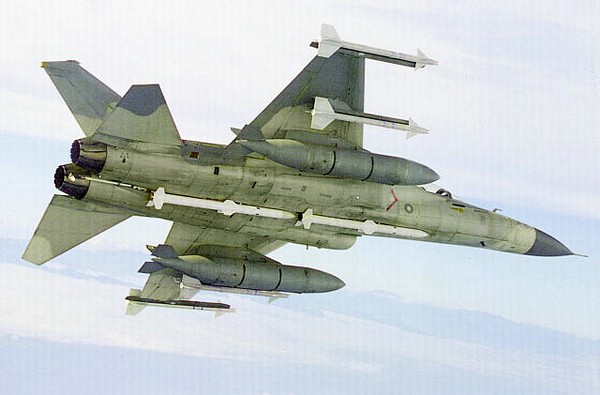
The bottom line for Sky Flash was AIM-7F costs soared to four times AIM-7E2 costs and the price didn’t settle down until around 1980. http://www.cbo.gov/sites/default/files/cbofiles/ftpdocs/51xx/doc5103/doc20-entire.pdf The US procured AIM-54 and AIM-7 each at twice the rate they procured the AIM-9. It took these massive purchases at the high end to justify such sophisticated weapons, whereas not many countries could. The Shah could afford such lavish spending, the UK could not. For similar reasons the UK wasn’t going to sink huge sums into Sidewinders.
The version of Sparrow that the UK did have would have been a handicap for the F-14. Ever read how one of the older, lighter Sparrows took out an F-14 during separation trials? http://www.ejectionsite.com/F-14%20SHOOTDOWN.pdf You definitely wanted the newer Sparrows to maximize your load. Tornado had no such limitations. The biggest issue for Tornado ADV was the UK ran shoestring budgets and it took two decades to get working. Once working it was a pretty good system. By the time it reached F.3 it was a fabulous system as promised.
So money was the problem for the UK. Buying F-14 or F-15 didn’t solve those issues.
Fedaykin-
Fox hunter addressed shortcomings in the AWG9 design. After all, the AWG9 wasn’t too concerned with ground clutter. The search capability was also better at its design range and volume, and it was less difficult to maintain in operations.
The swingwing wasn’t necessary for land based aircraft. The Tornado mission required the wing design in question for its original purpose. The ADV version shoehorned the mission to the design, the alternative was to use existing airframes which were unsuitable. The EAP program was the air superiority design destined for pretty much the same customers, which we know divided into the Typhoon and Rafale designs.
The British weren’t rushing out to adopt M61 beyond the Phantom experience. They also were lukewarm to AIM-9B, which they finally improved when they ordered AIM-9G. (Remember they used USN versions.) They didn’t rush to replace Red Top with Sidewinder. ASRAAM was all about independence from US suppliers. AIM-7E was so well liked that the UK knocked out their own version we know as Sky Flash. AIM-7E and Sky Flash were not compatible, contrary to popular opinion. The Sky Flash required modifications to the LAU-7 to work correctly.
And fuel modifications are not trivial matters. It takes serious work to get them to work right, hence the USN uses its own specialized form of JP and just about every AF out there has their own requirements.

The AGM-88 underwing robs them of the ability to carry self defense AAMs. The wing tanks gives them clearance for AIM-9 or AIM-132.
Q: Didn’t the Germans try anti shipping missiles with Tornado?
A: AS34 Kormorant

The basis of the thread is nonsensical, but we can explore the ramifications. The operating costs of F-14A were pretty steep directly compared to aircraft it would replace. It played a role unsuited to the UK as its radar was optimized for fleet operations, but handicapped relative to other aircraft on the drawing boards. ( The F-15A was not similarly handicapped.) The swingwing offered no advantage in operations compared to other aircraft. It used a cannon not suitable to the MoD. It used missiles not owned by the MoD. And it used fuel not used by the RAF. The F-14 was simply untenable for the RAF. Add in collaboration by European nations already planned at the time and you’re cutting those ties. If the RAF had used F-14 the you basically throw SEPECAT, PANAVIA, and EAP under the bus.
Not claiming the J-10 pic is authentic, but those are supposed to be PL-12 and not PL-11.
The following pick is from a mockup fitting of PL-12.


I had the priviledge to meet a WW2 ace in the Pacific Theater, last year. He travels regularly to speak about it. I’ve also had the pleasure of meeting the weapons officer of a successful Vietnam-theater F-4 pilot. One consistency between the two fellas is that they have told their respective stories so many times it is exactly the same story each time.
I like the F.3 the best, but found it disappointing to never see the quad Skyflash arrangement with 2200L tanks and twin rails per tank pylon for more Skyflash. And they could have topped it off by adding ASRAAM on the outer pylons. It wasn’t like the Skyflash couldn’t have been adapted to use an active seeker and lofted trajectory launches to keep it relevant. (as Taiwan did on Sky Sword II) Typhoon could have been more focused on A2G with a Tornado F.5 upgrade.
Of course a few racks of ADM-160 MALD would never disrupt such a system… /sarcasm
The only ‘not very good design’ MiG-23 were export models built to a lesser standard. The full fledged Floggers didn’t seem to ever meet competition. There is one thing all Floggers shared and that was their combination of short (rugged) field use and their phenomenal acceleration that powered them to terrific heights and speed.
MiG-21 was more of a fighter than a true bomber destroyer. The MiG-23 carried a pair of large AAM meant to take down bombers. The MiG-21 carried Atolls which were more or less meant for downing fighters.
Too much cost for minimal utility. The MiG-29’s hardly can be resold due to their track record and perceived value. They couldn’t even sell off surplus airframes to cover costs of upgrading a half dozen.
Why wouldn’t extending the life of homegrown airframes help the cause?
The F-22 is going to sweep through much higher and faster than the F-14 (any variant) and drop shots from hidden vantage points. The F-22 already has demonstrated this in exercises. When it was operationally hampered – O² issues for the pilot – the competition was allowed to operate within reach. In real engagements this isn’t going to happen if it is used to its full potential.
I never cared much for this layout:

I liked how the original Hornet carried the Sparrows on the hips.