 MadRat
You got a good solid idea there. A few of us can probably make one or two, too, and see where the community takes it from there… 🙂
MadRatI like the idea of two standards; 1pix = .025m and 1pix = .04m being my candidates for an acceptable standard.
This allows for enjoyable viewing of both fighter sized and jumbo-jet sized renditions.
MadRatI know, offer the Indians the F-16XL with recessed positions for AMRAAM-C7e and AIM-9Xe.
The little ‘e’ means I only support them getting the export version of each; no HOJ, no lofted trajectory, no tlu beyond the initial 27 miles, and no IIR.
MadRatOk here’s my take
1. Rafale
2. Mirage 4000
3. Mirage 2000
4. Mirage F1
5. Mirage III😀
Now I know why you thought F-16E/F Blk 60 was down the list. You like balalaika shaped airplanes the most.
MadRatNo mention yet of Avro Arrow!?
MadRatThat said, most air combat happens at BVR!
Since when?
MadRatThe F-16XL bearing fruit is long past due.
It doesn’t make much economic sense to develop the base F-16 airframe past the point of the last UAE deal. For one, they have to pay royalties on new deals for future development on the old F-16. Two, it looks bland on today’s market. The world, especially India, seems to want large monolithic wings on their planes, whereas the base F-16 now looks just plain outdated.
The F-16XL airframe, being a separate design from the base F-16, would give them more of the money for a deal which is what Lockheed would want. Why pay your old investors when new lucrative money can be made elsewhere. I say bring out the F-16XL!
MadRatWhere is the F-16E/F Blk 60 in everybody’s lists?
MadRatNow what keeps the RAAF from beating the hell out of its fleet to speed up the retire process?
MadRatSo you’re saying make a resting place for views of planes (real or imaginary) but in the exact same scale?
MadRatTactical training computers mimic the radar on their panel.
MadRatPretty much what Sens said. Obviously the Mirage 50 was the better choice.
http://www.faqs.org/docs/air/avmir3.html
[4] MIRAGE 5 / MILAN / MIRAGE 50 / MIRAGE 3NG
* The next major variant, the “Mirage 5”, grew out of a request to Dassault from the Hey’l Ha’Avir. Since the weather over the Mideast is clear and sunny most of the time, the Israelis suggested deleting avionics normally stored behind the cockpit from the standard Mirage IIIE to reduce cost and maintenance, and replacing the lost avionics with more fuel storage for the attack mission. In September 1966, the Israelis placed an order for 50 examples of the new aircraft.
The first Mirage 5 flew on 19 May 1967. It looked much like the Mirage III, except it had a long slender nose that extended the aircraft’s length by about half a meter, and made it arguably the most elegant of the Mirage delta series. A pitot tube was distinctively move from the tip of the nose to below the nose in the majority of Mirage 5 variants.
Like its predecessors, the Mirage 5 carried twin 30 millimeter DEFA cannon, and could lift a warload of 4 tonnes (8,800 pounds). It featured two more stores pylons, fitted at the rear junctions of the fuselage and wings, for a total of seven pylons. Any pretense of fitting the SEPR rocket engine was abandoned.
Rising tensions in the Mideast led French President Charles De Gaulle to embargo the Israeli Mirage 5s on 3 June 1967. This measure did no good, as the Israelis started the war anyway two days later. The Mirages continued to roll off the production line, even though they were embargoed, and by 1968 the batch was complete and the Israelis had provided final payments.
In late 1969, the Israelis, who had pilots in France testing the aircraft, requested that the aircraft be transferred to Corsica, in theory to allow them to continue flight training during the winter. The French government became suspicious when the Israelis also tried to obtain long-range fuel tanks and cancelled the move.
The Israelis finally gave up trying to get the aircraft and accepted a refund. The 50 aircraft built for the Israelis eventually found their way into the hands of the AdA as “Mirage 5Fs”.
* Like the Mirage IIIE, the Mirage 5 was popular with export customers, with different export variants fitted with a wide range of different avionics. While the Mirage 5 had been originally oriented to the clear-weather attack role, with some avionic fits it was refocused to the air-combat mission. As electronic systems became more compact and powerful, it was possible to provide the Mirage 5 with increased capability, even though the rear avionics bay had been deleted.
Reconnaissance and two-seat versions of the Mirage 5 were sold, with the designation “Mirage 5R”, and “Mirage 5D” respectively. However, a little consideration of the differences between a Mirage III and a Mirage 5 quickly shows that these designations were simply for marketing purposes. There was no clear dividing line between the configuration of a Mirage III reconnaissance or trainer version and that of a Mirage 5 equivalent, and in fact they were one and the same in many cases.
The Mirage 5 was sold to Abu Dhabi, Belgium, Columbia, Egypt, Gabon, Libya, Pakistan, Peru, Venezuela, and Zaire, with the usual list of subvariant designations and variations in kit. The Belgian aircraft were fitted with mostly US avionics, and Egyptian aircraft fitted with the MS2 attack avionics system from the Dassault-Dornier Alpha Jet.
The Israelis also built their own copy of the Mirage 5, under the name “Nesher”, discussed in more detail later. Some Neshers were supplied to Argentina. The Argentines took heavy losses in their Mirage and Nesher fleet during the Falklands war in 1982, and as a measure of solidarity the Peruvians transferred ten of their Mirage 5s to Argentina to help make good their losses.
A total of 531 Mirage 5s were built, not counting Israeli Nesher production.
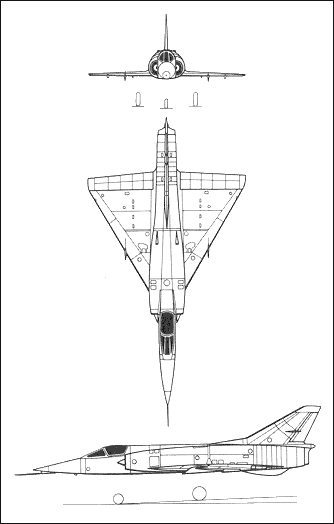

Mirage 5 versus Mirage IIIE
* In 1968, Dassault, in cooperation with the Swiss, began work on a Mirage update known as the “Milan”, or “Kite”. The main feature of the Milan was a pair of pop-out foreplanes in the nose, which were referred to as “moustaches”. The moustaches were intended to provide better take-off performance and low-speed control for the attack role.
The three initial prototypes were converted from existing Mirage fighters and had non-retractable moustaches. One of these prototypes was nicknamed “Asterix”, after the internationally popular French cartoon character, a tough little Gallic warrior with a huge mustache.
A fully-equipped prototype rebuilt from a Mirage IIIR flew in May 1970, and was powered by the uprated SNECMA Atar 09K-50 engine, with 70.6 kN (7,200 kg / 15,900 lb) afterburning thrust, following the evaluation of an earlier model of this new series on the one-off Mirage IIIC2. The Milan also had updated avionics, including a laser designator and rangefinder in the nose. A second fully equipped prototype was produced for Swiss evaluation as the “Milan S”.
The moustaches did provide significant handling benefits, but they had drawbacks. They blocked the pilot’s forward view to an extent, and set up turbulence in the engine intakes. The Milan concept was abandoned in 1972, while work continued on achieving the same goals with canards.
* The Atar 09K-50 engine, however, was still a good idea, and fit of this engine led to the next Mirage variant, the “Mirage 50”, during the 1970s. The uprated engine gave the Mirage 50 better take-off and climb characteristics than its predecessors.
While the Mirage 50 also incorporated new avionics, such as a Cyrano IV radar system, it did not prove popular in export sales, as the first-generation Mirage series was becoming obsolescent. South Africa received a small quantity of the type, and Chile ordered a quantity of Mirage 50s, receiving both new production as well as updated Armee de l’Air Mirage 5s. In 1990, Dassault also upgraded a batch of Venezuelan Mirage IIIEs and 5s to the Mirage 50 spec, with the upgrades designated “Mirage 50M”.
* Following the development of the Mirage 50, Dassault had experimented with yet another derivative of the original Mirage series, named the “Mirage 3NG (Novelle Generation)”. Like the Milan and Mirage 50, the 3NG was powered by the Atar 9K-50 engine. The prototype, a conversion of a Mirage IIIR, flew in December 1982.
The 3NG had a modified delta wing with leading-edge root extensions, plus a pair of fixed canards fitted above and behind the air intakes. The canards provided a degree of turbulent airflow over the wing to make the aircraft more unstable and so more maneuverable.
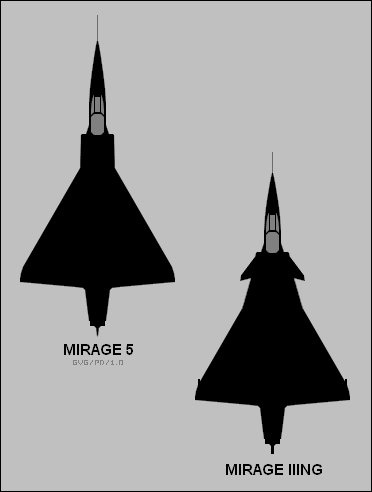
Avionics were completely modernized, leveraging off the development effort for the next-generation Mirage 2000 fighter. The Mirage 3NG used a fly-by-wire system to allow control over the aircraft’s instabilities, and featured an advanced nav/attack system; new multimode radar; and a laser rangefinder system. The uprated engine and aerodynamics gave the Mirage 3NG impressive performance. The type never went into production, but to an extent the 3NG was a demonstrator for various technologies that could be and were featured in upgrades to existing Mirage IIIs and Mirage Vs.
Enhancements derived from the 3NG were incorporated into Brazilian Mirage IIIEs following 1989, as well as into four ex-Armee de l’Air Mirage IIIEs that were transferred to Brazil in 1988. In 1989, Dassault offered a similar upgrade refit of ex-AdA Mirage IIIEs under the designation “Mirage IIIEX”, featuring canards, a fixed in-flight refueling probe, a longer nose, new avionics, and other refinements.
MadRatFor F-18 training.
MadRathttp://www.jet-engine.net/miltfspec.html
Did that help?
MadRatThe man hours/flight hour on the F-117 make the F-14A look pale in comparison.


 Sign In







