 Andraxxus
but the same can be said for anti ship missiles especially the supersonic one because they are much less maneuver
Anti-ship missiles do not exactly make hard maneuvers. On the contrary, P-550 P-700 missiles are known to make evasive maneuvers, and any subsonic missile that I know doesn’t.
but there no way you can intercept a torpedo by artillery or anti-submarine rockets , the depth charge you talking about are to be used again submarine not torpedo
simply google Udav-1 to see how wrong you are.
this is wrong on so many level
firstly, radar horizon not only depend on radar altitude but also target altitude:
SPY-1 height is about 17 meter
Supersonic antiship missiles like P-800 Oniks , P-700 fly at about > 10 meter above the sea
thus the radar horizon is 30 km
P-270 Moskit fly at 20 meter above the sea
thus the radar horizon is 35 km
http://members.home.nl/7seas/radcalc.htm
http://en.wikipedia.org/wiki/P-800_Oniks
even with the new BrahMos that is said to be able to fly 3 meter above the sea the radar horizon is still 24 km
True, I simply wanted to avoid missile specific calculations. If you want so much precision, also count in the time required for a volume scanning search radar in interleaved PRF to detect an incoming missile.
P-700 fly at mach 2.5 at high altitude but at low altitude that reduced to mach 1.6
You assume wikipedia quote wrong. P-700 cruises at around M1.6, accelerates to M2.5+ only at the terminal phase which occurs (at least for P-700) sea skimming.
Thirdly , AEGIS can guide a missile using the Interrupted Continuous Wave Illumination technique , with mean mid course guide can be done by SPY-1 ,SPG-62 only needed for terminal phase just before impact , and the fact that SM-2 , RAM both have IR seeker and SM-6 have active radar guider that mean only ESSM need SPG-62 for terminal phase , SPY-1 can track and lock 100 targets at the same times so 3 missiles wouldnt be that big of a problem
LOL, even by the meaning of the words, “interrupted CW illumintation” means SPG-62 interrupts its CW beam to guide different missiles to different targets; for a long range shot, it puts a missile on course, interrupts the beam, sets second missile on course and so on. Then re-illuminates target if target maneuves or missile weers off course. Its still the responsibilty of SPG-62, SPY-1 isn’t even capable of forming continious wave illumination.
Last but not least
Supersonic missiles are any thing but stealth , they all have high RCS and high IR signature + they fly very high from the sea which mean alot easier to distinguish from clutter , also since Arleigh burke have reduce RCS measure missiles cannot detect it from further than 24 meter so supersonic missiles will actually be quite useless here because they cannot turn tight enough to attack Arleigh burke at that distance
BS on both views. 1- At 20-30 kms, RCS is totally irrelevant for an overly powerful radar like SPY-1 or MR-800. Even a metal marble will shine proudly on the radar screen. What matters is the radar is not exactly looking at the point missile will appear on the horizon. Be it, electronically or mechanically scanned, time will pass before detection. SA-N-9 on fully automated mode has 8 second response time, for example. If SPY-1, -scanning at least 900 times greater volume than SA-N-9- also miracilously has the same response time, it has already wasted half the time it has to launch SAMs at it. Slower subsonic missile againist a higher mounted radar means time elapsed is relatively much less in percentage.
2- Even if 50 times range reduction is true -which really is doubtful to me- it would only mean 2.6 times reduction in detection range, a P-700 missile doing short pop-ups can detect target ships at 300+ km away. Does it matter that it detects burke at 110 km? Or a Zumwalt class with alleged 250 times reduction at 75 km?
Kirov radar track less target , lock less target at the same time compared to SPY-1,
MR-800 or MR-710 or SPY-1 are all capable of tracking 100+++ targets. Difference is SPY-1 is faster and is much network centric, offset by the lower radar horizon. SPY-1 should also excel in resolution and detection range, but all those qualities are irrelevent at 20-30 km.
And its totally irrelevant how many targets a search radar tracks. Engagement is achieved by SPG-62, which provides illumination to 1 target at a time. For such short range, SPG-62 is relieved only after ARH seeker has its target lock, and unfortunately there isn’t enough time to steer it to another target so another missile is launched. Kirov uses different radar sets to achieve it with numbers I’ve stated above.
all the missiles it carry is SARH thus rely on illuminator,
Do you really think SM-6 doesn’t rely on one? That it leaves VLS tube and readily flies into a coming anti-ship missile? You fail to understand what they are designed for: A Burke will provide excellent air defense with SM-6s, 20 aircraft detected by SPY-1 at 100+ km, 20 SM-6 missiles guided by SPG-62 with short intervals to their targets, and ARH of SM-6 makes succesful terminal tracking. Combining SA-N-4/6/9/11 systems, kirov can guide 42 missiles 26 different targets at the same time, at point blank range, which burke can’t,. And no, it cannot share illumination (at least in time), when targets are shot at so close range.
Subsonic missiles fly alot lower and have less RCS than supersonic one so i dont see how Kirov survive JSM , LRASM any better than Arleigh burke survive P-700 , P-800
You are talking about a modern missile, lets talk about current Petr Veliky then. Lets see, MR-800 is rated 200 km againist fighter sized targets, lets assume its 10m2. At 20 km range, it could detect 10m2 / (200km/20km)^4 = 0,001 m2 targets just as easily. New tomb stone radar can guide its missiles to 3m2 targets at 150 km, which also means it can also guide its missiles to 3/(150/20)^4 =0,0009 m2 uber-VLO targets at 20 km. Admittadly a VLO missile will be more troubling to air defenses, but speaking of 4 missiles againist kirov? Assured target lock at 20 km followed by each incoming missile engaged by a pairs of 5V55 or 48N6E2s, and then one or two pairs of 9M338, then 1 or 2 missiles of SA-N-11 system, then the artillery of the Kashtan system. I see perfectly clear how a kirov survives JSM.
All in all you are comparing success of a) 1.6 tons ordnance againist 28000 ton ship, which is primarily designed to defend itself from saturation AShM attacks, with b) 28 ton ordnance aganist a 8400 ton ship, which is designed as an escort to carriers. 58 less payload weight compared to target displacement, and polar opposite in design philosophy. No alleged technological edge gained in mere 8-10 years will offset such difference.
AndraxxusTorpedoes -when compared to AShM or even artillery- are pretty silly way for attacking surface targets; They are slow, short ranged, easily evadable (even by the means of maneuvering or just going at full speed), and easily divertable (by the means of ship launched decoys, or decoy carrying anti-submarine rockets) and easily destroyable (by any artillery -if close to surface-, or anti-submarine rockets -if submerged-)
In fact primary use of Udav-1 or similar systems is defense againist torpedoes. Speaking of Udav-1, It fires 111SO decoy rockets and 111SZ proximity fused mines along the way of the torpedo as soon as its detected. If both fails, it can fire 111SG rockets with depth charges at close range.
Add to that; missile dropped torpedoes barely reach 10 nm range with 40 kts max speed. Any modern warship can maneuver and run away from the torpedo at 30 kts, meaning torpedo has to be dropped at around 2.5 nm. If a missile managed to get so close, it should just as well fly straight onto the target.
And no; an AEGIS destroyer or Arleigh burke class specifically, wont survive 100 AShM, not by a long shot: No matter how many SAMs it carry, it can provide 3 Guidance channels due to fact it has 3 SPG-62 guidance radars. New ARH SAMs do not require terminal guidance, but they still require mid-course updates which is still provided by SPG-62.So only after first salvo of 3 missiles acquire their targets, another 3 can be launched, no more, not sooner. Due to curvature of earth, there is a such thing called radar horizon. With ~17m height of SPY-1 radars, its radar horizon is approximately 14,2 km. Time required for a M2.5 AShM to cover this distance is 16,5 seconds; AEGIS is fast and mostly automated, but it would be a real miracle can detect 3 different targets (that also involves differentiating from ground clutter if any), track and identify them, conclude them as threat to the ship, get missile launch authorization from the operator, direct CW guidance radars to target, and launch the missiles. Its not impossible, but re-engaging targets if not destroyed or launching another 3 set of missiles to different targets in that time? That is pretty impossible to me. 4 supersonic missiles will likely to mission-kill a non CIWS Arleigh burke, 5 or 6 will mission kill a CIWS variant. An Arleigh Burke assisted by datalinked AEW platform is another story, which would allow its ARH missiles to be used over the horizon.
Kirov is said to be able to theoratically survive an attack by 100 harpoons is another story; MR-800 3D search radar is located exactly 48 meters from S/L, covering 24,7 km range at sea level. With stated 864 km/h speed, it takes 103 seconds for Harpoon to cover the this distance. This radar does not provide missile guidance, it certainly provides tracking data to fire-control subsystems and alerts the crew. Now the impressive part; Each of two Volna systems can guide 8 missiles to 4 different targets in the air, with 4 in command guidance mode, and another 4 in terminal SARH or TVM mode. It takes 3 seconds for rotating dispanser to get into position (due to cold launch system it simply rotates the octuple missle magazine), so new missiles will be launched in command guidance. Which means, kirov can utilise all 12 of its SA-N-6 rotating launchers, engaging 8 different targets, with additional 8 in mid course update. 5V55R/U missiles reach 7200 km/h speeds, so time between launch and missile detonation (succesful or not) is roughly 10 seconds; At the end of 10 seconds, 8 missiles have reached their targets, another 8 will be in the air (now switched to SARH) and another 8 are just launched. Even by worst assumptions, kirov can fire and deplate its entire SA-N-6 magazine againist incoming harpoons in ~60 seconds. Add to that, when remaining inbound missiles close into 12 km comes the SA-N-9 system. By that time 3R95 which already detected tracked, prioritized and selected its targets, and guides 8 missiles to 4 different targets. Theoratically, kirovs are supposed to carry two of these radars and 192 SA-N-9 missiles. System as a whole puts 16 missiles againist 8 targets. It could operate in the same fasion as above, putting close to hundred missiles in the air if needed. Then there is SA-N-4s, each system can engage 2 different targets with relatively lower Pk againist missiles, and 8x AK-630 or 6xKashtan-Ms, each module of the latter can engage two different targets at the same time. What should limit a kirov battlecruiser is the fact that its not truly network centric; independent systems can operate in full automatic mode, they can also get information from MR-710 and MR-800 search radars, but they have no connection with other systems, at 8-9 km, a single harpoon can be engaged by all of the SA-N-6, SA-N-9 SA-N-4 and SA-N-11 systems, wasting tracking channels and ammunition.
AndraxxusNo? Any plane that weight X kgs and capable of pulling Y amount of Gs has an airframe capable of generating+withstanding X*Y kilograms amount of lift.
AndraxxusNo; Baseline Su-27 airframe can safely withstand 171000 kg of lift. With sufficent strengthening to landing gear assembly, and/or reduction in expected take off criteria (ie increasing runway length or altitude, etc), no airframe modification would be needed; even Su-27S could take off at 38 tons, but would be limited to 4,5Gs. Theoratically, there is no aerodynamic or airframe strength limitation that prevents Su-27S to take off and fly in level at 100+ tons. I am reasonably confident Su-30M2 airframe is mostly unchanged; just improved landing gear, and newer engines provide more thrust for better acceleration.
AndraxxusTrue, it can sustain M2.35 for 5 minutes, while F-15 sustains M2.5 for 1 minute – while reportedly reaching M3 in testing – heard it many times although I don’t know the source for that one unfortunately. Not that unbelievable though, seeing that F-15 is regarded as slightly faster than Su-27.
Those are general ‘service rules’ that have to be followed, but generally go out of the window during the serious combat situation.
Untrue.
Su-27:
Limit = Su-27 is limited to M2.35, speeds between M2.15 and M2.35 is limited to 5 minutes.
Ability = Su-27 can barely touch M2.35.
F-15:
Limit = F-15 is limited to M2.5, speeds between M2.3 and M2.5 is limited to 1 minute.
Ability = F-15 barely touches M2.25 with standard engine trim, and go slightly above M2.35 with Vmax.
Both would need colder than standard day in order to go faster. F-15 cannot go M2.5 without Vmax even at STD -10C. Test you mention may happen on very cold days, but that is not an indication of performance; 20 degrees colder than STD DAY, a MiG-29 or a Mirage 2k should have no problems going M2.5+ too.
Andraxxusiamnot saying sustain high altitude , but like to zoom up 60K feet , release missiles then come down , so that missiles dont have to climb much or fly in thick air
Theoratically possible, but imagine; a Su-35 flying at 12000 m @ M1.5+ will need so little AOA that it will be flying closer to its Cd0 (at given mach number). With the zoom climb and associated speed loss, its likely to come down stalled. Such action would waste great amounts of energy, and would not be practical.
Su-35 is really big air plane , not sure if carry 10 r-77 really affected it that much , how about mig-31 ?
I don’t have exact data for Su-27 for various payloads, but I can examplify how ceiling of F-15/16 changes with varying weight/drag. What matters is, such ceiling with missiles will certainly happen subsonic speeds, at supersonic at M1.3+ with 10 missiles, level flight altitudes will be much lower, around 12000m.
is the 5Gs limit of mig-31 is with or without weapon? , what is the limit when it loaded with 6 R-37 , 2 R-40 , 2 R-77 ? ( all pylon have missiles )
Not related to weapons, but should be related to airframe weight. I don’t have data, but logical estimate is at 50% fuel, it should be able to pull whatever Gs its capable of pulling. Speaking of performance, MiG-31 can achieve M2.83 with 4xR-33 + 2xR-40 thats I all know.
Assuming MiG-31’s level flight envelope behaves similarly to MiG-25 (which I have data); MiG-25 achieves its ceiling around M2.5; ~23000m at 24tons, 21500m at 28 tons with 4xFAB-500s. At 35 tons, its ceiling is approx. 15000 meters, achieved at ~M1.5.
So with full fuel and weapons load, MiG-31 should reach around 15000m, with decrased fuel to 50%, it should easily exceed both 20000m and M2.5 marks with full missile load.
but instantenius turn reduce speed and altitude significantly isn’t it ?
It depends on how negative SEP aircraft has at its maximal instantenius turn. For example, MiG-31 takes 65 seconds to complete an 360 turn at M1.4. This data means it has 5,53 deg/s turn rate, requiring it to sustain 4,2Gs. With maximum 5Gs, its instantenious turn drag is not that different than what is sustaining. With different speed/altitude combinations it may, or it may not lose speed/altiude. On an extreme example, a MiG-31 sustaining 5Gs at a certain speed will also be pulling its max. instantenius turn.
but 60 seconds seem like even longer than a ramjet engine ,wasnt ramjet supposed to have much much longer burn time than solid fuel ? ?
Ramjet/rocket/scramjet etc has nothing to do with burn time. One can design a turbojet that will deplate its fuel in 10 seconds, or a rocket engine that burns for hours, or even days.
Thrust = Specific Impulse (in seconds) * fuel mass flow rate (or fuel burn rate; in Newton/seconds)
Only thing that matters is the weight
Comparing the impulse from worst to best;
solid fuel rocket-liquid fuel rocket-ramjet-turbojet-turbofan.
Comparing engine assembly weight from lightest to heaviest;
solid fuel rocket-liquid fuel rocket-ramjet-turbojet-turbofan.
Obviously their order is the same. Impulse of a solid fuel rocket is around 500s at best. A ramjet can reach exceed 1500s at design speeds. However, for equivalent propulsion system weight, 1 kg increase in engine assembly will reduce 1 kg of available fuel. If impulse is improved sufficently to overcome the reduction in propellant, its better, othervise it is not.
Also engine assembly is dead weight when fuel is deplated, or engine goes out of its operating envelope; something to consider when missile is supposed to maneuver at the end of its flight, or a spaceshuttle goes above stratosphere.
With 500s impulse, a solid fuel rocket can be design to burn 50 kg propellant in 1 second, producing 245 kN of thrust, or in 100 seconds, producing just 2,4kNs.
Developing this example further; (excluding drag and reduction in mass with expanded propellant) a short range would prefer the former; 200kg missile fired at 200m/s speed (720km/h) would accelerate to M4.89 in one second, after travelling 812 meters, and will start slowing down. Latter burn time is preferred for long range missiles; it will also reach M4.89, but that is after travelling 81250 meters, only after that the missile will start to slow down. Obviously drag and reduction of mass will change those values, but this makes the point clear enough.
how much the situation change if we take in to account ramjet R-77 ( assume it have same performer as Meteor )
Assuming both types will be able to carry it? BVR Advantage still belongs to MiG-31, IMHO.
Wing area and Missile ?!?!!!
C’mon Andraxx, I thought we had that clear enough.
Look at them. Look at their fins. Look at the apparent section of their “airfoil”. Does it look like inviscid theo and low subsonic eq. can apply ? Does the H2K missiles employ large wings or thick airfoil ?
I didn’t read it all but Why do we have to write it that down again ?
Lift/drag formulae are not only for subsonic speeds. They are pretty valid, but supersonic Cd and Cl values change. Inviscid flow has nothing to do with this, as air viscosity is already included within the calculation due to Cl/Cd coefficients. With different -chord- reynold’s numbers come the different Cd/Cl. Thick, thin, cambered, supercritical, hexagonal etc all airfoils or even a flat plane can have Cl/Cd. What is to remember is both change with reynolds number and mach number.
Missiles never require large wings or thick airfoils. Ever read lukos telling about Cl/Cd increases with V^2? Difference of Cl between thickest and thinnest airfoils are 12-13% at best when supersonic. Difference of going 6% faster is 12,4% improvement in maneuverability.
That’s what basically I am trying to say 😉
You are comparing harrier in VTOL config with F-16. Both needs lift to make turns, it doesn’t matter if lift comes from side looking engines, or wings.
AndraxxusTBH, you’ve changed the subject entirely because we’re not comparing missiles, we’re talking about altitude affects on missile and aircraft wrt wing loading differences between the two, which this post has no bearing on.
Wasn’t it the beginning of that discussion? That missiles with small wings are unlikely to maneuver well at high alt? Otherwise your entire discussion is pointless, with 3,4 m2 wing area and 490 kg weight right off the rail, R-33 has 144 kg/m2 wing loading which less than half of any aircraft flying. BTW, I’ve also calculated the wing areas of AIM-120A and R-27RE. Their wing loadings are 176 and 159 kg/m2 respectively. With their propellent expanded, and weight reduced to half, these numbers should be halved also.
However, at a highly theoretical level, yes, if a missile has the same range but a lower wing loading, that subsequently implies that it likely has more drag, so to achieve the same range, it has to reach a higher peak speed, hence it’s average speed is higher and it likely gets there first. There’s a multitude of effects to consider. If it gets there a lot sooner, e.g. R-37 vs AIM-120D, then the other aircraft may be forced to break lock and go evasive, in which case the slower missile is left without the necessary mid-course guidance. If it arrives at the same speed or faster, then yes it will turn better and suffer less drag as it does.
I wasn’t talking about two aircraft firing their missiles on each other, but that was my point. PS, not necessarily higher peak speed as in case of R-33, It can have longer burn time so it reaches similar peak speed, but maintain much better average speed.
However a more interesting and pertinent question is what happens if you put bigger fins on the same missile. Wing loading reduces but drag increases, meaning speed and range is reduced. At a given speed it has more manoeuvrability but in any given intercept it is going slower at any point. The missile with the lower wing loading has better manoeuvrability at any point in time up until the missile with smaller wings exceeds its velocity by a factor equal to the square root of the wing loading ratio. E.g. for a 1.5:1 wing loading difference, when the smaller finned missile’s velocity hits 1.225 times that of the larger finned missile, then it will have better lift. Exactly when this happens depends on burn time but it should happen after burn time unless the burn continues until T=D, which it may do with a
sustainer. The narrower finned missile also reaches the target sooner. Swings and roundabouts.
That is why I called its about optimization. What you also need to consider is altitude; greater wing area will clearly lessen low altitude maneuverability of the missile.
By the way, now that we roughly know the wing areas; calculating by their wing loadings and taking Clmax=0,5 for M2.0+ thin airfoil;
At 18000m, missiles can reach following Gs at M2,0; M2,5; M3.0 and M3.5 respectively:
R-33S: 7,3G; 11,4G;16,5G; 22,4G
R-27RE: 6,6G; 10,4G; 14,9G; 20,3G
AIM-120A; 6G; 9,3G; 13,4G; 18,3G
What is more interesting is AIM-120A (with greater wing area than AIM-120D) has 9,95 deg/s turn rate and 5946 m turn radius at M3.5, but R-33 missile has 10,4 deg/s turn rate and smaller turn radius of 4846m at M3.0; So even if arrives much slower, it should have better Pk than AIM-120D for the above discussion.
For a target at 24000m (as in MiG-31) G ability of those missiles at same airspeeds as follows:
R-33S: 2,8G; 4,3G; 6,3G; 8,58G
R-27RE: 2,52G; 3,9G; 5,7G; 7,77G
AIM-120A; 2,29G; 3,5G; 5,1G; 7.0G
Even at overly optimistic terminal speed of M3.5; those missiles have following turn rates, and their turn rate covers following distance difference at 1km, 5km and 10km respectively:
R-33S: 4,6 deg/s; 80m/s; 401m/s; 802m/s
R-27RE: 4,16 deg/s; 72m/s; 362m/s; 724m/s
AIM-120A: 3,74 deg/s; 65m/s; 326m/s; 652m/s
Even if those missiles plot an intercept course, just a 80 meter change from expected course in a second at 1 km distance will prevent missile from hitting it, as it will lack to turn rate to compensate afterwards. Aircraft will simply fly faster and into the turn radius of the missile. MiG-31 at 24000 meters at M2.5 flies at 744 m/s airspeed just for the comparison.
Andraxxus12000 meters is only 39.370ft but since they both detect the other from 300-400 km isnt it more logical for them both to climb to higher altitude + accelerate to very high speed before launching missile to give their missiles more energy ? EX : 18000 meters ( 59055ft )
True for MiG-31, but not for Su-35. It has ceiling around 18000m, so with 10+ missiles and high fuel load, it should shrink to 15000m. That is pretty much the lift limit, Su-35 will have no great acceleration or maneuverability there. For any ordinary fighter, 12000 m is a good altitude.
so basically at 17km ( 55774ft ) the turn radius of mig-31 is about 34 km rather than 10 km (probably mig-31 can only turn 5Gs at slower speed ? )
5G is the supersonic limit for MiG-31, IDK about its subsonic limits. Its possibly talking about sustained turn, but I am talking about instantenius turn when pulling 5Gs.
Never @ > 100,000 m (~300,000 ft) ; in space
~150 seconds @ 24,000 m (~80,000 ft)
~70 seconds @ 18,000 m (~ 60,000 ft)
~25 seconds @ 12,000 m (~ 40,000 ft)
~10 seconds @ 6,000 ft (~20,000 ft)
~5 seconds @ Sea Level
so it seem that if fighter climb higher before launching their missiles then their missiles can remain fast for really long
too theoratical, missile also loses its airspeed at a) first rapid maneuver at launch where missile sets an intercept course horizontally, and setting a lofting flight path vertically. b)gaining altitude while flying ballistic
sustain for 100 km at mach M4.5 is equal to about 65 seconds , are you sure R-33S rocket burn that long ? wasnt it a solid fuel rocket ? , normally i only heard rocket burn for maximum of 6-7 sec
~60 seconds burn time looks pretty logical to me. Rocket burn is determined by design of engine. If you want quick acceleration right off the rail, you want a short burn motor; assuming specific impulse remaining same, increasing propellant burn rate should increase F accelerate missile to its max speed in a few seconds, which is wanted for VWR missiles. Like lukos says, rocket engine thrust is not affected by the increase of altitude. So for long range missiles, its desirable to reduce burn rate, where missile accelerates slowly but reserves some propellant for high altitude so missile will continiue generating thrust in thin air to reach longer distances. Sustaining M4.5 is not a correct term, a R-33 should reach M4.5 perhaps 40 seconds after its launch. On the negative side, this requires some minimum launch distance, where missile could gain some airspeed to have maneuverability to shoot down its target.
@lukos and obligatory; You both (and me in my example quoted) are talking about very different things;
I was talking about optimization, a theoratical F-16 with 33% lower wing loading will likely perform better at 30k feet for a given speed. But nothing is linear; double the wing area, it will perform worse at 30k, but perhaps better at 50k. Double it again and you will have something similar to U-2, it will fly high, but wont sustain turns at all. What lukos is talking about is very different to this, because it also includes variance in speed;
lukos is talking about missile’s reach, or effective range; and he is correct in his conclusion that less density at longer range allows for longer range; if you half the wing area at very high speeds, you also half the drag; you certainly half the max G at the same speed However with much greater (T-D), missile will fly faster, slow more slowly, and will have greater reach.
He is also correct that rocket engines do not lose thrust with the decreased air density, with simplest real life example being bell x-2 (M3.2 with only 67kN engine).
However I stand with obligatory in that terminal approach the missile’s wing area do matter. For intercepting a MiG-31 flying at M2.5 at 20000meters, an AIM-120C, R-27RE etc will simply have not enough maneuverability, after they flew reasonable amount of distance. Slighest turn by MiG (even by 30 degrees) will force missile to make huge corrections, which is impossible for a missile that is already slowed down to ~M3.0.
The issue about missiles is also optimization. Lift by itself is not only the only factor in missiles terminal maneuverability, but efficently carrying itself to its target is also another factor.
Lets say, AIM-120D, has certain Pk at 30, 60, 90, 120 kms. Question is, how would greater wing area affect Pk? 30 km? Cerainly would not matter, as missile would be G limited (rather than lift limited) anyway. 60km? Greater wing area increases the lift but as increased drag slows the missile down during 60 km flight, it also decreases the lift, so improvement is debatable. 90km? just like above example, but also missile with increased wing area may slow down too much to be able to catch its target. 120km? With increased drag AIM-120 wouldn’t even fly 120km.
You also realize the big extension in range is due to ballistic flight where energy from thrust is traded for altitude and drag only impedes it gaining altitude.
On a truly ballistic flight, a missile will not generate any lift. It will fly in zero lift Cd0 condition. A-A missiles do not fly truly balistic however.
speed exactly overcomes the loss of density.
However on this I have to disagree, in part. AIM-120D has 200+ km rated range. R-33S is also said to have 200+ km range. Looking at this by pure kinematics, (ignoring seeker performance etc), how would they perform if they were fired at at a high flying (not necessairly too high, lets sat 30k feet) maneuverable target at 160 km away? IMHO much lower wing loading would matter, and with bigger warhead I would put all my money to R-33.
BTW This discussion is not relevant at all; Lets make it more relevant by saying;
R-27RE max range = ~120 km. R-33S max range = ~200 km. I say,
a)R-33S fired at 100 km againist Su-35, has significantly higher Pk than a R-27RE fired at MiG-31BM at same range.
b)R-33S has much better terminal maneuverability than R-27RE at high altitudes, after both flies 100km distance.
Reasoning: R-33S has better sustainer, lower wing loading, better warhead, and its more or less at middle of its launch envelope.
AndraxxusIts not a matter of prediction, but kinematics. R-27RE has maximal range of 117 km, but againist a fighter that is closing in at same altitude, its effective range is 65.5 km. At a tail chase againist a fighter, its 16,5 km.
Lets assume for a second both flies at 12000 meters;
-Su-35 fires R-27RE at 110 km, 12000m. Missile will spend 2+ minutes in air, with steady 50m/s climb rate, MiG-31 slowly climbs to 18000 meters, and missile will fall short. MiG-31 can easily trade its speed for this.
Lets assume height difference has no affect on missile range for a second;
-Su-35 fires second R-27RE at 65 km. MiG-31 puts 15 degree angle to reduce its closure rate, and missile will fall short.
-Su-35 fires third R-27RE at 40 km. MiG-31 puts 60 degree closure angle, and missile will lack necessary terminal speed to reach MiG-31.
At 5Gs @ 2500 km/h, MiG-31 will have 4 deg/s turn rate, and 10km turn radius. It this bad? Not at all, as missile has to slowly turn with the MiG to plot an intercept course. To put it this way; 15 seconds is what it takes to give 60 degrees angle to target, getting immune to many types of missiles it fires and still maintain radar lock. 45 seconds is what is required for a 180 degree turn and retreat at will. 7,5 seconds is what it takes 30 degrees climb angle to achieve 347m/s climb rate at 2500 km/h, and furter 12,5 seconds (for a total of 20 seconds) to get from 18000 meters to 22340 meters.
Such thins are really problematic for the missile, as its struggling to a)maneuver while plotting new intercept points second by second MiG-31 changes course b)gain 8-10 km altitude in its puny 65 km range c)generate enough lift to turn itself into target, inside the air getting thinner and thinner with altitude increase, d)maintain at least M2.5+ airpspeed to catch its target.
Add to that, I completely ignored the fact MiG-31 will be firing its own missiles too. So it begins by; Su-35 fires its missile at 110 km, MiG-31 detects this illumination via RWR, fires its R-33S. R-27RE momentarily touches M4.5 then after a few seconds booster deplates and missile glides 60-70% of its flight. R-33S sustains maybe 80-100 km of its flight at M4.5. What happens? R-33S reaches target first, and Su-35 breaks its radar illumination to evade. Can it evade? Most certainly can, but at that point MiG-31 has a clear advantage; Su-35 deplated its energy, completely lost its SA, and MiG-31 possibly fired second R-33S by that time. Even to regain SA, pilot needs to turn towards target by following RWR, level the aircraft, activating radar with appopirate volume scan area, wait for target detection, switch to STT, all the while MiG-31 continiously changing position at M2.5+ and is shooting missiles -which by now includes both R-33S and R-77s types- at him. Its simply impractical, what is logical for Su-35 pilot is to disangage at this point.
Andraxxusand this method of target illumination is supposedly not really fast enough to illuminate maneuvering targets with sufficient frequency so the missile’s seeker can stay ahead of the target when it gets close to it.
This is your conclusion. Zaslon being PESA allows multiple target illumination. It takes like 1,2ms for each module to steer beam, or transciever to switch frequency. Not only R-33, it can guide 2 R-40 missiles along with two R-33 missiles as well.
Then there is also the size and the weight of the missile which would probably cause the missile to bleed most of its energy trying to stay ahead of the maneuvering target,
Missile/aircraft mass is completely irrelevant in energy maneuverability. Hence the term specific excess power. Is Su-27 less maneuverable than F-5 because its larger? RIM-66/67/174, 9M317, 5V55, 48N6 are all large missiles. They can still maneuver very well.
to be fair the high speed of mig-31bm do bring some disadvantage when target shot back though ,
1-very big turn radius ( like 30 or 100 km at mach 2.4 if i dont remember wrong ) make it actually have to come very close to target even after launching the missiles
True, but that is circumstential. If pilot wants, MiG-31 can always stay slow to M1.2 at 17000 meters, and dive to 13000 meters to gain M2.0+ speed then climb if necessary. From the MiG-31 pow, it should never allow target to shoot back succesfully.
AndraxxusA quick look at their images will tell the above statement is not true;
R-33 (490kg)
versus R-77 (175kg) and R-73(105kg)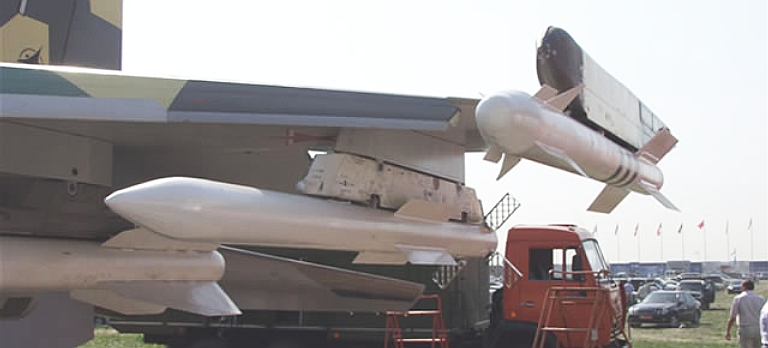
Andraxxusand the R-37 missiles would have had active guidance so it would be possible to engage maneuvering targets unlike with the R-33S
So SARH missiles cannot engage maneuvering targets? ROFL. If you are strictly comparing ARH vs SARH, by which I mean excluding INS or mid course updates, SARH missiles are FAR more suited to engage maneuvering targets at long range.
Andraxxus-R-37 is not in service; if/when it ever enters service, it will surely be integrated on Su-35S too. There is simply no point in introducing R-37 at all. Leaving R-37 out of the discussion, current MiG-31BMs are equipped with R-33S, and Su-35S will still rely on R-27ERs for long range; R-77 have 80 km max range, and around 50 km effective range. IIRC R-77M/M1 etc variants are not in service.
Radar/Sensor/Jamming sets: IMHO; radar range/performance difference is totally irrelevant, both types will see each other via RWR at 400+ km away. Both radars will achieve target tracking long before missile launches. Also this gives plenty of time for MiG-31BM to increase to M2.5+ speeds at the time of missile launch.
Weapons: Both MiG-31/R-33S and Su-35S/R-27ER combinations will face the same problem; they can fire their missiles at their maximal ranges, but simplest change in closure rate by target will make missiles fall short. Getting closer to target will improve the Pk, but also improve the Pk of the enemy missile. Both types will launch their missiles, and turn to their radar’s azimuth limits; R-33S surely has better range than R-27ER, but Irbis-E has 240 deg azimuth coverage, so it can actually direct targets while aircraft flies away from the target. IMHO this is the only definitive advantage Su-35 has when compared to MiG-31.
R-33S: I won’t get into R-33 is not designed for fighters discussion; see R-40 missile operational history. They can surely be used againist fighters. The problem is not the missile performance, but its target; Su-27/35 series are very maneuverable targets, ethiopia-eritia war has shown it had no single problem evading BVR missiles launched at their range limits.
R-27ER: While R-27ER is -theoratically- better optimized for fighters, MiG-31 hardly flies like a fighter, flying high and fast, its right at the edge of R-27ER’s target envelope. So it will have problems reaching the MiG-31 and still have enough energy to maneuver for a kill.
R-77: Both Su-35 and MiG-31 can carry this missile; Su-35 too maneuverable, and MiG-31 is too high+fast for effective shots, Pk will still be low.
In short; both types will have extreme difficulties in hitting their targets. I wont get into R-40TD and R-27ET, with continiously changing closure angles it would be difficult to succesfully utilize them without target lock before launch; Su-35 would have hard time getting close enough to lock R-27ET, and MiG-31 should not get close to use R-40TDs.
A typical scenario is MiG-31BMs and Su-35Ss would exchange their missiles at long ranges, close in and exchange their R-77s and then MiG-31s would withdraw.
However; for a theoratical discussion in an open zone; I would put my money on MiG-31BM due to several factors:
Speed. Means; a) greater boost own missile range. Combined with R-33S missiles with already better range, this ensures first shot. b) doubled energy state which can be used for missile evasion, climb or other maneuvering. Even a 60 degree turn after firing a BVR missile -to reduce closure rate- will waste energy. c) allows MiG-31 can disengage at will.
Excess power: At its engagement speeds of M2.0+, MiG-31 possibly has far better specific excess power than Su-35 does at ~M1.4, again aiding with energy management, and allows MiG-31 to disengage at will.
Maneuverability; Surely MiG-31 is limited to 5G when supersonic, but it can sustain turns better than Su-27 and possibly Su-35 at high Mach numbers.
This translates to me as “while both sides have little chances of hitting each other, Su-35S has even less chance of hitting MiG-31.”
AndraxxusIf there are any re-training for legacy Su-27 pilots that transcend up to the Su-35S, it would be different instrumentation and systems.
I believe utmost reason is the increase in landing weight of Su-35. Su-27 could only land at 21 tons. A slight 1 ton increase in empty weight, 2 tons increase in bring back capacity would total at 24 tons, 14% increase in landing weight would make glide angle, AOA and airspeed all different. As Su-35 pilots are logically most experienced Su-27 pilots, their experience may work againist them.
AndraxxusWhen the pilot moves the control stick, depending on speed, its a AOA or G demand, or mix of both from the FBW. On non-TVC negative stable aircraft, if pilot wants 5G turn, he pulls the stick back. What FBW does is to give positive phi angle on the elevators, reduce it as G meter approaches 5, and rotate elevators to some phi


 Sign In







