Mike Williams
A Ministry of Aircraft Production memo dated 29th June 1940 noted “…the Hurricane I aircraft now being delivered from the manufacturers all have Rotol constant speed airscrews” and that “…the De Havilland two-pitch airscrews on Hurricane I aircraft are due to be modified when Spitfire I aircraft have been completed” ( Air 2/2822). Operations Record Books note delivery of Rotol/constant speed propeller equipped Hurricanes in the April – June 1940 period (see for example 1, 79, 151, 213 squadrons). Books from Richey, Gleed and Neil also mention that new Hurricanes came equipped with Rotol constant speed propellers prior to the Battle of Britain. Which propeller a Hurricane possessed in 1940 may be more a question of when it was built rather then where.
Mike WilliamsIt was 19 Squadron that on 1 Nov 1939 recorded in their ORB: “A new type of “Spitfire” fitted with a “Rotol” constant speed airscrew was collected by Squadron Leader Cozens who began to carry out intensive flying and reliability trials with this aircraft.”
54 Squadron was completely reequipped with Rotol Spitfires in December 1939. I’m fairly certain that 74 Sqdn and Hornchurch had some as well early in 1940. It looks like 41 Squadron had them too. The more I look, the more I find.
54 Squadron loses over Dunkirk:
From Form 541
24.5.40 F/O Linley P.9455
25.5.40 P/O Allen N.3178
25.5.40 P/O Buckland N.3096
25.5.40 Sgt. Phillips P.9388
25.5.40 P/O Gribble N.3103
27.5.40 F/Lt Pearson N.3030
28.5.40 P/O Deere N.3180
From Form 540:
24.5.40: “F/Off Linley and Sgt Phillips did not return from this patrol at 1830 hours, but P/O Gribble reported that he had flown low over the bearch and had seen 2 Spitfires apparently undamaged and three pilots nearby who waved to him. P/O Gribble took off at 2046 hours with messages which he was to drop near the three pilots. On arriving there, however, the aircraft had been destroyed by fire and the pilots had disappeared.”
25.5.40 P/O Allen: Aircraft caught fire and he baled out.
25.5.40 “Sergt Buckland failed to return and up to the present no news has been received of him.”
25.5.40: “P/O Gribble’s aircraft was damaged and he forced landed on the beach near Dunkirk”
27.5.40: “F/ Lieut Pearson was missing. He was last seen heading towards Dunkirk.”
28.5.40: “P/O Deere’s engine was hit during this engagement, the pilot gave over the R/T that he had landed safely seemingly in our own lines.”
(Forms 540 and 541 are not in agreement as to the date Phillips did not return)
So, at least P.9455, P.9388, N3103 and N.3180 seem to have forced landed on the beach near Dunkirk.
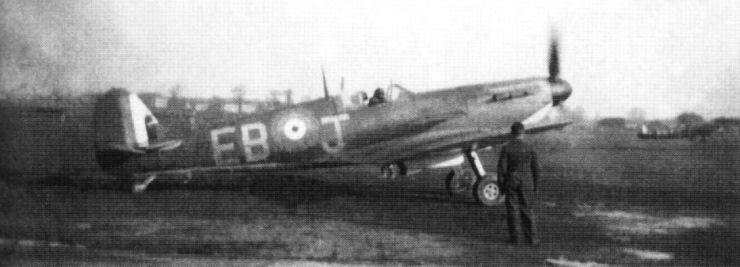
54 Squadron Spits with Rotol props prior to Dunkirk :
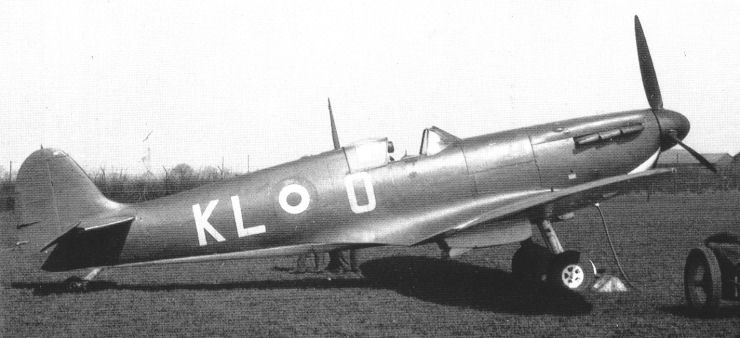

41 Squadron Spitfire at Hornchurch- looks like a Rotol prop to me (unknown when photo was taken).
Mike WilliamsAfter a hefty bit digging in my files to support a conjecture on another forum, I have come to the conclusion that there is or was no such thing as a Spitfire F.Mk IXb or F.Mk IXc….they just did not exist.
Although used widely in post war publications to date, I can find no such designator in official documentation.
Can anybody confirm otherwise?
Mark
As was touched on by others, it was not uncommon during the war for squadrons to call those Spitfires equipped with Merlin 66 engines Spitfire IXB.
Here’s a typical example from a combat report:

This excerpt from a February 1947 Air Ministry report “Air Fighting Tactics Used By Spitfire Squadrons” could be viewed as “official documentation”
Mike WilliamsHi Keith:
The following information ties into your story of the de Haviland constant speed propeller conversions:
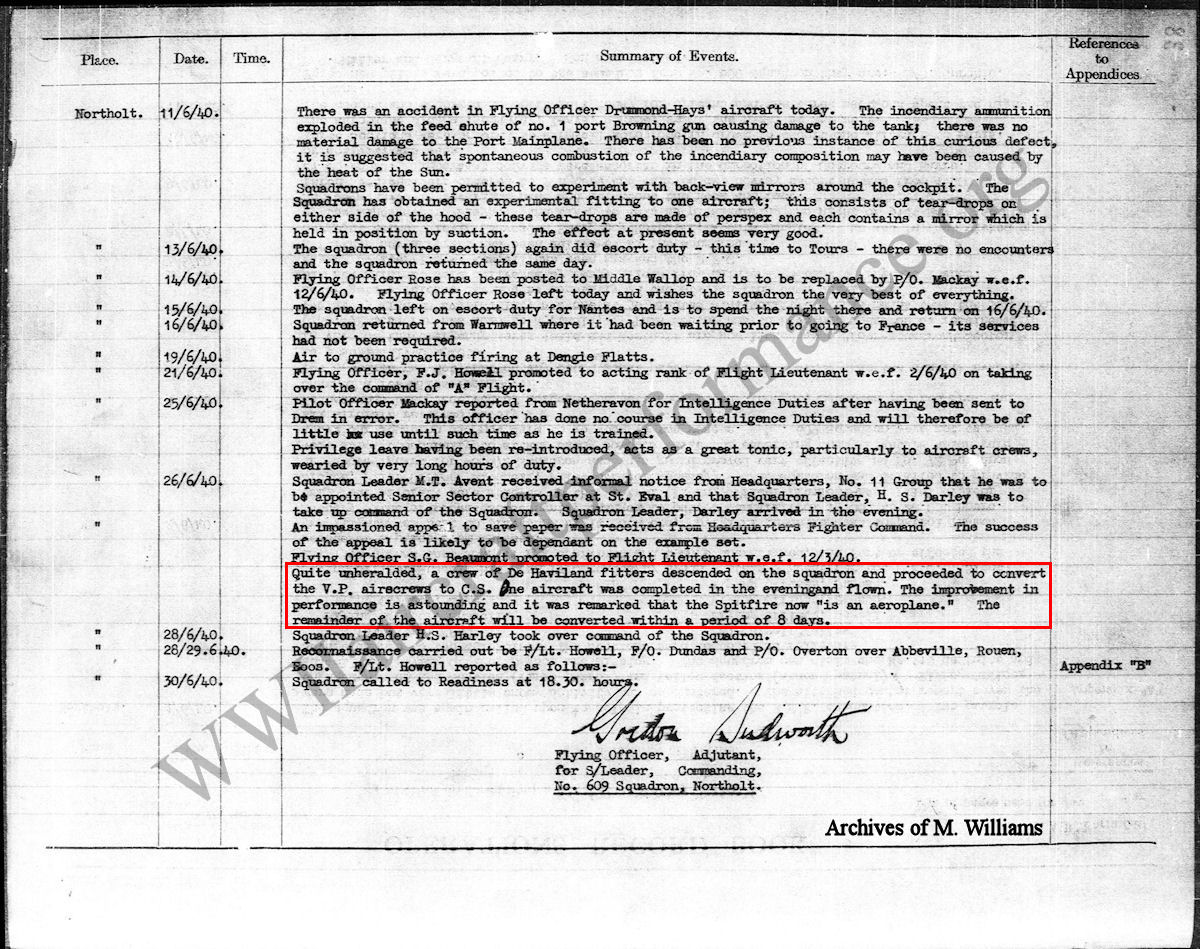
609 ORB, 26/6/40: “Quite unheralded, a crew of De Haviland fitters descended on the squadron and proceeded to convert the V.P. aircrews to C.S. One aircraft was completed in the evening and flown. The improvement in performance is astounding and it was remarked that the Spitfire now “is an aeroplane.” The remainder of the aircraft will be converted within a period of 8 days.”
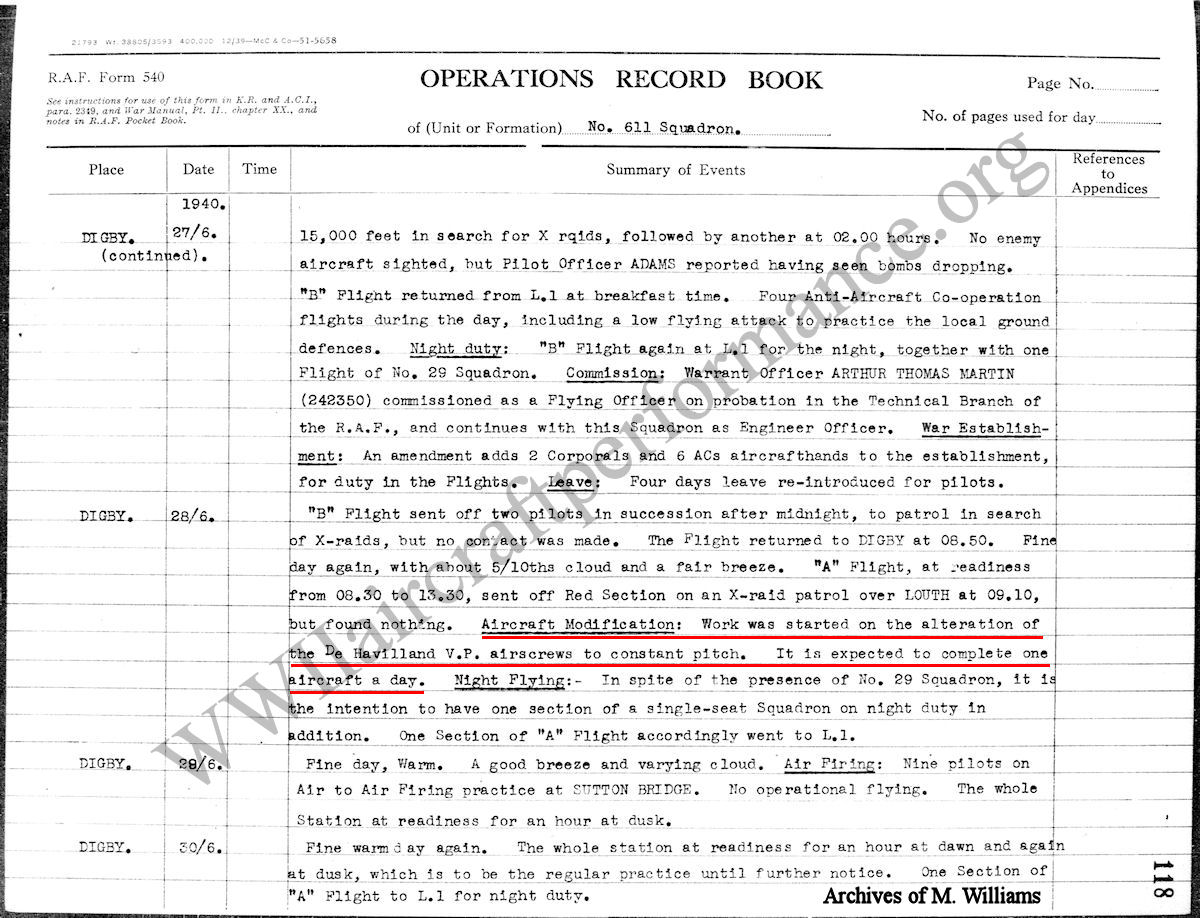
611 ORB, 28/6/40: “Aircraft Modification: Work was started on the alteration of the De Havilland V.P. airscrews to constant pitch. It is expected to complete one aircraft a day.”
611 also recorded on 3/7/40 that “Air tests of the new constant speed airscrews have proved very satisfactory. One pilot reports that he can now turn inside a Rotol Hurricane. The same pilot reached 35,000 feet (indicated) on a height test.” I have my doubts about a Spitfire turning inside a Rotol Hurricane, however, this statement is interesting none the less in that it implies that a Spitfire equipped with the constant speed propeller turned better than one without.
I think D. Ross got the Spitfire I development leading up to the Battle of Britain story pretty well right in his book on 603 Squadron. Its more than I have time to type out so See Here
>Reading between the lines of the permission of +12 lb emergency boost in March 1940 A.P.1590B/J.P-W http://www.spitfireperformance.com/ap1590b.jpg would indicate that its use was intended to be pretty limited. Fuel use, already at a premium would have been increased by a further 40% and there would probably have been a significant increase in engine wear, not to mention the disincentive to pilots of having to report it and enter it into the engine log.
Dowding is on record complaining that “some pilots pull the plug with little excuse on every occasion”. My research leads me to believe that use of +12 lb/sq.in. emergency power was so frequently and freely used as to justify Dowding’s complaint.
>I suspect that +12 lb boost was hardly ever used in climbing to altitude and the chart http://www.spitfireperformance.com/s…-rae-12lbs.jpg would suggest that it also had less effect on performance at common combat altitudes of 15,000 to 25,000 feet than we might hope to think.
For the Hornchurch squadrons you need look no further than Deere and Gray with 54 Squadron, Vigors with 222 and Quill with 65 Squadron as to why there was a need. For example from Gray: “54 Squadron, take off, take off, for Christ’s sake take off”, followed by section leaders ordering the Pilots to: “…press their emergency boost **** (giving double take off power)”.
Increasing boost increases climb and level speed performance up to full throttle height. Increasing RPM from the ½ climb limit of 2600 RPM to the 5 minute Emergency limit of 3000 RPM will increase climb performance up to the aircraft’s ceiling. I estimate this increase in climb rate to be somewhere in the order of 400 ft/minute from sea level to ceiling. As your initial post noted, however, it is difficult to pin down the performance figures for the Spitfire I. As I previously noted, in my opinion, this is more of an issue with climb rate than with level speed.
Keith, yes the Rotol Spitfire serial numbers come from 54 Squadron’s ORB. It turns out I have a copy of a portion of 65 Squadrons’s ORB which I forgot about, but they recorded too little to be of any value. Where did you get your information about 65 squadron’s conversion to the DH CSP? Oh, btw, Quill didn’t report to 65 Squadron until 5 August, so I’m not sure to what extent he would have been involved directly in the discussions at Hornchurch. I expect 65 squadron had already converted to CSP’s by the time Quill arrived.
Regards, Mike
Mike WilliamsHi Keith:
>Anyone ever noticed how difficult it is to pin down the performance figures for the Spitfire Mk 1?
Yes 🙂
Nice job of weaving various loose threads together to form a clearer picture of developments to the Spitfire leading up to its Battle of Britain configuration. I can share a few more strands to weave into the story.
In December 1939 54 Squadron recorded the delivery of the following “Rotol Spitfires”: N.3097, N.3103, N.3104, N.3110, N.3111, N.3122, N.3124, N.3130, N.3160, N.3172, N.3174, N.3176, N.3183, N.3185, N.3187, N.3188. In January 1940 N.3180 and N.3184 were taken on charge, presumably Rotol equipped, while 152 Squadron collected 15 Spitfires from 54 squadron, all these aircraft being in the K.9xxx serial range. As of 14 June the aircraft remaining from the initial re-equipment with Rotol Spitfires, still flying operations with 54 Squadron, were as follows: N.3097, N.3111, N.3173, N.3160, N.3183 & N.3184.
The experience in France should not be overlooked as an influence in Spitfire development. Gleed & Richey both make note of Hurricanes based in France in May 1940 equipped with Rotol constant speed props. France based RAF Hurricane squadrons were also retro-fitting armour to their aircraft. Similarly, Spitfire squadrons quickly retrofitted armour before going into combat over Dunkirk.
The first Spitfire II’s were delivered during the latter part of June equipped with Rotol props. Also during June 40 all Hurricanes were delivered from the manufacturers with the Rotol CSP while Morgan & Shacklady note that de Havilland was to supply Supermarine CSP conversion sets for new production Spitfire Is. (See: also http://www.wwiiaircraftperformance.org/hurricane/hurricane-csprop.jpg )
In late July A & AEE reported on trials it had conducted of R.6774 fitted with a de Havilland constant speed aircrew and found performance to be similar to that of N.3171 fitted with a Rotol CSP.
Regarding Spitfire I performance, the RAE chart that Paul linked is better than the usual figures generally presented since it shows level speed performance using +12 lbs/sq.in. boost which had been approved in March 1940 and used by Spitfires over Dunkirk and during the Battle of Britain. Climb performance is more of a problem since the figures generally given are based on the early ½ hour climb limit of 6.25 lbs/sq.in./2600 RPM. There must have been a very significant increase in climb rate when using the 5 minute emergency setting of +12 lbs/sq.in./3,000 RPM.
>I’d still love to know more about the conversations going on at Hornchurch in June 1940.
Yes, that would me interesting. 74 Squadron’s ORB, which is generally quite sparse in detail, simply remarks on 29 June for K.9871 – “Constant speed airscrew test”. I wonder if 65 Squadron’s ORB could shed any further light on this subject.


 Sign In