Two came through Blackbushe, the first in June 1976 was T8B-124 G-BDYA which went onto the Confederate Air Force. This was a transport conversion with extra cabin windows and no armament, CAF later refitted these items.
The second was N-99230 in September 1977 which later went on to the USA.
The third for Doug Arnold was the one that crashed en route killing Neil Williams his wife and an engineer. I was led to believe that the Spanish ATC would not let them take a direct route from Spain, across the sea, as the other two had done, which forced them to fly inland up the coast and they took the wrong valley which ended in a cliff.
My copy of ‘Aircraft Recognition’ a Penguin Special by R.A.Saville-Sneath from 1941 says the jaguar was a reconaissance bomber version of the Me110, distinguished by the glazed nose bomb-aiming position. With some saxrifice of speed and range the ‘jaguar’carries up to a ton of bombs.
I presume this was a figment of the press at the time.
The report mentions “spent machine gun bullets”. I wonder if they mean bullets or cases. Farm workers could have thought they were being strafed if spent cases fell around them, possibly from an aircraft testing its guns.
If a axis air force had gone to the lengths of flying an aircraft to Britain they would have used it iether for something clandestine or to attack something strategically very important.
Just a guess but could this be a ant-ice panel from a Belfast of Britannia or even a VC10 or something.
Thought being that the one plenum indication is for a common hot air duct fed by bleed air from all the engines, this provides hot air to the flying control icing protection. The control surfaces are physically split to provide redundancy, which accounts for the duplication, VC10 certainly had this feature, not so sure about the others though.
DH Heron heading north over Hampshire this morning. I assume the one from the Channel Isles. Is it still for sale?
“and directly in front of you is a B17”———Demonstration of the Fighter Collections new wear round the neck interactive talking museum guide. Specially trained one year olds.
The old Eastchurch airfield site has been a prison for many years but is now being given up(strange as I thought we were short of prisons) and the local council has an ambitious project, utilising the old WW1 hangars as a museum/visitor centre.
Details on their web site. http://www.theflyingstart.co.uk/main4.htm
Has anyone any pictures taken at Easchurch, a relative was stationed their for a while.
Mark12
That aircraft could be the third Iraqi two seater of an order for four, one was diverted to Pakistan and the other to the Royal Navy.
Early two seaters had seperate canopies but airflow caused the rear canopy to collapse so were later modified to the style we know on RN a/c.
So my choice is IDT3/263 delivered to Iraq 21/5/48 although things are far from clear.
EDIT The first picture of Ztango’s is the Fury diverted to Pakistan from the Iraq order, that too had the early canopy style. Was to be IDT2/262 with Iraq then K850 for Pakistan. Delivered 3/11/48.
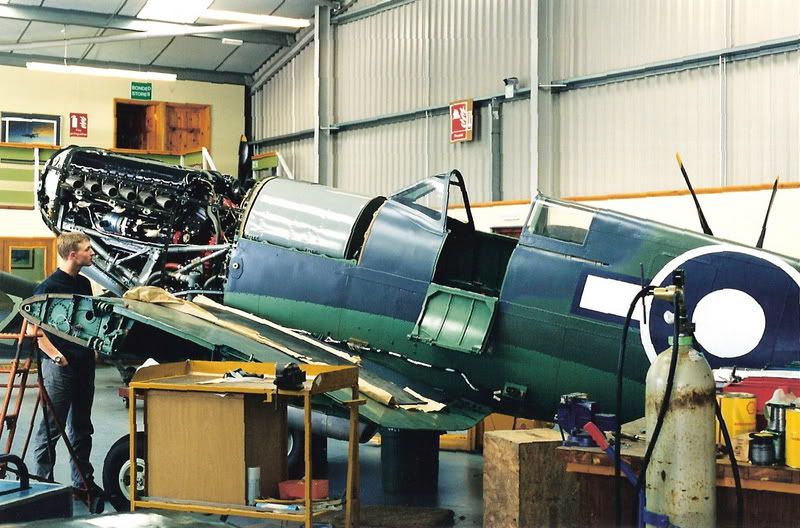
Here’s Seafire LF111c PP972 back in 1999 at Earls Colne. Lot still to do at that time but hopefully getting close to completion.

Nice painting, do you mean ED347 as WD347 was a Chipmunk!
Fantastic looking aircraft, love the look of desert colours and vokes filter.
Is this the first Spit to fly with this nose profile since they were used in wartime?
In the video the captions say its 4th feb 1955 when the Vulcan was rolled, and it was XA889 that was used to perform the feat.
I stand to be corrected but was it not XA890 that was used in 1955, which had the early plain delta wing, the a/c in the video has the later wing with extended leading edge profile.
XA889 was not completed until Jan 55 and did not fly until 4th Feb 1955 with the plain wing, getting the extended one later. The airshow was held in September 1955. Before XA889 first flew.
So was the roll performed at Farnborough in the years after 1955.
Only three X15 airframes were built, number 1 and 2 did the early flights and number 3 blew up prior to its first flight, it was repaired, and all three flew until Number 2 broke its back on landing. That was also repaired.
They all continued to fly until Number 2 suffered the excessive heating damage after which it was repaired but never flew again.
Number 3 was destroyed when it broke up in the air due to high G loads following a spin, Major Adams killed.
That left number one to make the last flights ending with flight 199 on 24-10-68.
X15-1 56-6670 Air and Space Museum Washington.
X15-2 56-6671 Dmgd/repaired/dmgd/repaired. Wright Patterson Museum.
X15-3 56-6672 Blew up/repaired/destroyed.
A slender delta version was proposed but not built.

Some wartime Thunderbolts had hollow steel blades, a museum in Norfolk(cant remember where) had several on display, some had been the subject of a field modification, a strip of steel had been welded onto the trailing edge from tip to near the root giving them a broader chord.
Looked a bit crude for something as precise as a propeller and the welding didnt appear too good either.
No thats the pilots version, two sets of flight crew.
I bet the passengers dont moan about low cabin air recirculation levels.