 packard
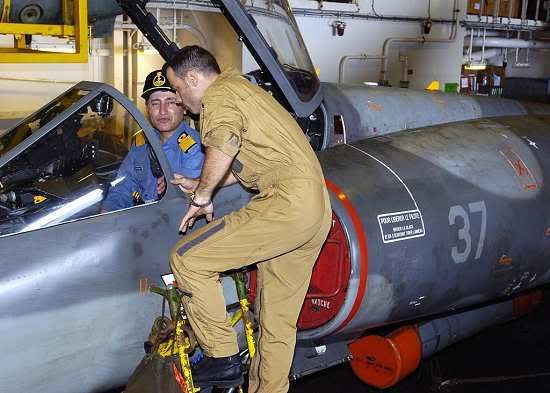
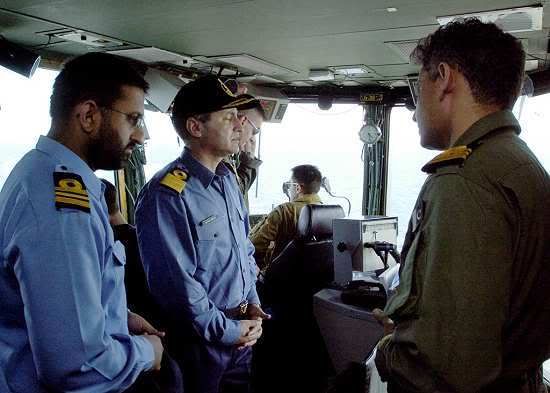
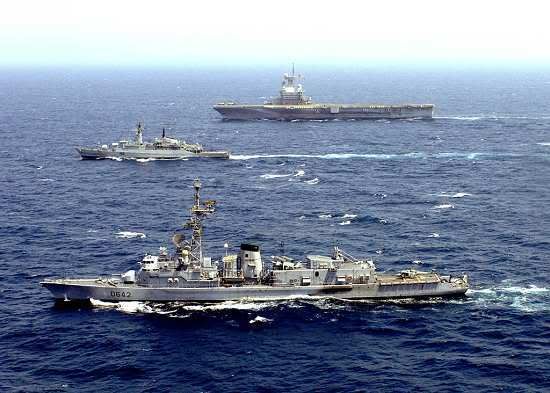
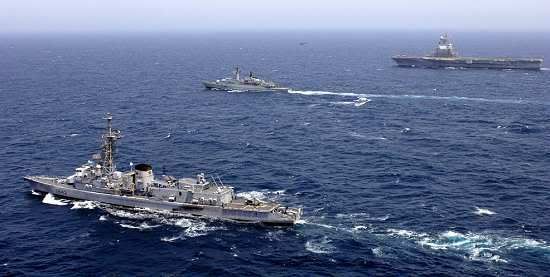
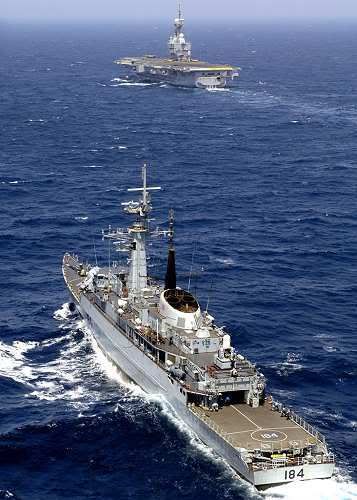
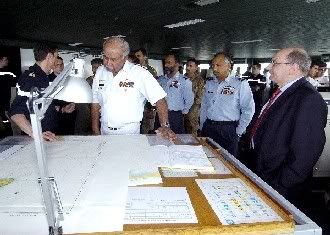
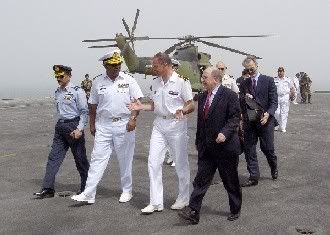
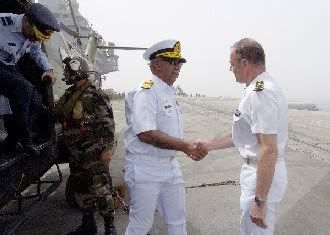
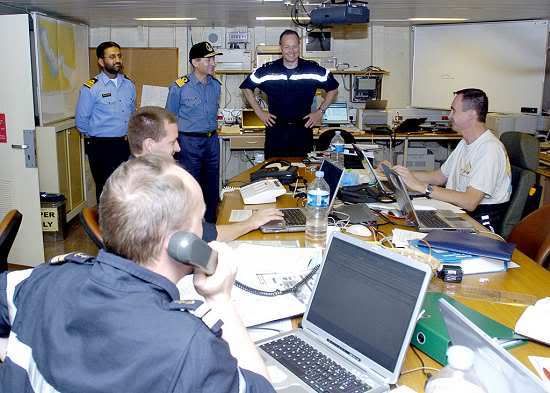
This year French Navy took part in an exercise in Arabian Sea with Pakistan Navy and Airforce. The exercises involved PAF Mirages simulating attacks on Charles de Gaulle, french aircraft carrier as well as PN surface/submarine units. Here are some of the pictures.
packardPakistan, U.S. navy to stage exercises
Pakistani and the United States Navy will stage a three-day joint exercises next week, according to a statement issued by Pakistan Navy on Friday.
The exercises, code-named “Inspired Union 06”, will begin on Sept. 4 and continue through Sept. 6 in the Northern Arabian Sea, the statement said.
“The purpose of the exercise is to advance maritime interdiction operations, counter terrorism and other wide rang of professional exercises,” it said, adding that the exercise would be conducted in 3 phases.
However, the statement did not mention the exact number of the troops from both sides involved in the drills.
Last April, Pakistani and the U.S. troops had also undertaken a joint exercises code-named “Inspired venture/gambit-05” in Cherat, south of Peshawar, the capital of Pakistan’s North West Frontier province.
packardOr it could be Indian pressure having the French sell “only” three. Whereupon India is informed that it can buy the next French sub..and so it goes … :rolleyes:
Why even allow three. Why not 0 ? Any special reason ? 😉
Pak orders new fast attack naval craft
PTI
Wednesday, September 06, 2006 17:50 IST

LONDON: Pakistan has ordered two advanced fast attack naval craft from Turkey, a leading defence weekly claimed on Wednesday.
The MRTP 33 vessels are considered the most recent patrol craft, the latest in a series that includes the MRTP 15 operated by Pakistan’s Special Service Group, according to Jane’s Defence Weekly.
It has a length of 35.6 m and carries a crew of 20, with a combined diesel and gas high-speed propulsion system. The diesels allow a patrol speed of 28 kt, while the gas turbine can produce a maximum speed of some 60 kt. With it Pakistan’s vessels will also be more heavily armed.
“The craft is able to carry larger equipment and payload such as a combined 30 mm gun, two 12.7 mm machine guns, short-range surface-to-surface stabilized missile launcher, medium-range surface-to-surface fibre-guided missiles, electro-optical fire-control systems and decoys,” the weekly said quoting a Pakistan Navy statement.
The Navy said the acquisition should provide better control of littoral and coastal waters.
Its role would include patrol; escort, fast attack missions; maritime interdiction operations at high seas; anti-terrorist protection of coastal and offshore installations, insertion and extraction of special forces; surveillance; special operations support with naval commando delivery vehicle and search and rescue.
packard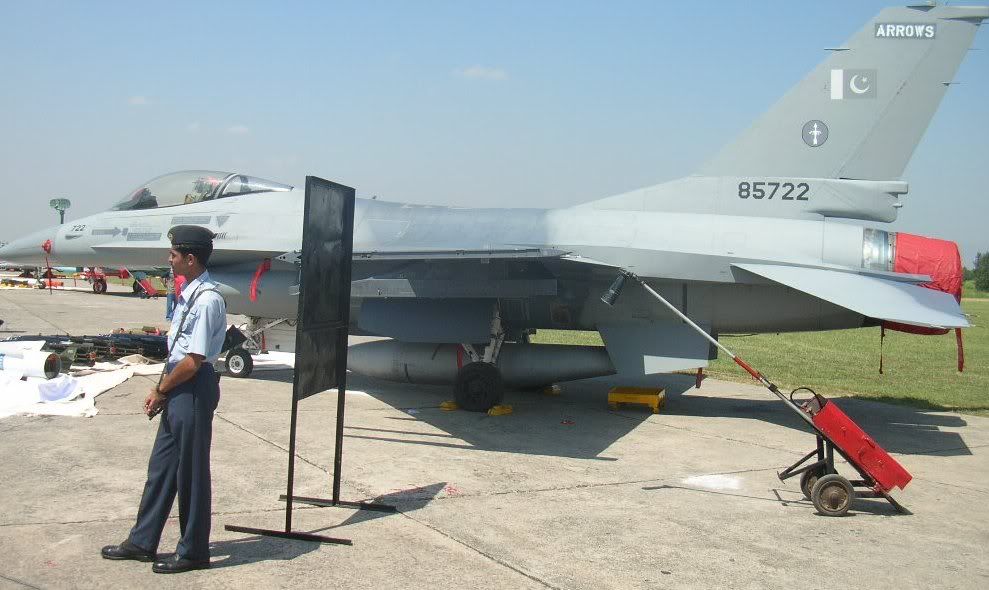
packard“Could everybody, please, finally come down to the ground, and concentrate on FACTS?
Once again, few photos of an Iranian prototype appear, and one side is rising it above the stars, while the other is bashing it endlessly. Is the ability to see the situation objectivelly completely unknown to so many people these days?
To summarize soberly:
– On 19 August, the IRIAS (Islamic Republic of Iran Armed Services) have launched a multi-phase exercise “The Blow of Zulfiqar”. It i s said that its third phase – beginning on 2nd of September – is mainly concentrating on the IRIAF (kind of “there is IRIAF too”). In fact, it is so that the attention of the media and public is by purpose drawn on the IRIAF since this date. But, the IRIAF is participating with many of its assets right since the beginning of this exercise.
– In interviews shown on Iranian TV, in no place has any of interviewed IRIAF officers even mentioned the F-18 with a single word. It is definitely so, that none of them has drawn a comparission between the Saeqeh and F/A-18.
We do not have a clue who has added this detail into written reports: it is possible that it was added by the official censor who has controlled the release of the original press release, or – more likely – a translator. Surely, somebody has permitted the release of this kind of report, even if none of IRIAF officers said anything similar (nor would they ever come to the idea to do so).
– Correspondingly, in no place has anybody from the IRIAF stated that the Saeqeh is “superior”, “similar” or anything else to FA-18.
Explaining that any IRIAF officer has compared the Saeqeh with F-18 would therefore be spreading misinformation.
The shown airframe is Saeqeh, as revealed by ACIG.org almost a year ago, and in the Iranian public (by then CO IRIAF, Maj.Gen. Pardis), on 30 May this year, and first flown in early July (on 6th, even if officially reported only on 8th of July).
The Saeqeh is the continuation of a whole series of Iranian projects based on the F-5-airframe. These included a series of F-5A-improvements, series of F-5E- and another series of F-5F-improvements.
One of the F-5A-improvements was rebuilding of the F-5A-airframes into two-seat Simourq, closely resembling the Northrop T-38A. Simourq is little more but an F-5A-airframe, overhauled and strenghtened, and then stretched to add another seat in the front. Nine airframes of this version have been modified this way by now.
Another was a re-deisgn of the F-5F-airframe, including addition of a large “hump” instead of original spin, containing fuel and avionics. A kind of “F-5F-SMT”. The original Iranian designation of this project was “F/B-22”. None have been ever built: this remained a “paper” project, even if some very nice drawings were completed.
Finally, the third series of designs included a project for reverse-engineering of the original F-5E. This was the project “Azaraksh”. It appears that at least few airframes (perhaps six) have been completed in the late 1990s: a series of 30 additional was planned but never completed, due to the lack of money, but also US pressure: F-5E-design, after all, is still owned by the Northrop-Grumman.
The Iranians therefore re-designed the airframe, and that’s how the Saeqeh came into being.
There is only one prototype of Saeqeh, and this differs to a “normal” F-5E in only three major details. Two-fins configuration, a deeper lower forebody (the part of the fuselage in front of the cockpit and up to the top of the radome is deeper; see photo bellow), and redesigned intakes.


Deeper nose and re-designed intakes are good to be seen on these two stills from a video released today.
Otherwise, this plane is entirely the same dimensions like F-5E, and obviously powered by the same J-85 like F-5E – even if by models built in Iran. Intakes are re-modelled, but have still the very same cross-section like those on F-5E (just like the whole area-ruled fuselage behind them is that of the F-5E), meaning that the plane is still powered by J-85s, and that even this Iranian version of this engine has no more thrust than the original: if it would be more powerful, intakes would be larger.
Equally, if this plane would be powered by RD-33s (or some derivatives of these), like not few wannabees are babbling around, it would require MUCH larger intakes.
Saeqeh has the same lenght like F-5E, and the same wing-span. Although the use of composite materials is quite widespread, and cannon armament is removed, its total empty weight is slightly higher than that of the “vanilla” F-5E. Means: the plane has the same wings area and same thrust, at higher all-up/operational weights.
Should somebody have doubts about what I say, import the photo bellow into Photoshop, and superimpose any photo of an “standard” F-5E to see what I’m talking about. There is no “bulb” canopy, nor a larger one, and the wings have exactly the same planform:

Now, why two fins and why this “strange” black add-on on the rear?
Given that the nose of the plane is larger, and there is more weight up front, but there was also a requirement for a some kind of “major” re-design (in order for the Saeqeh not to look like “vanilla” F-5E), the Iranians have put two fins on it. Two fins guarantee for an enlargened fin area, required by increased need for stability given increased all-up weights at which this plane should operate. It’s an “elegant” solution for other two problems as well.
Now, the airframe structure around engines in that part of the airframe is not sufficiently strong to support two fins. On the contrary, the F-5E – while built very well and strong – is quite “filmsy” in that part of the airframe. So they have put that composite structure in the place to hold the fins: you can see “bolts” protruding from that construction up the (very thin) fins on the photo bellow:

Additional details showing how is this “superstructure” fastened on the standard F-5E-airframe can be seen here:

with remark, that the “finish” – i.e. the quality of work shown on the still above indicate that it is very easily possible, that this “prototype” was actually one of 141 US-made F-5Es once before….
If you compare the photos above with video-stills, you’ll notice that some show the plane with, and others without cannon-armament. Guns were removed out of need for space required by extra avionics – for the time being, this avionics is certainly foremost needed for monitoring and testing purposes.
Means: the plane has no radar yet, only test avionics. That is a standard practice in the West: the first prototype has no “full standard” avionics, but foremost avionics required for basic flying, testing, monitoring and recording. But, it does contain an advanced HUD (even if no holographic, wide-angle wiz-bang stuff like on most recent Western fighters), usual UHF/ADF- and UHF/IFF-radio-antennas and -transponders. And this means very much that avionics is on board.
Photos and videos released by the Iranian TV have shown that single prototype armed with two LAU-3/A rocket pods (for 69.85mm/2.75in unguided rockets), and carrying a single centreline drop tank of 1.041 litres – like F-5Es are usually carrying.
Regarding the rest of what has been reported: there is MUCH more to be said, but this is the essence of Saeqeh. Explaining anything else or more about it in the context of original Iranian and press-reports forwarded by various foreign media (especially the AP), is completely misleading – and useless wasting of time and bandwidth.
Which means not, however, that there is not MUCH more to be said to this – and several other, but related, projects, events etc.”
packardIts a re-modelled aircraft. Just like Simorgh which is a re-modelled F-5A to a 2 seater.
Iran Upgrades Aging US-Made Jet
By VOA News
06 September 2006
State media in Tehran say Iran’s military has carried out a successful test flight by a new fighter-bomber – a jet that actually is a remodeled version of an American warplane Iran acquired decades ago.
The reports say the remodeled plane, called the Thunderbolt (Saequeh, in Persian) was redesigned and upgraded using only Iranian expertise and equipment. The jet carries a locally built missile with the same name.
Iran’s army chief, Ataollah Salehi, is quoted as saying the new fighter carried out a mock bombing mission Wednesday, in northwestern Iran. He added that Iran received no outside help for the project.
Televised pictures indicate the new plane is a modified F-5 fighter jet – a U.S.-made aircraft that was supplied to Iran before the Islamic revolution in 1979 that led to a break in relations between Washington and Tehran.
Iran has test-fired a series of missiles during its current land, sea and air maneuvers – a large-scale military exercise that began more than two weeks ago – on August 19.
packardawesome
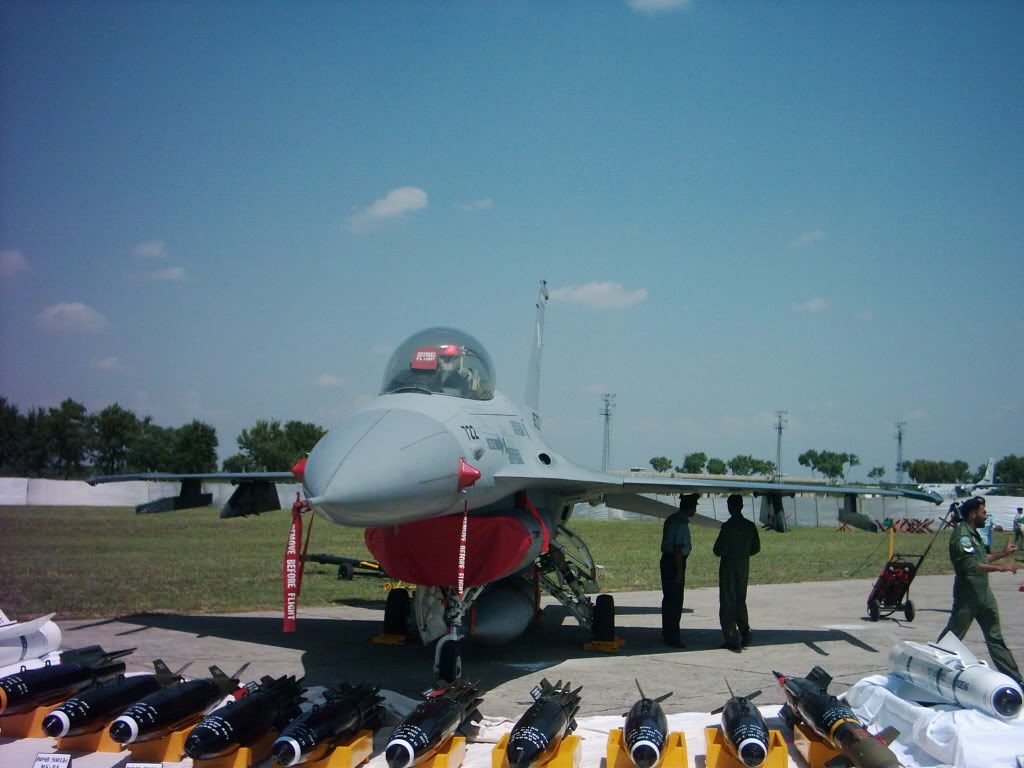
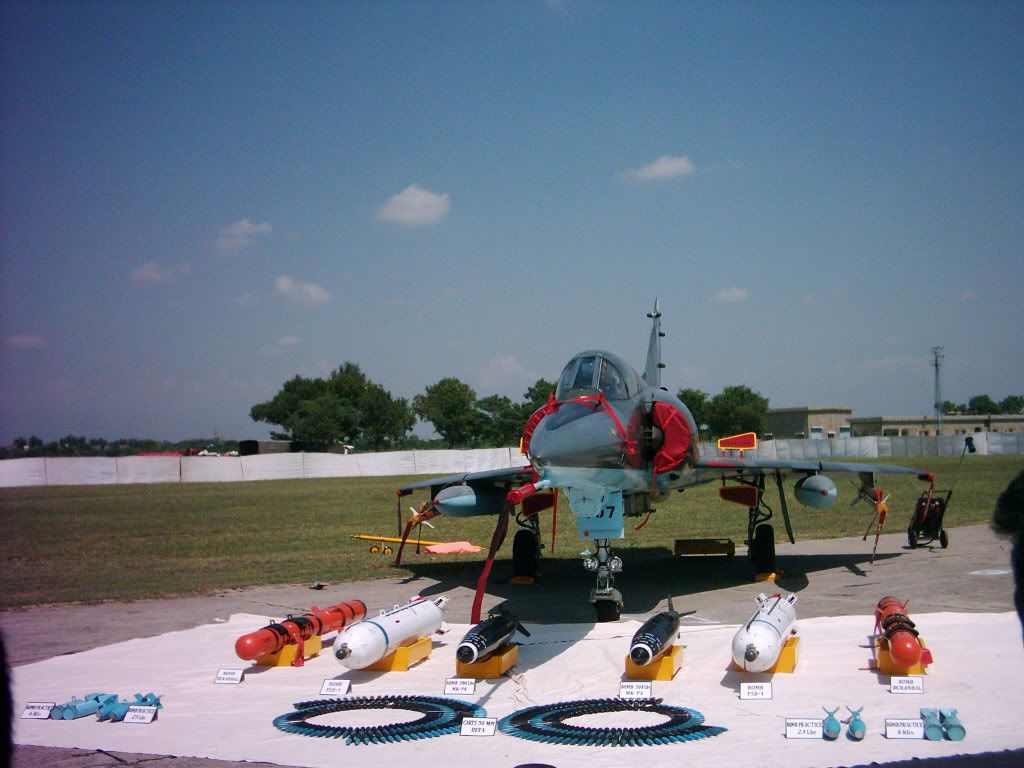
packardMore military aviation related images from Pakistani Defence Day celebrations.
Courtesy : Kamran from http://www.pakdef.info forums.
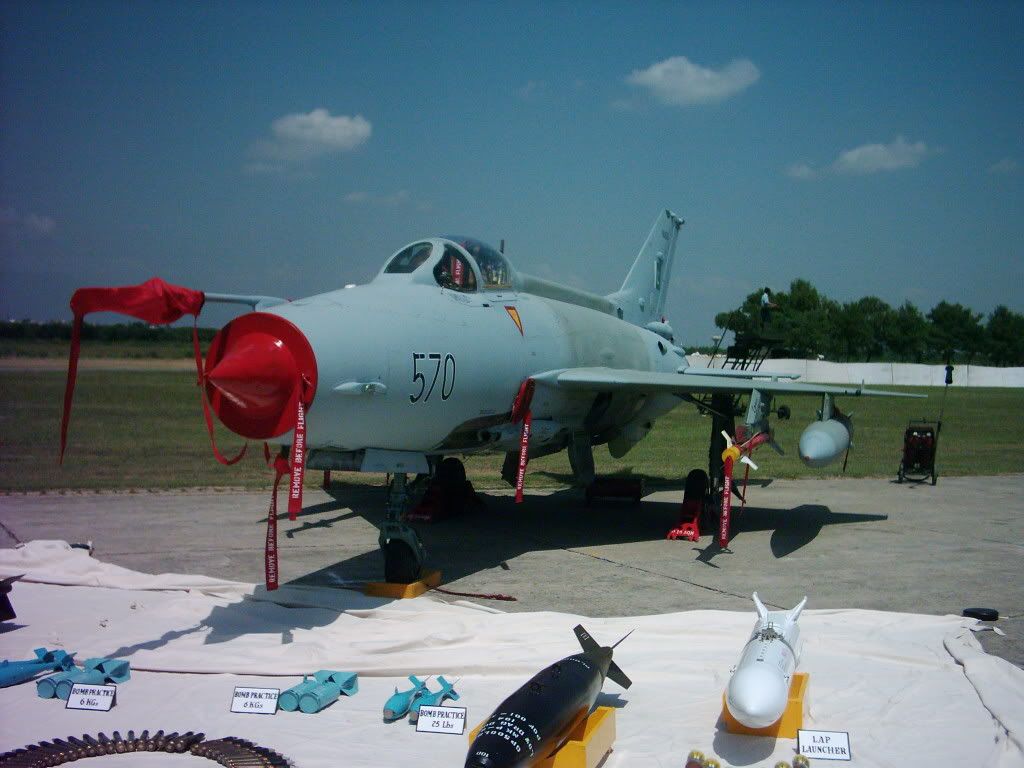
]
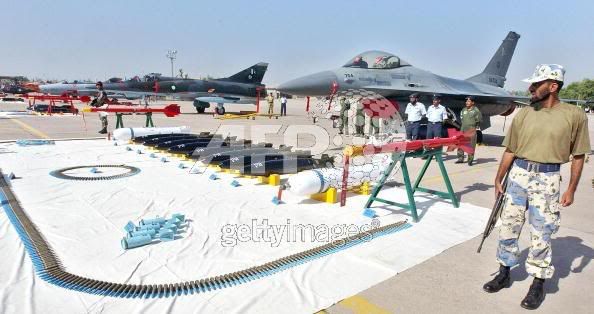
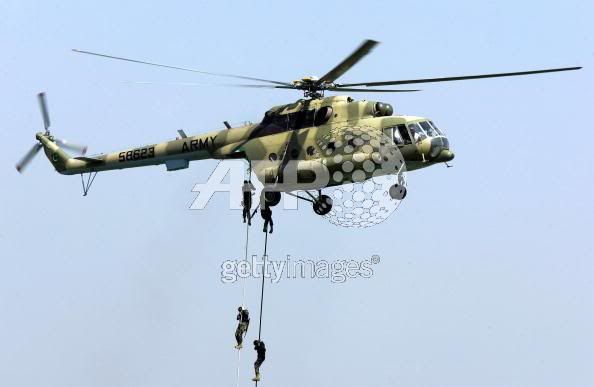
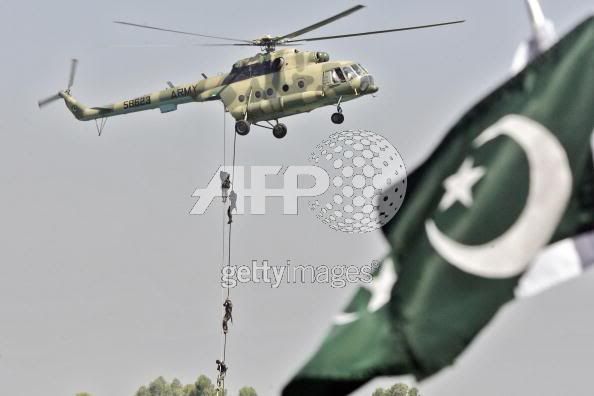
packardA few military aviation related images from Pakistan’s Defence Day Celebrations (6th September). Enjoy.
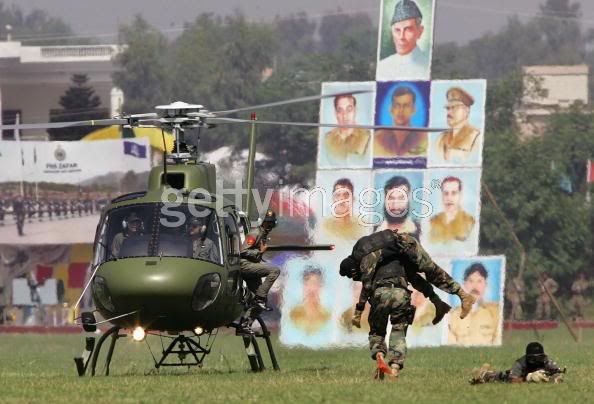
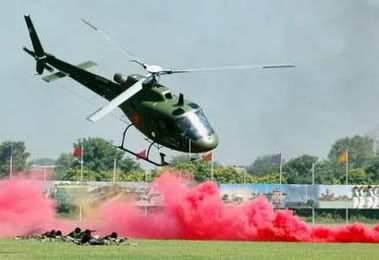
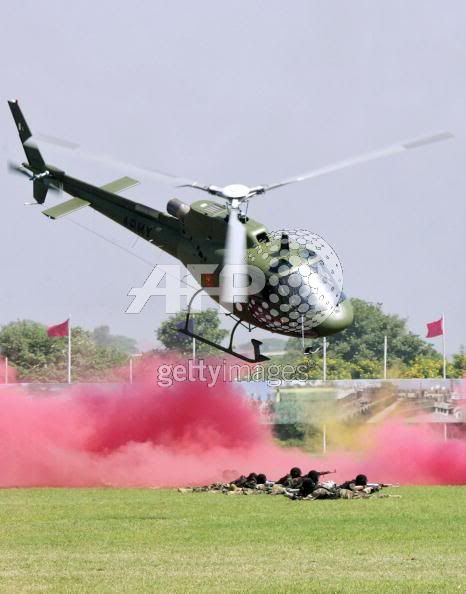
packardMaybe if they spent less time spewing hate, spreading violence, subjugating women, cutting of peoples limbs etc etc .
Too much Fox News/CNN i guess.
packardFunny, on how Pakistan could be close to both Iran and the US? :rolleyes:
Yeah i’m luvin’ it. We are so close to Iran that the Iranians almost launched the Saegeh when Pakistan celebrates Defence Day. 😀
Can’t wait for the specs of this one. I don’t think it uses two RD-33’s, they would be too big for an aircraft of this size. Especially two !
packardHow is the relation between Iran and Pakistan? Does Pakistan regard Iran as a threat?
Cheers,
Sunho
Pakistan and Iran have always enjoyed brotherly relations. From the time of the Shah uptil today.
There was some rivalry on the Northern Alliance/Taleban influence issues in Afghanistan. Nothing great.
They have trained together, various defence exercises, conducted operations together (balochistan with Iranian AH-1 support) and still co-operate in defence, Simorgh (the twin seat F-5 conversion) is an example.
Did I mention nuclear co-operation ? :diablo: (but thats history 🙂 )
packardLooks like they went for a significantly larger nose.
Nope. Its the same as ur normal single seater F-5.
packardHail mother Russia.
packardWhat’s your source for this?
This Indian report puts the number to 28 and mentions that some deliveries will take place in 2006.
“As for the new additions to the fleet planned for next two years, some 119 planes including 77 F-16s and six C-130 transport planes from the United States, eight Chinese-made JF-17s and 28 Karakoram-8 trainer jets will become part of the PAF fleet.
Pakistani and Chinese experts have jointly produced both JF-17 and Karakoram-8 planes. Eight JF-17s are to join the PAF fleet by March 2007 followed by commencement of serial production of the planes in Pakistan. Delivery of the K-8 planes is set to commence from the early next year.”
http://news.webindia123.com/news/showdetails.asp?id=115123&cat=Asia


 Sign In







