Wanshan
2nd DongDiao Class
The 2nd DongDiao class AGM/AGI was launched on December 10th, 2009 in Shanghai. It was designed by the No 708 design institute, the same institute that designed the YuanWang class space tracking ships, and constructed by the Shipyard 424 of the Hudong-Zhonghua Shipbuilding Group.
This 4600 ton (6000 ton maximum capacity) intelligence gathering ship is based on the smaller Daxin class training ship but instead of classrooms, it is packed with radars and other EW equipment. The first Dongdiao (851) class was launched in 1999 and commissioned by the East Sea Fleet. It is equipped with a pair of SEMT-Pielstick diesels to give it a top speed of 20 knots, and 5000nm range.
Unknown equipment is housed inside the radomes in both Dengdiao ships, but Hudong-Zhonghua labels them as “High Tech Radio Signals Gather-and-Process” ships.
The First Dongdiao Class (851)http://china-defense.blogspot.com/2009/12/2nd-dongdiao-class.html
Unlike in the first ship, the radome over the bridge appears the same as that on board Type 051C, 052B/C and Type 054/A.
WanshanVisby Corvettes Bunkers At Sea
(Issued in Swedish only; unofficial translation by defense-aerospace.com)
The delivery of the first two Visby corvettes to the Armed Forces is now very close. One of the final tests before delivery is the RAS (Replenishment At Sea), to fill up fuel from another ship at sea.
“Being able to get fuel from a support ship at sea makes the corvettes may no longer endurance at sea, thus avoid time-consuming movements to and from the quay,” says Patrik Norberg who is the commanding officer of HMS Härnösand.
If the ships are far from the port, such as during operation in the Gulf of Aden, the RAS capability becomes very important. A recent example was the support ship HMS Visborg, who took on fuel in the Stockholm area.
The bunkering will not necessarily come from a Swedish support vessel, so procedures and equipment are the same whether the refueling is done by support vessels of other nations.
The refueling ship drags a hose behind her, which is taken on board by the corvette, and when everything is connected and clear the fuel is pumped over. Should a leak occur, the transfer is immediately stopped.
What is special about the Visby corvettes is the way their foredeck is built. The crew is inside the hull, and must recover the floating hose by hand. Management becomes a bit harder, but on the other hand, it is weather-protected, which is a major benefit for staff.
The tests were incredibly smooth, we had prepared ourselves carefully and everything went as planned, “concludes Patrik Norberg.
On December 16, HMS Helsingborg and HMS Härnösand will be handed over to the Armed Forces. Bothe are in the so-called Version 4. In parallel, ongoing development of three Visby corvettes will upgrade them to Version 5, which will also have the ability to operate anti-ship missiles.The corvettes Helsingborg and Härnösand in their current configuration are able to carry out many different missions, of which security in Gulf of Aden is just one example.
During the next year they will have a busy training schedule with the goal to be ready for action both at home and abroad in October 2010.
Construction began in 1996 at Kockums’ Kalrskrona yard.
- The Visby (K31) was launched in June 2000 and was delivered to the FMV (the Swedish Defence Materiel Administration) in June 2002 for fitting with weapons and combat systems.
- The second, HMS Helsingborg (K32), was launched in June 2003 and delivered in April 2006.
- Harnosand (K33) was launched in December 2004. HMS Visby and Harnosand were officially delivered to the FMV in June 2006.
The other hulls are:
- Nykoping (K34), launched in August 2005 and delivered in September 2006, and
- Karlstad (K35), launched in August 2006.
The vessels are undergoing operational sea trials before commissioning in 2009. The Swedish Navy has cancelled an option on a sixth vessel (Uddevalla K36).
http://www.naval-technology.com/projects/visby/
If they are (still) to be deliverd in 2009, it will be a close call end of December….
WanshanPak developing indigenous version of F-22P frigate
Islamabad: Pakistan will start building the first indigenous version of the F-22P frigate, being developed with Chinese technology assistance, at a shipyard in Karachi.
Work on the warship will begin at Karachi Shipyard and Engineering Works tomorrow, said a statement from the navy.
Pakistan received the first of three F-22P frigates ordered from China in September.
The vessel to be built in Karachi will be the fourth of a series of frigates being constructed in collaboration with China under a transfer of technology agreement.
The statement described the indigenous construction of a frigate as “another significant milestone towards self-reliance in defence production”.
The frigates are armed with ship-to-ship and ship-to-air missiles.
Pakistan is expected to receive the two other vessels ordered from China by the end of 2010.
China will also supply four to six Harbin Z9EC anti-submarine warfare helicopters to be used with these frigates.
http://www.zeenews.com/news586068.html
First (licenced) domestically built F22P or indigenous development of F22P? IIRC the deal was the former. And it would make (more) sense fo first build a copy before starting work on indigenously designing and then building an F22p variant.
WanshanOk , just for arguement sake, they manage to kill 2 carrier groups.
Which carriers would they lose and what would happen to them? Would they be willing to sell one? Would any one be willing to buy one?
If the answer to any of that is yes and yes i know its like a 17,000,000 to 1 chance but the only people I can think who could manage it is the French. Although they dont have the money.
What would happen?
The hulls would be put in USN Naval Reserve and/or long term storage (Naval Inactive Ship Maintenance Facility). USS John F. Kennedy (CV-67) e.g. is kept in Philadelphia. The Naval Inactive Ship Maintenance Facility at Puget Sound Naval Shipyard, located next to Bremerton, Washington hosts, among its other ships, three aircraft carriers: USS Ranger, USS Independence, USS Constellation. The decommissioned aircraft carriers USS Forrestal and USS Saratoga are berthed pierside at the Newport naval complex. USS America (CV-66) was sunk as training and battle damage evaluation target 14 May 2005.
See:
http://en.wikipedia.org/wiki/United_States_Navy_reserve_fleets
http://en.wikipedia.org/wiki/Naval_Inactive_Ship_Maintenance_Facility
Would they be willing to sell?
No, not a single decommed supercarrier has found its way into another navy. Particularly unlikely considering nuclear propulsion of those to be decommed.
The French?
They’ld rather build something at home, I suspect (employment)
WanshanAny idea about weapons fit on Vikramaditya ? off course apart from the aircrafts and helicopters..:p
I expect little else than either a set of BARAK-1 vl-sam or a couple of Kashtan for self defense.
Wanshan!!!
please add little bit from you as well. 🙂
I did! Right after each quote. 😀
WanshanOld Warships Never Die, They Just Fade Away
December 4, 2009: The Russian public is becoming aware of the fact that they won’t have much of a navy in 5-10 years. The problem is that, in that period, most of the Cold War era warships that now comprise the fleet, will have to be retired. These ships are falling apart, as there was not any money, since the Soviet Union dissolved in 1991, for repairs and upgrades. The Russian parliament is calling for more money, to build enough surface ships to maintain a respectable fleet. That is proving difficult. Then there’s the problem that most of Russians warship building capability has disappeared since 1991. To that end. the government is negotiating with France to buy the right to buy a Mistral amphibious assault ship/helicopter carrier, and the right to built three more in Russian shipyards. During that process, Russian shipbuilders will learn how it’s done in the West.
For the last seventeen years, most of the Russian construction effort went into finishing a few subs, and building some surface ships for export. Currently building are three SSBNs (the new Borei class, one of which recently entered service), one new SSN (attack sub, that has been building for 15 years now and was recently finished), and one new Amur conventional sub, with two more building. There is a new class of 4,500 ton frigates (the Gorshkov class), but only one is under construction and won’t be finished for another two years. The Gorshkov’s have a 130mm gun, plus anti-ship and anti-aircraft missiles. The navy wants at least a dozen of these 4,500 ton ships, but the money has not been provided yet.
There is one Stereguschyy class corvette in service, with three more building. These are small ships (2,100 tons displacement), costing about $125 million each. These “Project 20380” ships have impressive armament (two 30mm anti-missile cannon, one 100mm cannon, eight anti-ship missiles, six anti-submarine missiles, two eight cell anti-missile missile launchers). There is a helicopter platform, but the ship is not designed to carry one regularly. Crew size, of one hundred officers and sailors, is achieved by a large degree of automation. The ship also carries air search and navigation radars. It can cruise 6,500 kilometers on one load of fuel. Normally, the ship would stay out 7-10 days at a time, unless it received replenishment at sea. Like the American LCS, the Russian ship is meant for coastal operations. The navy wants at least fifty of them. There is also an amphibious ship under construction, and lots of talk about aircraft carriers. But until money is allocated, and construction starts, it’s all just talk.
Meanwhile, the fleet is a collection of aging Cold War ships. This includes about a dozen SSBNs, two dozen SSNs (nuclear attack subs) and about fifty diesel-electric boats. There’s one aircraft carrier, five cruisers, 17 destroyers, eleven frigates and about fifty corvettes. There are about twenty amphibious ships still in service. All these Cold War era ships suffered from years of neglect during the 1990s, and most are not in the best of shape. In ten years, all of them will be gone. The new fleet, even if construction picks up, will be much smaller. The Russian fleet will go from 170 ships and subs now, to less than a third of that. This is not popular with most Russians, but the money, capability and will is not there to do much more.
http://www.strategypage.com/htmw/htsurf/articles/20091204.aspx
This is a poor article
– forgets to mention USSR navy was bloated to begin with
– forgets to mention additional Neustrashimy class ship delivered
– forgets to mention new frigates under construction (project 22350)
– gives a totally rediculous description of project 20380 ships
two 30mm anti-missile cannon > Kashtan: 2 30mm gatlings + 32 SAM
six anti-submarine missiles > not present
two eight cell anti-missile missile launchers > not present
“There is a helicopter platform, but the ship is not designed to carry one regularly.” > hence the heli deck and hangar?
kill stratpage!
WanshanThey took 12 years to deliver the first frigate! By late 1997, govt approved both P-17 and Talwar class frigates. Now where is Talwar and where is Shivalik! I know that they had to build many facilities but still there was no sign of interest to deliver them fast.
“Project 17 was conceptualised by the Indian Navy to design and build stealth frigates in India.
In 1997, the Indian Government approved the order for three frigates. In February 1998, regarding the same order, a letter of intent was released to the shipbuilders Mazagon Dock Limited (MDL). In 1999, the Indian Navy placed an order for three frigates under Project 17. Production began in 2000 due to the delays of design inputs for weapons suite by the Naval Design Bureau (NDB), changes in the hull steel specifications, and delivery delay of high-strength D-40S steel from Russia. Construction of the first frigate began in December 2000. In July 2001, the keel of this frigate was laid, and it was launched and named Shivalik in April 2003. In February 2009, the frigate underwent sea trials and it is expected to be commissioned in November 2009.
The keel of the second frigate, Satpura, was laid in 2002 and launched in 2004. It is expected to face sea trials in 2009 and be commissioned in 2010. Third frigate Sahyadri’s keel was laid in 2003, then launched in 2005. It will face sea trials in 2010 and is expected to be launched in 2011.”
http://www.naval-technology.com/projects/shivalik-class-friga/
Production start ?/2000
Construction start 12/2000
Commissioned 11/2009
9 years from production start to commissioning
By comparision:
“The German Navy started to plan a successor for the F122 Bremen Class frigates in 1997.
The concept of the replacement frigates was originally as a multi-role combatant but, by 2005 the requirement for the F125 was based on a capability to counter asymmetric threats and perform stabilisation operations with lethal and non-lethal intervention.
In June 2007, ThyssenKrupp announced the Arge F125 consortium had been contracted by the Federal Office for Defence Technology and Procurement (BWB) for four F125 frigates.
Construction is expected to start in 2011 and delivery of the first of class F125 is scheduled for 2014.”
http://www.naval-technology.com/projects/f125-frigate/
construction (not production!) start 2011
delivery (not commissioning!) 2014
> about 6 years from production start to commisioning
“The UK withdrew from participation in the tri-national Project Horizon / common new-generation frigate (CNGF) programme for the UK, France and Italy, and the project was terminated in October 1999. Production of the first-of-class ship, HMS Daring (D32), was begun in March 2003 and it was launched on 1 February 2006 at Scotstoun. It began first stage sea trials in July 2007 which concluded in August 2007. The five-week second stage sea trials commenced in April 2008, focusing on weapon systems, radar and endurance trials and the vessel completed contractor’s trials in September 2008. Daring was formally handed over to the UK Ministry of Defence in December 2008 and the vessel the vessel arrived at her home port of Portsmouth in January 2009 for further trials prior to commissioning in summer 2009.”
http://www.naval-technology.com/projects/horizon/
production start 3/2003
commissioning 8/2009
6,5 years
(if looking at development, count in all the years ‘wasted’ on Horizon project)
WanshanWanshan you probably didn’t read my earlier post:
Indeed, I was more or less adding/correcting my previous post (hadn’t time to go through the entire conversation, sorry)
WanshanI am intrigued as to why the Juan Carlos and the Canberra’s have the step in their flight deck aft. I can see it is large enough to be used as a landing pad, but given that the ships are due to use the Harrier (on the J. C.) and ultimately the F-35b on all that a full length flight deck would be advisable?
Note that the USN Sea Control Ship (a.k.a Spain’s Principe d’Asturias) also has this step and this ship was designed with the Harrier in mind.
WanshanBecause they got used to protect bases in Iraq and Stan.
Oh really? Can that be documented?
WanshanGoogle on-line translate:
Chilean Navy will build LPD
The Chilean Navy plans to build an amphibious assault ship LPD-type with 9,000 tons displacement and capacity to transport up to 500 Marines, more equipment and armored vehicles.
The ship is part of the plan for modernization and expansion of the Chilean Armed Forces. He would be the largest ever built in shipyards Chileans and is intended to serve as a support vessel for all types of naval operations, including support for natural disasters.
The Chilean project seems to be based on the Dutch concept “Enforcer” LPD 8000.
http://www.naval.com.br/blog/2009/11/03/marinha-chilena-vai-construir-lpd/
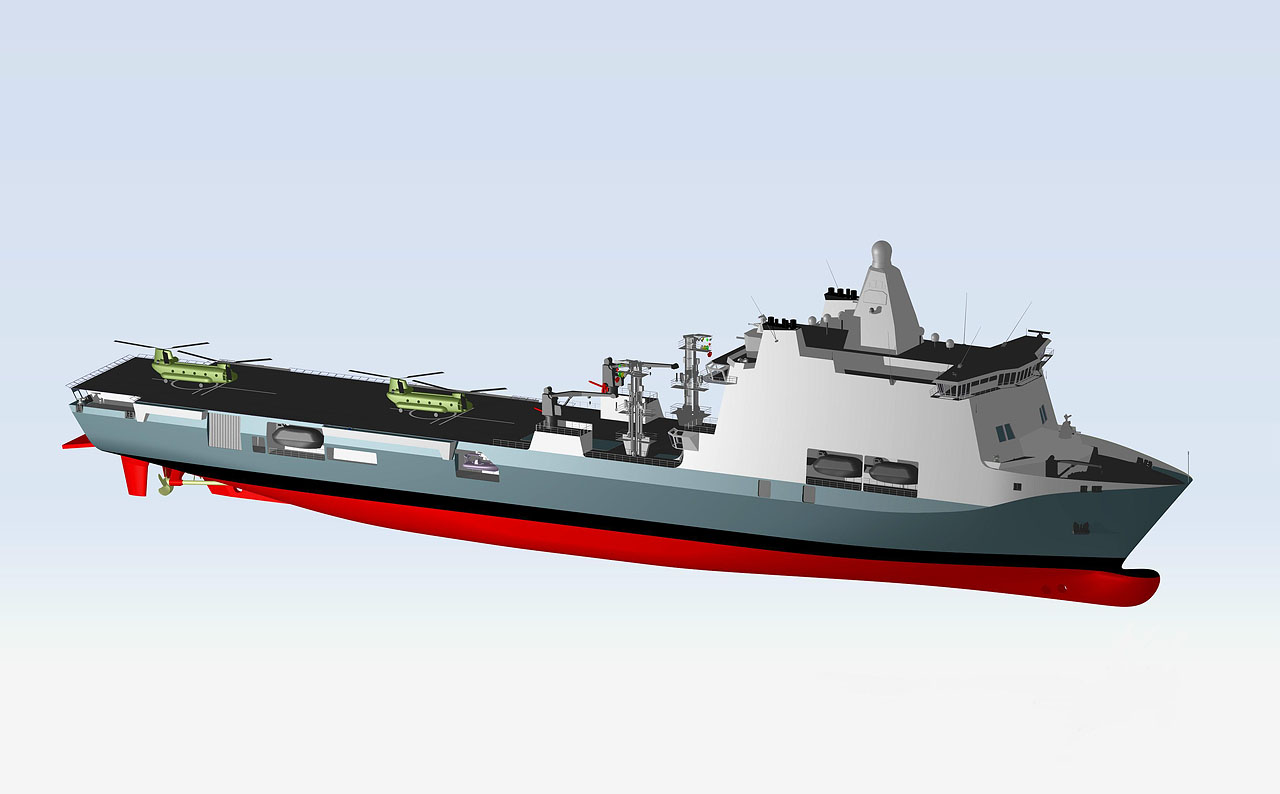
For comparison: The future OPV (Holland klasse) and the JSS (Joint Support Ship) of the Royal Netherlands Navy. I.e. it doesn’t look like the Chileans re getting an Enforcer family LPD but a JSS (an AOR, which has the ability to house/support 6 large helicopters and which can serve as a transport of heavy military equipment. It can load-unload unassisted but has no docking well. It has 2 spots for Chinook size helicopters)

Wanshana grand-scale removal of ocean-going warships from service with the Russian Navy by 2015
Might be referring to unmodernized Krivak I/II ships which date from the 1970s and/or early Grisha and Parchim ships (though these are littoral ships, corvettes).
WanshanYes, CNS Almirante Williams (FF-19) (ex-HMS Sheffield), a batch 2 ship.
She was decommissioned from the RN on 5 November 2002, and commissioned in the Armada de Chile on 4 September 2003.
She began a refit in March 2008, in ASMAR Talcahuano for installation of OTO 76 mm gun, Harpoon anti-ship missile and Barak SAM instead of Sea Wolf for defence.
She just recently was returned to service,conducting her post-refit trials last month, so she was unavailable for the photo shoot Tango III posted from.
There are pics & discussion (in Spanish) here: http://base.mforos.com/730111/3280645-fragata-tipo-22-2-ff-19-almirante-williams/?pag=23
Page 23 & all of page 24.
Interesting. Looks like they lifted complete modules with radar or missile launchers of the old County class ships that were refitted with Barak.

WanshanMore pics of both ships here: http://www.militaryphotos.net/forums/showthread.php?t=99988&page=1758


 Sign In