 Wanshan
As a side note, the Iraqi FACs were armed with MANPADs too. Only one SA-N-5 was able to be launched, and the Lynx evaded the missile.
SA-N-5 = SA-7 GRAIL (9K32M Strela-2).
A first generation manpads missile, dating from 1968, and limited in range (3.6-4.2km), speed (430-500 m/s = mach 1.4-1.75), as well as altitude (1,500-2,300m). It’s a tail-chase missile system with an IR-seeker, and its effectiveness depends on its ability to lock onto the heat source of low-flying fixed- and rotary-wing aircraft targets.
Sea Skua range is 2-25 km
WanshanA very poor example. There were a relatively small number of FACs, with a large enemy fleet offshore, no air support whatsoever, pretty much dead if they switched on radars, being hunted by helicopters with massive backup.
Frankly, I find this debate weird. There are so many assumptions being made, so little recognition of particular circumstances.
FACs are a complete waste of money in some circumstances.
FACs have been very effective weapons in some circumstances.
It is being argued here that against a superior blue water fleet with high-quality ISR assets & command of the air, FACs are useless. Well, what a surprise! The big navy can beat the smaller one!
What about against an equivalent force? What if the enemy does not have excellent ISR, or complete command of the air?
Well, what examples are there of FAC v. FAC battles in ‘recent times’, let’s say, since 1960 or so.
WanshanFull-scale mockup of the two-seater J-10S. Note nose and tail.
WanshanTo get into a fight with, and overmatch, the Syrian and Egyptian fast missile boat flotilla’s. Essentially refight Latakia better.
Most definitely not the same brief as the US has set for LCS. LCS is pure asymmetric threat and more optimised for battlespace monitoring/preparation in an entirely different threat scenario. If, through offboard assets, it detects a small flotilla of FAC(M)’s inbound it will be running from them at the rush screaming rape whilst trying to get an MQ-8/MH-60 to pot a couple with APKWS/Hellfire or at least guide in a Harpoon strike from the attendant fleet unit over the horizon.
We were talking AAW capabilities. They put un 2×32 cells for Barak, with a 10km range, to fight missile boats? Apparently, they saw no need for something more long range. Of course, the prospective Israeli version of LCS-1 would carry the long range Barak that is under development.
WanshanAs I see it, the only way to mitigate this deficiency is to dedicate more CAPs over the area the LCS is operating while the CSG is held back.
Same difference: CAP is part of group AAW
WanshanThe Flyvefisk is a 320 ton patrol boat, not 3000 tons like LCS. Hardly similar. Saar 5 is bigger, but still only 40% of the tonnage of LCS – and you say it “isn’t much better armed than LCS in terms of self-defence against air threats”.
The problem with comparing LCS with other vessels is that there’s nothing similar. It’s the size of a 1960s frigate, but with a very different role, & the speed of a FAC.
I kn ow what they are. The comparison is the threat, and the defence against it, not the hull. Why do you think the Israeli’s came up with the SAAR 5 in the first place?
WanshanIs everybody trying to look daft all of a sudden? Where did I say the LCS had no hard kill defenses? I said it didn’t have sufficient hard kill defenses.
The LCS program was announced on November 1, 2001, when the Navy stated that it was launching a Future Surface Combatant Program aimed at acquiring a family of next-generation surface combatants. This new family of surface combatants, the Navy stated, would include three new classes of ships:
1. a destroyer called the DD(X) — later redesignated the DDG-1000
— for the precision long-range strike and naval gunfire mission,
2. a cruiser called the CG(X) for the air defense and ballistic missile
mission, and
3. a smaller combatant called the Littoral Combat Ship (LCS) to
counter submarines, small surface attack craft, and mines in heavily
contested littoral (near-shore) areas.
…
The LCS’s primary intended missions are shallow-water antisubmarine warfare,
mine countermeasures, countering small boats, and intelligence, surveillance, and reconnaissance (ISR). Secondary intended missions include homeland defense, maritime intercept operations, and support of special operations forces.
http://www.fas.org/sgp/crs/weapons/RL33741.pdf
What makes you think combat ops with e.g. MILGEM in the Med would be any less demanding than US would typically face with LCS? Some would argue:
a) stealthy design is harder to detect/lock
b) layered defense including both soft kill systems (e.g. 3x SRBOC or Terma SKWS soft-kill weapon system) and hard kill weapons (Bofors 57mm Mk3, RAM)
c) backed up by group AAW
Initially the Aegis had a Standard Missile that potentially could provide air defense for an area that was on the order of 25-plus miles. The Aegis, with the newer generation Standard Missile, can provide air defense for an area that has a radius of on the order of 75-plus miles. And the Aegis of the future and DD(X) with ERAM, the new missile, is going to defend an area that has a radius well over a hundred miles.
Which ships with simular roles are better armed? Note that while it has more missiles (32 usually, as the rear VLU is no longer used due to topweight problems), the Israel’s SAAR V for example isn’t much better armed than LCS in terms of self-defence against air threats. Stanflex 300 (Flyvefisken) has ESSM but in limited number and with just a single illuminator, which under some conditions has to be shared with the 76mm gun.
WanshanAny pic’s available of the design?
Images courtesey of Talwar on http://www.china-defense.com
Wanshan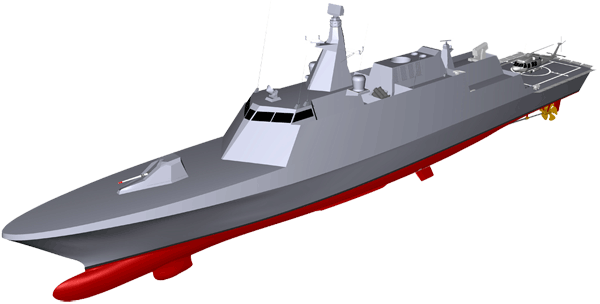
So eg this here cannot defend itself since it has no ESSM?
WanshanPerrys didn’t have tails at first, which limited their blue water capabilities and is why the upgrade program was instituted to fit them with it. Even those that never got tails still had the SM-1 at least, which provided for a limited area protection capability to give them a blue water/convoy protection capability. And the Knoxes which didn’t have VDS still have the long(ish) ranged SQS-26 LF sonar, whereas the LCS only has a tiny HF mine-avoidance set. Essentially, whatever blue water capabilities the LCS has are minimal and pure happenstance. Just look at the ASW module and where the sensors are located. RMMV, USV and SH-60. Only the SH-60 is applicable in the blue water environment. Like it or not, the LCS was built to be able to transit the blue water envoronment, not fight in it.
ESSM has similar range to SM1 on Perrys. How hard would it be to devise an AAW mission module? One could model on the STANFLEX ESSM container with 6 missile canisters. With twin packing, a single such container gives 12 ESSM. Two 24 ft standard ISO containers, each 1 with set of ESSM canisters and a STIR and you’re halfway in business. You’ld need a suitable containerized search radar as well.
What does it matter is LCS is not immanently suitable for blue water ops? It is part of a group! I’m sure carrier and DDG51 can handle threats in the oceanic spectrum. SO long as it has a reasonable self defense capability and is not a burden on the group it is part of, who cares? Likewise LCS will be in its element in the littoral zone, where the rest of the group is rather helpless apparently (don’t hear anybody complaining about that).
WanshanThat hinges entirely on the fact that the LCS would be the replacement for the FFG-7’s though. Which they aren’t.
The LCS job is purely littoral and, as such, is solely the MCM/coastal role that, as you say, they do not have any assets to service right now.
Stanflex is a way to get too few hulls service a bigger requirement. That is simply not the scenario with LCS if it goes to plan!.
So, what’s the deal with FFG7 replacement then. They aren’t going to be around forever, most currently operating were built 1979-1989 and that coupled with a service life of 30 (35) years means retirement in the period 2009-2019 (2014-2024). No fewer than 9 FFG7s are scheduled to retire in the period 2009-2013 already.
WanshanI’d argue that to say that the idea of the Stanflex is to swap and change as necessary, but, that the LCS concept is that modules can be changed if necessary.
Lets not forget that if the 55 hull order goes through there is little need to re-role a hull when there is always another to deploy. In the Stanflex case this is obviously different as there are a modest number of hulls that the different modules are necessary to get maximum utilisation out of.
The point about there being 1.xx modules per hull with LCS is that once fitted, save for windows when the hull is in for deep refit etc, the module will stay with that specific ship. Really you want this anyway as it means you get a nice specialised crew driving a specialist hull. Its not ‘fashionable’ but by crikey its the absolute best way to deploy a capability to theatre.
I’ld say “when necessary” i.e. depending on the threat situation. True, there will be 55 platforms. These will have to complement then replace 51 Perry’s, the newest of which are from 1989 and so most will likely have payed off by 2019 (which is what the FFG 7 Modernization Program aimed at: extending the lifespan of this hull class through 2019). USN has no dedicated MCM ships and no coastal combattants such as FACs. So, essentially the LCS pick up those roles as well, which the Perry could never do. In that sense, the situation if perfectly comparable with Stanflex: Flyvevisken class e.g. replaced the capability represented by several existing classes of MCM and FAC, with fewer total hulls.
WanshanClassic LST Design………….didn’t know anybody still constructed such types. Yet, they must be economical and versatile…….
Greece: Jason class
China: Type 072-III (Yuting-II) class
South Korea: Kojoonbong (Alligator) class
WanshanAren’t they supposed to be exactly like Stanflex modules, as you mentioned previously? They’ve proved it can work.
The STANFLEX containers are manufactured in Denmark by Promecon (a subsidiary of Monberg & Thorsen). They are 3m in length, 3.5m in width, and 2.5m in height. Containers are craned into wells in each ship, with standard interface connections providing access to ship’s services (power, communications, ventilation, water, and data). Installation of a single container is typically accomplished in about 30 minutes, and depending upon the weapon/equipment being installed, system checks are generally complete with a few hours. If one or more container positions are left unoccupied, purpose-made hatch covers are fitted to seal the wells.
http://www.amiinter.com/samples/denmark/DA6001.html
Role switching take at most a day in the Danish case (though currently they have settled into fixed roles)
WanshanSeriously to anyone that thinks the Navy needs a tender to swap out modules on LCS while at sea. Do you really think this is some simple task that takes but a few hours to crane modules back and forth? I would suggest the process takes days pier side and then more time testing out the installation. This is not a trivial task and suggesting that spending billions to build a few tenders accomplishes nothing.
Well, actually, that is the idea of mission modules, that they CAN be swapped in hours rather than days and that they are plug and play.
Illustrative: A month in the life of LCS


 Sign In







