Wanshan
Is Project 20350 a 30 years old design? 😀 Just ridiculous
22350
WanshanNothing condescending at all…..perhaps you have a complex?:confused:
You’ve a degree in psychology now?
Designing ‘new’ ships on the basis of 30+ year old hulls is ot demonstrative of a healthy shipbuilding and design industry. Especially given the progress made by western shipbuilders.
Again, where did I say russian shiphbuilding and design industry is healthy. Don’t put words in my mouth, thank you.
You pointed out Talwar class is basically ‘just’ a modded Krivak III. Well, if you look closely at drawings of project 22350 and compare to Talwar class, you will also see the Krivak lineage in the 22350. That’s all I said.
WanshanFor all Project Protector ships, add a Sea Sprint naval ADATS mount. Gives the reach of a heavier-than-25mm caliber gun (10km), is also dual purpose (SAM/ATGW roles) but does weigh as much as e.g. 57mm or 76mm naval guns and also does not have deck penetration. Alternatively a 35mm Millenium mount. Incidentally, both ADATS fire unit an Millenium gun unit can function as part of Skyguard/Skyshield SHORADS systems.
http://www.new-factoria.ru/missile/wobb/skyshield/skyshield.shtml
http://www.global-defence.com/1998/Missiles/adats.htm
Incidentally, if the Typhoon gun mounts are used, there is the option of integrating 2.5-4km SPIKE (mini-typhoon) / 8km SPIKE-ER or various MANPADS (Typhoon) onto those very mounts.
http://www.eurospike.com/sea.html
WanshanYou can be assured that after nearly 20 years of low funding the skills level has already taken a beating. Dont assume that just becuase these yards are turning out fancy pictures that they are actually capable of producing them on schedule or that the designs are that advanced beyond some smoothing out of the hull and superstructure. The Talwar’s for instance are basically just a Krivak III hull. Skills and knowledge have to be developed and in Russia they have been frozen for nearly two decades. When I see a Russian design using Aesa radars, IEP, and built in super blocks then I will be impressed. At the moment bothing like that is on the drawing board.
Who’s assuming anything here?
As for Talwar being basically a Krivak III hull… DUH! … incidentally, project 22350 is also basically a Krivak III hull.
Too many condescending tones with you for no good reason….
WanshanIn December 2002, the Venezuelan Air Force signed a contract with Embraer for 12 AMX-T. However, the USA blocked the transfer of US-built components and the order was cancelled.
In August 2004, the Brazilian Air Force signed a contract with Embraer for a mid-life update of 53 single seat (designated A-1A) and two-seat (A-1B) aircraft. The programme failed to receive funding, but in August 2007, Embraer received the first of three prototype aircraft to be upgraded. Flight testing is due to begin in 2009 with first delivery in 2010. The upgrade includes three new multifunction colour displays, head-up display, night vision goggle compatibility and new communications and navigation suite. Elbit of Israel is the lead contractor.
In February 2005, the Italian Air Force selected Alenia Aeronautica to upgrade 55 AMX aircraft with new avionics, including INS/GPS navigation system, new communications systems and IFF (Interrogation Friend or Foe), new displays and the addition of a capability to deploy smart munitions such as the Boeing Joint Direct Attack Munition (JDAM). First flight of the upgraded aircraft was in September 2005 and the first upgraded aircraft was delivered in March 2007.
http://www.airforce-technology.com/projects/amx/
AMX-ATA
The AMX Advanced Trainer Attack (AMX-ATA) is a new AMX two-seater, multi-mission attack fighter for combat roles and advanced training. The AMX-ATA incorporates new sensors, a forward looking infrared, helmet-mounted display, a new multi-mode radar for anti-air and anti-ship capability, and new weapon systems including anti-ship missiles and medium-range missiles.
The Venezuelan Air Force ordered eight AMX-ATA in 1999 for the advanced trainer and attack aircraft role.
In December 2002, the Venezuelan Air Force signed a contract with Embraer for 12 AMX-T. However, the USA blocked the transfer of US-built components and the order was cancelled.
WanshanLooks better in pink!
Salmon!:rolleyes:
WanshanWhy would one replace OH-58A/C with UH-72A and OH-58D with ARH-70A?
WanshanIn 1966, SEPECAT (Société Européenne de Production de l’Avion d’École de Combat et d’Appui Tactique – the European company for the production of a combat trainer and tactical support aircraft) was formed as a joint venture between Bréguet—now Dassault Aviation—and the British Aircraft Corporation to produce the airframe, and a separate teaming of Rolls-Royce and Turboméca to develop the Adour afterburning turbofan engine. Though based in part on the Breguet Br.121, using the same basic configuration and an innovative French designed landing gear, the Jaguar as built also incorporated major elements designed by BAC – notably the wing and high lift devices.
http://en.wikipedia.org/wiki/SEPECAT_Jaguar
http://www.targetlock.org.uk/jaguar/
The baseline for the Jaguar was the Breguet “Br.121”, an unflown design for a light strike aircraft that was a follow-on to the Breguet “Br.1001 Taon (Horsefly)”. The Taon had been built for a NATO requirement (the name was in fact an anagram of “NATO”), with two prototypes built, the first performing its initial flight on 25 July 1957. It had a span of 6.8 meters (22 feet 4 inches), a length of 11.68 meters (38 feet 4 inches), and an empty weight of 3,425 kilograms (7,550 pounds). The prototype was powered by a Bristol Orpheus BOr.3 turbojet with 21.6 kN (2,200 kgp / 4,850 lbf) thrust and was marginally supersonic. The NATO requirement had actually been won by the Fiat G.91 fighter, and the Taon never went into production.
http://www.vectorsite.net/avjag.html
avions.legendaires.free.fr/taon.php
WanshanCreating computer images of smoothed out 1980’s designs is one thing. Designing and building a 21st century LPH/,PD to the latest construction methods is quite another.
Jane’s is reporting delays of up to two years in current Russian building programmes, the Gorshkov saga is laid out for all to see, so it is pretty obvious that the Russian shipbuilding industry is not in a good state.
– Where did I say all was hunky-dory with Russian shipbuilding?
– see post of 20th November 2008 12:03I about which military ship types out of Severnoye design bureau lately.
– no military surface ships larger than frigates (notably Talwar class) were actually built in recent years.
The point was about whether that design bureaus and yard are still capable i.e. whether knowledge and expertise is still around. What is designed/build under severel financial constraints may not be a good indicator of that. Just because there’s no money doesn’t mean there’s no skills or expertise (though these will in time decline in the absense of real naval ship building activity).
WanshanDear Members,
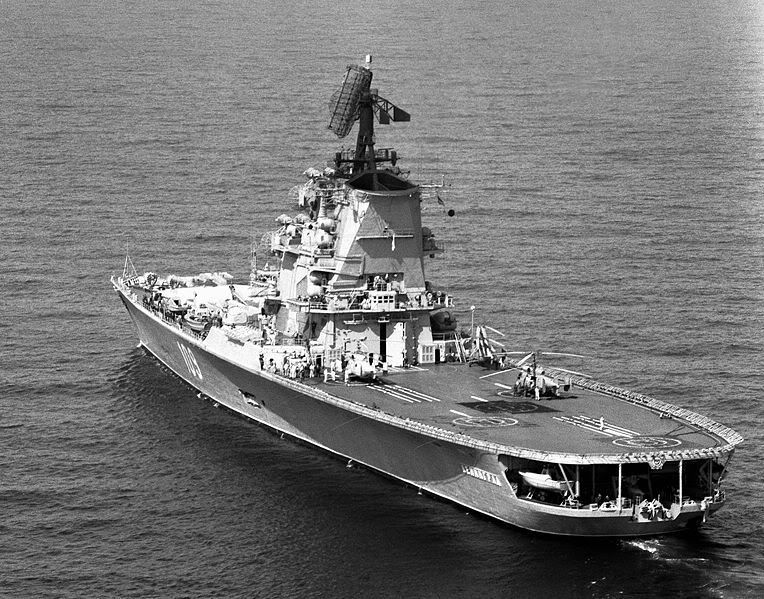
In the 1980s I always wondered why the USN did not have cruisers like the VITTORIO VENITO with the cruisers doing the air defense and helicopter ASW role for the larger conventional carriers. I discovered years later that while it looks like a great arrangement that is used by those two Italian cruisers, most of what I read stated it does not work to well on large warships (with a large deck on the stern and hanger space). One, the back part of the warship is where it is pitching up and down a lot and two it seems that the forward part creates winds and other type of air forces that cause landings to be a problem. The main reason that the Spruance class and Ticos have that landing deck located more near the middle of the ship.
The Russians took this type of design for a non amphibious helicopter carrier with the MOSKVA and they built only two, realizing the problem of the design and switching to the KIEV class. According to some Jane’s publications it was a bear to operate its helicopters unless the warship was going at a very slow speed due to the wind conditions its’ high super structure created across the flight deck in the rear.
Jack E. Hammond
.
Not to mention that the heavy weapons load out forward and the hangar in the rear made her trim by the bow.
http://www.defencetalk.com/forums/showthread.php?t=4392
WanshanJust because it’s a nice shot
WanshanExports were mainly relatively low-risk modifications of existing hulls (even that highly interesting destroyer you have posted seems to have inherited some Udaloy DNA).
Just some? 😀
Severnoye’s current portfolio has new small ship designs and revamped older large ship designs. But I agree about the difference in design and building.
WanshanWan,
I’ve stood inside the Schleswig-Holstein’s hangar. Was a decent sized hangar ok and the number of bikes they could fit up on a bulkhead was impressive, but, two Sea Kings would not be a sensible fit in the space. I have a recollection of thinking that it might be a bit tight with a couple of Lynxes in there?!.
Likewise I thought the twin Sea King capability on the Indian Brahmaputra’s was largely theoretical and that in practice it was one Sea King and an Alouette?.
Still I did say I couldnt think of a frigate that could embark two Sea Kings and the Indian ships can obviously do that to some extent. I stand corrected.:)
Yeah, I agree, the Brandenburg class is desgiend to embark Sea Lynxes only. You are right about the P16/P16As usually carrying only 1 Sea King plus 1 other, smaller helicopter (either Alouette III/Chetak or naval ALH/Dhruv), but afaik both hangars are equal size and these ships are designed to embark and operate 2 Sea Kings.
WanshanThey were all 30 or 40 years ago now though. The people that did the design work on them would be long retired, many of them would have long since died.
And they’ve closed schools and not trained anybody during those years? Like there is no shipbuilding going on (e.g. nuclear icebreakers, gas tankers)

http://spkb.air.spb.ru/en/news/publications/asian_def_february/
http://spkb.air.spb.ru/en/offers/warships/21956/

http://spkb.air.spb.ru/en/news/publications/asian_def_december/
WanshanMystery solved:
According to RP1, it might be a stretched Type 45 proposal for the early FSC requirement. Assuming the helicopter is an EH101, the drawing depicts a ship between 167 and 172 meters long. The size of the Sampson radome and RAM launcher would indicate a ship of this large size.
“Thanks Wan”
“You’re welcome”


 Sign In