Wanshan
Yeah baby! 😀
WanshanNow now, there there! This thread is for redesign-fun, not for really serious discussion. So, let’s not get carried away just because there are some different assessments and subsequently different redesigns. Do by all mean explain assumptions behind specific modifications.
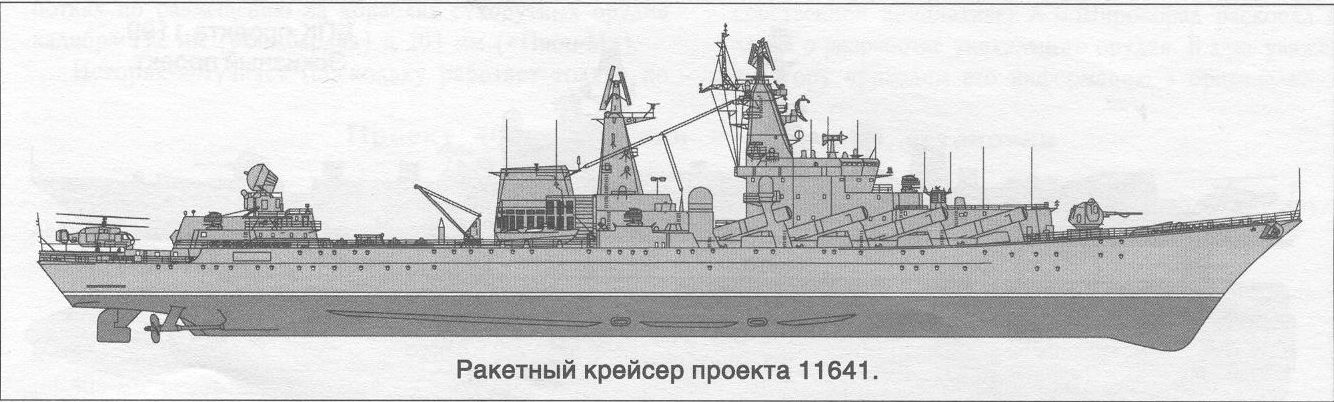
Wanshan16-24 Yakhont missiles is still a powerful antiship punch with minimal changes to the design and the benefit of freeing up of lots of useable deck space. Personally I might have been tempted down the Klub route in order to get the multirole capable VLS, but that could mean very significant changes in the hull down to 2deck. Still a 64 cell VLS capable of mission tailoring with competent AShM, LACM or ASW weapons, backed by the existing 64 tube area SAM fit would go a long way to maximising the usefulness of the hull.
Might work if the 8×8 VL area is tackled and S-400 in smaller 12 round VLUs put in.
WanshanI also agree with Gollevainen’s vision. As long-range killer, she should be armed with the P-1000. The replacement of the “Top Dome” by a “Tomb(Grave) Stone” (choose the most modern one) is a must. I also like to add the replacement of some SA-N-6 by 9M96M missiles on a 4 x 1 basis to lead to a sort of “naval S-400”.
An interesting option will be the replacement of 8 x P-500 by 8 x P-1000 and the remaining 8 x P-500 by 12 x P-800 Yakhont leading to a mixed configuration of 8 long range and 12 “short range” AShM. I don’t know if a mix with SA-N is possible but a high-lo 9M96M and 48N6DM ratio will also be nice in order to optimize reach/cost ratio.
Agree on the naval S-400. Though might this smaller missile not better fit in a VLU like that for VL-Shtil and then we’re talking replacement of the entire rear VLU farm!
This area might need modification anyway as I’m under the impression that those 8x 8-round launchers are in one large below deck ‘gallery’, with obvious damage- and fire-control risks. There would need to be some below decks compartimentalization there imho.
WanshanConcurred – very interesting. Initial thoughts would be for a bit more of a dramatic series of mods than Wan has put forward too.
Agree on removal of the P-500 tubes entirely. Yakhont seems the logical replacement and there is certainly space for inclined launchers in place of the forward couple of SSM launcher banks.
I’d want to shift the RBU’s to port and starboard of the bridge superstructure though – installed on raised deckhouses to handle the magazine space requirement. Every time I see those launchers in superfiring position over the bloody great SSM tubes it gives me a shudder just thinking of what a misfire might just touch off. Removing the 630 gatlings and FC set from the foredeck extension would also be an early change. Depressed firing arcs never seemed too clever from those positions.
Clearing the foredeck gives siting position, and reasonable arcs, for a forward TOMBSTONE director servicing the S-300 fit. I’d remove the reload crane and have port/starboard platforms built up for another TOMBSTONE on each beam just aft of the funnel group.
Aft TOP DOME would be removed and the aviation fit enhanced beam and hangar roofline mod should give addtional capacity. 2 Helix sized airframes should be absolute minimum on a hull this size.
Yes, additional hangar should be considered. Might even go take up some ideas from the old japanese DDHs there. Also like the idea of the removal of the crane (do they really need it? See example of the Mk41 3-cell strike-down crane: removed)
WanshanA BPC for the Russian navy ??
According to this http://www.ttu.fr/francais/Articles/bpcmistralrussie.html citing the “Russia Intelligence” letter, the Russian navy could buy the design of the BPC (LHD) Mistral and built it indigeneously.
Why would they need to buy such a design? If they can come up with vessels like Kiev class and Kuznetsov, like Ivan Rogov and Moskva classes, you would think they can cook up an LHA of their own.
WanshanMy choise would mostly follow in these lines:
Only change would be the Top Dome to be replaced with Tombstone.
For the main SSMs I would mostly go on with the P-1000 which was mented to replace the Bazalts in their associated launchers. Only reasonable option for P-1000 would be the Granit. Yakhont is completely different class missile than what is required here. The sheer size of this ship is useless unless it’s mented to carry heavy-range SSMs. The launchers for Granit are basicly just angled launcers beneath the decks so I quess it wouldn’t be hard to modify the missile to be launched from tubes of Bazalt/P-1000.
I’m curious about this drawing: what – if anything – is there forward of the RBUs? The AK-630s are obviously gone.
Another thought: if the RBU and AK630 forward were removed, could an additional 4 8-cell VLU’s be mounted there for RIF? (I’m obviously leaving more towards an AAW specialized vessel rather than a strike oriented vessel)
WanshanPretty much. And you’re welcome.
WanshanAlso, what is the difference between HUMSA and VDS? Which is better? In my notes, it states “HUMSA NG” as the new sonar.
So it seems they were talking of towed array sonars.
DRDO, BEL and the Indian Navy have developed and productionized a range of Sonars and related systems for the Navy’s frontline combat ships. These include the APSOH (Advanced Panoramic SOnar Hull mounted), HUMVAD (Hull Mounted Variable Depth sonar) and the HUMSA (follow on to the APSOH series; the acronym HUMSA stands for Hull Mounted Sonar Array) sonars, Nagan Towed Array Sonar, Panchendriya Submarine sonar and fire control system, sonobuoy Tadpole and its airborne signal processor Simhika. Other sonars such as the airborne sonar Mihir, are in trials, whilst work is proceeding apace on “New Generation” sonars. Sonars may be considered one of DRDO’s most successful achievements, with the work begun under the leadership of a young Naval officer decades back. Today, the Indian Navy’s most powerful ships rely on Indian made sonars. The standard fit for a frontline Naval ship would include the HUMSA-NG (New Generation) hull mounted sonar, a HUMVAD variable depth sonar and the Nagan towed array sonar. The Mihir, is a dunking sonar meant for use by the Naval ALH, working in conjunction with its Tadpole sonobuoy. The Panchendriya is in production for the Kilo class submarine upgrades. Some ships, such as the INS Beas field a mix of local (HUMSA and HUMVAD) and imported sonars (towed array), till the local towed array was developed. The Delhi class destroyer has the HUMSA and the HUMVAD
http://en.wikipedia.org/wiki/Defence_Research_%26_Development_Organization#Sonars
see also:
http://www.drdo.org/labs/npol/achieve.html
http://www.bel-india.com/index.aspx?q=§ionid=73
http://www.bel-india.com/index.aspx?q=§ionid=72
http://indiannavy.nic.in/t2t2e/trans2emins/21_indeginous_sonar.htm
http://frontierindia.net/national-symposium-on-towed-array-sonar-systems-at-npol
http://frontierindia.net/npol-hands-over-next-generation-sonar-design-for-india-navy-ships
http://trishulgroup.blogspot.com/2008/10/what-it-takes-to-wage-undersea-warfare.html
In the ocean there are layers of water of different temperature, which can interfere with sonar detection. As I understand it, a VDS is in essence a ‘regular’ ship sonar array mounted inside a separate tow vehicle a.k.a. ‘fish’ towed on a line behind a ship. The fish can be set to descend to different depths, this allowing the ship to search underneath layers of water it could otherwise could not search.
A towed array sonar is a sonar array is basically a long cable (up to 2000 m) with hydrophones that is trailed behind the ship when deployed. The hydrophones are placed at equal distance on the cable. This linear sonar too can be deployed in different thermal layers. The value of this type of array is that the signal processing techniques (beamforming, interferometry) can be used to calculate the distance and the direction of a sound source. For this, the relative position of the hydrophones need to be known, usually this is only guaranteed when the cable of the array forms a line.
Despite disadvantages, a linear towed array is useful as it offers better resolution and range compared to a hull mounted sonar (and VDS) and like VDS covers the baffles, the blind spot of hull mounted sonar.

http://www.arstech.de/sonar/active_towed_array_sonar.html
In the surface ship sonar’s, the indigenous development programme started in 1974 and up to now, 25 systems have been commissioned in Naval Ships. The sonar system is manufactured completely in India and only components are sourced form abroad. All sonar’s use transducers, which are also manufactured in India. Sonar’s under this category are of NPOL design. BEL has taken up the upgrade and reconfiguration of the original systems. Some of the sonar’s developed and supplied under this category are:
• Advanced Panoramic Sonar Hull Mounted (APSOH)
• Hull Mounted and Variable Depth Sonar (HUMVAD)
• Hull Mounted Sonar Advance (HUMSA)
• NAGAN
• Towed Torpedo Decoy (TOTED)With the experience of manufacturing these Sonar’s, BEL has developed expertise for high frequency, hull mounted, single array, dual array sonar’s. The special digital processing techniques for getting better range and bearing accuracy have also been acquired. Also, the digital beam forming technology has been deployed in these sonar’s. On the submarine Sonar’s, the indigenous development programme started in 1990s and up to now 5 systems has been manufactured and two are under evaluation in Indian submarines. The sonar systems is manufactured by BEL with designs from NPOL.
BEL has been working on airborne Sonar’s with designs from NPOL since 1990. The sonar’s under this category are:
• MIHIR – Light Weight Helicopter borne dipping sonar’s.
• SONOBUOYS – Air dropped passive non-directional radio sonobuoyOver the years, BEL has assimilated various technologies for different types of sonar’s and also established in-house facilities for testing and manufacture of these sonar’s. NPOL, Cochin is a technology partner for BEL for meeting most of the requirements
of Navy. However, in certain emergent cases, with new technologies, foreign collaboration is also resorted. BEL is trying to tie up with foreign collaborator for Towed Array Sonar’s for Submarines, Airborne sonar’s (LF version) and Mine hunting sonar’s.”
http://frontierindia.net/bharat-electronics-and-defence-production
WanshanMaybe Chinese fighters could be good alternative for Ukraine but, I believe this would be a too exotic solution for the Ukrainians. How much do the J-10 and JF-17 cost?
Off topic but, do you know that the old Soviet propaganda tabloid “Pravda” is still around? 😮 To fully understand the Russian posters here you need read Pravda´s articles about EU and NATO and USA. Believe me it´s so sick that it will make you laugh 😀 Not much seems to have changed since the Soviet Union. 🙁 Check it out at:
Reads like a tabloid, only worse :oP (not that I would know, since I don’t read tabloids …)
Wanshanfound a small pic of Ukraina
A whole bunch of images here
http://navsource.narod.ru/photos/02/172/index.html
It’s dirty and rusty but does appear to have most of its equipment fitted. Of course, that equipment today is mostly obsolete, irrespective of whether or not still functional after 10 years of laying idle.
WanshanThey should just buy some Chinese aircraft (J-10, or – better yet – J11B) :diablo:
WanshanI’ld check to see that each of these vessel is to have 2 sonar systems, a hull mounted one and a towed sonar. The Indian sonar they have in common is the hull mounted one (HUMSA). If that wasn’t installed, then Mumbai should still have a Thales ATAS (Advanced Towed Array Sonar) system and the Talwars should still have either a SSN-137 VDS (Variable Depth Sonar) or a French towed array sonar (TAS).
If HUMSA were the problem….the P16A Brahmaputra class are supposedly also fitted with these. (In addition, P16As would have a Thales – formerly Thomson Marconi – Sintra towed array sonar.) Why would only some ships not receive HUMSA while others did get them? Unless none got them, which would make to problem even bigger!
I would not be suprised it Talwar class was delivered by Russia without the HUMSA: this could be fitted later in India (if it didn’t want to compromise its equipment). Mumbai is a different issue, having been built in India.
WanshanThe latest CAG has put a question mark over the Naval fleet’s battle worthiness and says the warships were recently inducted into the Navy without Sonar capability.
This suggests that these mighty ships have little or no capability to detect submarines. The reference is to the three Talwar class stealth frigates and the guided-missile destroyer, INS Mumbai.
The reason for the lack of Sonars on these ships is a familiar one: the DRDO promised and then failed to deliver.
I’ld check to see that each of these vessel is to have 2 sonar systems, a hull mounted one and a towed sonar. The Indian sonar they have in common is the hull mounted one (HUMSA). If that wasn’t installed, then Mumbai should still have a Thales ATAS (Advanced Towed Array Sonar) system and the Talwars should still have either a SSN-137 VDS (Variable Depth Sonar) or a French towed array sonar (TAS).
Wanshanhttp://www.ad.nl/binnenland/2725234/Cockpit_JSF_extra_groot_voor_lange_Nederlanders.html
English: The Royal [Netherlands] Air Force has stipulated that the Joint Strike Fighter (JSF) will get an extra large cockpit for tall Dutch pilots.
During the development of the aircraft manufacturer Lockheed Martin considered cancelling the largest cockpit because of budgetary reasons, according to the RNlAF. After examination of TNO [Netherlands Organization for Applied Scientific Research], the Netherlands stopped this.
Because Dutch men are among the tallest in the world, it is essential that the new jet has sufficient working space. The military is already struggling to find pilots. The Air Force can not afford to loose the category of tall men for recruitment. The design of the JSF will now take into account pilots up to 1.93 meters.
Chucks, I’ld have 1 cm to spare (and I’m considered average height these days)


 Sign In