 Wanshan
Ok I can’t find the pic, but I was looking at it and thought, that’s odd, I didn’t know we had formally accepted CEA-FAR yet, can you or anyone else enlighten me?

posted on http://icc.skku.ac.kr/~yeoupx/ANZAC.htm and http://www.innovation.gov.au/…/profile_5.html

F-151 Arunta (from http://www.defence.gov.au/media/download/2005/sep/20050909a.cfm. These are the lo-res. Hi-res available too)
“HMAS Arunta was fitted with a single FAR panel for tests during 2003. It is expected to fit the completed system to ships between 2008 and 2010. Options for instillation include a multi-panel version of the trial installation, or mounting them on the mast”
http://www.geocities.com/randomsran/AnzacFFH.html
Obviously at odds with previous pic (unless by ‘single panel’ it is referring to a single mount with 2 panels, which appears the case here http://www.cea.com.au/products_services/phased_array/phased_array01.html)

“In completing this testing CEA has taken a significant step towards finalising the evolution of its fourth generation digital active array radar. This development commenced following trials onboard HMAS ARUNTA in 2004. The first two deliverable systems are currently in production at CEA’s facilities and are due for delivery in December 2009, with system level grooming and integration commencing in 2008.”
http://www.cea.com.au/news_media/pdfs/2007/CEAFAR_Media_Release_19Dec07.pdf
“The expected delivery date for the first of class is june 2011”
http://www.cea.com.au/news_media/pdfs/2008/CEAFAR-ADM-Dec%2007%20Jan%2008.pdf
WanshanI can see a few probs with this, notably that it makes rear-access boat ramps a bit of a hot experience. Also I wonder if it transfers more engine noise into the water.
Not sure that the exhaust is IN the water (below waterline)
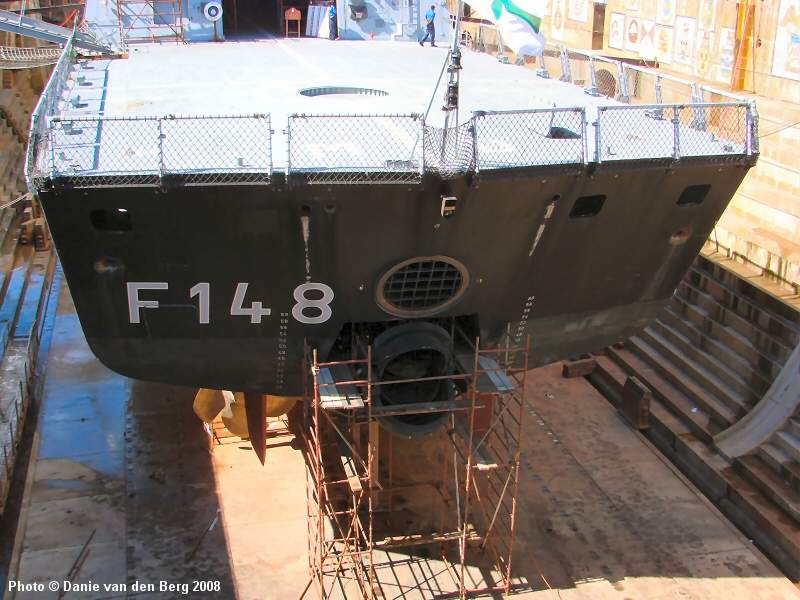
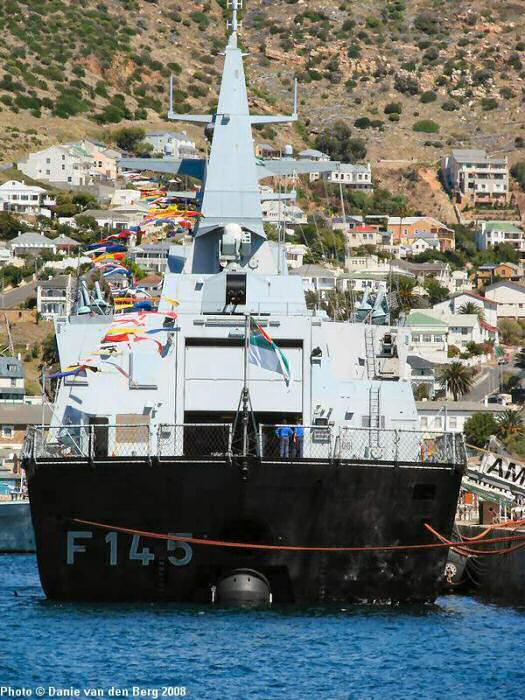
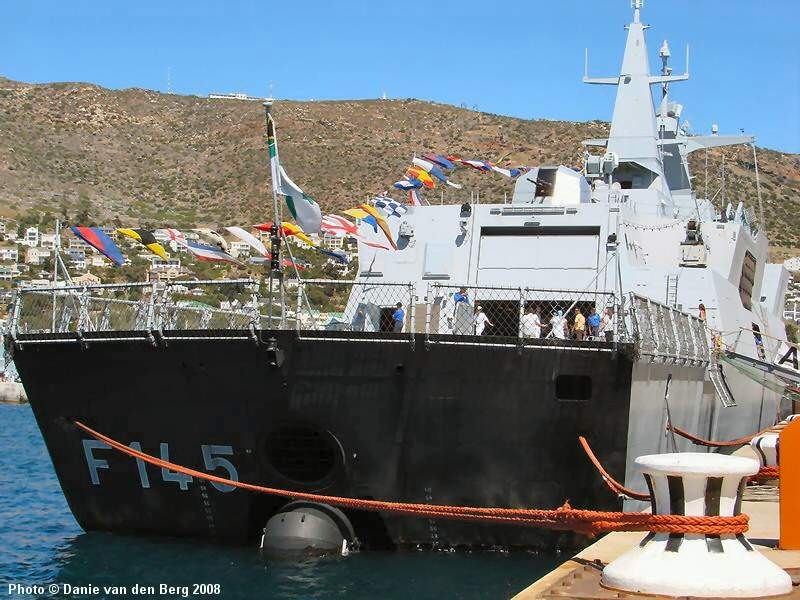

WanshanIf it were a big problem, it wouldn’t have been standard on a lot – and I do mean a lot – of ships to have main search air/surface radar sitting lower and either to the front or rear of a secondary air search radar. It’s been common practise forever.
WanshanA carrier battle group is not the easiest thing to hide. Its presence in a region rarely goes unnoticed.
Of course, very often that is exactly the desired effect.
However, projection of actual air power, i.e. the concept of a ‘surgical strike’ or similar action of a defensive type – CAP etc might very well benefit from using a distinctly lower profile platform.
I can see that SLCMs are already one good example of this.
Small ship – based UCAVs apart, can anyone predict other possibilities down the line?
Take example of 4 small vessels vice 2 larger vessel or 1 large vessel.
Regarless of its size, each vessel would need a complete set of navigation equipment, radars, EW/ECM/ESM. This implies greater cost. Although, clearly, equipping a single large vessel with just one set would probably involve more sophisticated gear. Nonetheless, you catch my drift: more numerous smaller vessel would probably be more expensive.
WanshanThe Iranians solved this problem a while back with their first stealth demonstrator aircraft, Saegheh! (lol)
Saegheh Before:
Saegheh After:
There’s NOTHING even remotely stealthy about this plane.
WanshanMost trainers (whether jet or turboprop) can easily be used as low cost mudmovers
“During the Farnborough Air Show in 2006, Hawker Beechcraft formally announced plans for the next spiral development of the successful T-6 platform into the AT-6B aircraft for the net-centric battlefield. Through the addition of open architecture avionics, state-of-the-art sensors, datalink, cockpit and aircraft protection components and various weapons capabilities to the proven training platform, the Beechcraft AT-6B provides multi-mission capability on a low-cost platform. The multi-role, multi-mission system is designed for net-centric Intelligence, Surveillance and Reconnaissance (ISR) and light precision attack missions. The AT-6 design allows for advanced training with weapons delivery capabilities and the ability to conduct actual operational missions with the same platform.”
http://www.airforce-technology.com/projects/at-6b-light-attack/
“The EMB-314 Super Tucano is an enhanced version, with faster speed and higher altitude, of the EMB-312 Tucano trainer aircraft which is operational in the Air Forces of 17 countries. The prototype of the Super Tucano first flew in 1992. Both Tucano and Super Tucano have been developed and built by Embraer of Brazil.
In 1995, Embraer was awarded a contract to develop a variant of the Super Tucano, known as the ALX or light attack aircraft, for the Brazilian Air Force (FAB), optimised for the environmental conditions of the Brazilian Amazon. The ALX is capable of operating day and night missions from remote bases and unpaved runways with minimal ground support. The first production aircraft was completed in 1999.”
http://www.airforce-technology.com/projects/super_tucano/
“Pilatus Aircraft Limited rolled out the new PC-21 training aircraft in May 2002. The PC-21 expanded envelope trainer aircraft is designed to fulfil the requirements for basic, advanced and fighter lead-in training for pilots and, if required, Weapon Systems Officers (WSO).
Four under-wing stores pylons and one centreline pylon can be installed.”
http://www.airforce-technology.com/projects/pc_21/
WanshanThe Yak-23 was a “fallback” design in case the MiG-15 failed… and was strictly a second-line fighter, used nearly exclusively by Warsaw Pact nations.
The Saab J29 Tunnan was a front-line fighter, fully the equal of the MiG-15 & F-86 Sabre.
During a visit to the UK in 1953, a group of Swedish pilots with Tunnans got a chance to take on US Air Force F-86 Sabres, with the two types proving very equivalent in performance. The Tunnan could out-turn the Sabre, but the Sabre could out-loop the Tunnan.
Don’t mistake remarks about looks for those about performance. Nobody said anything bad about the Tunnan (which I like)
WanshanNot sure that this

is uglier than this

Wanshanso 200 to 300 Su-34 may do the job of 2000 to 3000 1970s era bombers from Su-25 to Tu-22.
Ah, but the discussion was 1 SU-34 for 12 SU-27, not 10 Su-25 or 10 Tu-22 (that’s Blinder, not Backfire)
WanshanThat article said some of the 300+ aircraft not all of them.
I’m not sure Su-34 will replace all 300+ Su-24. It seem logical that upgraded Su-24 would remain in service for some time. However, the comments made by russian officials do seem to indicate a (far) greater number of su-24 will be replaced by a (far) smaller number of Su-34.
There is no other option if you consider that a) available finance is limited and b) approx. 1400 Su-24 were built, of which roughly 577 are currently operational with Russian forces, split 447 with the Russian Air Force and 130 with the Russian Navy. (leaving aside 162+93 Tu-22M and spaces left by retirement of Su 17/22, Mig 27 etc).
A 1:5 ratio on replacing all Su-24s and T-22Ms would mean producing 172 Su-34. How many Su-34 do you see the Russians producing in the next 5-10 years? Here’s a hint: “In December 2006, Ivanov revealed that approximately 200 Su-34s are expected be in service by 2020. This was confirmed by Air Force chief Vladimir Mikhailov on March 6, 2007” (http://en.wikipedia.org/wiki/Su-34). That’s a 1:4.31 ratio.
Yet, here’s another: “On 9 January 2008, Sukhoi reported that the Su-34 has begun full-rate production. Russia plans to have 24 Su-34s operational by late 2010 with a total of 70 to be purchased by 2015. A total of 300 aircraft are to be procured by 2020 to replace all remaining Su-24s “(http://en.wikipedia.org/wiki/Su-34). It seems that the more the number of operational Su-24 (and Tu-22M) dwindles, the closer the Su-34 replacement ratio can get to 1:1….
Anyway, the point was: EVEN IF YOU DID replace 300 Su-24 with 70 Su-34 , you’ld end up assuming 1 Su-34 does the work of just 5 Su-24 (so forget about 12 Su-27).
WanshanThose two or three Su-34 are more effective than couple of dozen F-111. More than 1000 test flights for perfecting Su-34 in 21st century on 8 to 10 machinese and considering Sukhoi Aerodynamics knowledge and experiance. These 1000 flights are almost equal to 10,000 flights for any other developmental program in previous era.
Alot of information about Su-34 is not released. 1 Su-34> 12 Su-27.
The Su-34 is meant to replace the Su-24 aircraft – the Russian equivalent of the F-111 – and eventually any remaining Su-17 and Mig-27 in Russian service.
http://www.globalsecurity.org/military/world/russia/su-34.htm
“The aircraft shares most of its wing structure, tail, and engine nacelles with the Su-27/Su-30 ‘Flanker’, with canards like the Su-30/Su-33 ‘Flanker-D’/Su-35 ‘Flanker-F’ to increase static instability (higher maneuverability) and to reduce trim drag. The aircraft has an entirely new nose and forward fuselage with a cockpit providing side-by-side seating for a crew of two. The Su-34 retains the Su-27’s engines, but with fixed intakes, limiting its maximum speed to Mach 1.8+.”
http://en.wikipedia.org/wiki/Su-34
As a machine that has such extensive commonality with the Su-27, it is extremely unlikely that 1 Su-34 would equate to 12 Su-27 in terms of combat power all round.
“In March 2006, Russia’s minister of defense Sergei Ivanov announced that the government had purchased only two Su-34s for delivery in 2006, and planned to have a complete air regiment of 24 Su-34s operational by the end of 2010 (total 70 aircraft will be purchased by 2015 to replace some of 300+ Su-24, which are going through modernization upgrades currently to prolong their service life). Ivanov claimed that because the aircraft is “many times more effective on all critical parameters” the Russian Air Force will need far fewer of these newer bombers than the old Su-24 it replaces.”
http://en.wikipedia.org/wiki/Su-34
I think you may be mistaken with this remark. On that basis (replacing 300+ Su-24 with 70 Su-34), it may be that the combat power of a single Su-34 is equal to that of some 5 older Su-24.
WanshanThere was nothing wrong with putting it into production, it’s just that it didn’t suit Sweden’s needs for the Visby class.
Unlike either the Mica VL or Umkhonto, the BAMSE is not a vertically-launched missile and therefore cannot be stored and fired from seamless below-deck launchers. It would have required an oblique launcher mounted externally, which would have compromised the Visby’s stealth profile and may have required a significant redesign. Using vertically-launched missiles is a lot easier.
The BAMSE is also a Command-to-Line-of-Sight (CLOS) missile, which means it requires constant guidance from the ship’s radar in order to score a hit. In practical terms, this means that you’re only able to launch missiles along specific axes (ie, where the radar is targeted at a given moment) and you’re limited both by the number of missiles you can launch simultaneously and the flight channels those can follow. In contrast, the Umkhonto is a fire-and-forget missile with full hemispheric protection, meaning that you can launch 8 of them in rapid succession and have them all target separate targets approaching from different directions. So it’s better against a saturation attack.
Finally, the Umkhonto-R, which Sweden is also hoping to bring into service, has greater range than the BAMSE.
The BAMSE itself is a fine missile, but it just wasn’t suited for this particular application. So far as I know, however, its adoption by other arms of the Swedish military continues unabated.
Given that Sea Wolf went from a non-vertical to a vertical launch system, I’ld assume it is not a problem that cannot be overcome.
Also CLOS guidance doesn’t necessarily require radar. A passive ElOp director would also do, and these can be much smaller than a radar director so that they are a) less of a signature problem and b) more can be employed thus partically solving the channels problem. Incidentally, the Israeli’s don’t seem to think that CLOS is much of a problem with their Barak missile, especially not when combined with a radar like Elta’s MF STAR.
WanshanThe front view is a single-seat FLANKER, the side view is the Su-33UB.
Whatever. The point is: side by side cockpit on one, single seat cockpit on the other.
WanshanWe should imitate them:diablo:
Very mixed up drawings.
Frontal view = Su 33
Side view = Su-34
WanshanSince when are MiGs European aircraft???? (I know that some parts of Russia are geographically on the european continent, but still).
Europe end in the East at the Urals. AFAIK the russian capital is west of the Urals. http://www.worldatlas.com/webimage/countrys/europe/europea.htm
Here’s a list of where russian aerospace industry is located. Mostly westy of the Urals.


 Sign In








