 Wanshan
Well, that means the first three P17 are well underway, as these occupied the slipway and dock at Magazon prior to the P15A (which I thought was going to be called Bangalore class, suggesting that as name for the first of class)
Wanshan“If the rule is 1 aircraft per thousand tons, how did the USN converted Essex CVs carry 60 F-8/A-7/A-4/A-3/S-2 aircraft on 42,000 tons max displacement?”
I would think that can be explained by the different ‘footprint’ of these aircraft:
F18E L=18.32 M W=13.62 M (wings folded: 9.32 m)
F-8 L=16.61 M W=10.87 M
A-7 L=14.60 M W=11.80 M (wings folded: 7.24 m)
A-4 L=12.29 M W= 8.38 M (non folding wing)
A-3 L=23.27 M W=22.1 M
E2C L = 17.60 m, W=24.56 m (wings folded: 8.94 m)
S-2 L = 13.26 m, W=22.13 m
WanshanWell, since it was unilaterally decided that army and navy forums were no longer worth the time and effort, I’ve unilaterally decided to invite all who regularly post on those forums and who would like to continue to exchange views and information to move to the http://www.ACIG.org forum.
Notwithstanding it is the Air Combat Information Group, it does retain a worthwhile NCIG and LCIG subsection. Yes, that’s right, Naval and Land Combat subsections….
Wanshannow where’s the Barbieque- texas style (and I want a robin Williams “Good Morning Vietnam” one!!! 😉
Wanshanhttp://www.alert5.com/2005/11/botched-bombing-efforts-embarrass.html
Pretty weird that it takes so much precise guided munition to destroy one ship.. and even after that the ship continues its ride..
How would these weapons perform in chaotic battlefield conditions, then?
Hellfire is an ATGW whose hollow charge warhead would mak a few small holes in the hullplating. As for the LGB’s, how many bombs did it on average take in WW2 to sink a merchant or naval vessel?
One would think a submarine would do the job with one or two heavyweight torpedos.
WanshanAsturias has a RAS rig on starboard so can refuel its own escorts. Can carry more AVB8B. However, Garibaldi is better armed and thus less dependent on escorts. Did I mention she’s more aesthetically pleasing?
WanshanOn the occasion of your birthday, we’ld like to extend our best wishes to you!

WanshanI am hoping for a combination of shtil-1 and Barak-2. If what they say about the range of barak-2 (70-80) km is true, then it would provide a decent air defence. Of course adding a few S-300 would be even better but might be wistful thinking.
If you have Barak 2 installed, adding Shtil 1 is just a waste of space and weight as the former missile would be superior to the latter in terms of range and – probably – guidance. Besides, I expect Barak 2 to be more compact and lighter than Shtil 1. Putting S-300 on this carrier makes no sense as this would take up even more space and weight, not just for the missile launchers but also for the Tombstone radar director(s). Instead of the Russian approach, which has carriers armed like a cruiser, India follows the ‘western pattern’ of carrier armament: light and purely for self-defense, much like a frigate. Medium and long range SAMs are then placed on escorting dedicated air defense destroyers/frigates
WanshanIt has somewhere been suggested that it would have Shtil-1 in VLS mode, but they also mentioned “carrousel” launchers, which makes that report rather unreliable… I think it mentioned 4 8-cell launchers or something like that.
I honestly think for Kashtan too, although it was also mentioned that Kashtan was refused by India, but as Russia did not want to incorporate Barak, I am not sure what will be installed. I guess we’ll see in a few years.
IN is perfectly capable of installing Barak itself, see current carrier.
WanshanDefensive probably Shtil-1 or Barak-2 (maybe later). I doubt it will carry any offensive missiles other than on aircrafts. The standard Kh-31p/a and KH-35 with sea eagle for Mig-29k/NLCA/Harrier.
Judging from the models, don’t expect much more than either a couple of Kashtan’s or a Barak/AK630 combo on board the Gorshkov.
WanshanIn 1993, the Swedish Government ordered full-scale development of the BAMSE Air Defence Missile System. BAMSE is a joint venture between Bofors Missiles and Ericsson Microwave Systems in which Bofors has the overall system responsibility. Series production will begin at the turn of the century. Pre-series production was scheduled to start in 1998, leading to series production being launched in 2000. The project is in jeopardy because of the austerity program, and the future of BAMSE will be decided by the cabinet.
(http://ftp.fas.org/man/dod-101/sys/missile/row/rbs23.htm)
BAMSE is a medium-range air defence missile system, in serial production for the Swedish Armed Forces (http://products.saab.se/PDBWeb/ShowProduct.aspx?ProductId=635)
July 13, 2000
The Swedish Defence Material Administration (FMV) has placed an order for series production of the Air Defence missile system BAMSE for the Swedish defence forces.
(http://www.findarticles.com/p/articles/mi_m0EIN/is_2000_July_13/ai_63359363)
Bofors Weapon Systems has received several orders from the Swedish Defence Materiel Administration (FMV) during the year. FMV, acting on the instructions of the Swedish Defence Forces, has placed an order for the RBS 23 BAMSE missile system with Bofors Missiles. The order, worth SEK 55 M, is a bridging order, designed to secure the retention of competence in the high-tech field of missile development and thereby enable placement of a subsequent series order, when a final decision has been reached concerning procurement of the air-defence missile system.
(http://www.defense-aerospace.com/cgi-bin/client/modele.pl?prod=1713&session=dae.18785837.1142715576.RBx0uMOa9dUAAEqIcS8&modele=jdc_1)
WanshanAn ongoing part of ATE’s business is the upgrade of the ex-Soviet Mi-24 helicopter into what ATE refers to as the SuperHind. The core system is to provide an integrated mission system and night mission capability (using either a FLIR [from Denel Optronics Systems (DOS)] or night-vision goggles). Other equipment fitted includes a programmable counter-measures dispenser, a rotor track and balance system, and improved front cockpit instrumentation.
The SuperHind MK2 integrates the core system with the existing weapon system, including accurate rockets and bombs. The SuperHind Mk3 has a 20 mm turreted cannon (from IST) which replaces the Mi-24 fixed 30 mm weapon. This turret is integrated with the DOS helmet-mounted sight. The obsolescent missiles fitted are replaced by Denel’s Ingwe anti-tank missile. Other fittings include a new head-up display, a digital flight/voice data recorder and a hybridised Doppler/GPS navigation system.
For all versions of the SuperHind a wide range of other options is available from ATE and other local defence and avionics companies. Amongst others these include:
* The fire and forget Mokopa missile (Denel).
* Laser warning systems (Avitronics).
* Missile warning system (Avitronics).
* A Health and Usage Monitoring System (HUMS) from AMS.
* Digital-based avionics.
* Flight management system.
* Sand filters (Aeroflo/CSIR).
* Infrared suppressors.
* Digital autopilot.
The final version of the upgraded helicopter supplied by ATE is the Agile SuperHind where extensive redesign and mass reduction raises the performance to that of modern combat helicopters of Western origin.
These extensive modifications described above turn the rather ordinary Mi-24 into a greatly-enhanced attack helicopter and ATE has the largest fleet of upgraded Mi-24 helicopters in the world.
WanshanIt should turn out to something like this:
WanshanWasn’t the 7500 one of the designs offered to Singapore? They chose a different design obviously but IIRC this was offered to them.
Very possible, I came across this pic in a thread comparing this design and the design they currently operate.
WanshanThis is the MRD 10000’s little sister, the MRV 7500: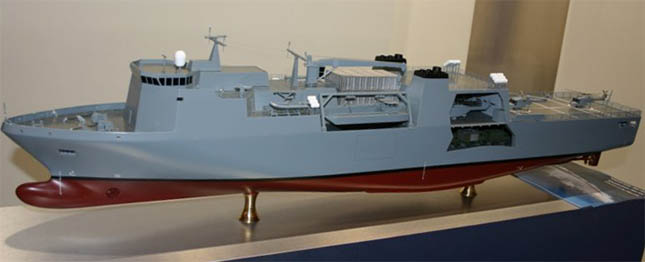


 Sign In







