 Wanshan
Building a model?
You can dig up quite a bit by just using Google and searching on ‘schnellboot’ in combination with the ship desginations you already mentioned. Here’s what I found:
Built at Schlichting Travemünde, 1943. Launched 18.09.1943 and commissioned 21.10.1943. One of the boats that sunk LSTs of the British coast that were participating in Exercise Tiger (just before D-day). Taken over by Britain as P5130 in 1945, used for early SIGINT. Sold to Germany in 1957 as UW 10 . Reclassified as experimental ship EF3 in 1968, sold in 1991 in Wilhemshaven, where she remained as a house-boat until her acquisition for restoration in England by her present owners (The British Powerboat Trust) in January 2003. It is the only known, surviving and seaworthy S-boot!
Lots of info here:
http://www.bmpt.org.uk/boats/S130/index1.htm
http://www.bmpt.org.uk/boats/S130/index2.htm
http://www.bmpt.org.uk/boats/S130/index3.htm
http://www.bmpt.org.uk/News/news.htm
http://www.german-navy.de/kriegsmarine/ships/fastattack/schnellboot1940/ships.html
http://www.schnellboot.net/de/bm/149/vorlage/
http://www.schnellboot.net/div/bilder/de/uw/
http://www.schnellboot.net/div/bilder/de/uw/uw10.html
http://www.schnellboot.net/div/bilder/de/uw/uw11.html
http://www.marinefunker.de/deu/mfrs/2003/mfrs1203.txt
http://www.wlb-stuttgart.de/seekrieg/km/sboot/s-verbleib.htm
http://www.mikekemble.com/ww2/slapton.html
http://de.wikipedia.org/wiki/S-Boot
S130 today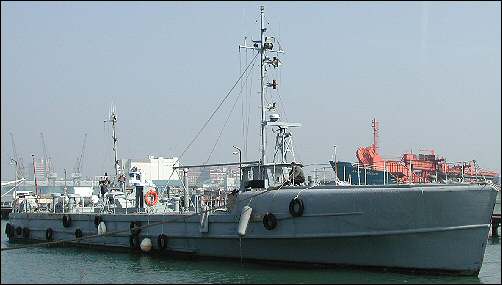
UW 11, her sistership
WanshanI know that. But the point I made is that it may not be the case that India would operate Hawkeye in support of a CBG (which would have organic Ka-31). The EMB-145 was mentioned for landbased AEWC, which suggests the Swedish Ericson Erieye. Hawkeye is a perfectly good competitor for Erieye.
WanshanThe AMX programme originated from a requirement of the Italian Air Force for single-seater and two-seater combat aircraft for surface attack missions. The AMX was originally conceived as a replacement for Italy’s aging fleet of G91 and F-104 attack fighters. The project began when the Aeronautica Militare Italiana (Italian Air Force) began drawing up specifications for a light tactical attack fighter to complement the larger Tornado IDS. The new aircraft needed to fulfill a variety of tasks ranging from attack and reconnaissance to long-range anti-shipping and air combat duties. Aeritalia began developing an aircraft to meet these needs, and Aermacchi also joined the effort. The cooperation between these two firms resulted in the new plane being designated the AMX for Aeritalia Macchi Experimental.
In the meantime, the Força Aérea Brasileira (Brazilian Air Force) had formulated a similar need for a light jet to replace the AT-26 Xavantes. In 1980, the Brazilian manufacturer EMBRAER also joined the AMX program. The AMX then became a joint venture of three firms to develop a light attack fighter for both Italy and Brazil. In 1982 a Memorandum of Understanding was signed by Italy and Brazil and the joint development and production programme was subsequently conducted by AMX Consortium, based in Rome, through the Italian companies Alenia Aerospazio, now Alenia Aeronautica, (46.5%) and Aermacchi (23.8%) and the Brazilian company Embraer (29.7%).
Although the AMX design that finally emerged emphasizes simplicity and low cost, performance has not been sacrificed. The AMX features a high-mounted swept wing with several high-lift devices. Coupling this wing with a powerful Rolls-Royce engine, license built in Italy, makes possible excellent short takeoff and landing capability. Both the wing and tail surfaces of the AMX have also been designed to operate at high angles of attack, and large control surfaces make for superb maneuverability. The main role of the AMX is ground attack in visual and marginal weather conditions, with primary roles in long range strike and air interdiction, close air support, reconnaissance and armed patrol. The aircraft is also highly effective in air defence missions and the lead-in fighter role. The AMX is capable of operating at high subsonic speed and low altitude, by day or night, and if necessary, from bases with poorly equipped or damaged runways.
The AMX designers also put great emphasis on upgradability, and a fuselage bay can be easily fitted with several types of reconnaissance palets or other mission-specific avionics. The AMX also makes use of rugged landing gear allowing operations from rough or damaged airfields. Although primarily an attack aircraft carrying bombs and air-to-surface missiles, the AMX is also armed with short-range Sidewinder missiles providing air defense capability. The AMX Advanced Trainer Attack (AMX-ATA) is a new AMX two-seater, multi-mission attack fighter for combat roles and advanced training. The AMX-ATA incorporates new sensors, a forward looking infrared, helmet-mounted display, a new multi-mode radar for anti-air and anti-ship capability, and new weapon systems including anti-ship missiles and medium-range missiles.The new AMX-ATA version is aimed at attack roles and advanced training, and is equipped with the most modern advanced technology man-machine interface and avionics systems. The integration of new sensors, a multimode radar to respond to a variety of new operational requirements, as well as the adoption of new weapon systems are some of the characteristics which make the AMX-ATA a potentially very competitive aircraft world-wide within the light combat/training aircraft market. It will be equipped with the new Eurojet EJ-200 Dry engine based on the same core as the reheated version developed for Eurofighter/Typhoon fighter.
In total, 192 aircraft, 155 single seater and 37 AMX-T two seater, have been delivered to Italy (110 AMX, 26 AMX-T) and Brazil (79 AMX, 15 AMX-T). The main difference between the AMX in two countries is the weapon and electronic system. The Venezuelan Air Force ordered eight AMX-ATA in 1999 for the advanced trainer and attack aircraft role. In December 2002, the Venezuelan Air Force signed a contract with Embraer for 12 AMX-T Advanced Training and Tactical Support Aircraft. Deliveries are to begin in 2005. In August 2004, the Brazilian Air Force signed a contract with Embraer for a mid-life update of 53 single-seat (designated A-1A) and two-seat (A-1B) aircraft. The upgrade will include three new multifunction colour displays, head-up display, night vision goggle compatibility and new communications / navigation suite. Elbit of Israel is to be the lead contractor.
KNOWN COMBAT RECORD:
Bosnia – Operation Deliberate Force (Italy, 1995)
Kosovo – Operation Allied Force (Italy, 1999)
(Italian Air Force AMX fighters were deployed as part of the NATO forces in Operation Allied Force against Serbia in 1999. Source )
Flug Revue and other info
WanshanThe AMX can carry external loads up to 3800kg on 7 hardpoints versus 4498 kg on the A4’s 5 hardpoints. While A4 can carry a heavier load, the AMX is much more advanced in terms of avionics and radar. AMX is a bit larger and heavier than A4. Still, A7 Corsair II may be a more cost-effective option. And then there’s always the smaller Mig29K also offered to India for use on ex-Gorshkov…
WanshanFolks, lets not go there. Instead, just stick with the topic of the thread. Thank you. 🙁
WanshanMmm. Has anybody considered the possibility that India might want to procure Hawkeye simply for land-based use? After all, this is what countries like Egypt and Israel do with theirs….
WanshanBrazil could get some A7’s and upgrade them. While still not a great fighter, it would be a more potent bomber/attacker than A4. Any reason why Brazil could/should not look into a carrier-capable version of their home-built AMX?
WanshanMmm, perhaps that is because you are looking at aircraft carriers. The pictures however show a helicopter carrier, much along the lines of an improved Jeanne D’Arc training/helicopter cruiser.
WanshanI don’t think bratwurstdimsum was referring to the stopwatch but rather to the other implement the officer is holding.
WanshanWhat will be the proposed modification for the E2-C on INS V. I read more powerful engines needed in some report.. any idea..
More powerfull engines might be an option, as would be fitting new propellers. The NP2000 is a digitally controlled, all-composite propeller blade system that will replace the electro-mechanical, steel spar propellers that are currently on all Hawkeye and Greyhound aircraft. The eight-bladed, all-composite NP2000 propeller is a military derivative of the commercial, six-bladed 568F propeller designed and manufactured by Hamilton Sundstrand and its French subsidiary, Ratier-Figeac. It replaces the out-of-production 54460 Hamilton Sundstrand propeller on the twin-engine E-2Cs and C-2As. The NP2000 also is designed to be compatible with the Pratt & Whitney Canada PW150 and the Rolls-Royce AE2100 engines for P3 and C-130 aircraft applications.
WanshanA KC/KE-2 would be even heavier than an S-3 tanker and the E-2C itself and therefore even less likely to operate succesfully from the Vikramadity or ADS.
Daniel
You’re probably right. Still, if you take an E2C airframe (i.e. without all elint and AEW related equipment), couldn’t you put in refuelling gear and additional fuel tanks and end up around the normal E2C weight. Likewise as far as C2 is concerned: as a transport, it has to have some ability to carry payload so couldn’t this be used for refuelling gear, fuel tanks and fuel? Is your point not really that you doubt that the normal E2C AEW plane could operate from Vikramadity?
WanshanIn other words, a C2 converted from COD to tanker (or even a converted E2 airframe) might be more cost-effective as complement to E2C AEW and Mig29K F/A.
WanshanWanshan the big problem with that one, mate, is what a detachment of 3 Hoovers is precisely going to offer you for its deck footprint and overheads. Airborne ASW is very much a numbers game and 3 S3’s may give you the ability to prosecute a single target OR man a single ASW picket station, but, not both simultaneously. To maintain a long duration presence, unlike the E-2, you need more than 3 in the airgroup.In this instance I’d imagine a few good medium choppers instead of the Vikings would be far more useful.
How about 3 airframes fitted as tankers? Any advantages over Mi29K buddy-to-buddy tanking?
WanshanBy 2010, the USN will have retired some 106 S3B Viking aircraft. If E2C can operate from Vikramaditya/Gorshkov, then maybe these could operate from it also. So you might get 3 E2C, 3 S3B, 1-2 ASW/UT heli’s 12-14 Mig29K
WanshanIMHO, 2 E2C, 2 utility helicopters, 2 ASW heli’s, 12-14 Mig29K (incl. 2x two-seater).


 Sign In







