 Wanshan
Yeah, but before the designation inflation of the last few decades, that really was a destroyer.
Vosper Mk5 frigate, from the start.
The 1950’s saw the building of the Brave Class powered by the Bristol Siddeley Proteus gas turbine using super cavitating propellers developed in the Vosper’s cavitation tunnel at Porchester. Later developments of this design led to speeds of up to 58knots being achievable. In 1958, the controlling shares in Vosper Ltd were purchased by the Mineral Separation Company which provided the financial support needed to sustain the Company into the 1960’s, during which time a number of larger twin and triple screw fast patrols boats were built for the German, Danish, Malaysian, Brunei and Libyan Navies. The Company also designed and built even larger corvettes and fast patrol boats for Ghana, Peru, and Singapore, four or which came from the Singapore shipyard. This was a profitable time for the company, and in 1963 the controlling interest was purchased by the David Brown Corporation. In 1965, the Vosper design team in collaboration with Vickers, completed the design of its first frigate known as the MK 5. This ship would displace 1300tons and be capable of 40 knots, however the ship could not be built at any of the current Vosper facilities, but in the event the strong financial position of the Company allowed a merger with JI Thornycroft of Southampton. This merger provided the larger building capacity required for Vosper’s to expand.
…
VT were also very successful in selling warships to the Shah of Iran, beginning with the refitting and updating on the ex RN Battle Class destroyer HMS Sluys to be renamed Artemiz. This work was followed by the order of 4 Mark 5 frigates, two of which were built by Vickers to share the financial and construction risk. These innovative heavily armed steel ships employed a CODAG propulsion system with RR Olympus gas turbines capable of driving the vessels at 40 knots using super cavitating propellers.This order was followed early in 1968 with a slightly larger Mk 7 Frigate for Libya. In 1967, a design for the replacement of the successful Leander Class was urgently required, but resource problems within the MoD meant that the ship could not be designed in-house, so VT in partnership with Yarrows on the Clyde submitted a proposal for a 3000ton Frigate that was to become the Type 21. The joint bid was successful, and the Woolston shipyard built the first of class HMS Amazon.
…
In early 1970, the Brazilian Navy issued a requirement for up to six new Frigates, and the VT design, the Mk 10 was based on an enlarged Type 21
http://www.battleships-cruisers.co.uk/vosper_thornycroft.htm
Mk10=Niteroi class
Naval Institute Guide to Combat Fleets of the World (Eric Wertheim) page 322
Illustrated Directory of Warships of the World (David Miller) page 430


DE12 Saam, June 1970
http://www.battleships-cruisers.co.uk/other_navies.htm
Note the Iranian designation DE – destroyer escort – which in WW2 was used for ships that the british called frigate. So, even in Iranian service it was NOT a destroyer
http://en.wikipedia.org/wiki/Destroyer_escort
Pics below from http://navyworld.narod.ru/frig.htm
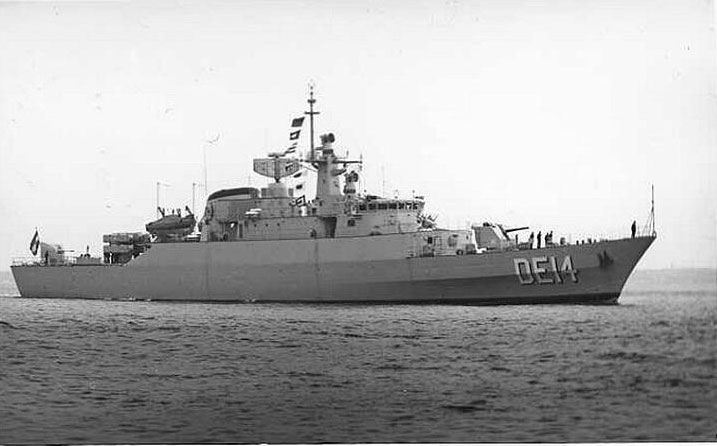
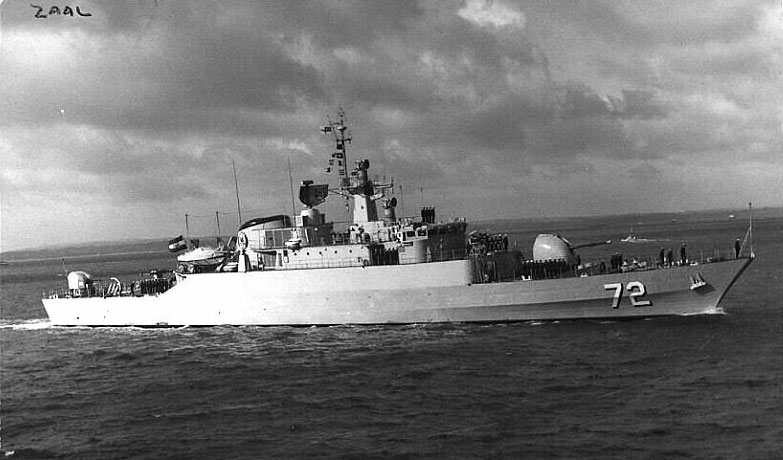
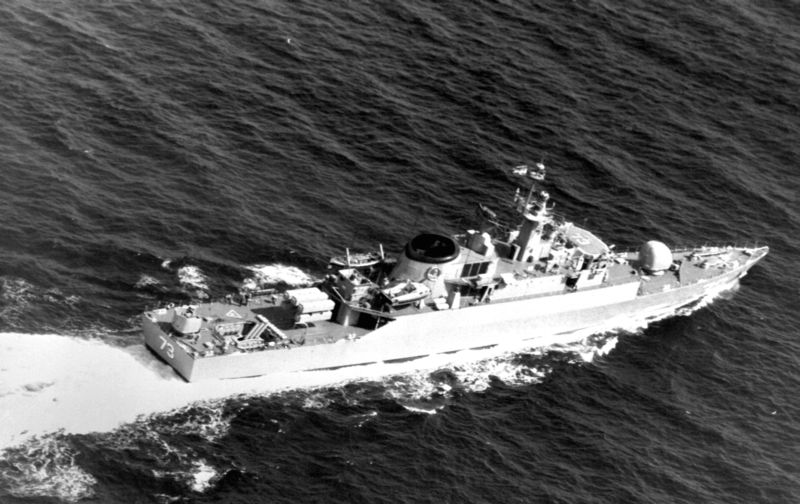
WanshanWell, if that’s what it takes to keep 10 CNVs plus have a bunch of F35B capable LHA/D’s ….
Wanshan++Several LST landing tank ships.
There you go! :p
WanshanI must admit my first thought on reading this report was they’ll probably ‘aquire’ a container ship, paint it grey, paint some helo spots on the deck (made up of containers welded together a la Project Arapaho) operating a sqn of former civilain Jet Rangers equipped with a couple of Revolutionary Guardsmen each hanging out of the doors with an AK 47. Which to the President Armoured Dinnerjacket will constitute a capability equal to the entire US Navy!:diablo:
LOL, most likely … 😎
Wanshan??????????????????!!!!!!!!
Like….?
1,420-ton destroyer (palm face!)
” It appears to be a development of the Alvand class (British Saam class) design. They are described as Destroyers by the Iranian state media but the size and weight of the ships are more in keeping with that of light frigates. With a 1,420 ton displacement, the ships are also referred to as Corvettes since they are on the lower end of frigate tonnage “
http://en.wikipedia.org/wiki/Moudge_class_frigate
Iran successfully test-fired the mid-range, surface-to-air Hawk missile (palm face)
“The Raytheon MIM-23 Hawk is a U.S. medium range surface-to-air missile. The Hawk was initially designed to destroy aircraft and was later adapted to destroy other missiles in flight. The missile entered service in 1960”
http://en.wikipedia.org/wiki/MIM-23_Hawk
WanshanThat article is incorrect. The MILGEM corvette may be the first Turkish designed warship since the days of sail. It certainly isn’t. as stated, the first built in Turkey.
Gölcük Naval Shipyard has been building warships for the Turkish navy for 40 years, starting with the two Berk class frigates (would now be called corvettes) launched 1971 & 1973. Several MEKO 200 frigates & quite a few submarines have since been built there.
Plus several classes of large FAC(M) iirc
WanshanThere are only two front line squadrons still equipped with F-4EJ Kai, unable to justify an individual acquisition program, let alone local assembly. The remaining RF-4EJ will be replaced by pod-equipped F-15J.
91 F-4EJ/EJ Kai
26 RF-4E/EJ (to be replaced by F15J with synthetic aperture radar pods)
Of the six Hikotais that once were newly raised on F-4EJ interceptors, 301 till 306, only 301 and 302 still fly Phantoms. The third squadron still flying F-4’s is 501 Hikotai at Hyakuri. Part of 7 Kokudan, the unit is tasked with reconnaissance. For this mission the squadron flies a mix of 12 out of an original total of 14 RF-4E’s fitted with the familiar camera noses, along with as many as 17 RF-4EJ Kais converted from F-4EJ Kai interceptors. Hiko Kaihatsu Jikkendan or Air Development and Test Wing also flies a F-4EJ Kai
Source: http://www.cavok-aviation-photos.net/japanairselfdefenseforce.html
Also: http://www.scramble.nl/mil/2/jasdf/jasdf-orbat.htm
WanshanThe phrase ‘Beyond Economical Repair’ in this context, ie in relation to the post Soviet Union Russian Navy can be misleading, as they were basicalll y broke so even normal maintenance and operation were beyond their means at the time.
…
By most Navie standards, the repairs required to return Gorshkov to service without major modification would have been reasonable and affordable.
IIRC she was laid down in 1978, launched in 1982 and commissioned in 1987, delayed due to problems with the command and control system, which was different from the previous Kievs and prototype for that of Kiev & Varyag. Renamed ‘Gorshkov” only in 1991, ‘Baku’ lasted only 5 years before being rendered inoperable by machinery problems. There was a major fire incident on the ship in 1993 and an explosion tore through the engine room in 1994. Subsequently, the ship was docked for a year of repairs. The ship returned to (nominal) service in 1995 only to be withdrawn and offered for sale in 1996.
Without a conversion to the Vikramaditya-layout, sounds to me like she at minimum would have needed a very serious propulsion system overhaul. Also, her command and control system would have to be put into working order or a state at least similar to that of Kuznetsov.
Machinery of the Kiev class was a doubled version of the Moskva machinery, and knwon to be deficient (both ships of this class suffered extensive machinery problems, Moskva to such an extent that the plant was rebuilt twice). All Kiev class ships suffered at least one significant fire. Kuznetsov/Varyag also use propulsion plant of the Kiev class. Like Kievs before her, Kuznetsov has suffered machinery problems.
WanshanMost sources quote 70%, give or take a bit. Completing Varyag was a matter of finishing her to the original layout with updated weapons and sensors. Vikramaditya was a former operational ship that had to be rebuilt to a new configuration as well as recieving new weapons and sensors. A much bigger job overall.
I’m aware of what each entail in present/near future and what that means in terms of the size of the job. One clear difference is that Gorshkov was ‘beyond economical repair’ for the Soviet navy while Varyag was a case of construction interruptus. Point is, how meaningful are such ‘X% complete’ expressions to begin with.
WanshanVikramaditya is 85% complete and should be delivered by end of 2012…
I shudder at an expression like that…. What % complete was Varyag again when construction stopped in 1992?
WanshanWhich leaves
2 officers to make all the decisions
2 to prepare the officers dinner
2 to serve the officers cocktails [not applicable to USN and similiar dry navies]
1 to perform the officers laundry
5-7 to perform all the maintenance and repairs on all the automated bits, and keep the ship clean
Danish Knud Rasmussen class Ocean patrol crafts
Displacement: 1,720 tons
Length: 72 m
Beam: 14.6 m
Draft: 4.9 m
Complement: 18 + aircrew and transients (Accommodation for up to 43 in total)
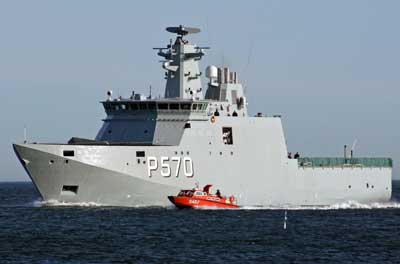
WanshanHow can something that size be operated by a crew of only 12-14?!
Automation and computer control.:p
Function
Compare
Dutch S-frigate (Kortenaer class)
Built 1975-1982
Displacement: 3,800 long tons (3,900 t) full load
Length: 130 m
Beam: 14.4 m
Draft: 4.4 m
Complement: 176–196
Dutch M-frigate (Doorman class)
built 1988-1995
Displacement: 3,320 tons full load
Length: 122.3m
Beam: 14.4m
Draught: 6.1m
Complement: 154
THAT’S AUTOMATION, GOING FROM 176-196 to 154 (minus 22-42)
Dutch OPV (Holland class)
Built: 2011-2013
Displacement: approx. 3,750 tons full load
Length: 108.4 metres
Beam: 16 metres
Draught: 4.55 metres
Complement: 50 (+ space for additional 40 i.e. marines)
THAT’s OPV role (fewer weapons, sensors) versus frigate role
COMPARE
UK Clyde (modified River class) OPV
BUilt 2005-2007
Displacement: 1,850 tonnes
Length: 81.5 m
Beam: 13.6 m
Draught: 3.8 m
Complement: 36 (room for 20 extra personnel)
UK River class OPV
Built 2000-2003
Displacement: 1,677 tonnes
Length: 79.5 metres
Beam: 13.6 metres
Draught: 3.8 metres
Complement: 30, accommodation for 20 more
UK Castle cllass OPV
built 1979–1981
Displacement: 1,427 tons full load
Length: 75 m (overall)
Beam: 11.51 m
Draught: 3.43 m
Complement: 40
OR COMPARE
Danish Thetis class Offshore patrol frigates
Built: 1988-1992
Displacement: 3,500 tons full load
Length: 112.3 m
Beam: 14.4 m
Height: 37.0 m
Draft: 6.0 m
Complement: 52 + aircrew and transients (accommodation for up to 101 in total )
Danish Knud Rasmussen class Ocean patrol crafts
Displacement: 1,720 tons
Length: 72 m
Beam: 14.6 m
Draft: 4.9 m
Complement: 18 + aircrew and transients (Accommodation for up to 43 in total)
WanshanHow about doing the opposite- 11356 hull and weapon systems from 22350?
I see your point but suspect that the new systems are the problem rather than the new hull (distant Krivak relative anyway)…
WanshanNot yet. But as part of the last round of cut-backs on the Netherlands military two of the ships will probably be put up for sale right after delivery. 🙁
It would save more to sell the remaining 2 M-class….
WanshanThere won’t be any more 11356s for Russian navy after the 6, that is almost certain.
That’s why I said export-versions of 22350: building on the commonality in systems, but on a different platform. Then later, switch platform altogether and move on to new ssystems (i.e. ‘non export’ 22350)


 Sign In







