WanshanWanshan
Could be sikorskis s97 prototype be the culprit?
Absolutely not.

Wanshanyes Taiwan is so far from The asian land mass that PLA need a carrier to get to it. :rolleyes:
I’d be worried if I have claims on the spraltys. :diablo:
Clearly, it would complicate matters greatly if a PLAN carrier group is located seaward of the island.:rolleyes:
Wanshanthe swiss EYRIE
uhm, eri-eye … Ericsson …. Sweden … haaaa – Saab [Microwave Systems, formerly Ericsson Microwave Systems). :rolleyes:
The case of Chile is more urgent….An alternative new potential can be version AEW of the C-295, that EADS CASA has begun to promote energetically in Poland, and that also would be equipped with the ubiquitous Erieye system of SAAB Microwave…EADS CASA takes to some years studying this project, anticipating a requirement of the Air Force of Spain that has taken in materializing itself, but seems to be it refocusing today towards those countries that already operate the C-295 in their versions of transport and marine patrolling.
http://www.enfoque-estrategico.com/reportajes/medios_aew_2.htm
Flight International 15/09/08
Saab unveils C-295 Erieye concept
“Some preliminary studies into the possibility of installing the Erieye on both the C-295 and ATR aircraft have been made,” says the Swedish manufacturer, which first revealed plans to integrate the surveillance system on a high-wing aircraft design during July’s Farnborough air show
WanshanI actually started that one :p
Thought so :;)
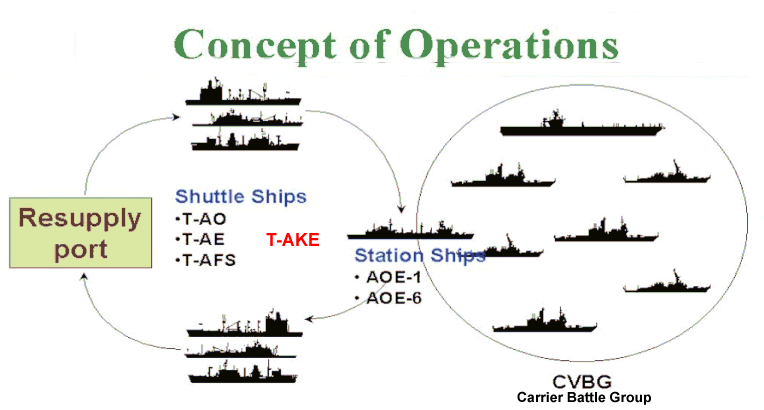


Interestingly, this DRY cargo ship comes with a port and starboard refuelling station (liquid cargo volume 3729 m3, located mostly in the forward/bow sections). 8,391 tons dry cargo + 18,000 barrels fuel
http://www.hazegray.org/worldnav/usa/aux_flt.htm
Conversely, the Henry J Kaiser ships (T-AO-187) have a small capacity to carry and transfer fresh and frozen foods as well as other materials, and have two dry cargo transfer rigs.
The T-AO fuel capacity is 26,166 tons (178,000 bbls). The T-AKE cargo fuel capacity is 2,646 tons (18,000 bbls).
http://www.dtic.mil/cgi-bin/GetTRDoc?AD=ADA401770&Location=U2…

So, the question is: would a set of ‘hybrid’ ships work better than two more specialized classes…..? (assuming T-AKE is not already to be considered a hybrid)
Federal Contracts : 2011-01-10 : (Custom Search)
19–Request for Information (RFI) – Fleet Replenishment Oiler (T-AO 187 Class) Recapitalization
Solicitation Number: N0002411R2204Agency: Department of the Navy
Office: Naval Sea Systems Command
Location: NAVSEA HQ
Recapitalization of the T-AO 187 Fleet Replenishment Oiler Class is part of the U.S.
Navy’s long-range shipbuilding plan. On September 17, 2010, the Navy announced that its Fiscal Year 2012 budget submission would include acceleration of the double-hulled fleet oiler T-AO(X) production from 2017 to 2014. Emphasis will be placed on compliance with environmental protection regulations, and on lowering total ownership costs (TOC) in the design and operation of the new oilers, including the use of mature, commercial technologies, and component commonality with other ships in the U.S. Navy fleet.
The Navy is preparing to conduct an Analysis of Alternatives (AoA) to refine the key attributes of the T-AO(X). The AoA will conduct various tradeoff analyses to determine the optimal solution in terms of cost, cargo capacity, speed and overall number of T-AO(X)s required to meet Fleet requirements.
Alternatives will examine various quantities of bulk petroleum products (JP-5 and DFM); dry stores/packaged cargo, fleet freight, mail, personnel and other miscellaneous cargo to determine the optimum cargo capacities. A range of dry cargo capacities at least 20% greater than the T-AO 187 Class should be considered.
http://www.implu.com/federal_contracts/listing/N0002411R2204
Wanshan@blark18/philbob
It certainly would seem a good match in terms of required size.
current T-AKE
• Length: 689 feet
• Beam: 105.6 feet
• Draft: 29.9 feet
• Displacement: 41,000 tons
• Speed: 20 knots
• Civilian: 124 civil service mariners
• Military: 11
• Government-Owned/
Chartered: Government
current T-AO
• Length: 677.5 feet
• Beam: 97.5 feet
• Draft: 35 feet
• Displacement: 41,225 long tons
• Speed: 20.0 knots
• Civilian: 89 civil service mariners
• Military: 3
• Government-Owned/
Chartered: Government-owned
Similar discussion on practical issue is here: http://warships1discussionboards.yuku.com/topic/16528/T-AKE-as-the-basis-for-T-AO-X
WanshanWHerefrom was the op mounted: inside (a base available to US) or outside (from LHA parked off-shore or from a neighboring country) of Pakistan?
WanshanSikorsy S-70i
from http://lotniczapolska.pl/PZL-Mielec-rozpoczal-koncowy-montaz-S-70i,8740
WanshanNASA SELECTS ACTIVE SENSORS RVDT’S FOR LATEST BLACKHAWK STEALTH PROJECT
1st April 2010A team of NASA engineers are looking into methods of increasing the militery stealth of the UH-60 Blackhawk helicopter through noise reduction tests being carried out this year (2010) at the National Full-Scale Aerodynamics Complex (NFAC), Moffet Field, California. To reduce noise from the rotor blades, engineers are developing motion-control technology by inputing low-frequency variations of rotor blade pitch-angle into the control system.
more here: http://www.activesensors.com/news/7

Wanshan160th SOAR photo – MH-60 Black Hawk Helicopter
http://www.americanspecialops.com/photos/night-stalkers/mh-60-blackhawk.phpNote the shape of the main rotor blade and its distinct leading edge
In relation to the rotor blade shaping: last year Eurocopter unveiled its most recent effort to reduce helicopter noise with the radical-looking Blue Edge rotor blade. In addition to the Blue Edge rotor blade, the company also introduced something called Blue Pulse technology. Also designed to reduce helicopter noise, the Blue Pulse system uses three flap modules in the trailing edge of each rotor blade. Both of these technologies are able to reduce noise by minimizing the blade-vortex interaction of the main rotor on a helicopter.
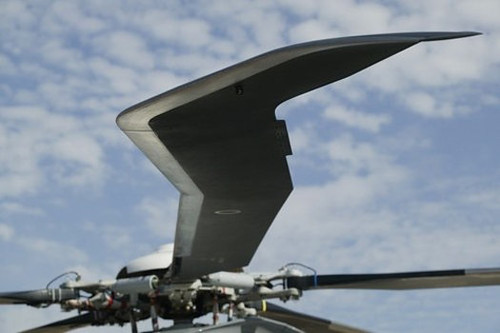
http://www.neatorama.com/2010/02/26/stealth-helicopter/
see also
http://www.propilotmag.com/archives/2010/June%2010/A4_Blade_design_p1.html
http://www.eurocopterusa.com/news_features/2010/02-22-10-heli-expo-2010-innovation.asp
WanshanLooks likely to be a pimped out Blackhawk, or at least use lots of Blackhawk parts.
160th SOAR photo – MH-60 Black Hawk Helicopter
http://www.americanspecialops.com/photos/night-stalkers/mh-60-blackhawk.php
Note the shape of the main rotor blade and its distinct leading edge
WanshanIn August 2010, Brazilian Naval Aviation announced that it will buy and modernized eight C-1 to served in the carrier onboard delivery (COD) and aerial refueling roles for use on its aircraft carrier São Paulo.
http://www.flightglobal.com/articles/2010/08/23/346412/brazilian-navy-buys-traders.html
http://en.wikipedia.org/wiki/Brazilian_Navy#Aircraft_inventory
C-1A Traders, not S-2 Tracker
The Brazilian Air Force used Trackers. They operated from the aircraft carrier NAeL Minas Gerais. Both S-2A and S-2E were used (respectively as P-16A and P-16E) at the end of its service in Brazilian Air Force, one S-2T was used as a possible upgrade, but due the high costs it was canceled.
http://en.wikipedia.org/wiki/Grumman_S-2_Tracker#Brazil
Brazil planned to perform a turbo upgrade on their Trackers, working with IMP of Halifax, Nova Scotia, to upgrade an initial machine as a prototype using PT6A engines. The upgrade was not regarded as satisfactory, the turboprops lacking adequate performance to get the aircraft back up into the air after a “bolter” on carrier deck landing, and the program was canceled. The Brazilian Trackers were then retired, one being donated to the Brazilian Air Force (FAB) museum in Rio de Janeiro, and the others were mothballed. Incidentally, although the Trackers were operated off the Brazilian Navy carrier MINAS GERAIS (named after a Brazilian state), they were flown and maintained by FAB crews. (The information on Brazilian Trackers was provided by Captain Marcio Jansen Calvacanti of the Brazilian Navy)
WanshanIs there any non radar based technology which could be used to detect low flying helicopters?
Passive radar detection e.g. Flat Box A on SA-9A TEL and Flat Box B on SA-13 TELAR1 (this would require that the helicopter emits)
Acoustic based e.g. Rafael Helispot
Infrared/ThermalImaging based e.g. Thales Air Defence ALerting Device (Adad) and Rheinmetall Defence’s Fast InfraRed Search and Track (First) reconnaisance sensor
WanshanJa Worsley strongly implied it would be permanent when he said this –
A temporary hangar is available off the shelf, needing no ship modification.
She can operate independently of the LHDs as is, with no hangar or a temporary one. She has already operated independently of any LPH or similar ship, as have her sister ships. She isn’t built or wanted as an independent amphibious assault ship.
Maybe the RAN will fit a permanent hangar in the future. Up to them. But I can’t see anything except a temporary structure like that already (temporarily) fitted being used for the time being, because of urgency, & I can’t see a large permanent hangar ever being fitted, because as well as being expensive, it would get in the way of her main function.
BTW, the news report linked to above which mentions Mexeflotes also says that a TAS (a temporary hangar of the type she’s already had aboard at times) is being bought.
My rowing boat can operate independently from the LPHs.
WanshanCombatfleets has a pic of the Shi-ling with one of the phased araay radars fitted on the port side over the bridge.
See also CDF, includes sarboard side pic IIRC
http://www.china-defense.com/smf/index.php?topic=4952.780
http://www.china-defense.com/smf/index.php?topic=4952.800


 Sign In