 Wanshan
Any chance of going back to talking about the aeroplanes now, chaps?
Thanks
GA
Demanding lil’ ******, aren’t you 😉
WanshanIndeed! Its hull was laid down in 1988, but the project was cancelled at 40% complete along with a sister ship in 1991. Scrapping began on 4 February 1992.
There were other Russian projects for carriers with catapults as early as 1968, e.g. project 1160 (1968-1972) However this didn’t find support at the secretary of the Central Committee of the CPSU D.F.Ustinova, Supervising defense questions, and was abandoned in favor of a design based on a modernized project 1143.
On the basis of executed NPKB studies on the aviabearing ships, in spring of 1976 the governmental order about designing in 1976 – 1977 and construction by 1985 of two nuclear: the aviabearing ships of the project 1153 was accepted. They were called in documents “big As cruisers with aviation arms”, but under the concept did not practically differ from the project rejected by the government 1160
In November, 1977 it is decided to conduct construction of the subsequent TAKR, beginning with the fifth ATAKR, the project which has received number 1143.5. The technical offer for the heavy aviabearing cruiser 1143.5 is developed by April, 1978. It preserves high degrees of continuity with TAKR of the project 1143.4, but the new ship is supposed to use the arms intending for the big cruisers of the project 1153.
WanshanThey are apples and oranges because of the different payloads, different fuel reserve requirements, landing on a CV vs on a runway, etc.
Which are … ? You’re not explaining anything here.
Comparing the avionics of the two is completely relevant. The question is not “which one was a better aircraft for its day”, the question is which one is a better fit for UK requirements today. Given the much better avionics, wider ordnance selection, air to air capability and much lower operating and maintenance cost of the Super Hornet, the answer is clearly not the Tornado, regardless whether the Tornado has a speed advantage in certain profiles.
A B-2 is n’t a good fighter either but, hey, that may have something to do with the purpose for which it was designed… Tornado IDS wasn’t designed to be a fighter. So judging it as a fighter makes no sense. I
As for ordnance selecion: a lot of today’s ordnance wasn’t born yet when Tornado first came online so duh.
Remember, all this in response to the statement that F/A-18E/F is “.. a better ground-attack aircraft than Tornado or Harrier; a better air-defence aircraft than (and less than a third of the price of) Typhoon.”
What is a better bomber? One that has superior a2a capability? Wider ordnance range? Lower running cost?
As far as which is better for that particular mission, as you say I would prefer not to do it at all since it is an obsolete and excessively dangerous way to do runway interdiction. The Super Hornet with its better ECM would likely be more survivable however. But the better question is, which aircraft is better able to carry out a runway denial mission regardless of specific ordnance, and in that case the Super Hornet wins.
Never said jp233 was the greatest way for knocking out your opposing number.
I was talking about air interdiction of ground targets as mission, since that appeared a previous poster’s point that the missions and profiles weren’t comparable. Both scenario’s however were interdiction missions, following a hi-lo-lo-hi profile.
Tornado actual ordnance selection:
Air-to-air missiles:
4x AIM-9 Sidewinder, IRIS-T, AIM-132 ASRAAM for self-defence
Air-to-surface missiles:
6× AGM-65 Maverick; or
12× Brimstone missile; or
4× Storm Shadow cruise missile; or
4x Taurus KEPD 350 cruise missile
Anti-ship missiles:
2× AS.34 Kormoran; or
2× BAe Sea Eagle; or
Anti-radiation missiles:
4× AGM-88 HARM; or
9× ALARM missile
Bombs:
Hunting Engineering BL755 cluster bombs; or
HOPE/HOSBO GPS/electro-optically guided glide bombs; or
Joint Direct Attack Munition; or
Paveway series of Laser-guided bomb (LGB); or
Up to 2× JP233 or MW-1 munitions dispensers (for runway cratering operations)
Up to 4× B61 or WE.177 tactical nuclear weapons
Others:
Up to 4× drop tanks for ferry flight/extended range/loitering time
RAPTOR aerial reconnaissance pod
RAFAEL LITENING targeting pod; or
TIALD laser designator pod
F/A-18E ordnance selection:
Air-to-air missiles:
4 AIM-9 Sidewinder or 4× AIM-120 AMRAAM, and
2× AIM-7 Sparrow or additional 2× AIM-120 AMRAAM
Air-to-surface missiles:
AGM-65 Maverick
Standoff Land Attack Missile (SLAM-ER)
AGM-88 HARM Anti-radiation missile
AGM-154 Joint Standoff Weapon (JSOW)
Anti-ship missile:
AGM-84 Harpoon
Bombs:
JDAM Precision-guided munition (PGMs)
Paveway series of Laser guided bombs
Mk 80 series of unguided iron bombs
CBU-87 cluster
CBU-78 Gator
CBU-97
Mk 20 Rockeye II
Others:
SUU-42A/A Flares/Infrared decoys dispenser pod and chaff pod or
Electronic countermeasures (ECM) pod or
AN/ASQ-228 ATFLIR Targeting pods or
up to 3× 330 US gallon (1,200 L) Sargent Fletcher drop tanks for ferry flight or extended range/loitering time or
1× 330 US gal (1,200 L) tank and 4× 480 US gal (1,800 L) tanks for aerial refueling system (ARS).
WanshanNot really. The SH has more room for development that was planned into the system from the start. In that sense, and keeping with the topic of this thread, the Rhino on balance is a better platform than the Tornado because of its expandability, at least IMO. But I am biased.
It is 20 years newer, of course it has advantages over an airplane of the previous generation. But none of this goes to performance.
WanshanIt is, and the range figures being thrown around are apples to oranges anyway.
Oh really? In what way? Would you like to expand on that, explain what you mean? If you have better comparison material, be my guest and provide it. At least that contributes to a relevant discussion.
Beyond that, the Super Hornet has more advanced avionics, more flexible ordnance, and is much cheaper to operate than the Tornado. Tornado was designed as a long-range interdiction aircraft and the Super Hornet wasn’t, so it is not surprising that it is longer ranged, but that doesn’t tell the whole story.
Ignoring speed and payload difference also mentioned. And, as mentioned, comparing the avionics of 2 aircraft of different generations isn’t exactly a straight comparison (esp. when the discussion started out on performance) Clearly, one would rather not have to overfly an enemy airbase to fire runway cratering ammunitions, but if you had to would you rather be in a Tornado than in a Rhino ?
(Let’s not pretent it isn’t a new aircraft relative to 18C)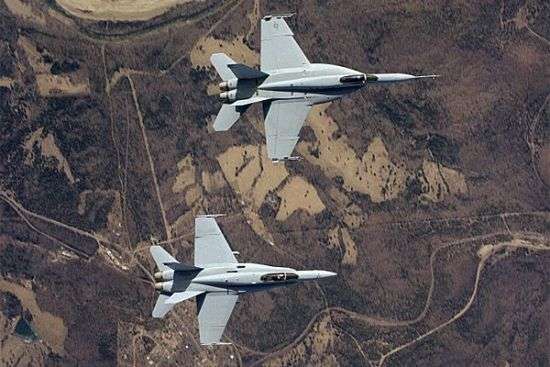
http://www.aerospaceweb.org/aircraft/fighter/f18ef/
Weight
Empty 30,600 lb (13,880 kg)
Max Takeoff 66,000 lb (29,935 kg)
Fuel Capacity internal: (F-18E) 14,400 lb (6,530 kg)
Max Payload 17,750 lb (8,050 kg)
Range
typical: 1,200 nm (2,225 km)
ferry: 1,660 nm (3,055 km)
Max Level Speed
at altitude: 1,190 mph (1,915 km/h) at 40,000 ft (12,190 m), Mach 1.8
at sea level: 835 mph (1,350 km/h), Mach 1.1
http://www.aerospaceweb.org/aircraft/bomber/tornado_ids/
Empty 31,065 lb (14,090 kg)
Max Takeoff 60,000 lb (27,215 kg)
Fuel Capacity internal: 14,000 lb (6,350 kg)
Max Payload 19,840 lb (9,000 kg)
Range
typical: 1,500 nm (2,780 km)
ferry: 2,105 nm (3,895 km)
Max Level Speed
at altitude: 1,450 mph (2,335 km/h) at 36,090 ft (11,000 m), Mach 2.2
at sea level: 915 mph (1,470 km/h), Mach 1.2
WanshanThe Super Hornet is in a spiral development path, adding planned upgrades and capabilities to the aircraft through it service life. While the airframe was designed in ~1995 and fleeted in ~2000, it systems are continuously upgraded, like adding an AESA radar, and in the next few years, the Distributing Targeting System. The fiber optic databus will allow further expansion as new systems are developed. This was one of the reasons why the Tomcat was retired earlier than expected – its adaptability to new technologies was limited.
That path is besides the point when comparing Tornado and F/A-18E. The point is that 18E is a newer generation aircraft. Not surprising, her key avionic systems and ‘backbone’ are more modern than that of Tornado. But it is not that Tornado wasn’t upgrade throughout her lifetime.
WanshanWonder if they can cross a Bronco with an Osprey for a Tilt Rotor COIN aircraft ?
In 2000, Boeing announced that the V-22 would be fitted with a nose-mounted GAU-19 gatling gun.[36] The gun was to provide defensive firepower in high threat environments.[36] The nose gun project was canceled, leading to criticism by retired Commandant James L. Jones, who was not satisfied with the V-22 armament.[37] A remote-controlled, belly-mounted, Minigun turret was later installed on some of the first V-22s sent to the War in Afghanistan in 2009.[38]
The Osprey can be armed with one 7.62x51mm NATO (.308 in caliber) M240 machine gun or .50 in caliber (12.7 mm) M2 machine gun on the loading ramp, that can be fired rearward when the ramp is lowered. A .50 in GAU-19 three-barrel gatling gun mounted below the V-22’s nose was studied for future upgrade.[67] BAE Systems developed a belly-mounted, remotely operated gun turret system for the V-22,[68] named the Interim Defense Weapon System.[38] This system is remotely operated by a gunner inside the aircraft, who acquires targets with a separate pod using color television and forward looking infrared imagery.[69] The belly gun system was installed on half of the first V-22s deployed to Afghanistan in 2009,[38] but found limited use due to its 800 lb (360 kg) weight and restrictive rules of engagement
http://en.wikipedia.org/wiki/Bell-Boeing_V-22_Osprey


WanshanWanshan :
Yes it is correct about range , payload , speed and robustness .
But it is incorrect regarding radar , avionics , etc …The Tornado has been and still is a hell of a fast mud mover , furthermore its crews always trusted it and praised it . What the Tornado did demonstrate the early days of GW1 is nothing short of outstanding .
Ah, but how fair is it to compare a system from 1975 with one from 1995: of course the latter will have newer and better gizmo’s installed. Even if the older jet was continually upgraded, the systemic basis will remain 20 years old. Just think what happened in that time frame 1975-1995 in terms of computing, for example. Wouldn’t a newer design always win such a comparison? If so, how meaningfull is such a comparison/statement?
WanshanWhat to keep in mind with a carrier based aircraft is that it can deploy much closer to its target than an land often can.
It also has inherent weight limitation that land based striker doesnt have.
Tornado
Empty weight: 13,890 kg (31,620 lb)
Max takeoff weight: 28,000 kg (61,700 lb)
Powerplant: 2× Turbo-Union RB199-34R Mk 103 afterburning turbofans
Dry thrust: 43.8 kN (9,850 lbf) each
Thrust with afterburner: 76.8 kN (17,270 lbf) each
F/A-18E
Empty weight: 30,600 lb (13,900 kg)
Loaded weight: 47,000 lb (21,320 kg) (in fighter configuration)
Max takeoff weight: 66,000 lb (29,900 kg)
Powerplant: 2× General Electric F414-GE-400 turbofans
Dry thrust: 14,000 lbf (62.3 kN) each
Thrust with afterburner: 22,000 lbf (97.9 kN) each
Unless the above figures for F/A-18E apply to landbased ops only (i.e. don’t apply for carrier ops), I don’t see much difference with Tornado. F/A-18E is in fact a tad heavier but has a far better thrust/weight ratio…
WanshanI see. That the Tornado is faster, is no doubt. As for range, don’t forget that SH is a naval figher/striker. I red somewhere that the fuel reserve for naval planes is considerably bigger than for land based planes.
Sufficiently bigger to explain the 668 km range difference? (Tornado’s given range for an interdiction mission is nearly double that given for F/A-18E!)
WanshanI wonder if the 410 might be hit as looking at the photo, the tailwheel doors are open and the wheel is partially out. (hydraulics?)
Any Me410 experts out there?
Baz
Don’t think it is supposed to hang out…
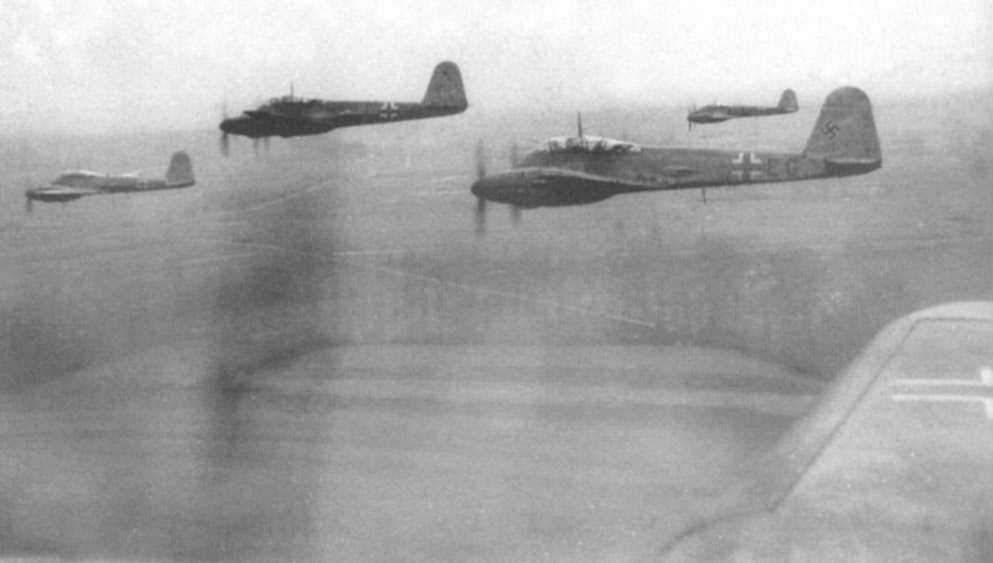
… but the photographic evidence is inconclusive!
/images/1-Me-410A1-Hornisse-ZG26.2-(3U+CC)-420292-01.jpg)
WanshanQuite a well known pic, but no less interesting.
The details of which I have no idea, but I think that’s a Messerschmitt Me410 in the shot.
Me 410 A-1/U4 version, equipped with a Bordkanone series 50 mm (2 in) BK-5 cannon.
http://en.wikipedia.org/wiki/Messerschmitt_Me_410
WanshanYou asked why the SH has 1/2 the radius of the Tornado. I tried to explain that this short(er) radius is because of the low flying profile. For mission at higher altitude, the SH radius is bigger. This is true also for Tornado, as the graphs you posted ilustrate.
No I didn’t ask that.
Tornado GR4 (IDS – interdiction-strike variant))
4× light duty + 3× heavy duty under-fuselage and 4× swivelling under-wing pylon stations holding up to 9000 kg (19,800 lb) of payload, the two inner wing pylons have shoulder launch rails for 2× Short-Range AAM (SRAAM) each
Maximum speed: 800kts IAS Mach 2.34 (2,417.6 km/h, 1,511 mph)
Range: 1,390 km (870 mi) typical combat
Ferry range: 3,890 km (2,417 mi) with four external drop tanksF/A-18E
Hardpoints: 11 total: 2× wingtips, 6× under-wing, and 3× under-fuselage with a capacity of 17,750 lb (8,050 kg) external fuel and ordnance
Maximum speed: Mach 1.8+[13] (1,190 mph, 1,900 km/h) at 40,000 ft (12,190 m)
Range: 1,275 nmi (2,346 km) clean plus two AIM-9s
Combat radius: 390 nmi (449 mi, 722 km) for interdiction mission
Ferry range: 1,800 nmi (2,070 mi, 3,330 km)I.e. Tornado carries 1 ton more ordnance/fuel over twice the combat range faster than F/A-18E?
__________________
I asked if it would not actually be more correct to state that Tornado is a better bomber than 18E, with longer range, higher speed and greater amount of payload (rather than the other way around which is what the initial post suggest i.e. that it would be incorrect that 18E is a better bomber).
As we’ve established, a typical combat mission for an GR1/4/IDS Tornado is interdiction, and its typical flight pattern would be hi-lo-lo-hi, which is what underloes the combat range figure: i.e. this does NOT explain the range difference between Tornado and 18 on an interdiction mission.
WanshanNope, the Hornet radius is so small in this type of mission because it is hi/lo/hi profile (the plane flies most of the mission at low altitudes were the fuel consumption is 2/2.5 times more than when flying high, and that’s true for any plane). For exemple in a Hornet booklet (I can’t post it because it is 7 MB) the radius for missions with high altitude flight profiles (fighter escort and maritime attack) is over 800 Nmiles.
As for max. speed you should know that it is a thoretic value. It is true OTOH that the varaible geometry Tornado could fly faster than the rather draggy SH.
The comparison we are responding to was F/A-18E relative to Tornado and Harrier on bombing mission and to Typhoon on fighter mission.
Wouldn’t you say the Tornado IDS/GR4 tends to be employed hi/lo/hi or (looking at how it was employed in the initial stages of e.g. Gulf I) lo/lo/lo, and so on comparable flight profile has better range?
Consider: “the Tornado GR.1 was conceived as a single-purpose strike aircraft, designed to come in under enemy radar and take out hostile air bases with the highly specialized JP-233 runway-cratering munitions and area-denial mines.”
http://www.flightsimbooks.com/pcpilot/page124.php
That doesn’t sound like a Tornado would typically fly in hi/hi/hi therefor I don’t quite see your point about the flight profile.
Besides, in comparison to 390 nmi hi-lo-hi interdiction mission F/A-18E, consider:
Tornado Contribution to Core Air and Space Power Activities
Air Interdiction (AI)
Lo-Lo-Lo-Lo Profile
Hi-Lo-Lo-Hi ProfileClose Air Support (CAS)
http://panavia.de/index.php?option=com_content&view=article&id=27&Itemid=44
Tornado IDS/ECR/RECCE
Combat Radius (Hi-lo-lo-hi) 1,390 km [i.e. 864 mi, 751 nmi]
http://panavia.de/index.php?option=com_content&view=article&id=19&Itemid=35


WanshanThere’s an article in the December issue of ‘Warships – International Fleet Review’, by a retired Commodore RN (former head of the Fleet Air Arm).
He wants the Royal Navy to lease 60 Super Hornets, which are currently being flown by RN pilots with the US Navy, and “..would cost less than the new engines needed to see Tornado through to the end of its service life.”
In the article, he claims that the F/A-18E/F is “.. a better ground-attack aircraft than Tornado or Harrier; a better air-defence aircraft than (and less than a third of the price of) Typhoon.”
Is it that good?
The Tornado MRCA first flew on 14 August 1974. The MRCA project was to produce an aircraft to perform in the tactical strike/reconnaissance, air defence, and maritime strike roles, allowing to replace multiple aircraft at that time in use by the partner nations. The contract for the Batch 1 aircraft was signed on 29 July 1976. Production ended in 1998. The Tornado was designed as a low-level supersonic ground attack bomber, capable of taking off and landing in short distances. This requires good high-speed and low-speed flying characteristics. In order for an aircraft to be operated efficiently at both high and low speeds, variable wing sweep is a desirable feature. Short field landing capability was considered essential in order to enable the aircraft to operate from short strips on potentially damaged runways and taxiways.
Tornado ADV first flight was late October 1979. The Tornado F2 (sometimes written as F.2) was the initial version of the Tornado ADV in Royal Air Force service, with 18 being built. It first flew in early March, 1984. Tornado F3 made its maiden flight in late November 1985. ADV entered service in 1986. It is a long-range, twin-engine aircraft, originally designed to intercept Soviet bombers as they came in from the east to strike the United Kingdom. It was designed as interceptor rather than as air superiority fighter. Its primary purpose was to carry a large number of missiles and fly them far from base over the North Sea and Northern Atlantic; once on station it needed to have good endurance, and then be able to engage and destroy targets at long range. These targets were envisaged to be formations of Soviet bomber aircraft, the engagement of which would not have required significant air combat manouverability. For this reason, dogfighting capabilities would always be a secondary consideration. Tornado F3s will retire from RAF service in April 2011.
The Boeing F/A-18E/F Super Hornet is a twin-engine 4.5 generation carrier-based multirole fighter aircraft. The Super Hornet is largely a new aircraft. It is about 20% larger, 7,000 lb (3,200 kg) heavier empty, and 15,000 lb (6,800 kg) heavier at maximum weight than the original Hornet. The Super Hornet carries 33% more internal fuel, increasing mission range by 41% and endurance by 50% over the “Legacy” Hornet. The empty weight of the Super Hornet is about 11,000 lb (5,000 kg) less than that of the F-14 Tomcat that it replaced, while approaching, but not matching its payload / range. Designed and initially produced by McDonnell Douglas, the Super Hornet first flew in 1995. Full-rate production began in September 1997. The Super Hornet underwent U.S. Navy operational tests and evaluations in 1999, and was approved in February 2000
Tornado GR4 (IDS – interdiction-strike variant))
4× light duty + 3× heavy duty under-fuselage and 4× swivelling under-wing pylon stations holding up to 9000 kg (19,800 lb) of payload, the two inner wing pylons have shoulder launch rails for 2× Short-Range AAM (SRAAM) each
Maximum speed: 800kts IAS Mach 2.34 (2,417.6 km/h, 1,511 mph)
Range: 1,390 km (870 mi) typical combat
Ferry range: 3,890 km (2,417 mi) with four external drop tanks
F/A-18E
Hardpoints: 11 total: 2× wingtips, 6× under-wing, and 3× under-fuselage with a capacity of 17,750 lb (8,050 kg) external fuel and ordnance
Maximum speed: Mach 1.8+[13] (1,190 mph, 1,900 km/h) at 40,000 ft (12,190 m)
Range: 1,275 nmi (2,346 km) clean plus two AIM-9s
Combat radius: 390 nmi (449 mi, 722 km) for interdiction mission
Ferry range: 1,800 nmi (2,070 mi, 3,330 km)
I.e. Tornado carries 1 ton more ordnance/fuel over twice the combat range faster than F/A-18E?


 Sign In








