 Wanshan
Actually, it is more from a “reduce the maintenance” perspective, as part of the ~30% reduction in ship’s company that CVN-78 achieves over CVN-77.
Urinals are, from what the USN says and from what those who have done plumbing maintenance aboard ship say, more frequently plugged-up or otherwise defective… to the level of requiring nearly twice the man-hours per urinal as per toilet.
Guys are retards/pigs when it comes bathroom use….:D
WanshanClearly politicing as there is no fact or verification or explanation in the article and statements.
French Warship for Russia ‘Won’t Work in Cold’ – Minister
RIA Novosti 17:50 26/01/2013MOSCOW, January 26 (RIA Novosti) – Two amphibious assault ships bought for the Russian Navy from France in a 1.2 billion euro deal will not be able to operate in temperatures below seven degrees centigrade, Russia’s Deputy Prime Minister Dmitry Rogozin admitted on Saturday, in critical comments about the contract.
‘It’s very odd that ships for offloading a landing force, floating in our latitudes won’t work in temperatures below seven degrees,’ said Rogozin, who has special responsibilities for the defense industry, in a meeting of the Academy of Military Science on Saturday.
‘Maybe they thought we’re going to undertake special operations in Africa but I doubt that’s going to happen,’ he added. He did not elaborate on why the ships would not work in cool temperatures. It was also unclear whether he meant plus seven degrees or minus seven, as Russian-speakers often leave out the word for minus when they assume it is clear which side of freezing they are talking about.
It is the second time this week that the Mistral deal has come under fire from a senior defense official. On Thursday, Military-Industrial Commission Deputy Head Ivan Kharchenko described the deal to buy the ships as “absurd,” saying the deal had inflicted harm on the Russian shipbuilding industry.
I suppose if all water is frozen, your floating dock isn’t much good…. but is that a design flaw?
WanshanWow! Such a huge structure being moved by a single crane.
I wonder how much that island weighs.
555 tons (493 tons of structure, 62 tons of equipment). The island was the 452nd lift of nearly 500 lifts involved in the construction. And … on a side note …. she will not have urinals (i.e. more gender neutral facilities will be provided)
http://wtkr.com/2013/01/26/live-stream-island-lifted-aboard-the-gerald-r-ford-aircraft-carrier/
http://events.tvworldwide.com/Events/HIINNS/CVN78IslandLanding.aspx
http://en.wikipedia.org/wiki/USS_Gerald_R._Ford_(CVN-78)
Wanshan:confused:wtf?
WanshanYou do realise they are all blokes.
:D:rolleyes::rolleyes:

WanshanHmm, and here I though that it got 1 × 8-cell Mk41 VLS w/ 32 × RIM-162 ESSM!
And that this means it got 32 surface to air missiles.
You do know that each cell have 4 missils, so total 32 missils 😉
You forgot to mention that Ticonderoga CG has only 4 Raytheon/RCA AN/SPG-62 and Burke DDG only 3, so for a frigate FFG a pair is not bad. 😉
WanshanWhat’s up with that Krivak they acquired?
WanshanWanshanMachines capable of vertical flight have to compromise between hover performance and speed. The highly prized attributes of good hover efficiency and hover endurance, low speed controllability and low downwash mean that forward speed is severely limited. In that context, it should be considered that the Westland Lynx holds the official world speed record for helicopters. That attribute (speed) probably also applies for the Wildcat and is particularly usefull in the naval context (getting within range of a sub or surface target). Another strengths of the Lynx is its impressive manoeuvrability: it is able to do rolls and loops that other helicopters cannot, and that combined with high speed make for an interesting package.
WanshanDo some searching & research on MAW (Mission Adaptive Wing) done back in the late 80’s. Did not curve in as many degrees of freedom as your drawing, but similar (and was almost the subject of my senior design project in college).
Indeed, iirc there even was a NatGeo issue in the Nasa F-111 test aircraft.
See:
http://flxsys.com/pdf/NATO_Conf_Paper-KOTA.pdf
http://spaceflightgtm.nasa.gov.speedera.net/centers/dryden/pdf/88274main_H-1855.pdf

Xtra big here: http://www.dfrc.nasa.gov/gallery/photo/F-111TACT/Large/ECN-3931.jpg
WanshanYeah, but PdA isn’t an off the peg SCS. The Spanish started with the SCS design, & modified it to optimise it for STOVL, not VTOL & helicopters like the original. They didn’t just tack on a ski-jump, as was done with the Invincible class after building had started.
SCS
Aircraft carried:
3 x AV-8A Harrier VTOL
3 x SH-2 Seasprite LAMPS I
14 x SH-3 Sea King
…
The SCSs were smaller than most fleet aircraft carriers, and the concept was seized upon by nations wanting cheap aircraft carriers. Spain’s flagship, Principe de Asturias (R11), and her smaller cousin ship, Thailand’s HTMS Chakri Naruebet, were based on the final US Navy blueprints for a dedicated sea control ship, but with the addition of a ski-jump ramp and follow a similar mission profile. As currently configured, the Italian aircraft carrier Giuseppe Garibaldi (551) would also fit under the SCS description.
http://en.wikipedia.org/wiki/Sea_Control_Ship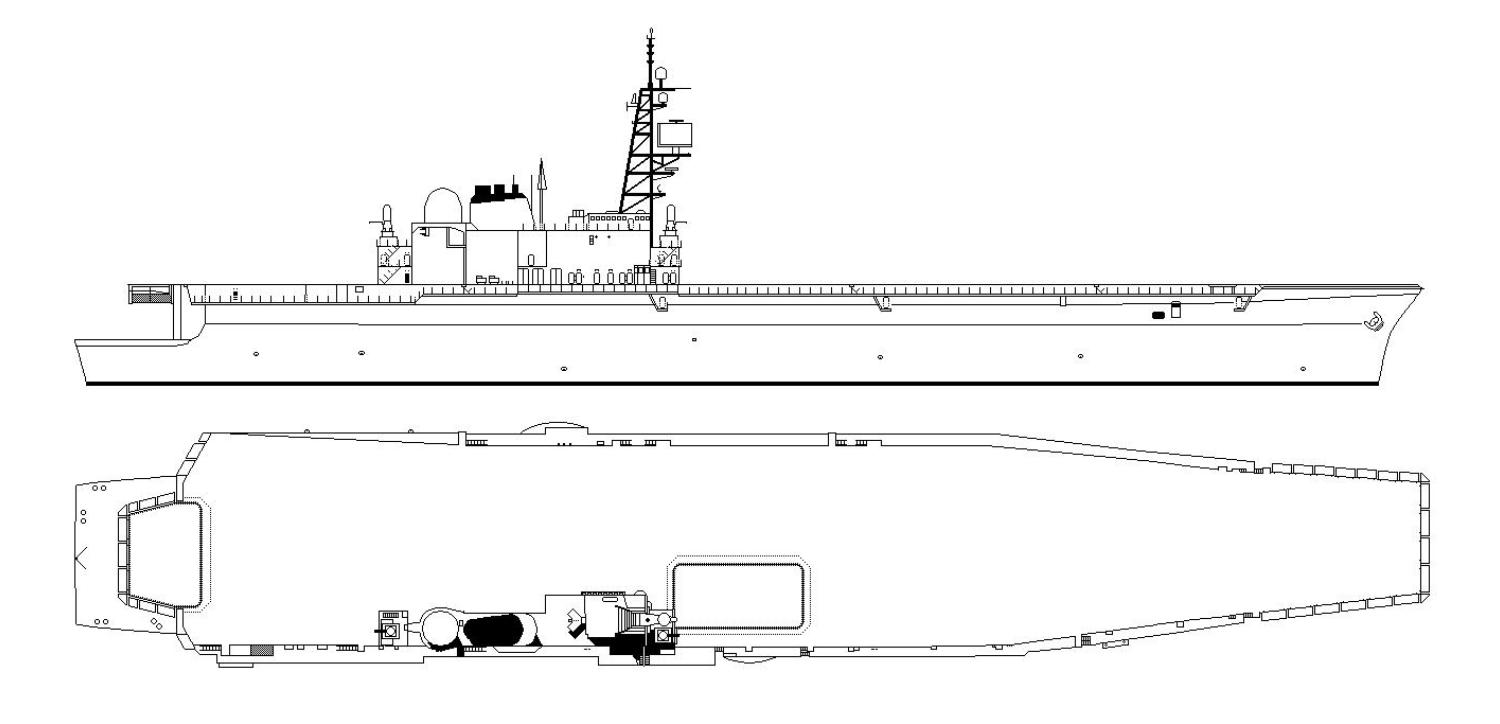

PdA
The design is basically that of the initial US Navy’s Sea Control Ship design of the 1970s, modified with a ski-jump ramp added to better enable V/STOL aircraft takeoff.
http://en.wikipedia.org/wiki/Principe_de_Asturias_(R11)
The layout of the ship was partly derived from the design of the US Navy Sea Control Ship.
…
The ship supports up to 12 AV-8B Harrier II Plus and Harrier II (being upgraded to Harrier II Plus configuration) aircraft.
…
The carrier also has facilities to support up to 12 helicopters, usually six Sikorsky Sea King SH-3H, four Agusta AB-212 and two Sikorsky SH-3 AEW helicopters.
http://www.naval-technology.com/projects/asturias/
Garibaldi
Her air-arm consists of either a maximum sixteen AV-8B Harrier IIs, or eighteen Agusta helicopters or a mix of helicopters and fighters.
http://en.wikipedia.org/wiki/Italian_aircraft_carrier_Giuseppe_Garibaldi_(551)
The ship can accommodate up to 18 helicopters, such as the Agusta Sikorsky SH-3D Sea King or the Agusta Bell AB212. Alternatively, the Garibaldi can accommodate 16 AV-8B Harrier II aircraft, or a mix of helicopter and Harriers.
http://www.naval-technology.com/projects/garibaldi/
Cavour
8 x AV-8B Harrier IIs (combat jet)
12 x EH101 AEW/HEW and other helicopters
http://en.wikipedia.org/wiki/Cavour_(550)
The ship can support eight VTOL (vertical take-off and landing) aircraft such as AV-8B Harrier or F-35 joint strike fighter VTOL variant, or 12 helicopters, such as the EH101, NH 90 or SH-3D, or a mix of platforms.
WanshanAccording to some spanish colleagues, it really seems the PdA will be scrapped.
Unless some country shows interest in her and she will be OFFERED, the purchasing country just having to spend the costs of refitting at Navantia(!!!!)
Hello ,Chile?????
Never used that word.
WanshanPrincipe de Asturias is heavily optimised for STOVL aviation, having been designed from the keel up for it. Invincible & Ark Royal were originally designed for helicopter operations only, & both have demonstrated their suitability for use as LPHs.
The Sea Control Ship (SCS) was a small aircraft carrier developed and conceptualized by the United States Navy under Chief of Naval Operations Elmo Zumwalt during the 1970s. Currently the term refers to naval vessels that can perform similar duties. The SCS was intended as an escort vessel, providing air support for convoys. It was canceled after budgetary cuts to the US Navy.
The SCS was to be equipped with a mix of Rockwell XFV-12 fighter aircraft and anti-submarine warfare helicopters. It was tasked with carrying out anti-submarine warfare operations.Spain’s flagship, Principe de Asturias (R11), and her smaller cousin ship, Thailand’s HTMS Chakri Naruebet, were based on the final US Navy blueprints for a dedicated sea control ship, but with the addition of a ski-jump ramp and follow a similar mission profile. As currently configured, the Italian aircraft carrier Giuseppe Garibaldi (551) would also fit under the SCS description.
WanshanIn addition, these three ships are now old. There is not that much service life left, therefore there value would be questionable, especially, if they have to be converted for their new role.
R11 PdA commissioned 1988 > 25 yr
R07 Ark commissioned 1985 > 28 yr
R06 Ill commissioned 1982 > 31 yr
Note the typical age at which OHPs got transferred to non-US navies and thaqt all but 1 of all Perry’s are older than PdA. Heck, there’s a number of navies still operating Knoxes! Mexico still operated and Edsell and a Gearing class ships (1943 and 1945 respectively). Phillipines still operates a Cannon class destroyer escort (1943), Auk class and Admirable class minesweepers (1943-1944). Note the age of e.g. HMS Hermes, which commissioned 1959 and is expected to serve to 2020 (61 yr).
That is in the eye of the beholder imho.
WanshanOne of the Gripens apparently transferred its refueling probe to one of the KC-10’s in mid-air so they diverted to Mildenhall.
:rolleyes::D


 Sign In








