 Wanshan
would you say that in terms of frigates, the Indian ship building industry is now capable of building better ships than Russia
No, I wouldn’t, because we’ve not yet seen (apart from the Steregushy corvette/light frigate) what the new generation of Russian vessel will be like and how they will be equipped. I am convinced the currently building project 22350 won’t be inferior to P17. And then we’ll have to see if they come up with a new destroyer (which will be substantially larger than these frigates, when it comes)
WanshanCame across this on a vietnamese forum: Talwar model with 3×12 cell VLU in place of current 24 round SRL.

Wanshan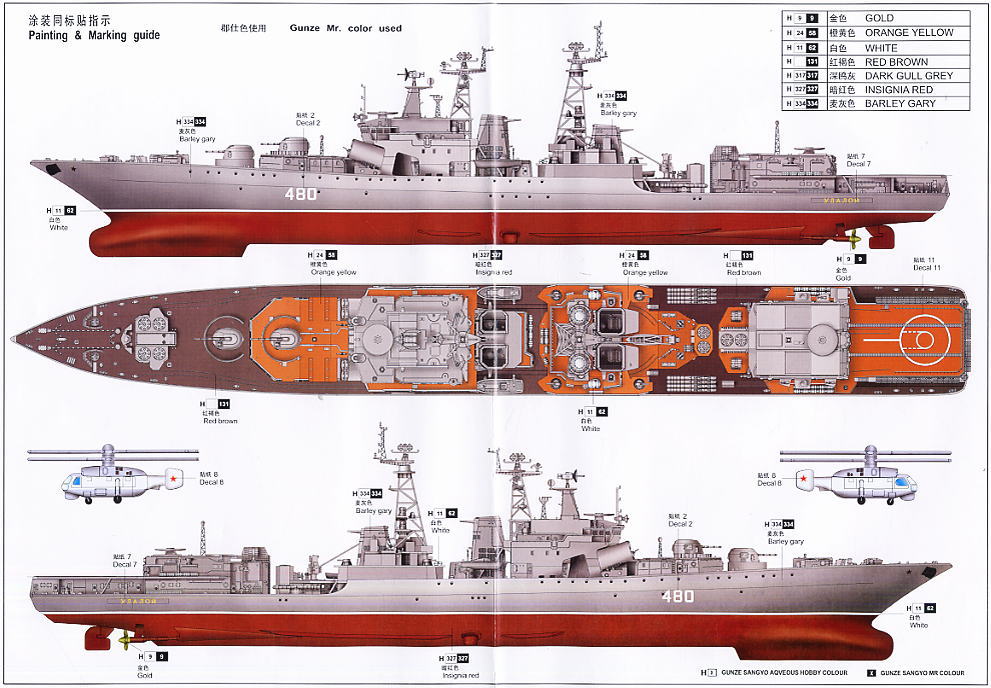
See also here, for another model of a derivative: http://archive.kaskus.us/thread/1112360
WanshanOkay… those pics help put it in perspective. But the similarity is fairly slight. It’s not the same as that between the old Krivaks and Talwar; aside from the lower part of the hull and the positioning of some superstructure elements the two designs have very different shapes.
With all that space only six Rif-Ms is a real waste.
Balony! All key superstructure characteristics are the same. The twin hangars are identical, for example. As is the lay out of the stacks (because it uses the same powerplant. The modification is reminiscent not only of the mode from Krivak III to Talwar, but also of the kind of (Servernoye helped) modifications of the Delhi (P15) design to turn it into the Kolkata (P15A).
project 11550
project 21956
Severnoye has produced several other proposals for modified Udaloy I/II, of which 21956 is perhaps the most comprehensive modification. Here’s an example (note how the decks are beginning to get more enclosed):


WanshanSorry, can’t see much of a resemblance. But in the 21956 pic what is that planar array radar in front of the main mast? It looks like Podberezovik-ET2.
And is the radar on the smaller rear mast the Tombstone illuminator?
The big planar radar IS Tombstone. On the mainmast is Fregat-M and on the rear mast is a smaller member of the fregat family to support the 2 Kashtan units.
A blind man can see the lineage. If you can’t see the resemblance than there is something seriously wrong with your eyes or you are just being obnoxious.
The hull line over the top of the number 543 is exactly the same as on 21956, which has an enclosured rear where the Udaloy has an open rear. The Kashtan on the 21956 is where the two AK630 are on the Udaloy. When you extend a horizontal line from the bow rearwards to the Bass Till / AK630s platform and you enclose the sides, you essentially have the 21956. The small rear mast on the 21956 is about where the tall main mast of the Udaloy is. The main mast of the 21956 is about where the forward secondary mast of the Udaloy is. The Tombstone is roughly in the place of the Kite Skreetch missile tergeting radardirector and the Mineral ME is roughly just a little forward of position of the Cross Sword SAM control radar.
Severnoye did very much a similar thing when developing the Talwar from the Kirvak III.
WanshanI was fairly sure both active and passive radar could be installed on the same ship. That’s how it is with the Garpun-B, anyway.
It is not 2 radars but a single radar that can operate actively (i.e. emit and receive) as well as passively (receive only, with another radar elsewhere – friebdly or otherwise – acting as emittor). In that sense, it is no different from dedicated ESM gear, except that it is integrated into a radar system.
From your own source:
Composition
• active radar channel
• passive radar channel
• equipment used by both channels (multiband dish antenna, control panels, power management unit, antenna hydraulic drive, high-frequency channels, and offset antenna)The radar makes coordinated use of active and passive channels to acquire and designate targets. It boasts increased operational range thanks to employment of high-energy active channel, advanced methods of signal generation and complex modulated signal processing, coupled with passive channel data, and requirements of covert operation, in severe ECM and sea clutter conditions.
The active channel uses a multiprocessor system to generate probing signals and radar data. It is integrated with a multi-computer secondary data processing, control and display network.
The passive channel performs hardware/software-based analysis and classification of incoming radar signals by comparing their parameters with those available in the database (up to 1,000 entries).
WanshanMineral-ME shipborne radar system is intended to control missile armament system and provide over-the-horizon early radar acquisition and target designation on virtually all types of ships.
The system comprises:
– Mineral-ME1 active radar (ARdr),
– Mineral-ME2 passive radar (PRdr),
– Mineral-МЕЗ data exchange and orientation radar (DEORdr).
All radars are built around a single design base
Active radar
Passive radar
Datalink
Courtesy http://www.concern-agat.ru/en/production/75-typhoon/91-mineral-me
It still is like ESM integrated into a weapons targeting radar: someone else will do the active bit.
WanshanI didn’t know that. Where did you read it? The 21956 design is over 1000 tonnes heavier thanthe Udaloys and has an almost completely different weapon and sensor suite.
But yes, it’s likely that whatever new destroyer the Russian navy decides on will look nothing like the 21956. It’s based on older systems like the Fregat radar and S-300FM SAM whereas any new destroyer will likely leverage the new systems developed for the Admiral Gorshkov frigates.
Designation: Project 1155 Fregat I / Udaloy-I
Displacement (tons): 6,200-6,700 tons standard, 8,200-8,404 tons full load
Dimensions (m): 163.0 meters long, 19.0-19.7 meters beam, 7.87.9 meters draft
Designation: Project 1155.1 Fregat II /Udaloy-II
Displacement (tons): 6,200-6,700 tons standard, 8,200-8,900 tons full load
Dimensions (m): 163.0-164.0 meters long, 19.3 meters beam, 6.2-8.0 meters draft
From : http://www.globalsecurity.org/military/world/russia/1155_1-specs.htm
Project 21956 Multi-purpose Ship
Full displacement, tons: ab. 9,000
Overall length, m: 163.0
Overall width, m: 19.00
Mean draught at full displacement, m: 5.55
From: http://spkb.air.spb.ru/en/offers/warships/21956/


Wanshaninteresting you would rank lanzhou so high.. what about De Zeven Provincien, Sachsen, etc? I noticed many of your corvettes are also quite old
That’s just my top five favorites, not todays top 5 as in ‘the ultimate’ in rank order.
I so want to include CGN Long Beach somewhere…..
There aren’t that many (new) corvettes: Commandanti class, Barroso class (light frigate), Lekiu (light frigate), Steregushy (light frigate)
Wanshanwhere would you place the Cavour then?
Cavour doesn’t have a well-deck/dock
where would you place De Zeven Provincien on this list?
Logically at the same place a Sachsen (same AAW fit, similar in most other important respects)
WanshanWhy do you include the Kidd class?
Why not, that’s what it is isn’t it? Besides, it’s a more allround unit than the ASW oriented Spruance and the AAW oriented Ticonderoga (which is called a CG anyway). THe assignment didn’t state that only the lated models of ships could be included. Kidd is a KA destroyer in my book.
And how to define “destroyer”? E.g. there is no big difference in size and capabilities between the Dutch LCF/German F124/ Spanish F100 and the Type 45/Horizon/Type 052C – especially if you consider the difference between the Horizon class and the Sejong the Great class!
I haven’t. I have taken the classification given by the parent navy at face value i.e. the Brits call Type 45 a destroyer, the Dutch call the LCF a frigate as do the Germans the F124 (which is an altogether different ship, albeit with similar sensor and weapons fit) and the Spaniards the F100.
Official classifications are somehow useless if you compare “cruisers”, “destroyers” and “frigates” – and if you compare e.g. the Dutch frigates of the De Zeven Provincien class and the French frigates of the Floréal class.
Agree, look at how USN used to classify its ships. USN Guided Missile Cruisers with Nuclear Propulsion (CGNs, like e.g. Bainbridge) were once called DLGN = Guided Missile Frigate, Nuclear Propulsion.
WanshanTop 5 super carriers:
“Supercarrier is an unofficial descriptive term for the largest type of aircraft
carrier, usually displacing over 70,000 long tons. The U.S. Navy currently has 11 such ships. In comparison, a few countries operate medium carriers of around 40,000 tons (such as Charles de Gaulle), whereas light carriers closer to 20,000 (such as HMS Illustrious) are more typical. Supercarriers are the largest warships ever built.”
http://en.wikipedia.org/wiki/Supercarrier
If focus is on actual (rather than projected) ships then there is no real choice here but US ships. I.e. not really interesting.
Top 5 LHD
“Landing Helicopter Dock (LHD), is the US Navy hull classification symbol for multipurpose amphibious assault ships which are capable of operating helicopters and have a well deck.”
http://en.wikipedia.org/wiki/Landing_Helicopter_Dock
By this definition, there are only 5 possible contenders, of which two are US ships and clearly the largest and most capable:
Wasp (LHD 1) class
Tarawa (LHA 1) class
Juan Carlos I (BPE) class & derivative Canberra class
Mistral (BPC) class
Dokdo (LPH 6111) class
Top 5 LPD ( + LSD)
– San Antonio Class
– Whidbey Island / Harpers Ferry classes
– Galicia/Rotterdam/de Witt/Bay classes (Enforcer series)
– Albion Class
– Type-071 (Yuzhao) class
Top 5 guided missile destroyers
– Arleigh Burke/Kongo/Atago/Sejong the Great class
– Kidd class
– Daring (Type 45) class
– Horizon/Orrizonte class
– Lanzhou (Type 052C) class
Top 5 corvettes
– Niels Juel class
– Minerva class
– K130 Braunschweig class
– Commandante class
– A69 aviso
WanshanRussian design bureaus already have multiple designs ready for a new large destroyer(most prominently the Project 21956, a real beast that was displayed in an older thread). It only remains for the Russian Navy to finalize one for production, which they’ll do in 2012 or assuming no funding problems.
Based on the venerable Udaloy hull but fitted with more modern weapon and sensor systems.
They will be building projects 20380 and 22350 for a bit before they come up with something of a modern destroyer and judging from the corvette and frigate design adopted, I doubt that destroyer will be a rehashed Udaloy but rather something more innovative (if we’ll see a destroyer at all).
WanshanAgreed.
But the RSAF and other Asian E2 operators used it as an AEW. So it is relevant to them.
All I’m saying is that an enhanced E-2 derivative with an APY-9 radar and C3 capabilities on a different aircraft platform would have been another contender.:rolleyes:
The Israeli Air Force has purchased 3 Gulfstream G550 aircraft to serve as the new IDF platform for its new generation of AEW systems.[4] The system is called Eitam. Extensive modifications made to the Gulfstream’s fuselage, such as the addition of protruding composite radomes, are intended to allow for the housing of the radar arrays. In 2007, 4 similar G550-Phalcon aircraft were also purchased by the Republic of Singapore Air Force, to eventually replace its upgraded E-2C Hawkeyes. All 4 G550s are expected to be in-service by 2010
http://en.wikipedia.org/wiki/EL/M-2075

Singapore Air Show 2010: An operational G550 CAEW of 111 Squadron Republic of Singapore Air Force on display
Wanshan” Electronic Support Measures (ESM) describe the division of electronic warfare involving actions taken under direct control of an operational commander to detect, intercept, identify, locate, record, and/or analyze sources of radiated electromagnetic energy for the purposes of immediate threat recognition (such as warning that fire control RADAR has locked on a combat vehicle, ship, or aircraft) or longer-term operational planning.”
http://en.wikipedia.org/wiki/Electronic_Support_Measures


 Sign In








