Wanshan
Most pics of carriers sinking in wartime show them rolling over before sinking, there are not pics of carriers ‘with their back broken’ afaik. Even in WW2 it usually took multiple hits by 500-1000 lb bombs and/or 553mm torpedoes.
WanshanThe only thing odd about this is the Israeli ship, the rest is just the Truman group which is on a routine deployment.
The treaty governing the use of the canal specifies that Egypt must allow passage of warships, even of belligerents, even in wartime.
WanshanThat looks like this:


Scene at Stead Airport, Nevada, June 9, 2008. Aero Vodochody L-29 Delfin in Russian Winter markings on the ramp.
http://www.silverstatenews.com/stead1.htm
On October 2, 2007, an unmodified L-29 was used for the world’s first jet flight powered solely by 100% biodiesel fuel. Pilots Carol Sugars and Douglas Rodante flew their Delphin Jet at Stead Airport, Reno, Nevada in order to promote environmentally friendly fuels in aviation
Between September 10-14, 2008, two L-29s took first and second at the Reno Air Races. Both L-29s consistently posted laps at or above 500 miles per hour. Former Astronaut Curt Brown took first in “Viper,” followed by Red Bull Racer Mike Mangold in “Euroburner.”
http://en.wikipedia.org/wiki/Aero_L-29_Delf%C3%ADn
By the way, there’s a second in black and gold (yellow) right next to the blue and grey one on the LHD!.
In recent years, the L-29 has become popular on the jet warbird market, mostly in the USA, but also in England, Italy and South Africa.
http://www.warbirdalley.com/l29.htm
These are privately owned. The plane is probably hitching a ride on the LHD (transport, not ops).
The owners of those L-29 planes (N179EP a.k.a. #79 and N5959L), Tactical Air Support, Inc., also own a Su-27 that operates as an aggressor in the US.
Our Aero Vodochody “Super Delfins” have upgraded engines (replacing the original engine with a Pratt & Whitney J-60) with increased fuel efficiency and a startling 50% increase in maximum thrust. With its reduced weight and increased power, our L-29s have the same thrust-to-weight ratio as the USAF’s A-10, will do 425 KCAS at sea level with a 12,000 fpm climb rate. Equipped with modern avionics, including UHF radios and GPS, this rugged jet is the perfect low cost training or test platform. The Super Delfins are ideal for basic air intercept targets, and initial, no-drop forward air controller (FAC) training.
http://www.airfighters.com/photosearch.php?key=N179EP
http://www.airfighters.com/photo/50202/M/Russia-Air-Force/Aero-L-29-Delfin/N179EP/
http://www.airfighters.com/photosearch.php?key=%20N5959L
http://www.airfighters.com/photo/50201/M/Czech-Republic-Air-Force/Aero-L-29-Delfin/0909/
WanshanWhy? Isnt it a fairly common occurence? :confused:
It is, and a requirement by international treaty. But not surprising the govt opposition is angered by it, though.
According to the nationalisation act, SCA is bound by the Constantinople Convention of 29 October 1888 which grants the right of free access and use of the canal at equal conditions to all ships, commercial ships and ships of war, in times of peace or of war, even to ships of belligerent parties.
WanshanThe Brazilians routinely run on ships well past 20 years. They buy 20 year old ships!
I know.
No, it’s increasing from 9 or 14 (depending on your definition of ‘main surface combatant’) to 18 or 19, plus a shifting of workload from the smaller members of that fleet to another 10 new OPVs. The number of vessels above 1000 tons increases from 14 to 28 or 29. The total tonnage increases more. The number of hangar spaces increases from 10 to 28 or 29.
Major warships (not missile boats etc).
Are the OPVs operated by the navy of civilian agencies?
I’ve not argued that they’re interchangeable (though the new OPVs will have greatly superior helicopter support facilities to the current corvettes, which gives them a significant combat potential despite their lighter weapons). What I’m trying to get across is that your comparison is too simplistic. You can’t draw a line & say “we’ll only consider ships above this line”, because the roles those ships have to perform is affected by the other ships in the fleet.
I didn’t perform an advanced analysis but responded from the hip to a from the hip statement about FREMM numbers being relatively large or small
The Macaé class will be able to replace the taskings of everything up to the Bracuí class, while expanding patrol coverage. The Comandante OPVs will replace the two ancient (50+ years old!) Imperial Marinheiro class, & extend the patrol fleet’s range into areas currently covered only by the Inhaúma class & larger ships. I don’t understand why you can’t see the effect that has on the corvette & frigate fleet. It’s effectively increasing the size of the fleet, by relieving it of taskings. Those 18 FREMMs will all be able to be dedicated to tasks which currently only the frigates are devoted to.
Who says I don’t see the effect on tasking?
Let’s nott make this a hefty argument, because it is not really worth debating.
WanshanBut you are failing to take account of what is happening to the rest of the fleet. Remember the 10 Comandante class OPVs (1500 tons). Also, Barroso is new, therefore not likely to be replaced by FREMMs, & was planned to be the lead ship of a new class – though I’m not sure if any more will be built.
No, I’m not. If the Barroso is the newest ship of the fleet then it will be replaced by the last FREMM entering service. If the FREMM enter service at a rate of 1 per year, starting now, she would by that time be 20 years old (from date of commisioning). You can figure out the variations.
18 FREMM plus 10 Comandante plus (if all built) 27 Macaé patrol vessels implies a large increase in both total numbers, & in tonnage at each tier. Brazil now has 31 pre-2000 frigates, corvettes, & patrol boats over 200 tons. It seems they are to be replaced by 55 vessels.
New:
18 @ 6000 tons
10 @ 1520 tons
27 @ 500 tonsOld:
3 @ 4400 tons
6 @ 3700 tons
4 @ 1970 tons
2 @ 960 tons
4 @ 700 tons
12 @ 215 tons (oldest built 1993)There will be an overlap in roles. The large numbers of new patrol vessels will take over tasks now done by the Inhaúma corvettes, as well as the ancient Imperial Marinheiro corvettes, Bracuí OPVs & smaller patrol boats.
Since the original discussion was that 18 FREMMS was a lot and would mean considerable fleet expansion, I’ve not loooked at small craft (less than 1000 tons). And when you look at the main surface combattante, the number remains roughly at 18.
Given the amount of coastline Brazil has, an increasing in quantitiy of small craft is not surprising. In line with general naval trends, ave. tonnage is increasing. OPVs and corvette may have overlapping tasks but are vastly different in their combat capabilities and should not be seen as interchangeable.
WanshanOf which 5 are corvettes, & which were never all in service at the same time. All the Garcias were decommissioned before Barroso joined the fleet.
Paraíba (D-28) – decommissioned 26-07-2002
Paraná (D-29) – decommissioned 26-07-2002
Pernambuco (D-30) – decommissioned 11-03-2004
Pará (D-27) – finally retired 12-11-2008.There is now a new Pará, according to the Brazilian navy website, a river transport commissioned in 2005.
Four Type 22s were commissioned in 1996-97. For a few years, until the Garcias & Dodsworth (Brilliant) were retired, there were 14 destroyers & frigates in Brazilian service, but 4 of those were over 30 years old. 18 FREMMs would not only put numbers above that peak, but be a much more up to date fleet, when compared with leading navies, than in the past.
At 1,785 tons standard (2,350 tons full load), one might well consider Barrosso a light frigate (FFL). Likewise the Inhauma class from which is was developed: 1,670 tons standard, 1,970 tons full load. The two are at the very top-end of the range that might be called corvette. Compare: Lekiu class (2,270 tons full load), Jiang-Wei class (2,393 tons full load).
My point was however the overall number of main surface combattants:
6+3+4+1 = 6+4+4 = 18
If you start taking in FREMMS and replace the oldest ships first, then essentially the total fleet number is not expanded though the overall capability is uprated.
WanshanPernambuco (D30)
Paid off 11 March 2004. “Desativado em definitivo em agosto de 2005.”Pará (D-27)
“Na reserva” – “A mostra de desarmamento do CT Pará ocorreu em 12 de novembro de 2008”Decommissioned 12th November 2008. Currently the subject of a campaign to preserve her as a museum ship.
6 Niteroi
3 Type 22
4 Garcia
4 Inhauma
1 Barosso
> 18 ships.
WanshanQuite true, and a good plan.
Not really, they currently have 5 corvettes, one of which is new (2,350 tons full load), and 4 x 15-20 year old (1,970 tons full load).
They also have 15 OPVs, one of which is a new Franco-Brazilian design. Another of this type is under construction, and 4 more are planned.
http://en.wikipedia.org/wiki/List_of_ships_of_the_Brazilian_Navy
In addition to 6 Niteroi and 3 Type 22, aren’t there also 2 ex-USN Garcia class frigates in reserve?
Pará (D 27), ex USS Albert David (FF-1050) (sits in reserve).
Paraiba (D28), ex USS Davidson (FF-1045) (sank while under tow to India to be scrapped)
Paraná (D 29), ex USS Sample (FF-1048) (scrapped in Pakistan, 12/2004)
Pernambuco (D 30), ex USS Bradley (FF-1041) (placed in reserve)
WanshanCivilian shipbuilding in Nikolayev is part of the deal
As I said, it is remarkable. It’s another clue that perhaps Nikolayev capacity may at some point come available to the Russian navy again (Kuznetsov overhaul, or new CV). And if not that actual yard itself, then at least their expertise with building large ships.
WanshanSeems to be official confirmation of previous speculation….
…..
Ukraine will build Russian ships
The Black Sea Shipyard in Nikolayev and a number of Ukrainian companies will be transferred to the United Shipbuilding Corporation (USC).
The USC will get minority and blocking packets of shares from several Russian companies, specializing in export and import of vessels and equipment. The USC will also be granted tax relief.
This information became known after the meeting of the Security Council of Russia. The State will provide support to the shipbuilding industry of Russia, but the industry will be strictly accountable for the effectiveness of it’s spending of funds, said the RF Security Council Secretary Nikolai Patrushev to reporters.
“State orders there will be, but control will be tightened”, – said Patrushev as reported by Itar-Tass.
continued in Russian at (it goes on about the restructuring of the shipbuilders around Russia and tax incentives) :
http://nnm.ru/blogs/shamba/ukraina_budet_stroit_rossiyskie_korabli/
Remarkable, considering:
United Shipbuilding Corporation (Russian: Объединённая судостроительная корпорация) is a open joint stock company in Russia which unite shipbuilding, repair and maintenance subsidiaries in western and northern Russia, and in the country’s Far East, to streamline civilian shipbuilding using military facilities. The corporation was established by a series of Presidential Decrees signed by President Vladimir Putin. According to the decree, the corporation has 3 subsidiaries: the Western Shipbuilding Center in St. Petersburg, the Northern Shipbuilding and Maintenance Center in Severodvinsk and the Far Eastern Shipbuilding and Maintenance Center in Vladivostok. The state owns 100% of the shares.
http://en.wikipedia.org/wiki/United_Shipbuilding_Corporation
WanshanNice drawing now all they need to do now is to get that Russian Aircraft Carrier fired up. Now here comes to tricky part they still need a functioning engine to make the Varyag work.
Somehow I think they have managed to fix/finish/refit the steamplants (improved version of plants on the Sovremanny’s, and similar to 051C)
What about the protection and defensive weapons? Perhaps a purchase of 6-8 Kashstan systems and adding on VLS HQ-16 Sams could help.
Type 730 ‘Goalkeeper clone’ plus FL3000 ‘RAM clone’ and a few HQ-16?
Having a Radar, adding the Electronics, and Sensors would be the tricky part the Varyag is such a big ship and much wiring and time is needed to integrate everything all together.
How so? I don’t see enything that hasn’t already been put on and made to work together on Type 052C.
In the end of the day China would still have to go back to Soviet Moscow for help in some areas especially a must to acquire the more capable duel rotor Kamov Ka-27/31 Helicopters to defend itself in anti-submarine warfare.
Why wouldn’t Z-9C/D suffice for ASW? Escorts will have Ka-27. Z-8 could well serve as base for AEW aircraft, if a more powerfull helicopter was needed, and could be fitted with the same (or better) ASW/ASuW suite as Z-9C/D if necessary.
I still think China should just buy the off the shelf Sea Flankers that Russia offered them Su-33 (modernize to least MK3 standards or better) that way they could have a competent aircraft and slowly work their way into maturing their J15 pet project until its ready. Because the last thing they need is a Naval conflict with the USN and having unproven aircraft flopping or engine malfunctions breaking down in a heated exchange if that were to happen it won’t end well.
That would be a short term fix, but a longer term ability to manufacture domestically has important advantages, even if the product is of lesser quality/capability (which I am not saying it is)
WanshanBe careful Wanshan, the Rafale deal in Brazil is not yet a done deal….
Regards,
Hammer
Neither is flying J15 off the skijump-less Sao Paolo
WanshanThat nation though is home to the worlds largest producer of iron ore, so China is quite interested in getting cosy with the government there. Especially since relations with Oz under our “sinophile” PM don’t seem to have worked quite as they may have hoped. We’ve pursued a national agenda, who would have guessed?
Dan
It procuring Rafeles already, and would need a new carrier first in order to operate this J15.
Wanshan
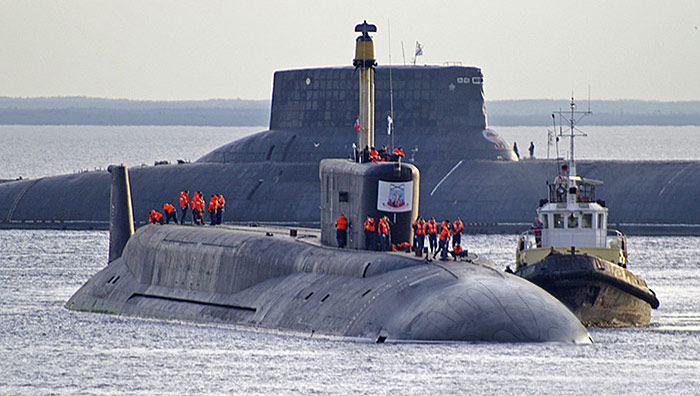
That Typhoon is a huge mother. 😮
Multi-hulled design – five inner hulls are situated inside a superstructure of the two parallel main hulls. In the main body of the sub, two Delta class pressure hulls lie parallel with a third, smaller pressure hull above them (which protrudes just below the sail), and two other pressure hulls for torpedoes and steering gear.
Displacement:
a) surfaced: 23,200–24,500 t (22,830–24,110 long tons)
b) submerged: 33,800–48,000 t (33,270–47,240 long tons)


 Sign In