Don’t-cha love the exaggerated hype these shows give such things?
That glider-towed “testing” was just the first phase of flight testing… and they likely would have lost a few aircraft early on to one of the problem that caused the cancellation of the YB-49.
Basically, the overall length was too short, and pitch changes could get out of control fairly easily. Towing it would have camouflaged that aspect.
Additionally, it tended to “hunt” back and forth in yaw for extended periods after turns and in disturbed air… and the YB-49 had small vertical fins that provided some yaw control… the Horten had none. Towing would also hide this issue.
While the Lockheed plant was at Burbank airport then, there was more at the airport than just Lockheed… and I suspect those shots are of some of that “more”, as well as Lockheed.
After all, 3 PV2 Neptunes in one place at that time indicates they just came off the assembly line, as might the Connies, but the P-51s indicate a USAF, USAFR, or ANG outfit.
That Corsair looks awfully like a racing ship, and the lack of F-80/T-33/F-94 jet fighters indicates it isn’t Lockheed’s flightline.
Wiki has a nice photo of a F9F-8T (redesignated TF-9J 1962) on USS Saratoga CV-60 sometime between 1957 & 1959.
![]()
larger version:
http://upload.wikimedia.org/wikipedia/commons/e/e0/F9F-8T_on_USS_Saratoga_CVA-60.jpg
I’m curious too, couldn’t see the photos either :how (or maybe why) was this resurrected? Brian S.:confused:
The “thread necromancer” responsible has exactly 2 posts in the 19 months since he joined this forum… one in August 2008 re-activating a 4-month dormant thread to list a book directly relevant to the thread discussion (books about Beaufighters)… and this one, re-animating a 7-year moribund thread to list a book relating to the thread subject…
Seems to be a pattern… albeit a very sporadic & sparse one.
Are they trying to get more?
HUP, 2, 3, 4…
I’ll get me coat


I liked the animated “Sovereign Airways” vids.
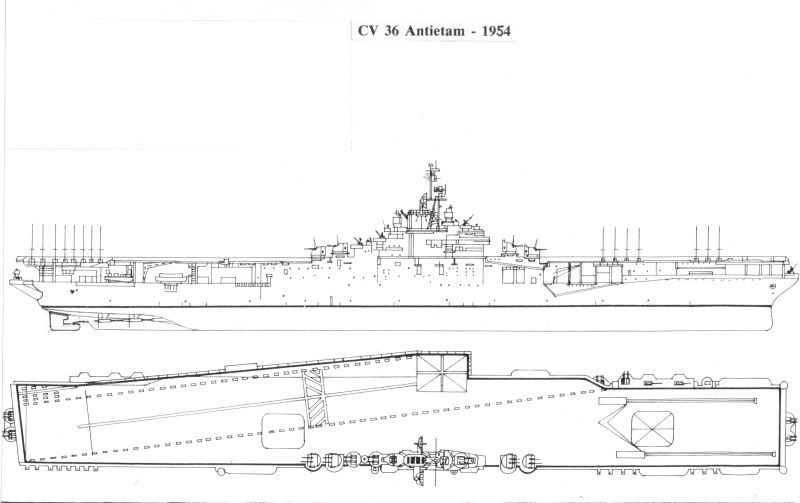
Modifications to the US Essex class carriers (17 completed before V-J Day, and 7 after) for an angled deck were simple and easily done.
Also note the Essex class had 2 x H-4 or H-6 hydraulic catapults. These were replaced in the post-war upgrades by either H-8 or C-11-1 (steam) catapults.
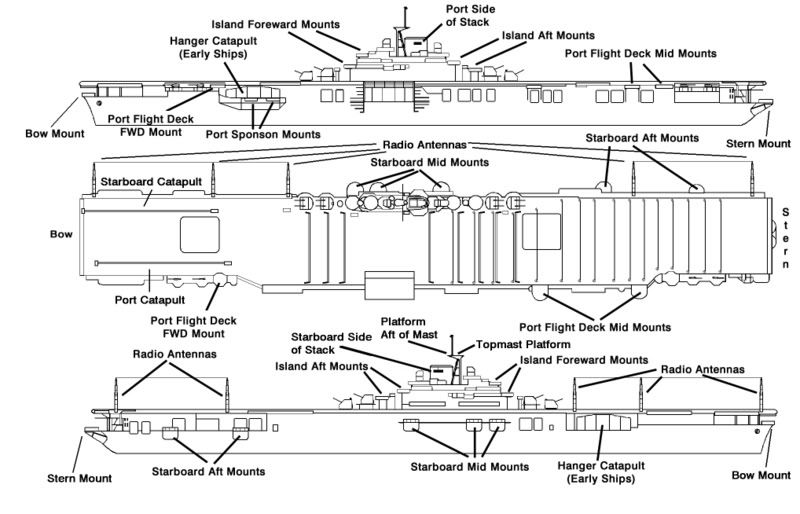
Look at this drawing of CV-36 USS Antietam, the US prototype angled-deck carrier, and compare it to an un-modified Essex (CV-36 was a “second group” ship, with 2 quad 40mm mounts on the bow, therefore the bow was longer than the “first group” with the single bow quad 40mm mount in the second illustration).
The CV-36 drawing keeps a line showing the old flight deck outline.


Interesting, Anna.
I’m guessing that bird was one of the 95 Corsair Is?
Or is it a non-RN bird “in drag”?
All of the 510 Corsair IIs, 430 Corsair IIIs, & 977 Corsair IVs had the “clipped tips” as shown here:

In for a penny, in for a pound…
Ling-Temco-Vought A-7E Corsair II:
Two can play at that game!
‘Corsair’ (Noun) – Pirate, privateer, Buccaneer….
….I’ll get my coat…;) Brian S.
You asked for it…
Consolidated PB4Y-2 Privateer:
Vought F6U Pirate:
“WW2 aircraft”….
Role: Trainer/Light attack
Manufacturer: China Nanchang Aircraft Manufacturing Corporation
First flight: August 27, 1958
Introduced: 1960
Status: Operational
Primary user: Chinese People’s Liberation Army Air Force
Number built: 2,000+A common, but erroneous, belief is that the CJ-6 is a Chinese version of the Yakovlev Yak-18A. Its predecessor, the Nanchang CJ-5, was a licence-built version of the Yak-18. However, advancements in pilot training brought a need for a new aircraft with improved performance and a tricycle landing gear. When the Soviet Union developed the Yak-18A, PLAAF engineers decided that its performance and design would not suit China’s needs.
During late 1957 Aeronautical Engineers Bushi Cheng and Lin Jiahua began work in Shenyang on a trainer design that addressed the shortcomings of the Yak-18A. The design they delivered featured an aluminum semi-monocoque fuselage, flush-riveted throughout, and introduced a modified Clark airfoil wing design with pronounced dihedral in the outer sections. Wind tunnel testing validated the design, and in May 1958 the program was transferred to the Nanchang Aircraft Manufacturing factory where Chief Engineer Goa Zhenning initiated production of the CJ-6. The first flight of the CJ-6 was completed on August 27, 1958 by Lu Maofan and He Yinxi.
May 9th 1981 at Hill AFB, Utah when Captain David “Nick” Hauck from Mingo Jct, Ohio flying Thunderbird 6 crashed while attempting to land his ailing T-38 after an engine malfunctioned and caught fire.
With black smoke bellowing from the exhaust and the aircraft losing altitude in a high nose-up angle of attack the safety officer on the ground radioed Capt Hauck; “You’re on fire, punch out” to which he responded; “Hang on… we have a bunch of people down there”, the aircraft continued to fight to stay airborne for about ½ a mile before hitting a large oak tree and a barn, then sliding across a field and flipping as it traversed an irrigation canal ultimately erupting into a fireball just a few hundred feet from the runways end.
No one on the ground was injured even though the wreck occurred adjacent a roadway packed with onlookers.
The road, Utah highway 193, crosses the flight path just outside the perimeter fence, approx 1/4 mile from the end of the runway. Police had cleared spectators from the roadside just a half hour earlier, but a number of vehicles had again stopped directly under the flight path. The T-38 likely would have impacted near or on those vehicles had Cpt. Hauk ejected late, and it would have dropped into a housing subdivision had he ejected immediately.
He found the largest field in the area to put it down in.
I was there that day… 25 days before I reported for transport to USMC boot camp.
(Note, the Wiki article has a false entry for this accident, which is completely contrary to the USAF accident findings and the recordings of the Safety Officer – Tbird-6 exchange cited above.)

Or a 20-year-old spotty memory mixed with UFO “wanna-be-itis”.
I acquired it purely because it looks interesting (I like buttons!) – it’ll be even more interesting when I know what it is!
many thanks,
Timbo
Ooo, what does this button do?
😀
Ah thanks Peter,i need a decent book on aircraft! (I have the Observer’s Book of aircraft coming soon which will help!)
Far more info can be found here (detailed model-by-model descriptions & specifications, along with type service history and airframe number lists)… but no photos or drawings: