 Bager1968
Saw this in another thread but I thought it might be interesting here. I suspect the author of the article is wrong, but it also might be that he has some inside track:
take from: http://www.defensenews.com/story.php?i=4969353&c=AME&s=SEA, third and second paragraph from the bottom of the article.
This would be really bizarre, since the MOD is paying Converteam to develop EMCAT… the UK’s counterpart to EMALS!
http://www.janes.com/news/defence/jni/jni100726_1_n.shtml
CHRISTOPHER P. CAVAS seems to be uninformed as to recent developments both in the UK and the US (EMALS).
Bager19681. Not long. Just detail wiring diagrams to be drawn up principally. The structure is already designed to accept the Catapults and Arrestor engines. If it takes more than six months to do the redesign work someone in the drawing office is swinging the lead.
No, they would need the specific dimensions, weights, and stress forces for that… all that is in the existing detail design specifications and drawings are large empty spaces set aside in the locations where the catapults and arresting gear would go.
Detailed design work won’t be able to proceed until the decisions have been made as to which catapults and which arresting gear will be installed, and until the design of those components is far enough advanced to deliver those definite dimensions & weights.
Right now the catapult choice seems to be between EMALS and EMCAT (no full-scale version designed yet) for the catapults, and between AAG, the current Mk 7 mod 3 hydraulic arresting gear (in USN CVNs), and some revival of the DAX II arresting gear that McTaggart-Scott built for HMS Ark Royal R09 in the late 1960s.
AAG = Advanced Arresting Gear… to replace the current arresting gear in CVN-68 class aircraft carriers as well as for all new USN CVN construction.
http://www.globalsecurity.org/military/library/policy/navy/ntsp/aage-i_2002.pdf
http://atg.ga.com/EM/defense/aag/index.php
Bager1968Most of the talk from IN sources as reported in the media emphasizes “lessons from the tsunami” and humanitarian missions, rather than opposed amphibious assault.
While this is to be expected, in an image-conscious world, that still seems to indicate that a significant expectation is that this class will be spending a lot of its time in non-hostile work, and that much of their design will be oriented towards operations involving island locations… massive simultaneous airlift assaults aren’t really in the IN planning right now.
Later maybe… but not right now.
An force of 2-3 LPDs would be sufficient to strike at unwanted forward bases on islands in the Indian Ocean, or to provide significant disaster relief capabilities.
Remember the typhoon that hit Bangladesh just after the end of Desert Storm in 1991?
A USN amphib group was on its way home, and was diverted to assist. The UN effort leader said afterwards that the most valuable assets were the LCACs the USN used… their capacity to operate over flooded fields, cross debris-filled areas, skim along roads, etc, as well as over open water was even more valuable than the helicopters, as the LCACs were able to operate at night and in bad weather, and to carry large amounts of supplies and large numbers of passengers.
I expect that the IN will have remembered that as well, and will be seeking such craft for whatever variety of dock-equipped amphib they finally build..
Bager1968Whilst going for the US arrester gear engine is low risk I think MacTaggart Scott still have a fairly low risk system. Remember technology wise the US arrester gear engine isn’t that much changed from those used fifty years ago whilst in all respects DAX-II is a newer concept. Also arrester gear engines made in the US and the UK are not mass produced but rather bespoke effectively hand made systems. MacTaggart Scott despite not making an arrester gear engine in decades has better chance at building one with minimal risk then Converteam does with its EM catapult which is still in prototype stage.
The main advantage that the US built systems have over the UK is the facilaties in the US. If the UK decides on its own arrester gear engines and catapult they will have to be built and tested on land here. Using US facilaties piggy backs of USN/DOD spending.
Wrong!!
EMALS is only half of the new technology for “cat&trap” operations for the USN.
The second part of that is covered by AAG (Advanced Arresting Gear).
http://atg.ga.com/EM/defense/aag/index.php
http://www.globalsecurity.org/military/library/policy/navy/ntsp/aage-i_2002.pdf
The Advanced Arresting Gear (AAG) program will retrofit and forward fit Navy aircraft carriers with an electric motor based system that will replace the current MK 7 hydraulic system for aircraft deceleration during recovery operations. AAG allows arrestment of a broader range of aircraft, reduces manning and maintenance, and provides higher reliability and safety margins. GA’s design replaces the mechanical hydraulic ram with rotary engines using simple, proven energy-absorbing water turbines coupled to a large induction motor, providing fine control of the arresting forces.
* The system provides significant benefits over current recovery systems
* Operational capability to recover projected air wing, with renewed service life margins
* Full compatibility with CVN 68-class and CVN 21-class carriers
* Higher availability
* Self-diagnosis and maintenance alerts
* Reduced manning and Total Ownership Cost (TOC)GA, as the system prime contractor, has assembled a team to design, develop and build this system for prototype testing at the Naval Air Engineering Station (NAES), Lakehurst N.J. beginning in late 2009. Included on this team are the FMI Division of Qinetiq, Curtiss-Wright Electro-Mechanical, ESCO Corporation, ITT Corporation, and Alion Science. The GA team completed a competitive technology demonstration phase and, in 2005, was awarded the follow-on System Development and Demonstration (SDD) phase. In 2007 the team completed the Critical Design Reviews and began assembling full-scale prototype system components for reliability testing, which began in 2008. This system, designed to replace the current MK 7 arresting gear system, will eventually be installed on the new Gerald R. Ford (CVN 78) class aircraft carrier. It will also be installed on USS Nimitz (CVN 68) class aircraft carriers.

Since CVN-78 Ford is scheduled for commissioning in 2015 (may slip to 2016), this gives lots of time for the bugs to be worked out in time for inclusion in CVF by 2020!
Also note that Qinetiq is involved… meaning this is a serious contender for CVF as well.
Bager1968Is it possible that they’ll replace the C-130…
with yet another new variant of the C-130? One that’s optimised for STOVL and carrier ops?
You may be right…
From 2 years ago:
http://www.flightglobal.com/articles/2008/09/08/315626/lockheed-looks-to-widen-hercules.html
Bager1968However, LPD indicates something with only a partial flight deck for helicopters.
LHD would indicate a full-length flight deck along with a well dock.
LPH has the full-length flight deck but no dock.
Now, here is what India says it wants…
“The plan is to add four more LPDs to the fleet and these would operate alongside INS Jalashwa, the only LPD currently in service,” a senior Navy officer told PTI here on Sunday.
“In the coming year or two, we are going to finalise the design for the LPD, which is somewhat akin to INS Jalashwa.
http://beta.thehindu.com/news/cities/Delhi/article64571.ece
Since INS Jalashwa is the ex-USS Trenton, a classic LPD, it seems India is NOT going for a full-length flight deck!
Bager1968In addition to the group training in the US, I would expect to see a lot of dark blue uniforms in a couple of RAF Tornado squadrons for the next decade… specifically the two that will be kept around to transition to F-35C.
With the plan (as currently stated) to be 1 “mixed” F-35C squadron for the carrier and 2 RAF F-35C squadrons, there is scope for a core of RN pilots to keep flying inside RAF Tornado squadrons with periodic rotations to the US for Super Hornet/carrier experience.
This would see more than those 12 trained to re-constitute the RN’s cat&trap fast jet experience base.
Similarly, RN ground/deck crew can go through the same path, with the same result.
Bager1968If budget cuts are severe:
Thunderbirds will use the new jet trainer.
Blue Angels will use T-45 Goshawks.
If budget cuts are moderate:
Thunderbirds will likely keep using F-16s until the type is retired, then transition to the first “operational” batch of F-35A, as there would likely have been system upgrades by then, and there won’t be money to upgrade all of the early production blocks, but the USAF won’t want to get rid of them… and type commonality will reduce costs to operate a few from the older blocks.
Blue Angels will keep using F/A-18Cs (with one F/A-18B/D) until the type is retired, then transition to early block F/A-18Es (with one F/A-18F)… since apparently airframes prior to lot 26* can’t be upgraded to the AESA radar that most Super Hornets are getting, but type commonality will still reduce costs to operate a few from the older blocks.
If budgets aren’t cut… or are restored:
What am I saying… that won’t happen.
* Lot 26 saw a redesign in the forward fuselage in anticipation of the AN/APG-79, but the first 135 after this still received the older AN/APG-73 because the -79 wasn’t ready yet. These 135 airframes are now being upgraded with the new radar and other avionics. http://raytheon.mediaroom.com/index.php?s=43&item=902&pagetemplate=release
Bager1968Perhaps the new USAF trainer that replaces T-38 will replace the F-16 for the Thunderbirds, but there is no way in h#!! that the Thunderbirds will go BACK to using the T-38!
The Thunderbirds used the T-38 from 1974 to 1982, then replaced it with the F-16 because the T-38 was flying on the ragged edge of its performance envelope during shows, and several crashes occurred due to an insufficient safety margin between the Talon’s flight limits and what was being asked of it (5 deaths from 1980 to 1982).
By comparison, the F-16 performs its maneuvers slower, with higher AOA, faster/steeper climbs, tighter turns, etc. than the T-38 was capable of… and has quite a bit of safety margin left during all maneuvers!
Bager1968As it is, the launch of Queen Elizabeth will be an odd affair. An unwanted carrier, that will serve for three years without aircraft, then be mothballed or sold off. Wonder what morale will be like on board?
QE WILL get full cat & trap equipment!
The SDSR clearly says “We will therefore install catapult and arrestor gear. This will delay the in-service date of the new carrier from 2016 to around 2020.”
Since in 2008 QE’s ISD was set as 2016, and POW’s at 2018, then the reference can only mean QE. See page 23 of the SDSR.
POW will also be completed, but upon completion will either be placed in “extended readiness” or sold.
POW would only come out of “ER” to replace QE when she needs a refit (and QE would then go into “ER”) or in case of a war where a second deck is needed.
The 2015 SDSR will refine POW’s fate further, but both are to be completed.
Here is the link to the full document: http://www.direct.gov.uk/prod_consum_dg/groups/dg_digitalassets/@dg/@en/documents/digitalasset/dg_191634.pdf?CID=PDF&PLA=furl&CRE=sdsr
Bager1968A few years ago the US Army was proposing a 4-engined tilt-rotor for this requirement… which would make it somewhat carrier-compatible.
Bager1968Check your local UFO group… they probably have copies (or at least “photos” they claim are copies)!
Bager1968There were a bunch of trial floatplane conversions in WW2:
There WAS a British twin-engine floatplane conversion… but of a light bomber:
Bolingbroke Mk III :Floatplane conversion of sixteenth Bolingbroke Mk I, with two Edo floats.
Too much spray got into the engines, so it was “de-floated”, and the project cancelled.
Here is a photo of a model of it:
http://www.flickr.com/photos/sbathy/1628637679/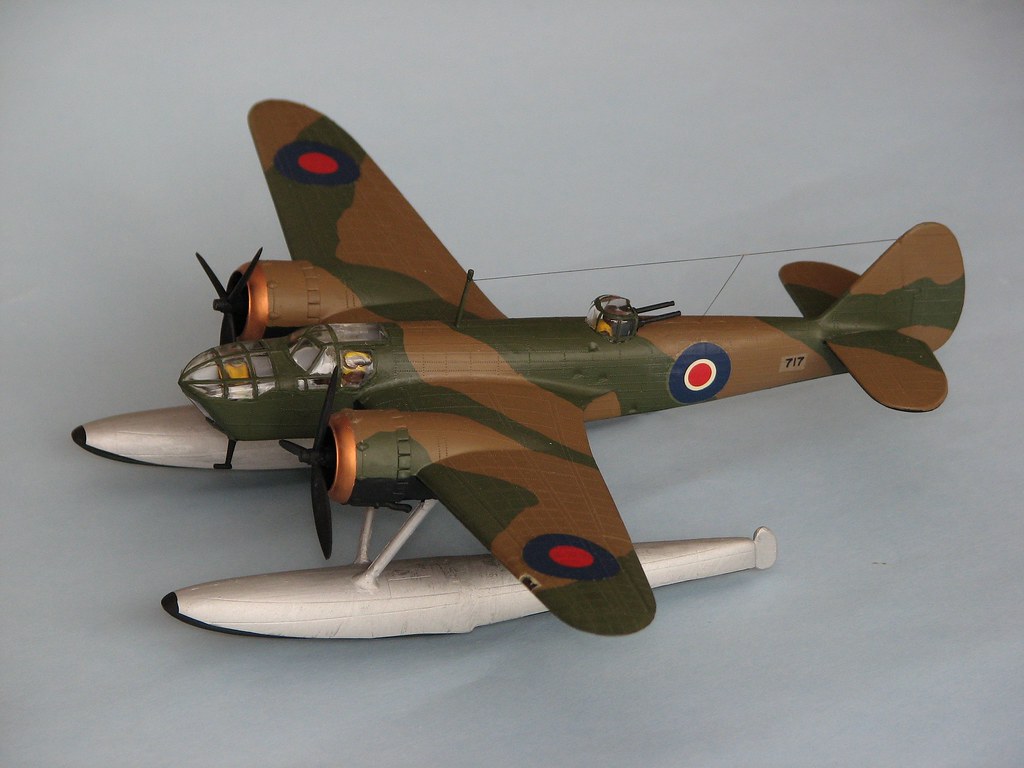
This guy here offered (in 2006) to send the 3-view drawing of the Mk III to anyone interested:
http://airfixtributeforum.myfastforum.org/sutra25966.php#25966
Bager1968Both your links get this result on the Flight Global page:
Page not found
We’re sorry, but there is no web page that matches your entry. It is possible you typed the address incorrectly, or the page may no longer exist. You may wish to try another entry or choose from the links below, which we hope will help you find what you’re looking for.
This one should work: http://www.flightglobal.com/articles/2010/10/20/348764/sikorsky-unveils-s-97-for-high-speed-scout-and-attack.html
Bager1968India: same as for China and Russia. Mig29K and Su33 should be CTOBAR, so no catapults…
We’ll see. I just hope things work the right way.
India is planning for their second “home-built” carrier to be “cat & trap”.
Look at the bottom of this entry (Yes, it’s Wiki… but follow the reference links at the bottom for more reliable sources):
http://en.wikipedia.org/wiki/Vikrant_class_aircraft_carrier


 Sign In







