 Bager1968
As for the Falklands, we can’t go through history continually citing this one-off saga as a yard stick for the future. If we’re going to do that, we may as well throw-in every other one-off campaign.
Of which there have been a lot, haven’t there?
Which is precisely the strong point of carriers… the ability to flexibly respond to whatever comes up… especially if the particular circumstance wasn’t part of the long-range planning!
As for my imaginary crystal ball, well one doesn’t need one. Far easier to extrapolate an estimation of our future needs by looking at the past.
Which is full of unexpected events, and “one-off” campaigns that caught the planners by surprise.
And what is your response?
To summarize your posts here:
Lets eliminate the capability to respond to unexpected events, and only prepare for ones we can see coming a long way off!
Reference the “5-year rule” in place after WW1.
Bager1968Since having drop tanks on when entering combat is a bad idea due to adverse drag etc (see Thomas B. McGuire), even if there is still fuel in them, a Lightning driver might want to be rid of them quickly.
Could they be got rid of by hitting the eject switch then rolling inverted (or in the reverse order)?
Bager1968but then i took a look over the bow of the submarine, and saw torpedo tube doors….
I really thought this thing was only meant for deep sea and miner exploration…
Or launch bays for small UUVs (which have short ranges, so deploying and recovering them at depth in the correct location makes sense)… or for grapple arms/sampling equipment, which then bring the sample inside the hull.
Bager1968Indeed all fuel had to be dumped before the over wing tanks could be jettisoned.
If I remember correctly what C/T Jarred told me (ground runner of the Lightning in Dr FOD) the tanks were 270 gals each and it required 270 gals to overcome the extra drag.
How interesting.
The same story (different volumes) is told about the underwing drop tanks on the F-8 Crusader!
Bager1968George had projected several developments of the Student including a 4 seater with a more powerful engine and also a twin engined version with podded engines a la Citation.
From Jane’s Aircraft ~1963: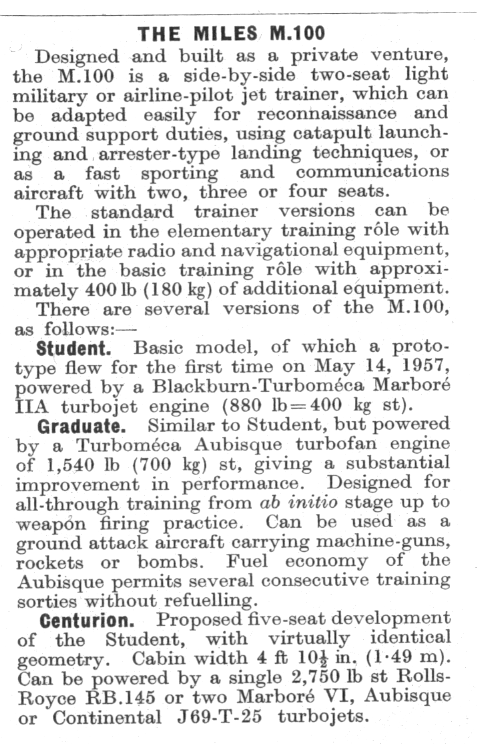
Bager1968so why can’t the officials search the other area?
The officials refuse to accept the other location as a valid possibility, because then they would have to admit having been wrong for all these years.
Bager1968Why an AT6 though why not a Cessna or Beech Baron?
And the US (Obama) plans to withdraw from A-stan in tops five yrs IIRC. So what need would the USAF have for AT6 then?
The idea as souch is not a bad one though. And I’d love to see this thing buzz around on low level over Helmand. But how realistic is it? And why not just buy Super Tuccanos of the shelf instead?
Same answer to both of you… because the US already has several hundred in service, the T-6 being the primary Basic and Intermediate Flight Trainer for the USAF & USN.
Thus, there already is a large-scale logistics, maintenance, support, and training network in place… something that would have to be set up for the Super Tucano!
As for “when we withdraw from Iraq & Afghanistan”… the Iraqi Air Force has a number of T-6s on order as its new trainer, so they can take over some of these easily (same notes as earlier mentioned)… and the Afghans are likely to end up with AT-6s as well.
Bager1968And what’s to stop an A-10 from employing the same PGM from 35k ft (40k might be stretching it for the F-35B) as the A-10, via verified downlinked Litening G4 data (an even surperior A2G sensor than sniper based EOTS) could do?
Nothing… which is what the A-10C & avionics upgrades are about.
But that converts this CAS aircraft into just another medium-high-altitude smart-weapons delivery platform.
It takes away the strong points of the A-10, leaving it handicapped in range, loiter time, and response time (due to its slower max speed).
Which means that, for the roles the USAF is envisioning the A-10 filling in the near future, the F-35 is BETTER!
For the “down-in-the-weeds” anti-personnel missions that we are seeing in Afghanistan, the USAF is working up armed AT-6C (US-produced variant of PC-9) turbo-prop trainers… even cheaper and more expendable than A-10s!
So, there will be little role in the future for the large, heavily armed & armored twin-turbofan attack jet (A-10), at least not in the USAF. The USMC will continue to see the F-35B fitting its particular needs better than the older A-10, so no joy there.
Only if the US Army is allowed to take over the A-10s with few operational strings will there be an extended future for the A-10.
Bager1968http://www.strategypage.com/htmw/htspace/articles/20101015.aspx
Michael Evans, Pentagon Correspondent
This would bring accusations that the launch of X37B, and a second vehicle planned for later this year, could lead to the militarisation of space.
Someone needs to remind Mr. Evans that a hunter-killer satellite was tested by the USSR in the late 1980s, and that similar systems are, and have been, developed and ready for use (in small numbers) by the US, USSR/Russia, and (by some reports) China for at least 10 years.
Bager1968Something Scottish Aviation cobbled together in its early days?
:D:D
Bager1968http://nymag.com/daily/entertainment/2010/10/top_gun_2.html
Maverick would be confused and slightly depressed by the state of Top Gun these days, anyway.
…..
Since 1986, the TOPGUN syllabus has been changed so the focus is far less on the spectacular and dramatic air-to-air dogfights that defined Top Gun and far more about teaching U.S. pilots to drop very large bombs on very small ground targets.
In 1986 there was the US Navy Fighter Weapons School (Top Gun) and the Carrier Airborne Early Warning Weapons School (TopDome) at NAS Miramar, California, and the Naval Strike and Warfare Center (Strike U.) at NAS Fallon, Nevada.
In 1993, the post-Cold-War BRAC (Base Realignment And Closure) process ordered MCAS El Toro (the USMC’s west coast F/A-18 base) closed, and its squadrons relocated to NAS Miramar (now redesignated MCAS Miramar). The F-14 squadrons moved to NAS Oceana, Virginia, & the E-2C squadrons moved to NAS Point Magu, California.
In 1996, the moves were complete… with TopGun moving to NAS Fallon, and merging with Strike U. to form the Naval Strike and Air Warfare Center (no sexy nick-name, just NSAWC, pronounced “EN-SOCK”), which co-ordinates and conducts all USN air combat training, combining A-A, A-G, AEW&C, SAR, and other helicopter missions… as well as pre-deployment group training of the entire air wing for the carrier as a single body.
The USMC has its own, smaller, fighter & ground attack school… Marine Aviation Weapons & Tactics Squadron – One (MAWTS-1) at Marine Corps Air Station Yuma, but Marine aircrew also attend NSAWC.
Bager1968I can only think that when it was first designed it had to have two folds to be accommodated below decks on the then current carriers, but by the time it entered service (almost 10 years later!) the newer carriers could house the Wyvern with a single fold?
Illustrious, Formidable, & Victorious: both hangars 16′ height
Indomitable: lower hangar 16′, upper hangar 14′
Implacable, Indefatigable: both hangars 14′ height
Victorious as rebuilt: 17’6″
Colossus class: 17’6″
Majestic class: 17’6″
Centaur class: 17’6″
Eagle & Ark Royal: both hangars 17’6″
Just as an aside… USN Essex & Midway class carriers: 17’6″; supercarriers 22’+
Bager1968C-141A
Empty weight: 136,462 lb (61,898 kg)
Max takeoff weight: 316,608 lb (143,610 kg)
C-141B (lengthened version)
Empty weight: 144,492 lb (65,542 kg)
Max takeoff weight: 342,100 lb (147,000 kg)
Il-76D
Empty weight: 159,000 lb (72,000 kg)
Max takeoff weight: 346,000 lb (157,000 kg)
CL-99
Max takeoff weight: ~400,000 lb (~182,000 kg)
C-17
Empty weight: 282,500 lb (128,100 kg)
Max takeoff weight: 585,000 lb (265,350 kg)
CL-99 = C-141B with larger diameter fuselage.
Bager1968You don’t need high-end radar & SAM systems to participate in the Great International Somali Pirate Hunt.
Or similar future operations.
Bager1968Canadair CL-200: A few specs from KM Molson’s “Canadian Aircraft since 1909” pg 511.
“laminar-flow control. Six 18,000 lb (8,172 kg) st Pratt & Whitney JT3Ds. Span 325 ft (99.05 m); length 140 ft (42.67 m); height 55 ft 10 in (17.02 m); wing area 22,417 sq ft (2,082.5 sq m).”

Possibly developed using info from the BKB-1 flying-wing glider developed by Canadair employees in the late fifties.
http://www.twitt.org/Brochocki.html



 Sign In







