 Bager1968
Quite right, german fulcrums were donated to Poland. I don’t see the US having any need for second hand french MF1s. Only as a “middle man” to pass them over to Iraq or Afghanistan, but still, why wouldn’t France itself pass it over?
Because they are being purchased with US aid money… part of a larger re-arming of those nations.
All of the equipment purchased through the program becomes the property of the US before it is transferred to the recipient nation.
Bager1968This right here
The Mig would be stored on the base 51 and serve sometimes as “aggressors”.
says the writer doesn’t know his @$$ from a hole in the ground.
No “aggressor aircraft” is ever “stored” (or flown normally) from Area 51 (Groom Lake).
The USAF flies “aggressors” mainly from Nellis AFB (a hundred miles or so from A-51, and right next to Las Vegas, where they can be seen from the freeway), while the USN/USMC fly theirs from NAS Fallon, a good 300 miles NW from A-51.
Yes, all 3 bases are in the state of Nevada, but that state is bigger than most European nations.
Bager1968It did? The caption on the photo of the aircraft in flight indicated it was a successful test.
This comment was also attached to the photo in the website:
Comment by: Nikolaos I. Hantzis on Apr 6, 2006 04:44 AM
Yep, this is true. I was lucky to work at Sikorsky in Stratford C.T. from 1987 to 1989. Jimmy Kay was the Sikorsky test pilot who was flying at the time this photo was taken ( I have a signed black and white copy at home) He said that they had a slight vibration @80knts and around 110 knts but everything else was smooth flying.
Care to share your source for your comment?
Bager1968With the Corsair II from 1966 something modern was at hand for the “Low end ” general purpose fighter.
Excuse me?
“Low end” general purpose fighter A-7 Corsair II was a pure attack aircraft
– Excellent escort / fighter interdiction capability (i.e. gun, acceleration, maneuverability) gun yes, maneuverability yes, acceleration no (until the A-7E in 1970), no air-to-air radar
– Good air-to-ground capability (at least as good payload/range as latter Skyhawks, Bullpup avionics etc.) yes, but then this was its sole design purpose
– Secondary fleet air defense capability vs. Soviet bombers (ideally provision for fitting avionics boxes for continuous wave illumination on an “as needed” basis for limited Sparrow capability) none whatsoever
The A-7 had NO air-to-air radar… the AN/APN-153 Doppler radar set, AN/APQ-116 attitude heading reference set (terrain-following), and an AN/APN-141 radar altimeter were for ground attack only.
The only functional air-to-air weapons & capability the A-7 had were the gun and two Sidewinders… and without radar cueing, those were purely for a last-ditch self-defense action only.
Even an FJ4 Fury from 1957 was a much better fighter than any model of the A-7!
Bager1968Note also that the F-15, designed for primarily Air-to-Air combat, and for dogfighting, preceded the F-16 into service.
The first F-15A Eagle to be delivered to an operational USAF unit was TF-15A 73-0108, formally accepted by the 555th Tactical Fighter Training Squadron of the 58th Tactical Training Wing at Luke AFB, Arizona on November 4, 1974 in a ceremony presided over by President Gerald Ford.
This is only 19 months after delivery of the first F-5E.
Bager1968How about a link about that?
The Russians did reveal that the F-5E was superior to their MiG-21s after evaluation. There was something available between the F-86 and F-16.
Not for very long:
The first F-5E (71-1417) was rolled out at Hawthorne on June 23, 1972 and was sent to Edwards AFB for flight testing The aircraft took off on its maiden flight on August 11, 1972, with Hank Chouteau at the controls.
On April 4, 1973, the first Tiger II reached the 425th Tactical Fighter Training Squadron at Chandler AFB in Arizona. This squadron was assigned the task of training for crews that had acquired the F-5E under the Mutual Assistance Pact (MAP).
The prototype YF-16 (serial number 72-1567) was rolled out at Fort Worth on December 13, 1973. The YF-16 was air freighted by C-5A to Edwards AFB on January 8, 1974. Its first flight was an unintended short hop around the pattern on January 21, 1974 at the hands of test pilot Phil Oestricher. (The first official flight took place February 2, 1974, again with Phil Oestricher at the controls.)
On January 13, 1975, Air Force Secretary John McLucas announced that the YF-16 had been selected as the winner of the ACF contest.
The first F-16A/Bs were delivered to the 388th TFW at Hill AFB in Utah in January 1979.
So, first flight of the F-5E was 18 months before first flight of the YF-16, and first delivery of an F-5E to an “operational” USAF unit was just under 6 years before the F-16A.
Info is from http://www.joebaugher.com/uscombataircraft.html
Note that JBaugher’s sites have been moved to a new host, and the old URLs won’t work.
His new home page is http://www.joebaugher.com/
Remember, the previous models of F-5 were ground attack aircraft with a decidedly secondary, minimal, Air-to-Air capability.
Bager1968I agree with the other comments, I love the HH-3 it always seemed to be a nice size..and that’s what I see the S-92 as replacing.
I haven’t compared the numbers, so I might be off there.
Who knows, maybe some of the S-61T technology will rub off and they’ll make a new batch…I don’t think there are many left at AMARC, so they’d probably have to be new-build.
Yes, the S-92 was aimed at the CH-3/HH-3/Sea Knight (CH-46) replacement category… but just seems (from all I have read) to be less rugged and more fragile than those earlier helicopters… better suited to non-demanding civilian operations than to military ops.
Perhaps a re-designed, beefier version…
Bager1968You need to find the photo of an HH-3 flying with only 3 rotor blades. Thalk about rugged!
http://www.popasmoke.com/visions/image.php?source=4225
That was a CH-53A or D model, which started with a 6-blade main rotor.
HH-3, like its Navy cousin CH-3 Sea King, had a 5-bladed main rotor.
Note that the CH-53E has a 7-blade main rotor.
Bager1968Personally, a modern version of the HH-3E would be perfect.
Yes, the H-60 replaced the HH-3 for USAF CSAR & USCG SAR, but the HH-3 had a greater passenger number and weight capacity. And one other thing… (see 2nd pic below)
The main advantages for H-60 were speed, better reliability (modern engines & systems), and that the HH-3 airframes were getting worn out.
Build new ones with modern, more powerful/fuel-efficient/reliable engines, up-to-date blades & transmission, composite materials replacing non-critical structures to reduce weight, etc… and it would meet what the USAF wants.


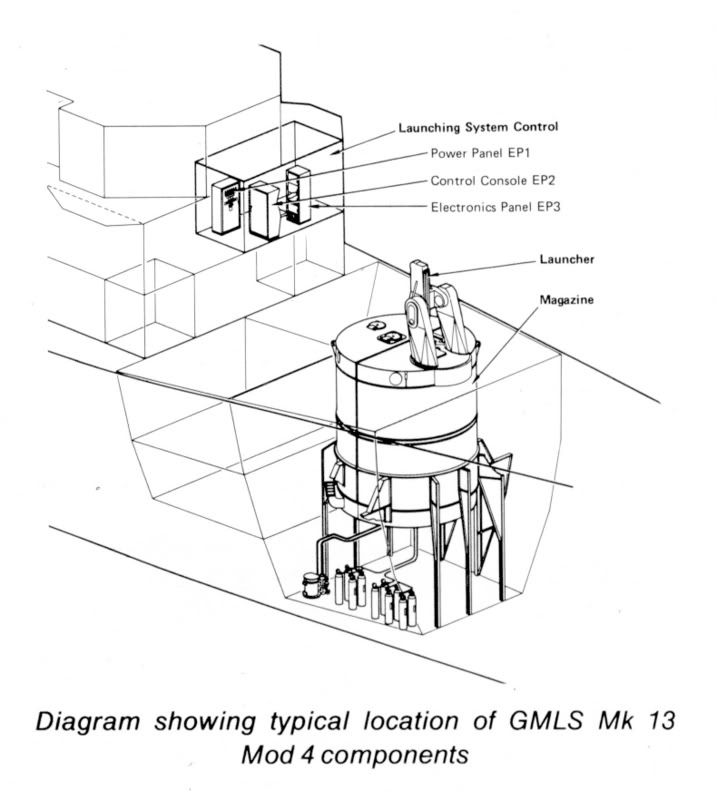
Bager1968This drawing shows how much space is taken up in an FFG-7 by the Mk13… and gives a clue how important to strength the structure is.
Bager1968I remember reading in an aviation magazine or book ( i cannot remember which, damn middle age ) that there was a fly-off between the Super Tiger and the F-104. I don’t recall if the context was the German order or the U.S. order, maybe someone with readily accessible date/version information can tell us if the Super Tiger was a contemporary of the F-104G or F-104C.
What stood out was an account of a takeoff and climb-to-hight test in which the F-104 had already reached 60,000ft whereas the Super Tiger was still struggling to clear 30,000ft. Maybe the wing of the Super Tiger wasn’t as efficient as some think?
No, it is simply that, among other factors, that they weren’t “fitted with the same engine”.
F11F-2 (later redesignated to F11F-1F): J79-GE-3B; 9,600 lb (14,800 lb)
F-104A: J79-GE-7; 10,000 lb (15,800 lb)
That 7% difference in thrust, and the lower drag of the F-104 (due to its thin, short wing {no tip tanks at that time}) would account for quite a bit… it also depends on their relative weights at take-off, etc.
Note that the F-104S got the J79-GE-17; 11,430 lb (17,860 lb)
Also, for the USN, the A-5A/RA5C Vigilante had two J79-GE-8; 10,900 lb (17,000 lb)
Bager1968That would seem to take a bite out of training I’d think. :confused:
Agreed.
The non-deployed squadrons will drop from 12 aircraft to 10. Since (in my experience spending 6 years with USMC squadrons) non-deployed squadrons almost never send out more than 3/4 of their aircraft for any training mission, and individual pilots usually only fly 3-4 days a week, all pilots should still be able to get all the required training in easily.
Bager1968Here. Link is directly from the US embassy. Hope thats good enough for you!
😉
http://islamabad.usembassy.gov/pr-10021501.html
“Our Navy SEALS have enjoyed a close training relationship with the Special Services Group – Navy for a number of years now; but this relationship is on the verge of a new era. We are building a new training facility at Gharo Creek and will have an enduring presence to work full-time with your SSG-Navy.”

Thanks.
Never know… it could have been like the reports of India being offered Kitty Hawk… 😉
Bager1968Skilled crew to bring that one in!
Bager19681 mile (“statute” or “land”) = 1760 yards = 5,280 feet = 1.609344 kilometers
1 nautical mile (nm) = 2,000 yards = 6,000 feet = 1 nautical mile = 1.85200 kilometers


 Sign In







