 Bager1968
old shape… That was said by Jackonicko, in post #45, not Scooter.
http://forum.keypublishing.co.uk/showpost.php?p=1329312&postcount=45
Bager1968I think the design for USS ford cvn class was only small changes compared to Nimitz. (different elevator, nuclear plant, island, ect…)
Even with crew reductions, the crew is still more than 4,000 men, which is enormous.
Current plan for layout of USS Gerald Ford CVN-78: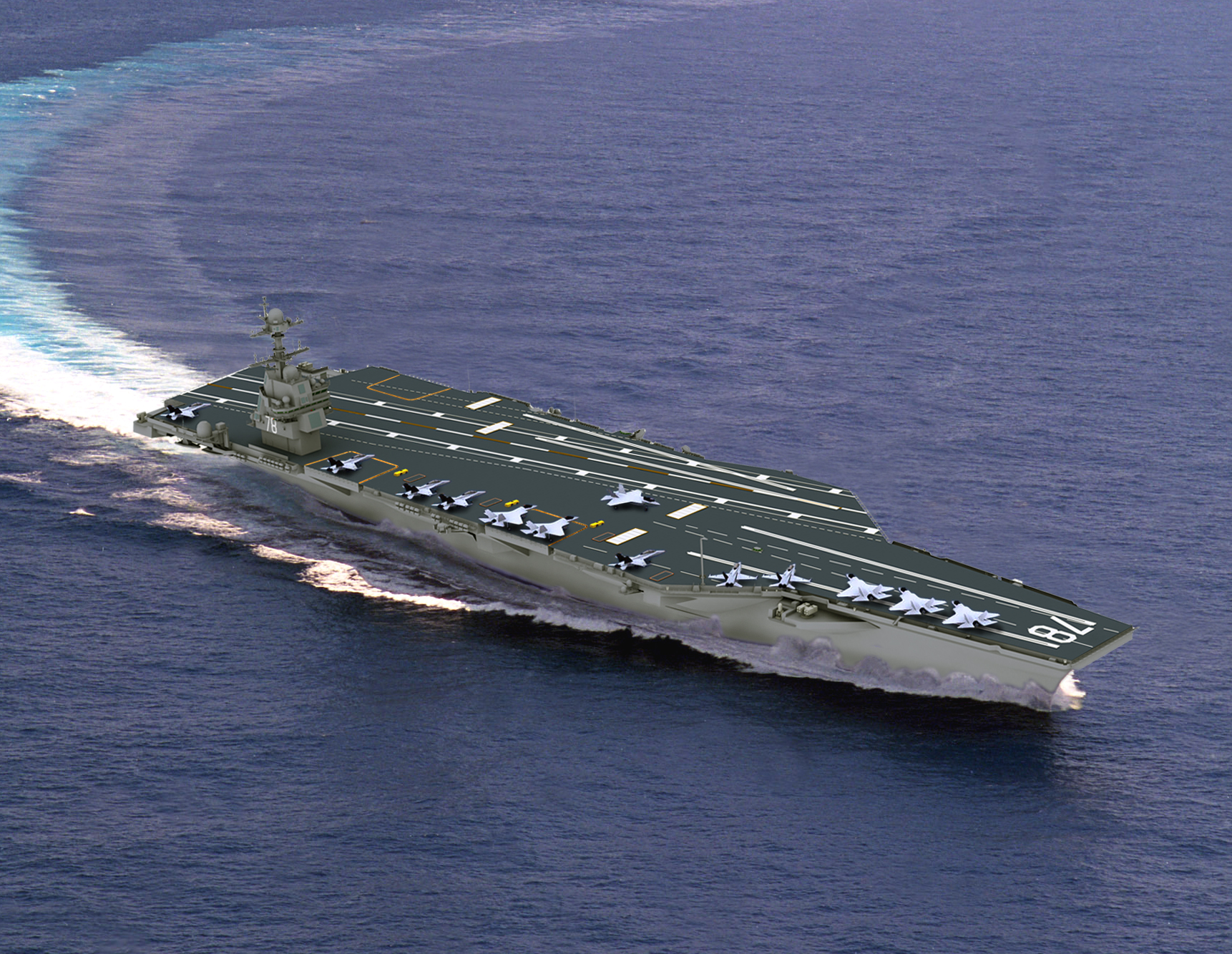
Note that you need to indicate which USS Ford you are speaking of, as there is a USS Ford (FFG-54), an Oliver Hazard Perry-class frigate, which is named for Gunner’s Mate Patrick O. Ford (1942–1968). Ford was awarded the Navy Cross posthumously for his heroism as a patrol river boatman in the Vietnam War.
Bager1968Nice photos, and nice coincidence… a few minutes ago I was just looking at a cutaway drawing of the Messenger in Bill Gunston’s book Classic WW II Aircraft Cutaways.
This is the drawing of the initial version done by J.H.Clark for The Aeroplane magazine 20 April 1945.
Bager1968Marines are not getting EA-18G’s.
Not as currently planned, but I expect Obama will slow down the production rate of the F-35, forcing a temporary replacement (due to aging of the remaining EA-6Bs) before the USMC completes its conversion to “all-F-35B”. The EA-18Gs will then transfer to the USN or USAF.
Bager1968Don’t forget… they may be only carrying 60 aircraft (including helicopters, AEW, EW, & the like) right now, but if a real high-intensity shooting war broke out, there are 35 (+1 reserve) USN Hornet/Super Hornet squadrons assigned to 9 carrier wings (11 carriers), and 14 USMC Hornet squadrons (12 active & 2 reserve) that could augment those numbers aboard ship.
That’s 50 F/A-18 squadrons of differing types, which could provide up to a ~50% increase in the numbers of strike-fighters on each carrier, given 6 CVNs deployed in the combat zone & 2 with normal complements patrolling elsewhere.
Note that this is not counting the 7 USMC AV-8B squadrons.
Additionally, the USN has 3 Hornet/Super Hornet training squadrons, & the USMC 2 Hornet & 1 AV-8B training squadrons.
When the Growler replaces the Prowler, there will be 15 – 4-plane detachments of USN EA-18Gs (+1 training unit) & 4 – 4-plane detachments of USMC EA-18Gs as well… which will still have their fighter/attack capabilities available for emergencies.
Bager1968The most credible theory I have heard was simply that the plane was sabotaged.
Bager1968DJCross, 300 AV-8B/TAV-8B Harrier IIs are almost entirely US-designed, and had well over half the aircraft content built in the US. In the AV-8B+ variant, this US content was increased further.
Bager1968Many “popular histories” in the US & UK dismiss the P-40 as “ok for 1941, but out-of-date and outclassed by the beginning of 1943. Tolerable for the start of the war, but should not have been in front-line service past late 1942”.
Similar things are said about the Hurricane, and the F4F Wildcat.
In fact, I have been reading and looking at aviation books since the early 1970s, and it wasn’t until just a few years ago that I learned that the F4F stayed in service with the USN and RN past the beginning of 1944 (actually, in front-line service through the end of the war)!
The more technical sources that tend to focus on flight-test data have the same regrettable fascination with the “mid-war” generation of fighters… F6F, F4U, P-38(G+), P-51, all-cannon Spitfires, Typhoon/Tempest, etc.
Only such places as these discussion boards and books that focus on operational use and value give them the credit they deserve.
P-39 anyone?
Bager1968Jane’s says the flight-deck modifications (widening the fore end of the angle and making an extension of the flight deck just behind the island for two aircraft to park there) were done “in 1980-81”, and also that “at the same time all necessary modifications were made to allow for operation of Super Etendards.”
Conway’s 1947-82 says “was not yet fitted with the essential electronics to provide the inertial guidance data to the aircraft”.
Elsewhere, I have read that 25de Mayo’s boilers were not in good condition, so she was a bit slower than normal, and that her catapult was in need of overhaul and not producing full throw force, so they couldn’t quite generate a safe combination of “wind over deck” and launch force for SuEs, thus they weren’t used.
I get the overall feeling that if everything had been in good repair, she could have operated SuEs, but they would have needed to have an A-4 go with them to guide them home, as their INS couldn’t be initialized aboard ship.
This photo shows her after her 80-81 refit. Note the angle deck front and the extension behind the island with the A-4 on it:
Bager1968The Allison/RR TF41 is an improved non-afterburning Spey… and produced 14,500-15,000 lb.s.t. in the A-7D/E… with virtually the same dimensions as the Spey used in AMX. They were in production well before AMX began its design phase.
The TF41-A-1 for the USAF’s A-7Ds was in production in 1968, with the USN’s TF41-A-2 shortly after.
It is, however, some 700 lb heavier and 7 inches longer… but the 31% power increase would be well worth it.
Just that nasty US export-use license to get.
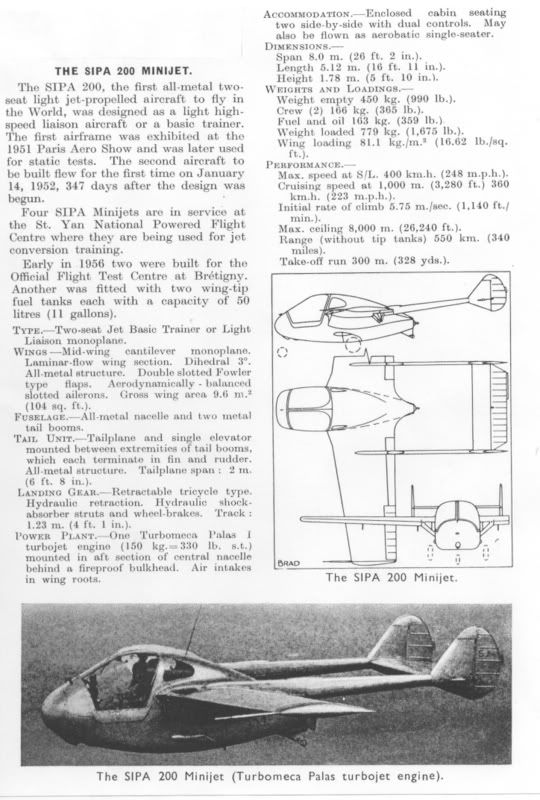
Bager1968Here is the ~1957 Janes entry on the Sipa:
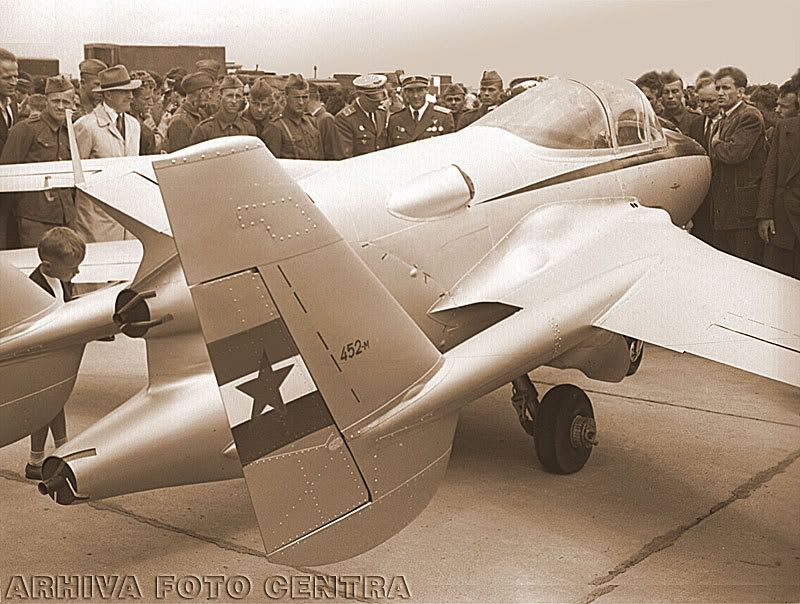
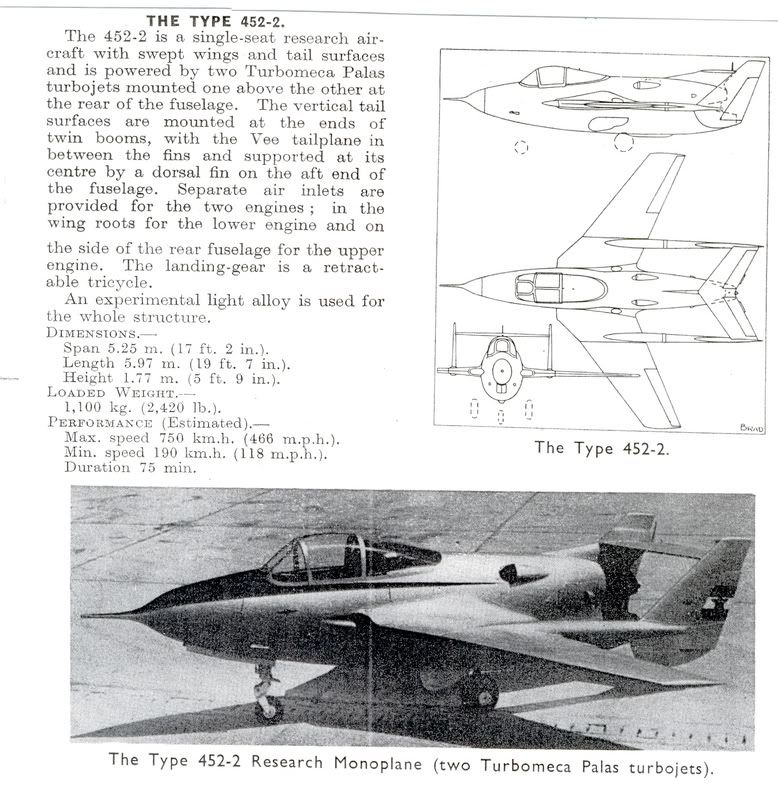
And a Yugoslavian entry…
Bager1968I think you’ll find that the price for F-35 included the offset created by Norway’s share of manufacturing work… their parts will be on all 1,000+ (more like 2,000+ in reality) F-35s sold to anyone… that’s a lot of return to lower what is being paid out.
Additionally, this is part of an actual spreading out of aircraft design & build capability across the Western world, caused by the “multi-national production” aspects of both the F-16 and F-35 programs.
It is due to this that a number of nations have any military-aircraft-related industry at all!
Bager1968USAF YC-14:
QSRA:
Bager1968Unfortunately for India, Russia is not as economically weak as it was a few years ago – thanks to the petro dollars – and is quickly turning into a strategic competitor to US.
Unfortunately for Russia, there are far fewer “petro dollars” flowing into its treasury.
They seem to have set their budgets to depend on a price of $70 per barrel… thinking to be more cautious than Iran, who budgeted for raking in $90+ per barrel.
The boom price of ~$170 was short-lived, and is now only in the low $50 range… so Russia is now hurting economically.
What will be the situation a few years from now, we can’t say… but it won’t be as rosy for Russia as it was a few months ago, I guarantee.
Bager1968The problem with Egypt is that they have a barely-contained radical Muslim faction that has tried to instigate rebellions several times in the last 20 years.
Attacks by Muslim pirates on Western (and infidel Eastern) commercial shipping are seen as showing the strength of the Muslim world… and acting to suppress “those poor, starving Muslims who only want to feed their children, but the evil infidels won’t let them” would play into the radicals’ hands.
I know that a Saudi tanker has been seized… Saudi Arabia is not in favor with the radical Muslim sector, as they are working too closely with the US for their liking.


 Sign In







