 Bager1968
Well, the USS Midway Deck received extensive modifications to its Flight Deck. As for the larger hanger I am not sure but maybe the US Carrier has more height??? :confused:
No, Midway’s hangar height is 17′ 6″, while CVF’s varies from 23′ to 29′.
Crew accommodation standards are quite different as well… Midway had group berthing with blocks of 6-8 bunks (stacked 3-4 high, with small lockers) separated from others by curtains for junior crew and petty officers, while CVF has 6-man cabins (bunks 2 high, with doors and large lockers) for junior crew and petty officers.
Of course, this actually balances out, as CVF needs about half the crew of Midway, but has crew spaces using twice the volume per man.
Bager1968Umm, why is the midway longer then CVF and have a hanger that is larger by ~7200 square feet, from about 15,000t less displacement?
Because that’s the way they were designed?
Midway: hangar width 85′, hull width 113′ (the later, wider dimensions are all over various sizes of bulges). Difference 29′ (14.5′ on each side). Hangar 75.2% of hull width.
CVF: hangar width 95′, hull width 128′. Difference 33′ (16.5′ on each side). Hangar 74.2% of hull width.
The hangar widths are the same percentage of hull width, with CVF’s hull being wider.
The length is the key… the USN always placed a premium on high speed for carriers, and their WW2 CVs were always 2-3 knots faster than their RN counterparts. This continues today, with CVF being a good 6 knots slower than the Midway class.
To achieve the higher speed without an overly-large propulsion plant, you need a longer, narrower hull… which Midway has, compared to CVF.
Add in the Midways being originally designed for aircraft that needed much less complex repair/maintenance facilities, and more of the hangar deck is available for the hangar.
Midway was also designed for maximum aircraft capacity… they were expected to carry “everything you can fit in, crowding is OK”.
CVF was designed around a pre-determined air group size. Thus, there was no attempt to fit a larger hangar in CVF than that needed for the planned air group, as “there should never be any attempt to fit more than the planned complement of aircraft”.
Midway (as designed): hangar 692′; hull length 900′; flight deck 968′. Hangar 76.9% of hull length, 71.5% of flight deck length.
CVF: hangar 535′; hull length 865′; flight deck 928′. Hangar 61.8% of hull length, 57.6% of flight deck length.
Bager1968CV 41 (Midway-1945), 42 (Franklin D. Roosevelt-1945), 43 (Coral Sea-1947)
45,000 t. std. (59,900 t. full); 900′ w.1. (968′ o.a.) x 113′ (136′ fd.) x 32.7′ (35′ full);
2 catapults (H-6 hydraulic); 12 oil boilers; 4 shafts; geared turbines; 212,000 s.h.p.; 33 kts.;
18-5″/54 d.p. (18×1)[14-# 43], 84-40 mm (21×4), 28-20 mm (28×1); 137 aircraft; hangar 692′ x 85′ x 17′ 6″
CV 41 (1957), 42 (1958)
51,000 t. std. (62,000 t. full); 900′ w.1. (968′ o.a.) x 121′ (174′ f.d.) x 33′ (35.3′ full);
3 catapults (C-11 steam); 12 oil boilers; 4 shafts; geared turbines; 212,000 s.h.p.; 33 kts.;
10-5″/54 d.p. (10×1),22-3″/50 a.a. (11×2); 75 aircraft; hangar 692′ x 85′ x 17′ 6″
CV 43 (1960)
51,000 t. std. (65,200 t. full); 900′ w.1. (979′ o.a.) x 121′ (238′ fd.) x 33′ (36′ full);
Elevators 56’ x 44’, 74,000 lb capacity; 3 catapults (C-11 steam); 12 oil boilers; 4 shafts; geared turbines; 212,000 s.h.p.; 33 kts.;
8-5″/54 d.p. (8×1)[removed 1978],3-20 mm CIWS [added 1981]; 75 aircraft; hangar 692′ x 85′ x 17′ 6″
CV 41 (1970)[1987]
52,500 t. std. (65,241 t. full)[69,873 t. full]; 900′ w.1. (979′ o.a.) x 126’[136′] (258′ fd.)[263’] x 33′ (35.3′ full);
Elevators 63’ x 52’, 130,000 lb capacity; 2 catapults (C-13C steam); 12 oil boilers; 4 shafts; geared turbines; 212,000 s.h.p.; 33 kts.;
4-5″/54 d.p. (4×1)[removed 1978],3-20 mm CIWS [added 1980]; 75 aircraft; hangar 692′ x 85′ x 17′ 6″
(as modified width too great, elevators covered in spray; bulges [66′ x 10′] added on each side in 1986 to keep sides up, depth then too shallow causing rolling problems)
CVF (2008) Delta design
“928ft long 64,500 tons
283 meters (928 feet) length overall; 69 meters (226 feet) max width at flightdeck;
263.5 meters (865 feet) pp; 39 meters beam (water line) (128 feet)
26.5 knots
40 aircraft (including helicopters)
Hanger Dimensions (length x width x height): 163 x 29 x 7.1 to 9 meters (535 x 95 x 23-29 feet)”
Bager1968another ugly jet is the A-6 Intruder, IMO.
Hey!!! Them’s fightin’ words!!!
The “Sky Pig” is gorgeous… in its own, unique way.
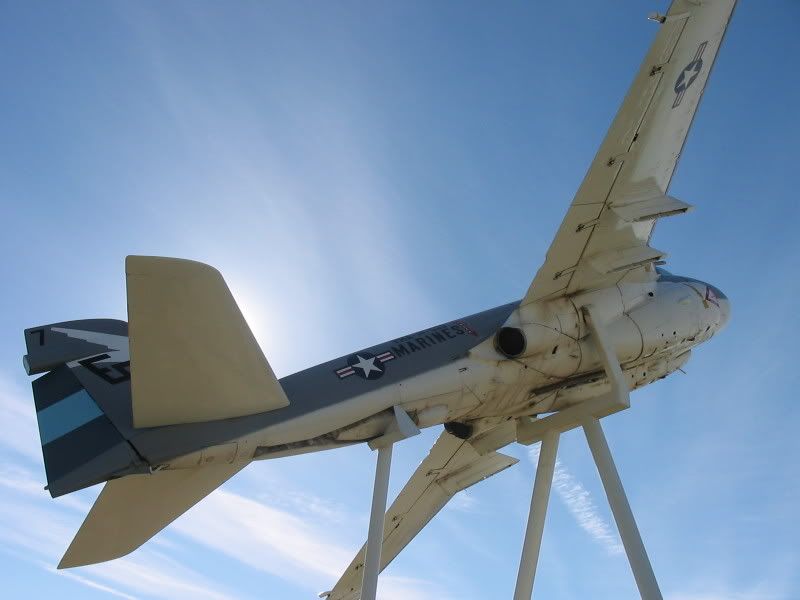

Ok, so the guy in the second photo isn’t a looker himself, but what can I say?
I fixed their fancy ‘tronics for most of an 8 year USMC stint!
A very “workman-like” plane… every inch designed for her purpose, with no excess added “just for looks”. Not a “cover model”, but the one that’ll “do the job and get you back home”.


I agree, there is just something about the Draken that is breath-taking:
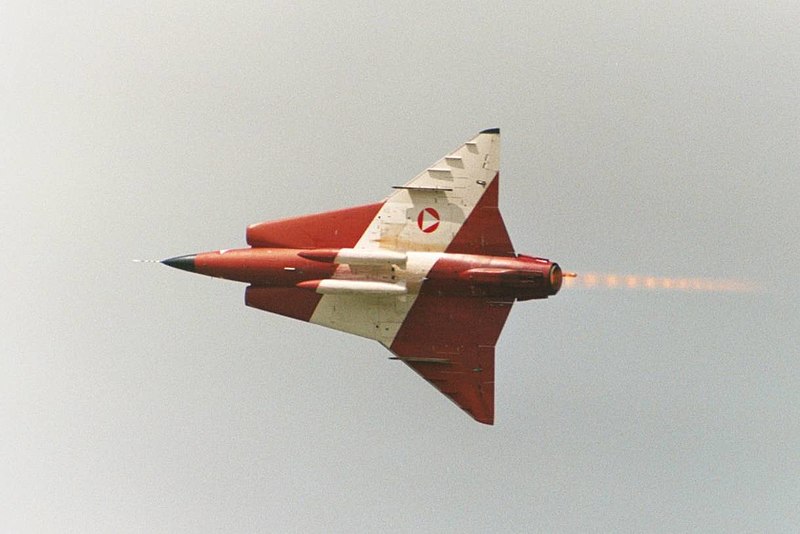

Bager1968Why couldn’t the cameraman have caught either one folding its wings?
Instead of a minute or so of both sitting still?
OK, complaint over… I really wish I had been there!
Bager1968Same for F-35B: when will it take off S, dash supersonically, and land V?
I’d imagine relatively frequently – in USMC and RN markings.
And Italian and Spanish as well.
Bager1968The YB-60 was developed from the B-36, and while intended as a B-36 replacement, was contemporary with the development of the B-52 (and used the B-52’s engine pods and engines).
The 2 prototypes had some stability/buffeting problems, but those would have been solvable, if the B-52 hadn’t outshone it.
http://www.globalsecurity.org/wmd/systems/b-60.htm

Bager1968I had one yesterday, it said “You have got to see this!”, which seemed suspicious for someone’s very first post on the board. As I didn’t know the sender, I just deleted it without clicking on the link.
Good move.
I don’t remember the name, though.
Bager1968Or some real quality program-resurrection.
The Boeing C-127 was a twin-engined experimental transport (or a 4-engined one, depending on the source).
If it was a twin-engined aircraft, it may well have been in the same class as the G222 (C-27).
Bager1968Well, obviously. You came up with ‘all of Europe.’
My mistake, as I am used to thinking of the eastern border of Europe being where the USSR/CIS started… so any former Soviet “republic” isn’t Europe to me.
It is hard to re-draw the borders in my mind, unless I stop and re-think the map.
That comes from being born in the beginning of the Cuban Missile Crisis (the shipments of equipment to Cuba started in June 1962, one month before I was born), and completing my 8 years in the USMC 4 months before the “fall of the Berlin wall”.
Bager1968C-127J?
C-127 was the designation for a proposed, large, turboshaft-driven transport aircraft to have been built in the early 1950s by the United States aircraft manufacturer Boeing for use by the nation’s military forces. The project was canceled at an early stage. No aircraft were built.
The original C-127 designation was given to a number of De Havilland Canada DHC-2 Beaver aircraft which were then redesignated U-6.
Bager1968I guess you included Ukraine… etc?
Bager1968Well, we get plenty of your blokes who can’t understand why they won’t be able to rent a car & drive from New York City to Denver and back in one weekend, or who fail to understand that Washington, D.C. is not in Washington State… or that they are over 2,000 miles distant from each other.
When you remind them that (not including Alaska) the US is larger (much larger) than all of Europe, they say “Cannot be, old chap!”.
Do they mention that the first take-off of an aircraft was from a USN warship on 14 Nov. 1910, and the first landing of an aircraft on a ship was on a USN warship (18 Jan. 1911), followed a couple of hours later by a successful take-off?
http://www.history.navy.mil/photos/events/ev-1910s/ev-1910/ely-birm.htm
http://www.history.navy.mil/photos/events/ev-1910s/ev-1911/ely-pa.htm
And that the first take-off from a RN ship was not until 10 Jan. 1912? http://www.rafweb.org/Biographies/Samson_CR.htm
And the RN’s MOD site claims “In a remarkable event on 2 August 1917 Squadron Commander E.H. Dunning landed his Sopwith Pup on Furious’ flying off deck, the first aircraft to land on a ship.”
http://www.royal-navy.mod.uk/server/show/nav.3919
:rolleyes::rolleyes:
Bager1968.. I have not yet heard countries like France or Germany signalling any interest in manned 5.gen aircrafts, so what other option than 4.5gen + UCAV do they have? Or perhaps they have simply decided to wait with their F-35 orders until they have sold some Rafale/Typhoons…?
L
1. All their defense budget for aircraft purchase is devoted to Typhoon (Germany) or Rafale (France).
2. They cannot for economic reasons… their aviation industry depends on their respective aircraft… and they could not hope to replace the industrial share they have now with an equivalent share of F-35 work.
3. It would be political suicide to admit they have spent so much on aircraft programs that are producing inferior aircraft (at least that is what buying F-35s would imply).
Bager1968I agree, so I changed the pic to the production type.


 Sign In







