 Bager1968
Still waiting for the pics of the Indonesian Sverdlov
You ever get some?
Here are some links with photos:
http://yogifajri.blogspot.com/2011/02/kri-irian-untold-stories.html
Although the aerial pic of a cruiser firing is actually one of CA-45 USS Wichita!
http://navywallpaper.blogspot.com/2011/09/kri-irian-indonesia.html
And the color shot is of the preserved one in Russia, not the scrapped KRI Irian.
Bager1968You mean the bulkhead? The one where they designed a fix and the 5th & 6th test airframes (and all built after that) were built with the new one?
Bager1968Thats a flight crew winning a bet…..has to be!. Someones shot their mouth off that they can set it down and lift off the dinky little strip down the road and they’ve been called on it. This crew will be looking to collect, if they survive the disciplinary!.
Interesting fantasy… but the aircraft was finishing a flight from “the near east” with 23 pax and 19 crew (yes, 19)… most to cater to the pax, which is strongly rumored to have included Marine General James N. Mattis, Commander of CentCom.
Not exactly the time to pull a “dare stunt”.
Also, the crew was taken to MacDill, and a different crew flew the C-17 out.
Bager1968This was the impetus and reasoning behind the common Support Aircraft program. The plan was to replace AEW, EA, ES, EW, IFR, COD, ASW, ASUW, etc with a common airframe that supported all the various rolls with little customization.
IMHO, The Viking is too small for the radar dish and would have to give up to much internal fuel space to put all the radar gear.
Maybe if they went with a stretched version and the triangular AESA seen on some V-22 AEW designs?
Given today’s compact computers it’s possible. Given the power requirements of AESA it might need new engines or an APU though.
Length/wingspan/wing area/max TO weight (metres/sq metres/kg)
E-2: 17.5/28/65/26100
S-3: 16.3/21/55.6/23800Not very much difference except in wing size. The S-3 has internal weapons bays & as built, has sensors which would not be needed in the AEW role. That provides internal space which could be used for AEW radar equipment. The main drawback is the lack of space for on-board radar operators, which could be overcome by using it as a plain airborne radar for the fleet, transmitting its radar data to a ship.
Smaller aircraft than S-3 have been successfully equipped & operated for AEW. Look at what Erieye has been fitted to.
The main S-3 AEW proposal DID have a triangular array:
http://www.secretprojects.co.uk/forum/index.php?topic=5696.0
Then there was the Greyhound 21 proposal for the CSA:
http://www.secretprojects.co.uk/forum/index.php?topic=662.0
“Fitted with turbofan engines in place of the Allison T56 turboprops, it could be used for anti-submarine/anti-surface vessel warfare, electronic surveillance, carrier onboard delivery and aerial refuelling missions. In the COD rold, the Greyhound 21 will be able to airlift a 4536 kg (10,000 lb) cargo payload; for other roles, the hold area will contain specialised mission equipment and system operators.”
Bager1968BAe has a load of four engined aircraft available for sale or lease, good field performance, can carry more than a C-295, used but a decent number of flight hours left, going cheap. – & the RAF’s already getting some.
:diablo:
How much to fit the MRA4 stuff we have in storage?
Already being converted to bomber config in the US.
OK, fire-bomber… and we’re looking to get a bunch of them (at least 15 between Neptune Aviation [11] and Minden Air [4]).
BAe-146 jet-powered Large Air Tanker
And then Canada’s Tronos is doing even more of these conversions. http://www.tronosjet.com/forest-fire
Bager1968Can’t remember seeing an announcement saying that this is ok with the US State Dept, or the FAA.
Since Drakren Intl works extensively with the US DOD as well as various branches of the US military (training and research support, JTAC/CAS training as well as threat simulation and “red air” adversaries), I can’t see either of the agencies you mention objecting.
Bager1968I see a bad moon arisin’.
I see trouble on the way.
:diablo:
Bager1968RAF F14 Tomcat – unreliable engines with missiles we couldn’t afford but probably the best looking jet ever flown unlike the Tornado F3 which is one of the ugliest a/c to enter service?
However, replacing the TF30 with the slightly smaller Spey from the RN/RAF Phantoms would be simple, and while having the same thrust and fuel consumption, the Spey was far more reliable!
As shown by the TF41, the Spey had more power growth potential, so the “Tomcat FR.1” would be easily upgradable to a higher-powered FGR.2 version (similar to the USN’s F-14D, but earlier).
After all, the USN wanted to upgrade the F-14 much earlier, but Congress wouldn’t fund them until the early 1990s..
Bager1968The tail wheel was a big part of its success, allowing it to operate from unimproved runways, getting the cargo door closer to the ground for easier loading/unloading without equipment, and so on.
Bager1968In WW2 they were the first to introduce intercontinental ballistic missiles.
No, they never built an ICBM*… the V-2 was a tactical (or theatre) ballistic missile… with a range similar to the Soviet SCUD.
V-2 Operational range: 320 km (200 mi).
Scud-A Operational Range: 180 km
Scud-B Operational Range: 300 km
Scud-C Operational Range: 550 km
Scud-D Operational Range: 300 km
An intercontinental ballistic missile (ICBM) is a ballistic missile with a range typically greater than 5500 km or 3500 miles.
The first successful ICBM was the Soviet R-7. On 21 August 1957; the R-7 flew over 6000 km.
* The Germans were trying to develop an ICBM (the A9/A10) to strike the US, but they only tested the second stage separately, they never tried to launch an assembled test article.
Bager1968Don’t forget to photoshop the single 30mm Aden cannon in each side to 3 x .50 browning MGs.
Bager1968Australian MirageIII using Avon engines
While that is indeed “a good’un”, I’ve always been partial to RAAF J35D/F Draken instead of the Mirages.
Bager1968Blackburn Buccaneer w/TF41 for the USN. (pre-Intruder)
However, this is utterly impossible unless you shuffle things around in time.
Buccaneer S.1: design chosen July 1955; first flight (8,000 lb.s.t. Gyron Jr. engines) 30 April 1958; production deliveries August 1961; operational service July 1962.
Buccaneer S.2: ordered January 1962; first flight (11,380 lb.s.t. Spey engines) 17 may 1963, operational service October 1965.
A2F Intruder: design chosen January 1958; first flight 19 April 1960 (8,500 lb.s.t. J52-6A, quickly replaced by 9,300 lb.s.t. J52-8A); redesignated A-6 18 September 1962; production deliveries February 1963; operational service late 1963; first combat mission over Vietnam 1 July 1965.
So for the USN to select Buccaneer over the A-6 they would have had to select the Bucc with the anemic and dangerous Gyron Jr engines, as the Spey version wasn’t even ordered until the production of the A-6A was underway… and the A-6 entered combat before the Spey-engined Buccs entered operational service!
Then you have to wait another 3 years before you can get TF41s… since the first flight of a TF41 (14,500 lb.s.t.) was in the 3rd A-7D on 26 September 1968 (the first two A-7Ds flew with TF30 engines starting 6 April 1968, having been ordered by the USAF in November 1965). Remember, the A-7A/B/C models all used Pratt & Whitney TF30 engines, not Allison/Rolls-Royce TF41s.
The RN would have had to specify the Spey for Bucc at least in 1960… and preferably in 1959… for the USN to see its way clear to buying Bucc over Intruder.
I suppose it is possible for the USN to buy Bucc fitted with the 9,300 lb.s.t. J52-8A, but that is a smaller engine than the Spey, so the “A-6A Buccaneers” would be stuck with the J52 permanently (possibly receiving the 11,200 lb.s.t. J52-408 from 1968 on).
It is unlikely for TF30 to be specified instead of Gyron Jr. or J52… Buccaneer could take it, and it would be more powerful (and more fuel efficient) than either… but it was not available at the time (development started in 1959, but military certification was not completed until July 1965, just in time for the first flight of the A-7 prototype 27 September 1965).
Only later new-build purchases could be made with a Allison-built version of the Spey (pre-TF41). This would be the counterpart of the A-6E (design initiated July 1966, first flight 27 January 1970). TF30 is a possible option instead for this model.
I can see a 2-seat ECM version of the Buccaneer as a counterpart of the EA-6A (ordered March 1962, first flight 26 April 1963), but I’m not sure the Bucc could be widened for a 4-seat version (EA-6B).
Bager1968Yes… due to airframe lightening to maintain payload requirements in vertical landing.
F-35A: 9G
F-35B: 7G
F-35C: 7.5G
Compare to:
F-14: 7.5G
F-15A: 7.33G
F-15C: 9G
F-15E: 9G
F-16: 7.33G (9G* conditionally)
F/A-18A/C: 7.5G
F/A-18E/F: 7.6G
AV-8B: 7.6G
* The F-16 was originally designed for 7.33g at its most critical air to air flight condition, 0.95 mach, 10,000 ft., full internal fuel. The high g structure was thus designed for that condition. USAF also specified the airplane go to 9g at other conditions so long as the structural loads did not exceed the 7.33g critical condition. For example, at 0.8/20k, the airplane could go to 9g without exceeding the 7.33g loads at 0.95/10k.
Bager1968What always impressed me with the Jaguar was the manner its self defense missiles were attached, OVER the wing. The same with the A-7, right beneath the canopy, very strange and rare configurations.
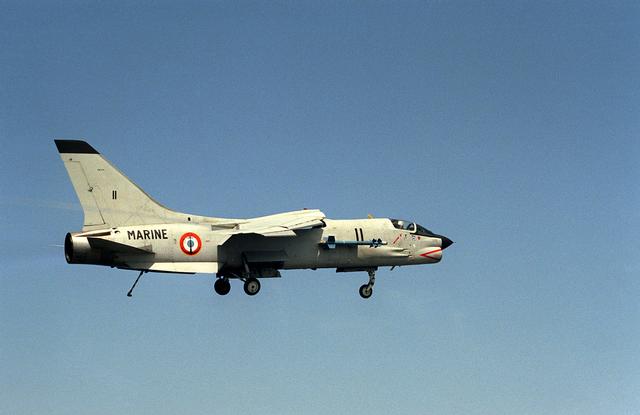
The A-7 inherited that from its design “parent”… the F-8 Crusader.



 Sign In








