 Bager1968
Here is a list of ~66 of the 88 (or 87):
http://www.joebaugher.com/usaf_bombers/b29_13.html
Bager1968Add WF495: http://35squadron.wordpress.com/washington-b29-wf495/
Too bad you weren’t looking for 207 sqdn: http://www.207squadron.rafinfo.org.uk/washingtons/
88 total sent to the RAF.
The first 70 were serialed WF434-WF448, WF490-WF-514 and WF545-WF574.
The second group of 18 were serialed WW342-WW356 and WZ966-WZ968.
RAF Marham
No. 35 Squadron RAF, No. 90 Squadron RAF, No. 115 Squadron RAF, No. 207 Squadron RAF
RAF Coningsby
No. 15 Squadron RAF, No. 44 Squadron RAF, No. 57 Squadron RAF (moved from RAF Waddington in April 1952), No. 149 Squadron RAF
RAF Watton
No. 192 Squadron RAF
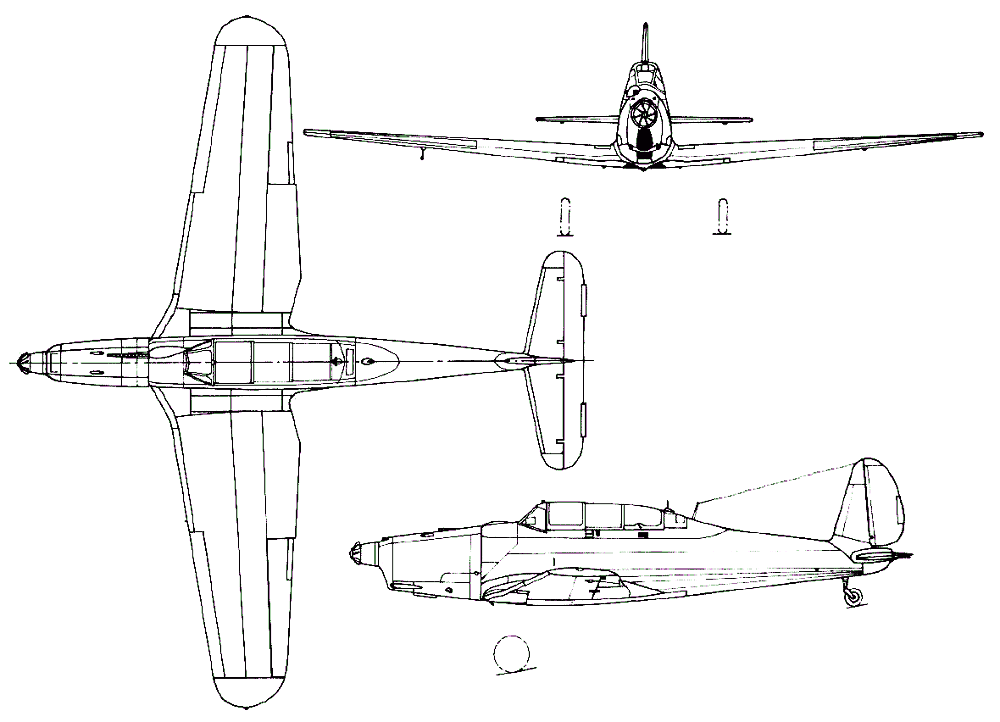
Bager1968Does Arado Ar 96 help?
Nope. Enclosed cockpit & wrong tail surfaces.
Bager1968Now the Sweden has plans to replace all 100 Gripen C / D for 60 Gripen E.
[SIZE=3]
The numbers from Royal Swedish Air Force over the years has been decreased with ratio more intense than others Air Force, and despite several allegations that the Gripen has been one of the cheapest aircraft to operate around the world, but those dramatic cuts in numbers has been such incontestable evidence that in fact there are not such thing as cheap advanced fighters to operate in any Air Force around the world, in the final analysis, or there are budget for it, or then the fighters will inevitably disappear from inventory.
In 1990, the RAF (UK) had 33 fast-jet squadrons; in 2003, 17. That is a 49% reduction – in the same period the RSwAF reduced its fighter numbers by only 35%.
Yes, the RSwAF only has 60 Gripens now – and the RAF is to drop to 6 squadrons before 2020 – an 82% reduction from 1990 for both.
In 2024 the RAF is expected to have 7 such squadrons – a 59% reduction from 2003, while the RSwAF will see a 63% reduction from 2003 (80 Gripen-E, not 60).
Overall, the RAF will have reduced by 79% from 1990 to 2024, while the RSwAF will have reduced only 76% from 1990 to 2024.
So there is no truth to your claim of “Royal Swedish Air Force over the years has been decreased with ratio more intense than others Air Force”.
Bager1968Interesting… didn’t recall hearing this on the local news this morning.
May have to run out to Double Eagle (about 20 minutes from my house) and take a look.
Rob
You won’t see much – it was really minor.
Here is a link that doesn’t demand you subscribe or answer a bunch of intrusive Bullshiite questions before you can read the story: http://www.kirtland.af.mil/news/story.asp?id=123434332
CV-22 damaged at Double Eagle Airport
Posted 12/12/2014 Updated 12/12/2014 – KIRTLAND AIR FORCE BASE, N.M.
— A CV-22 Osprey tilt-rotor aircraft experienced a nose landing gear malfunction while landing at Double Eagle Airport near Albuquerque, N.M. at approximately 11:30 a.m. today. The aircraft was on a routine training mission at the time and sustained damage to the nose of the aircraft. There were no reported injuries.
A board of officers will investigate the incident.
Media Advisory:
For more information, call Kirtland AFB Public Affairs at (505) 846-5991.
Bager1968One of my father’s brothers was in the US Army in the late 1940s – he was one of those ordered to sit in a trench in the Nevada desert with goggles on and his back to one specific side. Pretty soon there was a very loud sound, followed by a wave of hot air and dust blowing over them – then came the shadow… a mushroom-shaped cloud shadow.
And yes, he developed cancer in the 1970s, dying in the early 1980s.
As for alertken’s comment
There is no mileage in pursuing where this kit was later operated, then scrapped. You could track ships and aircraft identities, then follow through enthusiasts’ sites to their end…but why? All you would do is upset people and trigger vexatious claims.
History shows that there would instantly be hundreds of claims for radiation exposure from people who once walked past where the airframes had been stored years earlier, etc – despite the airframes not actually being “hot” by the time they left military custody.
As shown in other UK tests in Australia, any equipment that was still “hot” by the time the testing was over was dropped in a pit on the test range and buried… including several airframes. In this case, they would have likely dumped them into the ocean.
Bager1968Of interest, and as a follow on to Graham’s post, in the Korean War the USAF found that the armor plate fitted to Mig 15s was pretty much impervious to the 0.5 inch ammunition used by F86s.
Which was fine for the pilot (the armor was for the cockpit only)- but the rest of the aircraft was not protected by armor – and you were much more likely to hit the engine than the pilot anyway. Then there were the fuel tanks, etc – etc.
Bager1968When the services pared down overlap EF-111A was stood down and USMC EA-6B, just retired this year, stayed on duty. No F-15 or F-35 program will replace the EF-111A duty because it’s role simply doesn’t exist. The EA-18G is the main escort jammer into the future although it’s range isn’t anything like EA-6B or EF-111A.
Ummm – you are a little confused.
Both the USN and USMC provided EA-6Bs to cover USAF operations.
The last of the USN’s EA-6Bs returned from their last deployment 16 November 2014 – and have been replaced by EA-18Gs.
These will be needed due to the intent to operate the F/A-18E/F for at least 2 more decades – as well as to help out the EW-less USAF.
NONE of the USMC’s EA-6Bs have been retired yet (there are 4 squadrons) – currently, the USMC’s EA-6B program will not conclude until 2019, although phasing out will begin in 2016 and no replacement has been announced yet. The USMC plans to utilize the F-35 radar’s limited EW capability to provide a partial EW capability, due to the intent to have no non-stealthy fighters in the USMC.
Bager1968The RAF have the Hawk. USAF the T-38, which is being scheduled for replacement with T-X program.
The Hawk is capable of carrying some munitions, the T-38 none and the two principal T-X contenders, T-50 and M-346 are capable of carrying arms.
Both airforces are currently involved in COIN operations in Syria/Iraq. Yet neither seem interested in developing their trainers into something capable of carrying out these ground attack operations at a fraction of the cost of the top-line fighters.
Is it yet another case of ego-driven pilots or ex-pilots who are in charge waving their proverbial d**ks around, or is there a real need to have a $20k+ per flight hour aircraft running around dropping LGBs on pickup trucks?
1. The Hawk has a light-fighter variant – actually, there have been more than one.
The Hawk 50 was the original export trainer version, and offered a limited attack capability. 1977-1985
Another export version, the Hawk 60, was intended for conversion and weapons training. Weapons carriage is increased. 1982-1997
Hawk 100: two-seat advanced weapons trainer with additional avionics, an optional forward looking infrared, an optional laser rangefinder, a redesigned wing and HOTAS. 1989-1997
The Hawk 200 is a single-seat, lightweight multirole combat fighter with emphasis on air defence, air superiority, anti-shipping, air-denial, long-range interdiction, short-range close air support and ground attack. The Hawk 200 is equipped with a Northrop Grumman APG-66H multi-mode radar. 1990-1998
2. The USAF has issued development contracts for COIN versions of the T-6 and the PC9. Yes, for export, but still USAF funded.
3. The USAF already did the F-5 (fighter/strike version of the T38) – in the Vietnam War. They decided that a warmed-over trainer was a great low-budget aircraft for small poor nations or when you don’t care how many you loose, but that more-sophisticated aircraft were a better buy because you could use them in more than just low-intensity conflicts against poorly-equipped enemies.
Buying something just for Afghanistan/Iraq-type operations means fewer aircraft that are capable of combat against more-sophisticated enemies.
Bager1968http://www.historynet.com/deadly-sabre-dance.htm
Story and video of the first “Sabre Dance” F-100 crash.
Bager1968That’s five projects not one.
1. F-16 replacement
2. A-10 replacement
3. F/A-18 replacement
4. AV-8B replacement
5. F-15C replacement (eventually)[Seven projects if you add the F-117 and F-111A to that.]
Except that the F-15E already replaced the F-111A in the 1990s, and the F-35 is NOT intended to replace the F-15E.
Bager1968The F100-PW-100 engine used by the A/B was a very advanced design for the time but suffered from some teething problems. The F100-PW-220 used by later F-15s corrected these problems and are extremely reliable but max thrust was reduced slightly.
While the -220 engine’s static thrust is less, actual performance is quite a bit better.
F100-P-100 (F-15A/B): 14,670 lb.s.t. (23,830 lb.s.t. afterburning)
F100-P-220 (F-15C/D): 14,670 lb.s.t. (23,450 lb.s.t. afterburning)
F100-P-229 (F-15E): 17,800 lb.s.t. (29,100 lb.s.t. afterburning)
Bager1968I was under the assumption that the Allison inline where nowhere near as powerful as the RR/Packard’s that’s all and now I have my answer.
Geoff.
Packard Merlin V-1650-1: 1,390 hp (1,040 kW); Based on Merlin 28. Used in P-40F/L
Packard Merlin V-1650-3: 1,280 hp (950 kW); Based on Merlin 63. Used in P-51B/C
Packard Merlin V-1650-7: 1,315 hp (981 kW); Similar to Merlin 66, primary powerplant of the P-51D Mustang
Allison V-1710-39: 1,150 hp (858 kW); P-40E, P-51A, A-36
Allison V-1710-115, 1,360 hp (1,015 kW); P-40N late-production
Allison V-1710-89/-91: 1,425 hp (1,060 kw); P-38H/J
Allison V-1710-111/113: 1,600 hp (1,194 kW); P-38L
All Merlins had superchargers – most 2-speed/2-stage.
P-40/P-51 Allisons had superchargers, usually single-stage.
The Allisons did just as well or better than Merlins below 12,000 feet – but their performance fell off noticeably at higher altitudes, while the Merlins retained their power at high altitude.
P-38 Allisons had turbosuperchargers, which did even better at high altitude than the Merlin’s 2s/2s superchargers – but were heavier and more complex (and thus less reliable).
Bager1968While some of the US hydro projects predated FDR’s election – the law authorizing the funds to start work on Hoover dam was signed by President Calvin Coolidge on December 21, 1928 – just 2 1/2 months before Herbert Hoover was sworn in as President.
So naturally the dam was named after HH.
Bager1968In addition to an aversion to disrupting the production lines, there was the following:
The Allison-powered P-51 had no turbo-supercharger, which is why the Merlin improved its mid-high-altitude performance.
The P-38 had turbo-superchargers for its Allisons, which gave excellent high-altitude performance. Thus, any gains would be much smaller, and as the change-over would cause a significant disruption on production rate, the idea was dropped.
This article has a discussion of the proposal, phrased in terms of the benefits… but glossing over the problems (it only discusses performance to 30,000 feet).
The P-38 Lightning
In 1940 Packard Motors of Detroit began building the two-speed Merlin V-1650-1 (Merlin 28) under license from Rolls Royce. This engine had 1170 horsepower in high blower with a critical altitude of 21,000 feet. Lockheed ran a study comparing a Merlin XX powered Lightning with a standard V-1710 powered variant. The reported speed difference was over 25 mph, favoring the Merlin powered airplane. Climb performance was similar to the Allison powered machine.
Another Merlin vs. Allison comparison in 1942 involved the V-1710-89/91 Allisons (engines used in standard P-38J) and the Packard V-1650-3 two-speed, two-stage Merlin used in the P-51B/C. Utilizing Military Power speed was almost identical.
Yet another study in 1944 compared V-1710s producing 1725 bhp and “advanced” Merlins using “special” fuel and producing 2000 bhp (no altitude specified). The Merlin powered version could supposedly attain 468 mph at 30,000 feet, which was considerably better than the Allison powered version.
These studies were all conducted by Lockheed and exhibit a certain amount of optimism in regard to maximum speed for both types, but the consensus clearly shows better performance with the Merlin powered Lightning.
Note however, that the same article earlier says that the factory-set maximum manifold pressure ratings for the Allison engines were rarely followed by front-line units. They used significantly-higher manifold pressure settings (up to 60″ vs the factory 40″-45″!
As a result, combat units regularly achieved higher climb rates and maximum speeds than the factory did. Thus the above Lockheed factory comparison short-changes the performance the Allison was capable of.
This article mentions one of the areas where performance would have dropped with the Merlin (it discusses performance above 30,000 feet):
Whatever Happened To The P-38K ?
There were some performance areas that would suffer. While a gain in speed at medium altitudes was expected, the rate of climb would be reduced by as much as 400 feet per minute. Service ceiling would also be reduced as the Packard Merlin XX made considerably less power above 30,000 feet than did the Allison V1710.


 Sign In







