 Bager1968
There’s only one grocer’s apostrophe, though!
Or is it a grocers’ apostrophe?
If you are referring to “It’s our last”… while “its” (possessive) does not have the apostrophe, “it’s” (contraction for “it is” or “it has”) does have one.
http://dictionary.reference.com/browse/its
its
–pronoun
the possessive form of it (used as an attributive adjective): The book has lost its jacket. I’m sorry about its being so late.it’s
1. contraction of it is: It’s starting to rain.
2. contraction of it has: It’s been a long time.—Confusables note
A very common mistake is to write its (the possessive form of it) when it’s (the short form of it is or it has) is required: It’s [it is] unclear what he meant. It’s [it has] been wonderful seeing you again.But do not use it’s for it has when has is the main verb: It has a strong flavor; use it sparingly cannot be written as It’s a strong flavor…
An equally common mistake is to use it’s for the possessive, probably because ordinary possessives of nouns are formed with an apostrophe: the dog’s coat; Mary’s cell phone. But the possessive its is a pronoun, not a noun, and, like other possessive pronouns (his, hers, yours, and theirs), is written without that particular bit of punctuation: I have to fix my bike. Its front wheel came off.
—Usage note
While it is possible to use its as a predicate adjective (The cat is angry because the bowl you’re eating out of is its!) or as a pronoun meaning “that or those belonging to it” (Your notebook pages are torn. Borrow my notebook—its aren’t), such use is rare and in most circumstances strained.

Bager1968Actually, Biskra is in Algeria… although not too far from the Tunisian border.
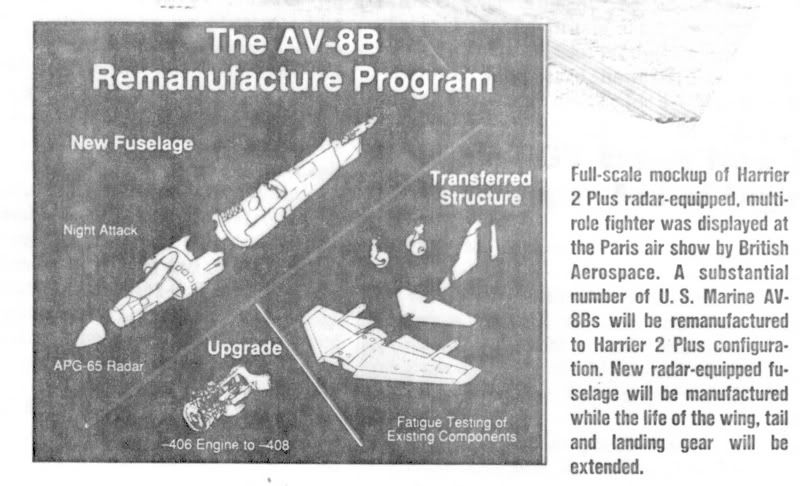
Bager1968If the Marine Corp are getting them nobody hold any illusions about them flying again. There is significant avionics differences between a GR7/9 and an AV8B/+, if they are going to America they will be parted out to keep the current AV8B fleet alive. Certainly major airframe and engine components would be useful to the Americans.
A few of the USMC Harriers are the non-APG-65 “Night Attack” version… these could use most of the airframe components of the GR.9, as well as the engines and some of the flight controls, etc.
Most of the USMC Harriers are the APG-equipped “B+” version… these can really only use the wings, engines, and flight controls. The fuselage is somewhat different, but some of the aft fuselage can be used.
Bager1968Most likely to counter-balance the added weight of the boom (& motors for same) added to the aft fuselage (especially when it is extended and pumping fuel).
The other way to “fix” it would be to modify the horizontal stabilizers… either to add a certain amount of area to “increase lift”, or to adjust their angle-of-attack so as to lift the tail by brute force.
The first requires much more engineering/re-certification than a fuselage stretch (which is a very common and well-understood process) and the second increases drag, thus increasing fuel usage. etc.
Simpler & cheaper to add the fuselage plug.
Bager1968A bit more that I’ve managed to obtain on the original purchase. Rhodesia had hoped to obtain newly built Agusta-Bell’s from Italy as they had successfully aquired aircraft from Italy in the past. This was unsuccessful but they were put in contact with a US company which delt with surplus aircraft. They were marketing 40 ex-Israeli machines which were not airworthy but they agreed to have a number of them made airworthy. Due to the political situation Rhodesia could not send anyone to inspect these machines and they had to rely on an American engineer for this. When these aircraft arrived in Rhodesia they were found to be in a poor state with many more hours on the airframe than they were led to believe. This led to the rumour that it was a three way deal with Agusta supplying Israel with new built machines and Rhodesia getting the old ones from Israel.
And not a Lebanese militia member in sight.
Bager1968The USMC regularly operates from carriers* (they just gave in to the USN and agreed to outfit enough USMC squadrons with the F-35C to allow 4-5 USMC squadrons to be permanently assigned to carrier air wings).
Thus, all USMC carrier-capable aircraft squadrons need aircraft with carrier cycles available.
* in the second half of 2007:
VMFA-251 was part of CVW-1 aboard USS Enterprise;
VMFA-232 was part of CVW-11 aboard USS Nimitz; and
VMFA-323 was part of CVW-9 aboard USS John C. Stennis;
Bager1968However… to answer flanker30’s question… EVEN THOUGH I AM NOT SAYING C-295 AEW&C IS FOR CARRIER USE:
Several carrier aircraft have or had folding vertical fins… the A-3 Skywarrior and the S-3 Viking for example.
Link to a large pic of an A-3 with tail folded:
http://www.airliners.net/photo/USA—Army/Douglas-RA-3B-Skywarrior/1619789/L/
Link to a pic of an A-3 in flight:
http://www.airliners.net/photo/USA—Navy/Douglas-EA-3B-Skywarrior/1194430/L/
You can see the fold joint on the tall tail of an S-3 clearly here, just above the numbers on the fin:

A good pic of an S-3 with both wings and tail fin folded:
http://www.airliners.net/photo/USA—Navy/Lockheed-S-3A-Viking/1593426/L/
Bager1968I hope this clarified it a little.
Sorry for my spelling mistakes, (I’m sure there’s plenty).
That clarified it very well, thanks.
What threw me is that most people’s proposals are for the specific aircraft to be operated.
In a way, basing the hangar/flight deck parking schemes with the E-2 spot factor for all “support aircraft” roles is good, as it is the largest carrier aircraft anybody has operated… any alternatives are likely to be smaller, and thus take up less space.
Bager1968CFTs are basically permanent weight added to the airframe… even when empty. They also do add measurable drag… even though less than drop tanks.
Drop tanks can (and are) dropped in real combat if hard maneuvering is required… and thus add NO weight or drag penalty when it matters most.
CFTs also cover maintenance access panels, which increases maintenance time and adds more complexity (things that can go wrong) to those maintenance tasks (gotta remove the CFTs before starting the repair job).
Bager1968And how were the Lebanese militias supposed to have gotten their hands on Israeli helicopters in any sort of flyable condition?
Bager1968Ummm… is there a lack of english language comprehension around here?
I mention the E-2, and that THE E-2 operates off carriers just fine, to show that the C295 is even MORE suitable for that sized rotodome… and suddenly people are inventing some sort of statement that they attribute to me claiming the C295 AEW&C is to be a carrier aircraft.
Something I never said or even implied!
Incomprehensible!
Bager19689x E-2 (3x AEW&C)?
Where did you get that bizarre load?
What are the non-AEW&C E-2s for… cargo? Or are you proposing an ASW variant? S-3s would do better… they already existed, where SE-2s would require a full development/integration process.
If you really need a fixed-wing ASW aircraft, S-2s (a completely different, earlier design) are available… they can be easily turbopropped.
USN CVNs only have 4 E-2C, no permanently assigned C-2, and no more S-3… all ASW is carried out by helos.
The French CVN carries 3x E-2 AEW&C and no fixed-wing ASW or cargo aircraft (they are currently being supplied off Libya by USN C-2s).
Why on earth would a smaller carrier use up more hangar/flight deck space by shipping twice the E-2 of a much larger USN CVN?
Bager1968It looks a bit larger than an E-2… and those operate just fine from carriers with the apparently same sized rotodome… this should have no problems at all.
The rotodome actually adds some lift, canceling out the weight of the dome & support structures.
The “balance-beam” doesn’t.
Bager1968Not the only one.
The naming of a carrier after a great battle, naval or aviation hero or, after a navy ship which is one in a line of ships was one not followed very well. USS Langley, Ranger, Wasp, Monterey, Enterprise, Bon Homme Richard, Constellation, George Washington were all named after a previous series of ships with that name.
Naming a carrier after a person has a long tradition… starting with the very first carrier the USN commissioned!
USS Langley CV-1* was named after Samuel Pierpont Langley, an American astronomer, physicist, aeronautics pioneer and aircraft engineer.
USS Langley CVL-27 was named for the earlier ship.
* converted from the fleet collier Jupiter (commissioned 7 April 1913) from 24 March 1920 to 22 March 1922. Her name was formally changed on 11 April 1920.
Bager1968ps: FYI RAN recently bought RFA Largs Bay, which is an LPD and topic of this thread.
Ummm… wrong!!!
Largs Bay is a LSD*, not a LPD… they are two significantly different types of ship, despite the superficial external similarity.
LSD is the abbreviation for Landing Ship, Dock (a cargo/vehicle-emphasized landing ship).
LPD is the abbreviation for Landing Platform, Dock (also called Amphibious Transport, Dock…a troop-emphasized landing ship).
A LSD has about twice the floodable dock space, more vehicle/cargo storage space, and less than half the troop accommodation (usually 1/3 or so) when compared to a similarly-sized LPD.
* The RN designated it LSD(A), indicating that it was an auxiliary LSD (intended for follow-up operations), not a front-line LSD (intended for opposed combat landing operations).


 Sign In







