 Bager1968
As far as I remember, we don’t have any christmas cards from my maternal grandfather’s time in France… either for his preparatory time (1917), or for 1918, when he was in a US Army hospital, being treated for gas inhalation.
We do have a number of his letters home, a few pics, and I have his metal document tube with end-caps.

Bager1968I’m not sure if Dokdo was considered, as I’m not sure Hanjin Heavy Industries is willing to upgrade the Russian facilities, but I believe that ThyssenKrupp was invited to submit a bid based on an upgrade of their MHD-200 design.
Bager1968As I understand it SRVL landings happen at about 60 knotts and the brakes are used to bring the aircraft to a stop.
60 knots minus the 20-25 knots forward speed of the ship, minus whatever actual windspeed there is (ships recovering aircraft do their best to head into any existing wind, to lower the required landing speed of the aircraft compared to the ship).
So on a “zero-wind” day, a SRVL would actually be at 35-40 knots relative to the ship’s deck, and if there is a 10-knot wind in the area, the landing speed would be down to 25-30 knots relative to the ship’s deck.
Bager1968A major part of the Mistral plan can be described in one word… facilities.
Specified in the RFP (yes, Russia also invited Spain’s Navantia and Italy’s Fincantieri to offer designs based on Juan Carlos I and Cavour) was that the winning bid must include modernizing a shipyard in Russia so that at least 2 of the 4-ship order can be built there, using modern western construction methods (like large pre-fabbed blocks, etc).
Russia doesn’t want to build carriers (or LHDs) using 1970s techniques, they want to build them using up-to-date methods. This means that new carriers can’t be started until the shipyard has been modernized and the workforce has gained expertise via building the LHDs.
Bager1968From a thread in the Naval Aviation section:
It would be interesting to compare, say, a German versus a US mech-armor brigade. I very much suspect that given similarly equipped units deployed in similar circumstances, the German unit would need fewer supplies than the US unit. Germans in Afghanistan are just as far from home as are US troops in Afghanistan.
In ~1992, there was a report comparing USMC and US Army airlift needs. It compared similarly-equipped & manned combined infantry/armor units, and found that the US Army’s list of “required equipment” would use ~30% more airlift than the USMC’s list.
The main difference was not in the combat equipment, it was in the other stuff…
the USMC would bring basic tents with folding cots while the Army wanted ones with floors, heating & air-conditioning units, and metal bunks with matresses;
the USMC would bring a minimal field kitchen while the Army wanted a “portable mess-hall” (specialized tents to eat in, full-up stoves & dishwashing equipment, etc);
the USMC would bring the absolute minimum of administrative personnel & equipment while the Army wanted to bring the full admin sections with field offices;
the USMC planned for minimal R&R gear while the Army wanted a field gym, etc;
the USMC had basic shower-tents & field latrines while the Army wanted trailers with showers & water heaters, other trailers with proper lavatories, etc.The difference was summed up as:
The USMC plans to go fight a war, the Army plans to “establish a presence in order to conduct combat operations”.
Wanshan, I understand your point!
In ~1992, there was a report comparing USMC and US Army airlift needs. It compared similarly-equipped & manned combined infantry/armor units, and found that the US Army’s list of “required equipment” would use ~30% more airlift than the USMC’s list.
The USMC is far more self-contained, overall -its ground organization is closer to the Army’s airborne units than “mech” or “armor” units. The Marines come with self contained artillery, and air support.
I remember reading around 1994, a Russian Army evaluation of the USMC’s deployment during Operation Desert Shield. They were surprised and impressed at how fast all parts of the Marine Corp organization were completely setup and ready for combat.
Bager1968They should have just done the obvious… chosen one of the other options for making an AEW Nimrod:
http://www.spyflight.co.uk/nim%20aew.htm
Eventually, UK scientists deciding to ditch the FMICW radar in favour of the pulse-Doppler radar and funding for the system was finally approved in 1972. Various options for the Nimrod airframe were considered; the first option involved mounting the E-2C AN/APS-125 radar and associated avionics above and inside the airframe. The second option was to use the AN/APS-125 radar with British avionics. The third option was to mount the AN/APA-171 radome and antenna on the Nimrod, with Britain supplying the radar transmitter, receiver and avionics. The fourth option was an all British radar and avionics system, with some American components, and a FASS with pulse-Dopper processing operating in the S-band. Although this option provided the greatest input from British industry, it also carried the greatest technical risk and the alarm bells should already have been ringing. But, as in so many UK defence fiasco’s over the years, political decisions, namely keeping BAe & GEC workers employed and retaining AEW radar technical expertise in the UK, overcame the many doubters and outweighed common sense.
By the end of 1974, instead of purchasing an off-the-shelf system with a proven track record, the Labour government predictably decided on the fourth option, the Nimrod AEW 3, accepting whatever extra cost and technical risk that involved. At the time the Labour government also considered that joining a possible NATO purchase of the Boeing E-3A was just too politically complicated, expensive and subject to unknown delay – which is rather ironic considering how things eventually turned out. At this point it was widely reported that the RAF was in favour of a dedicated UK purchase of the E-3A, rather than the Nimrod, but the cost, together with the potential loss of jobs in some marginal Labour seats, was always going to mitigate against this option.
http://www.secretprojects.co.uk/forum/index.php?topic=1272.0
Aircraft with APS-125:
Nimrod AEW.3 variants: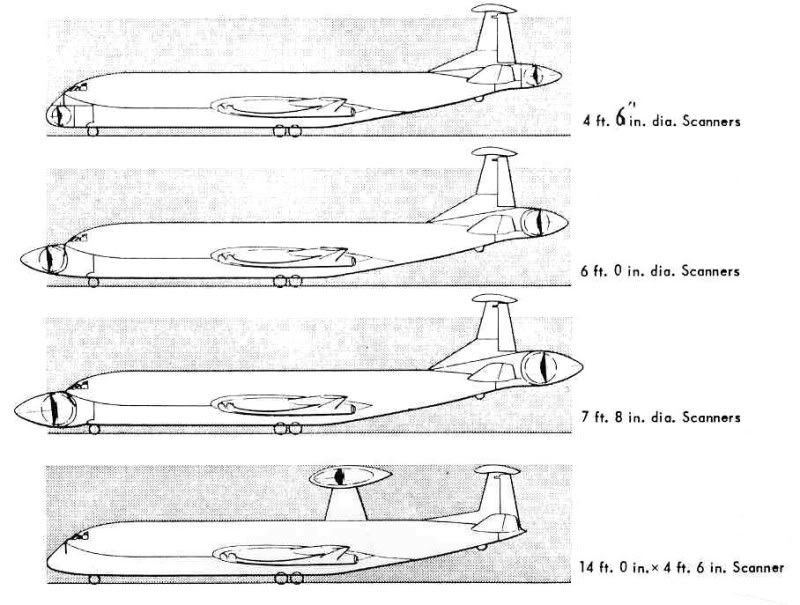
Nimrod-E-2C fit: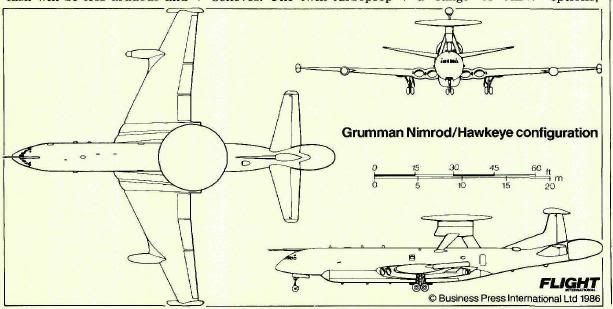
Bager1968I scratch my head and wonder why the Indian Navy wants Vikramaditya and the Chinese want refurbished Varyag. The only potential saving grace would be to add catapults so heavyweight jets (with useful ordnance loads) could be launched.
India was originally buying Vikramaditya because it was supposed to be a “quick & cheap” gap-filler to get to 2 carriers by ~2005, and to maintain 2 until the second Indian-built carrier is completed (Viraat being taken out of service when the first Indian-built carrier is completed).
Of course, once the project was started, it gained inertia separate from its original rationale, and it became impossible to cancel once the problems were known.
The rationales for China putting Varyag into service are clear.
First, they need to gain experience with some form of fixed-wing carrier before construction of their home-built ones is too far along, so they can adjust the design to incorporate lessons learned.
Second, they need a training carrier to gain experience and develop procedures for not only the aircrew, but also deck crews and command/control personnel.
Varyag fills both these needs at a comparatively low cost.
The refit also added to the knowledge base of the shipyard, for a third benefit.
Bager1968It would be interesting to compare, say, a German versus a US mech-armor brigade. I very much suspect that given similarly equipped units deployed in similar circumstances, the German unit would need fewer supplies than the US unit. Germans in Afghanistan are just as far from home as are US troops in Afghanistan.
In ~1992, there was a report comparing USMC and US Army airlift needs. It compared similarly-equipped & manned combined infantry/armor units, and found that the US Army’s list of “required equipment” would use ~30% more airlift than the USMC’s list.
The main difference was not in the combat equipment, it was in the other stuff…
the USMC would bring basic tents with folding cots while the Army wanted ones with floors, heating & air-conditioning units, and metal bunks with matresses;
the USMC would bring a minimal field kitchen while the Army wanted a “portable mess-hall” (specialized tents to eat in, full-up stoves & dishwashing equipment, etc);
the USMC would bring the absolute minimum of administrative personnel & equipment while the Army wanted to bring the full admin sections with field offices;
the USMC planned for minimal R&R gear while the Army wanted a field gym, etc;
the USMC had basic shower-tents & field latrines while the Army wanted trailers with showers & water heaters, other trailers with proper lavatories, etc.
The difference was summed up as:
The USMC plans to go fight a war, the Army plans to “establish a presence in order to conduct combat operations”.
Bager1968Also buying very expensive things that either never enter service or are withdrawn after short service lives (Nimrod AEW.3 & MR.4, Sentinal, HC.3 Chinook, “extra” LSD(A), etc).
The UK MOD wastes more money in “canceled just before completion”, “improperly managed then mothballed”, and “under-utilized” projects than most industrialized nations.
Bager1968Contact Red Bull :diablo:
You stole my line!
Bager1968But do I read it right that you think that the procurement process was worse back then than now?
I would see it as a few accountable suits (some genuinely talented, some a waste of a suit) in wood panelled offices on civil service pay coming up with the requirements and specifications of aircraft, componants, and support kit, while these days it gets passed to the contractors with all sorts of chances for odd deals and making managers a quick buck, while still costing the taxpayer large sums of money.
It looks more like hundreds of suits, each of which has to define one specific component, then other suits put a dozen components together and define the package, then still other suits put the packages together into sub-assemblies… etc.
Apparently it sometimes took years to define what they wanted built.
Contrast this to what happened with the P-51… RAF reps asked North American Aviation to build P-40s, NAA said “we can build something better”, the reps said “OK, do your thing”… and 117 days later the first prototype left the factory, and flew 61 days after that (178 days after the “go-ahead” had been given)!
Bager1968Iraq, multiple deployments of USMC squadrons. Cargo & troop transport, air-scout missions over areas where fighting was occurring.
Afghanistan, USMC. Transport duties, also used to insert troops during combat operations in the Now Zad Valley of Helmand Province in December 2009.
Oh… compared to what it is replacing for the USMC:

Bager1968Cut the MV-22 for one, if the X2 or eurocopter hybrid X3 technologies prove to be worthy it makes less sense to keep the MV-22.
Yes… lets take out of service a combat-functional aircraft that has made multiple successful combat deployments in favor of a couple of aerodynamic prototypes that don’t even have an actual program to begin developing a service model set up yet (making any such service model at least a decade away… IF one is ever ordered).
Brilliant!!!
:rolleyes:
Bager1968How much money would the USA save a year by eliminating the Corps all together???? The Army does the same training as the Marine Corps so it seems redundant to pay for both.
Why don’t we just unilaterally disband the entire US military, eh? That will save lots of money!
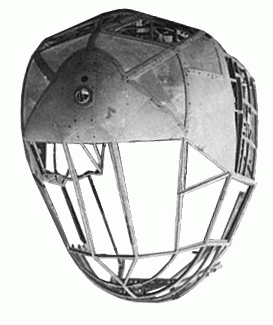
Bager1968That long flat plate in the center almost reminds me on a bomb-aimer’s window… if it was turned over.


 Sign In







