Schorsch
http://www.nasa.gov/centers/dryden/p…n_H-1957V1.pdf
nasa.gov/centers/dryden
Man. i’m sure you’re going to LOVE the material you can find there and have some for breafast, lunch and diner.
I do.:D I downloaded 136 PDFs from Dryden/NASA some of which arent available for free by now, they corrected the mystake some time ago.
Thanks. Some interesting passages, especially some concerning my professional field. Interesting though that “near sonic airliners” were proposed back then but nothing happened in that direction. The first airliners really using the potential of the wings close to the maximum are the A380 and the B787 with MMO pretty close to M0.9, slightly short of the Convair 990 (but potentially with a huge increase in aerodynamic efficiency).
SchorschPersonally I don’t know why they didn’t go with the Convair 200. The lift jets had already been built and run. Seems to me it would have been the less risky of the two. One of my favorite might-have-beens.
You’ll see with the F-35B, which is far away from being operational, that jump jets are a BIG pain in the a**. When you require them to start vertically and perform a mission, you virtually castrate the aircraft.
Pretty much all VTOL projects were either given up before anything close to perational aircraft came out or ended as failure (Yak-38). The only exception is the Harrier, which was very limited in performance in the beginning.
Even the F-35B will retain heavy scars from its STOVL requirement, and I guess it will be the least successful variant. Today’s exact specifications are yet to be released, but I think it will be less shiny than expected.
SchorschMORE of the usual for which you’re welcome to appoligise too; “i can’t get my wires uncrossed so i’ll try to make yours looking like they are”.
These supercritical wing profiles were developed by Dryden through the F-8 supercritical/FBW programme and apparently used in the F-22 and F-35 designs, in ANY case i made a mystake crediting them with ONLY a 0.011% drag penalty at supersonic speed…
Quite a lot can be found about the F-111 research (it was called TACT).
Anyways, can you indicate if the things you are posting are available somewhere on the net, or proprietary documents? I would like to have a closer look, they seem worth it.
SchorschI guess it is relevant to the topic…
Yes, it is, but also at speeds below M1.3 inlet efficiency is an issue, other than one might suppose from the pitot intake pressure recovery.
SchorschJust a question to ponder….Given the resolution of these Google Maps, could it be possible that these “signs of disrepair” are in fact fake and were put there to make people believe the runway isn’t being used?
You mean to hide the secret tests with alien space craft from the general public?
SchorschAm not to sure about this one, i.e F119 vs F135 sort of optimisation and we all forgot to mention ceiling i mean tropopause and I think YOU can elaborate there……
Uninstalled normally means that some random correction factors apply.
Most thrust data is uninstalled, I have a few tables on installed engine (for example MiG-23 and MiG-29), and the characteritsics are not that different high up in reheat. A more detailed analysis would be needed to check the xact ratio between thrust at – let’s say Mach 1.5@45000ft – and dry/wet thrust at 0-0.
“Lack of” is relative, TWR is just marginaly lower than the German F-4s which are lighter than most…
The RB199 is REALLY a slouch at altitude.
I cannot exactly judge but if you make a visual comparison of the intake areas, and check the reference thrust, I mean the Tornado has twice the reference thrust of a Mirage 2000, but the inlets don’t seem to double the size.
Turbo-fan (and RB.199 has bypass ratio of 1) needs lots of air.
Thrust = mass * speed
Turbo-fan means more mass but less speed.
Isn’t Mass flow related to TET?
TET (Turbine Entry Temperature) is a hard limit, you cannot go beyond that.
The air that enters the combustion chamber is spilled with fuel and – guess what – combusted. Now, quite logical, more air means more potential to burn fuel. If not enough air enters the combustion chamber less fuel can be burned, otherwise the temperature would get too hot.
I am truly not smart on engines (and actually, have no idea about aerodynamics, either), what I write is basically digested basics. Normally engines are limited by various parameters (RPM, TET).
Would be interesting to know if the RB.199 is TET limited at altitude. Since arrival of FADEC I guess no one knows any more.
True but the F-3 was considerably redesigned this i believe did involve the inlets not as for design but optimisation of…
I guess enlarging the intake would have been a bit too much. Additionally, the Tornado F-3 performs magnificent in its role.
Too much “fighter” in an aircraft makes it a bad subsonic cruiser, I guess you know that after having spent some time in the Mirage.
This IS what i meant (on inlet pressure recovery)…
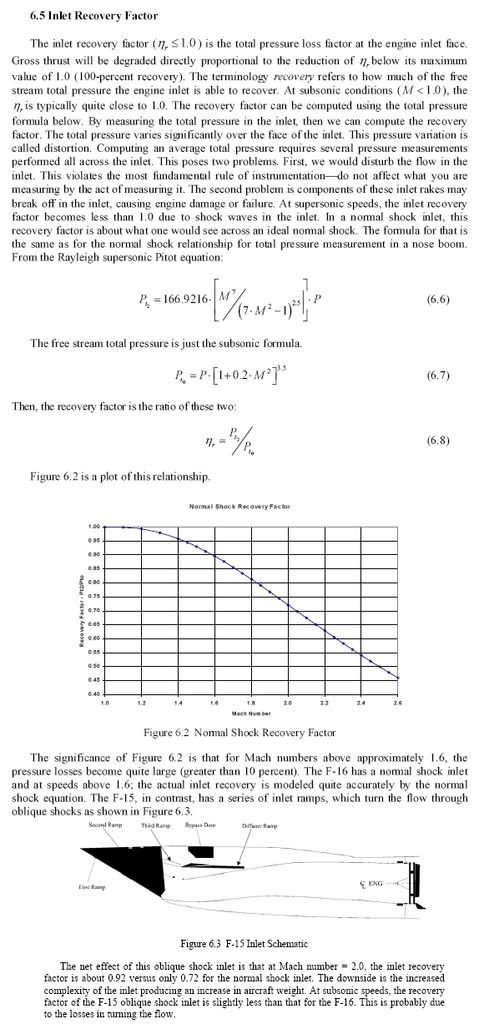
You are referring to the Mach number dependent pressure recovery by compression shock. But each intake will lose pressure (with can be translated as lose thrust) by its intake, even an A320 has a pressure recovery below 1.
Supersonic aircraft tend to have up to 10% loss at subsonic speeds (which have nothing to do with Mach number effects) due to mass flow issues and stuff. Intakes have optimum design points, the F-16 for example has much better recovery at speeds below M1.3 than the F-15.
The F-15s intake (which are similar at most 4th generation fighters) are not the best in subsonic cruise. Reasonable, but not optimal.
SchorschIt’s total dry and A-B thrust is also much more likely to decrease with altitude and speed for the SAME type of inlets.
Uninstalled engine thrust in reheat does have similar thrust over Mach and altitude characteristics for both turbo-jet and turbo-fan.
RAM drag btw is (according to Nellis H-B) “the result of slowing the air from free stream to near zero speed at the inlet”.
This have another name which i believe to be Spillage drag.
Not necessarily. Spillage normally means compressed air (due to external compression shock) that does not enter the engine. Means you do compression but it is wasted. The ram effect at Mach>1 is drag, but on the other hand free compression for the engine. Normally the ram drag is included in the net thrust the engine produces.
Spillage is a problem when intake and Mach number do not fit.
It’s pretty obvious that a M 53 will be able to recover a lot more of it than a RB199 at altitude regardless of inlets type and settings.
I am not sure if there is any major difference between them in reheat.
Problem of an aircraft like the Tornado is high wing loading and limited thrust.
Pressure recovery is normally simplified to a pure function of Mach number, which is not entirely correct. It is also a function of mass flow, and hence of engine actual thrust and altitude. Depending on the design point of the whole machine an intake might be ill-suited for other demands. The Tornado was built for low level flight at high subsonic speeds, meaning plenty of dense air available. At flight Mach numbers of M0.9 at high altitude the intake might have issues getting enough mass supplied to the engine, so that the engine produces less thrust (not enough air to combust all that fuel) than it technically could provided enough mass is available. The engine itself, may it be turbo-fan or -jet, is secondary then.
SchorschThe Mig 23 should be evaluated as deployed in walls firing Apexes at theoretically outnumbered F16s without BVR missiles and outnumbered F15s in Central Europe. Unfortunately most of its engagements have been in WVR domain where like the Phantom it was flying out of the best part of its envelop. Conceptually the Soviets copied the USAF’s mistake with the Phantom, focusing on speed and BVR for interception at the expense of all else (an area where performance wise, it seems to have met its requirements).
The concept of BVR needs to be put into perspective. Calling the MiG-23 a BVR fighter is somehow a bit too much. In the 60ies all IR-AAM were rear aspect only, had limited range and lacked destructive power. To successfully engage an intruding enemy, which is identified by ground based radar, the aircraft needs radar guided missiles. The MiG-23 was never considered to work stand alone and find, track and attack targets.
The first aircraft able of doing that with a single guy was the F-15A.
The objective was to give frontal units the ability to engage enemies that would have been a huge problem to the MiG-21. The first truly operational MiG-23 also employed a limited look-down option, a big step forward, as before Western fighter bombers could enter the airspace virtually unhindered when the sticked to low-level high-speed flying.
The numerical advantage of the MiG-23 is offest by its defensive character. An air force needs to have a set number on station, and an attacker can normally outnumber the defenders by employing many aircraft in a short time frame on a single location. Nothing special, a normal fact of aerial warfare: the defender is usually outnumbered.
SchorschThe lifting body tests in preparation for the space shuttle needed quite a runway, primarily as precaution as they couldn’t go around.
SchorschBut the MiG-27s are almost a decade younger compared to the MiG-23BNs and overall have had a much better safety record.
And the MiG-27 uses some specific features of the MiG-23 for a different purpose with success: good (but slow) cruise performance, good low level handling. With turbo-fan engine it can be seen as a swing-wing Sepecat Jaguar (which the Indians also use I think ??).
SchorschTrue. But but Cuban 23s performed pretty ok against SADF over Angola in the 80:s didnt they? No stuning sucess in anny way, but still ok if memmory serves me right. (After all Cuba/Angola sort of won that war anyway. Sort of).
Ethiopian MiG-23s should have seen at least some acton against Somalia and Erithrea too. No idéa of how they performed there though.
Premium requirements of the MiG-23 were:
– radar guided missiles
– Mach 2+ performance
– short/medium take-off and landing performance
When we look at the specific actions, all these specifications were useless for those conflicts.
The Mirage F.1 in contrast, which had similar time scope and was subject to similar technological limitations, came out much better. The Russians didn’t lack the technology or the ability, but specified the wrong aircraft for any but their own (perceived) needs.
I guess the Iraqis can tell the story best, as they used both and preferred the F.1.
[P.S.: Low intensity conflicts somewhere in Africa don’t really count as benchmark; I guess the Cubans had gratefully traded their MiG-23s versus F-5Es.]
SchorschAs for the F-35’s top speed: as excess thrust will be quite marginal above M1.6 (look at F-18, it doesn’t really get above M1.65, even virtually clean). So I guess operational speed would – if no software restriction applies – not get much above M1.7ish, if at all.
The more interesting thing would be how long it takes to get to this top speed.
Some aircraft may fly M2.0, even with some weapons, but virtually burn all fuel to accelerate to that point.
SchorschThe MiG-23 was designed for very specific and contradicting requirements, that all with the limitations present in 1960ies Soviet aviation.
It only saw combat outside the Soviet Union, and performed quite miserably most of the time (but the airlines using it didn’t really win with other aircraft, either).
However, I think the aircraft – though not really a winner – cannot be blamed for it. It sacrificed many beneficial characteristics for its supersonic ability and swing wings.
SchorschAs one previous poster pointed out, it is often “over-specification” rather than over-engineering. A problem even the Russians couldn’t avoid (look at all the swing-wings, M2+ aircraft and stuff).
In the 1950ies, the Soviet oriented pretty much on what was possible in which time frame.
In my opinion, a good example of well specified aircraft is the F-16.
A bad one is the F-111.
SchorschYou do forget, that the F-15 has to stay below 30000 feet to allow the F-16 that advantages, when both do fly alongside at the same speed and someone “unknown” will rise the flag, please start the contest gentlemen. 😀
OK, if we a pit an F-16A versus an F-15C (1981 style) the F-15C has lower wing loading and probably more thrust to weight (at least they have at static, and as engines are the same and pressure recovery is known, the resulting thrust should be similar for both until a certain Mach number). That gives the F-16 a flight mechanical disadvantage at high altitude.
The F-16A has better lift-drag ratio for higher Gs (>> less energy bleed), also at 1G by the way, better handling qualities throughout the flight envelope, onsets of carefree handling, and is smaller and lighter.
Seem to recall Israeli pilots, during the early years of operating the F-15A/F-16A, when they used to train WVR the viper won most of the time. The Israeli Eagle pilots believing the F-16 must have been the best in the world at it due to the losses they received.
We need to remember that Israeli fighters normally operate pretty low, much lower than USAF or other.


 Sign In