 Ja Worsley
Yeah I know mate, but still, are the planes flyable? The Kiwi fast jets are still up for sale and are given a check flight once a week to maintain their flyable status!
Ja WorsleyPreferably without whatever the hell is wrong with them this week? :diablo:
Ouch!
Ja WorsleyWith Regards to the Ashmore Guardian, she looks like a converted tuna boat.
I know what you mean mate, but there is just something about this boat that makes me love it- think of it in naval terms- landing a small squad of Special Forces 😉
In regards to pirates, please list the pirates that have 5″ guns? the Armidale class with their Stabilised 25mm Typhoon mounts could probably take on any conceivable law enforcement task, unless pirates can get their hands on retired FAC’s including SSM’s.
I personally have seen (When I was in the Navy) Pirate vessels armed with WW2 era large caliber guns, ranging from 2 Pounders through to 6.9 inch canons. In and around Indonesian waters there are many places to get such weapons, the ammo is more difficult to come by (one boat we intercepted had only five rounds that it shot off at us and fell silent), thus many of the Pirates make their own ammo. As for the 25mm Bushmasters, apparently yes these weapons are quite capable of taking on larger weapons, simply for the fact that the stabilisation gives accuracy.
Wonder if it would be worth it for the RAN to pass the Armidales to Customs and replace them 1 for 1 with a class of 1,500-2,000t helicopter capable “sloops”.
There was a plan at one stage to do just this- the RAN were looking at a joint project with Malaysia to produce the OPC. Sadly the Malaysians opted out and went for the MEKO A-100’s. What we should do is as you say hand over the the Armidales to the ACS and produce the same number of Tenix designed OPC’s like what we built for the Kiwi navy.
Ja WorsleyInteresting, thanks greg.
So are the M2K’s still in a decent condition, what will be sold along with the planes?
Ja WorsleyOriginally posted by d’clacy
For all the rhetoric in recent years from Howard and his cronies denying a Coast Guard, it appears we have one, albeit in another name. It is not really the province of Customs to be looking for illegal migrants and protecting oil rigs.
Mate you know how much the population hated Howard for crawling up Bush’s back door! Had we have started an Australian Coast Guard, we would have been America in all but name, politically it would have been like taking a gun and putting it to your head then pulling the trigger and praying that the gun misfires. The only thing with the ACS’s vessels is that like the RAN’s Patrol boats, they are not really equipped to take on the Pirates who have far superior weapons on their vessels- I mean how can 2 50’s take on a 5 inch gun? If any of the Bay class come across a pirate boat armed with RPG-7’s then I am sorry to say that the Bay class will loose the fight as they (again like the Armidale’s) are made of aluminium alloy and this burns very hot and very fast just like magnesium!
Of the entire surface fleet, the latest vessel “Ashmore Guardian” is the one I think is great, I am looking forward to hearing more of this vessel in the future. She is a purpose built vessel as you can see, but the only down side it weapons- the only ones she has are the personal weapons of the crew, she doesn’t even have the 50’s 🙁 Oh and did anyone notice the Anzac in the back ground of this pic? 😉
Ja WorsleyThe Dash 8’s operate with the Raytheon SeaVue surface search radars with additional Inverse synthetic aperture radar (ISAR), Synthetic aperture radar (SAR) and Moving target indication (MTI) capability, advanced electro-optical sensors and sophisticated communications suites. They can operate day and night close to land and at low altitude. These aircraft can search an area of 110,000 km² per flight.
I can’t find any info as to which radar is installed in the F406’s just that it is a 360 degree radar coupled to a visual system like the MX-15 electro optical system.
There is an inbuilt capability to link radios with the ADF and provide a real time video and radio link between the aircraft and ADF assets such as the AP-3C’s and naval vessels.
Ja WorsleyPlaneman: well this certainly is due its accolades but as you did expect, someone out here did find a few faults with the data mentioned, it is a long and drawn out comparison but worth the read. I was disappointed by the lack of an outcome which would have been in my humble writings something along the lines of:-
In summing up a comparison of this nature, it would be basically remiss of any person to say that the options of a Carrier of this nature entails any user some measure of power projection is the simple fact of it’s shear presence and what it is capable of doing rather than what it has deployed with- this is certainly the case of the Sao Paulo (which regularly deploys simply to help the Argentinian Navy keep it’s carrier qualifications up to date, this bringing more Skyhawks and returns the Super Etendards back to this vessel), or in the case of the new British carriers who will deploy with air groups relivant to the missions empossed on the vessel.
It should also be reminded that even if a carrier is deployed on a mission, it may not be on a peace keeping or show of force mission, as with the case of Sao Paulo deploying to Haiti. Carriers of this size represent a lot of space and this space doesn’t need to be filled with planes and associated equipment, they do make ample space for relief supplies urgently needed in disaster zones such as the hurricane ravaged Caribbean. So while a carrier can flex the muscles of a nations might, it can also be the mercy bringer to people in need anywhere around the world with supplies coming in 24/7 (lets face it, there is very little civialian traffic or population around to complain about the noise, so supplies can come in all night and be sent out all day).
Like I said, that’s just a rough sum up of what I’d say.
Now for the few mistakes I did find and should point out.
Nimitz class aircraft carrier
Most of this class are still fitted with the 20mm Phalanx CIWS. I can’t remember which one or ones it is, but I know there is a multi layer defence system incorporating ESSM’s (using the same Sea Sparrow launcher but with four ESSM’s in one cell giving more shots per launcher, RAM’s and Phalanx as well (these systems are mounted with the Phalanx lower on the rails and the RAM’s behind them in opposing quarters with the ESSM launchers on the other corners.
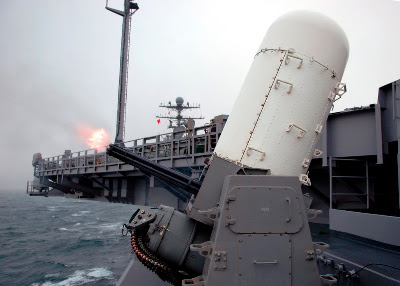
070709-N-9079D-007 PACIFIC OCEAN (July 9, 2007) – One of three close-in weapons systems (CIWS) aboard Nimitz-class aircraft carrier USS Abraham Lincoln (CVN 72) fires test rounds during a routine training exercise. Lincoln departed her homeport of Everett, Wash., for a scheduled work-up after spending a week in port following sea trials and a nine-month dry-dock planned incremental availability. U.S. Navy photo by Mass Communication Specialist 3rd Class Ronald A. Dallatorre (RELEASED)

Atlantic Ocean (Nov. 3, 2005) – The Nimitz-class aircraft carrier USS Dwight D. Eisenhower (CVN 69), foreground, sails alongside the Military Sealift Command (MSC) fast combat support ship USNS Artic (T-AOE 8) as it conducts an underway replenishment with USS Harry S. Truman (CVN 75). Truman and Eisenhower are currently underway in the Atlantic Ocean conducting ammunition offloads and underway replenishments. U.S. Navy photo by Photographer’s Mate 3rd Class Kristopher WilsonIf you look carefully at this pic you can see the the dual inner system I was talking about on the Ike with the Phalanx tilted almost vertically just below the RAM on the aft Starboard quarter.

ATLANTIC OCEAN (March 19, 2008) The Combat Systems Department aboard the Nimitz-class aircraft carrier USS Theodore Roosevelt (CVN 71) fires the ship’s Phalanx close-in weapons system (CIWS). Theodore Roosevelt and embarked Carrier Air Wing (CVW) 8 are conducting tailored ship’s training availability and final evaluation problem (TSTA/FEP). U.S. Navy photo by Mass Communication Specialist 2nd Class Christopher Mason (Released) Note the Sea Sparrow launcher behind the Phalanx.
NAe São Paulo
As mentioned in my version of a conclusion, Sao Paulo is regularly deployed with elements of the Armada Argentina to keep that services qualifications up to a modest level, the last two joint excercises were ARAEX and TEMPEREX.

Argentine Navy Grumman S-2T Turbo Tracker onboard brazilian aircraft carrier NAeL Sao Paulo, during exercise TEMPEREX 2002, off the brazilian coast.Photo taken and donated by Rob Schleiffert.
HAL Tejas
In your summary of India’s future carrier, you mention that she will deploy with Mig-29K’s, while this is pure speculation as only one batch of 12 Fulcrums have been ordered, one has to ask where the Naval Tejas has gone from your article? Considering that this aircraft will include a high degree of Air to Ground capability, it might come as a logical conclusion that future IN carrier opps could include deployment of 6 Fulcrums and 6 Tejas N’s giving a true multi role capability. Though another more probable conclusion is that the IN will follow suit and deploy aircraft as needed on it’s carriers.
This brings me to my final point, the indigenous carrier program was meant to be for at least three vessels allowing for one on each coast and one in dock (this assumes that the last carrier to be built will replace the Vikramaditya which will have just about run out of time by then).
Anyway mate again it is an interesting article and well worth the read given the time spent going over it.
Ja WorsleyJust got a message from a good friend in Trinidad who tells me that USS Kersarge has been seen in Port of Spain.
Apparently two CH-53’s have been buzzing the locals flying all over the country, if anyone is interested I could share the news in detail.
Personally I find it really interesting since the Russians are due there in a couple of weeks to excercise with the Venezuelans.
With the Russians in town, I don’t expect the Fourth Fleet to be too far away.
Ja WorsleyWhere are you getting this about Osprey as a support jammer for a fastjet strike package?
Logical conclusion- I know I’d at least try to make a system like this. Sure there is a speed difference but given that the Osprey can change flight modes think of what it can mimmick- Charter turbo prop flights, SAR helo on station, news chopper- the point I am making here is that on radar, it fits the profile (sorta like a B-52 flying a Civilian 747 route- on radar who can tell the difference)?
Where did you hear that TOSS was going to demand a pressurised cabin for V-22. It was my understanding that the whole concept of TOSS is that its a rapid-fit pallet to a stock V-22 for organic ISTAR support as and when required. Hardly tracks with having specialised airframes?.
I hadn’t heard that the TOSS was going to be a “Quick fit”, I had however heard that this was being proposed as part of a package to find a replacement for the Hawkeye and Greyhounds as well as the Viking (in both Tanker Support and Fixed Wing ASW roles). Given that the Hawkeyes need to be pressurised due to the height that they fly at, my assumption came as logic (remember the Hawkeye equation- Height equals distance, logice dictates that the same equation would apply to the TOSS system)!
How many EV-22 would be needed on a carrier for 24/7 ops, taking into account the Osprey struggles to achieve 60% mission capable rate?
Given that this is a new type of system and that it is still being refined this is actually a very high missions rate success, the nextgen of V-22, the V-X will be far superior when it comes because we’d have a better understanding of how the system works- Look at the Bell P-59 Airacomet, how bad a performance did it have- compare that now with Jets today and you see what I mean, give technology time to mature and then things work!
As for how many would be needed, depends on size of the carrier and operational profile! France are doing it with three E-2C’s.
The main thing I wish to point out here is that my EV-22 is a theoretical, but logical adaption for a small carrier such as what is being proposed here in this thread.
Merchant ‘carrier’ conversion studies were carried out in the US and in the UK. The British program was called SCADS and the US had their ARAPAHO concept.
This is not actually a new idea- During WW2 Merchant vessels were converted into emergency carriers called Merchant Aircraft Carrier (MAC) ships. The British converted 19 vessels to this standard.
Ja WorsleyThanks mate- The publication has posted pics of the Vita class, but also a pic of a Damsah Class claiming that it is a Vita class (silly people).
Ja WorsleySwerve and Steve: Guys you are saying exactly what I am saying.
Steve: I understand all to well the constraints placed on the RAN (personal experience), still, the government are looking at 10x subs to replace the operational ineffectiveness that six provide the current fleet- and don’t tell me it’s because of the problems of the Collins class- we’ve had these problems well before then Back when I was on O-Boats as well. The new boats that are being sought are to have a smaller crew (max of 42), but such a high level of automation that the likes have never been seen in the silent service. What i would like to see is a two tier service with 6 SSK’s and 4 SSG’s in a similar fashion to what the RSN is getting with their new subs- Smaller ones used in coastal patrols, larger ones extending out.
Dodger: Ahh yes the African troop lift idea- last I heard everyone but South Africa and Kenya had pulled out saying that it was going to cost too much and that the money could be better spent on other priorities. Still the MRD 150 does seem to be the favoured design over there and not the Juan Carlos design
Ja Worsley150 compliment 😮
What did they do with the 100 personnel they got rid of? Loosing that many from a key design is kind of worrying- really! 🙁
Ja WorsleyF-111: Oh yeah one final point I forgot to mention, also comes from my time in the service- we have a retention problem and a recruitment problem. If we do go for all those vessels you mentioned, we’d have no crew for all of them (another reason why the forces are looking at high degrees of Automation!
Ja WorsleyThat is interesting mate but speaking as someone who served in the RAN i can say that ASC have over compensated highly there. The only thinking I can see, is that ASC are looking at putting in a bid for building the vessels for over seas use as well as ours (there is no secret that the Australian government has tried to sell ASC’s capabilities for building highly complex vessels in the past- refer to Australia trying to sell Collins class to Taiwan).
Perhaps ASC are ramping up again to put in bits for vessels for other naval services. As for our new subs, last I heard we were looking for 10 not 8. This will give our navy a better coverage in our global sphere of influence. Then there is all the other stuff mentioned, interesting.
As for the Aprentices, well they have to leave room for the Navy to send some of theirs in!
Ja WorsleyActually the whole thing is based on two points, one which is covered already: Could the Hawkeye handle the stress of a rocket launch- answer= not really.
It’s not so much the stress on the airframe you have to consider but rather the stress on the supports holding the radar on to the frame. These attachment points are actually kinda weak compared to the rest of the aircraft. The question of weather the electronics could handle the stress is another point stemming from this question.
The other point I wish to make here is cost. Having these rockets is ok but they do cost a fair bit, here is a break down of their standard operation and then I’ll let you work out the costs involved:
[INDENT]
[/INDENT]
As you can imagine, Rockets do become cost prohibative after a few uses.
It’s a nice idea but feesably unrealistic.


 Sign In







