crobato
I disagree with the above. Elevons are not present on all canard-delta planes. As an example, as per the schematic diagram of Rafale, from the top-view and bottom-view, the trailing edge of the wing has visible airelons only. In case of J-10, lower flaps are present throughout the trailing-edge of the wing, however, on the upper part of the same edge, only airelons are visible.
In the J-10, there are actually four control surfaces, two on each wing, on the trailing edge. How would you know the difference between an elevon and an aileron? From a visual standpoint they look the same.
Again, even if assuming that canards assist the wings in lift by providing more moment about the lift-point, it must be remembered that the lift due to the wings is restricted by the constant subjection to low pressure vortex generated by canards, also called as “downwash”. The downwash is also the reason for longer take-off distance.
This is compensated, and why its not an issue, with the Gripen, J-10, Lavi and Rafale, because the canards are dihedral meaning the wing tips point upward so the wings appear like a V, while the main wings are anhedral, meaning the wing tips point downward or at a lower height compared to the wing root. This makes the planes look like a rough flattened “X” if viewed head on. Thus the canard wash is thrown over the plane and not on the wings.
You know this happens when the J-10 and the Eurocanards exhibit large rudder surfaces to compensate, because the canard wash is affecting these, not the wing.
Videos of takeoff of the J-10 and the Eurocanards never demonstrated anything like a long take off distance, in fact, they tend to be rather surprisingly short, with short landing distances at high angles of attack and slow speed.
Elevons are not efficient control surfaces because they can only deflect the air stream that is already flowing downstream from the past the main wing. They are also subject to the turbulence and bursts from the vortices produced in the leading edge of the delta. An elevator whether its in the tail or in the canard, is a completely independent and separate form on its own, which means it takes on a fresh air stream, and best yet on the canard because it does not have the after effects of the main wing.
crobatoSee, canards are forward tail-planes only. There is no other function. As a secondary effect, canards generate a vortex above the main wing, a function which is already performed by Tejas’ sloping lower-swept part of the wing.
Again, canards are used for pitching moments only, whereas for rolling the delta-wing’s airelons are used (canards cannot oppose each other like airelons).
There is also a misconception that delta-winged planes like Tejas or Mirage-2000 are less manoueverable because they have only 2 control surfaces, whereas planes like F-16, MiG-29 or Gripen, EF etc. are more manoueverable because they have 3 control surfaces. It must be remembered that the Tejas and Mirage-2000 can also perform all the 3 movements i.e. pitch, yaw and roll. Combinations of these movements is also possible.
We may consider the airelons and elevators of the F-16 or Su-30. The airelons ALWAYS oppose each other, whereas the elevators ALWAYS support each other. In a delta like the Tejas, the 2 elevons (elevator + airelon) can oppose as well as support each other, thus performing the actions of elevators and airelons as and when needed.
Assume that an F-16 is executing a roll while simultaneously pitching up. The Tejas can also execute this manouever simply by deflecting one elevon lower than the other. Now assume that an F-16 is pitching up and banking. The Tejas can execute it in again the same manner.
It is known that pure delta configs have higher instantaneous turn rates than canard-delta configs. High sustained rates may also be achieved by lowering the AoA and by the vortex generation of the sloped lower-swept wing.
Its not established that pure delta configs have higher instant turn rates—Gripen, Rafale and Typhoon has higher instant turn rates over the Mirage 2000, all three planes at least over 30 degrees per second.
A pure delta config has its elevons closer to the center of gravity or better yet the fulcrum point of the plane. If you understand the mechanics of lever action, the closer you are to the fulcrum point, the greater the effort or in this case, control authority exerted to lift the other side of the lever, which in this case, is the nose to pitch.
With this in mind, you can start to understand why some tailed configurations like the F-22, try to extend the tail planes as far away from the plane’s fulcrum. You want the least amount of control authority to exert the same force to turn the aircraft on the same degree, or the same amount of control authority to turn the aircraft on a higher degree. Being efficient on this is a major factor in maneuverability. This is the reason why tailed configurations have an inherent advantage on maneuverability. The Soviets knew this early and hence why they junked the pure delta configuration early and went to the tailed delta. Note the way the MiG-21’s tailplanes extend backward, and it isn’t just for sweeping.
If the control surfaces is more efficient producing the same amount of authority thanks to lever action, the control surfaces can trim less to produce the same amount of authority and turn. That means less drag, and less drag means better sustained rates. That’s one reason pure deltas don’t have good sustained rates and have a high energy bleed on turns.
Canards offer a variation to the control authority issue by providing a second lifting force on the other side of the lever which complements the downward force from the elevons on the other side. So you have two forces acting simultaneously. And because of this too, the required trim for all four surfaces amounts to a lower degree than if you have two large control surfaces as the elevons. This produces less drag on the sustained turn.
Canards differ from cranks or LERX because they are _variable_ which means they can adjust dynamically to the changes in the downstream vortices using an air flow sensor downstream.
crobatoWell Tanzania has the Chinese double-seater version of the MiG-17 still flying, but when it comes to the oldest military fighter jet you just can’t beat Bolivia’s T-33s.
China still flies many double seater MiG-17s as trainers, e.g. JJ-5, as well as the double seater MiG-19 type (JJ-6). These aircraft are still active part of flight academies today and are quite meticulously maintained. These flight academies are also flying the Nanchang CJ-6, which is based on a two seater WWII style prop fighter aircraft, I think its based on an air cooled Yak or Lavochkin.
When the serial FW-190 production was restarted for private aircraft collectors (the serial numbers were sequentially after the WWII production), they needed brand new air cooled radial piston engines, and they sourced the engines from China, probably the same engine used on the CJ-6.
In the Philippines they fly Huey helicopters that are of Vietnam war vintage—still doing the very same things these choppers did in the Vietnam war—in fighting Communist (NPA) and Muslim (Abu Sayaf) insurgents.
crobatoMy views is that the latest J7s are focused in what they want to be and are uncompramising in being the best they can at that role.
Exactly what I think it really boils down to.
Let me add something on the way the Fishbed flies. One the plane leaves the edge of controllability (e.g. stalls), the plane has a very vicious spin cycle that is very difficult to recover from. This what makes the plane a killer. The higher the aircraft weight, the higher the speed is the stall edge, which means you can only maneuver so and so before the speed drops off and reaches the stall point. It also means your angle of attack will also be limited since high AoA is going to seriously slow down the aircraft, and the wings lose lift, brings the plane quickly to the stall point. Any attempt to push the stall envelope downward to a slower speed is going to be most welcome as well as any improvement in the low speed handling and AoA. Hence from the sheer flyability point of view, I would rather have the wings of the J-7E/G.
crobatoThere are millions from other other countries why they dont become Pioneers in missile propellent field?
Rocket propellant was first invented by the Chinese in the Song Dynasty.
crobatoYes, but what exactly is the RADAR carried in the J-7G/G2?
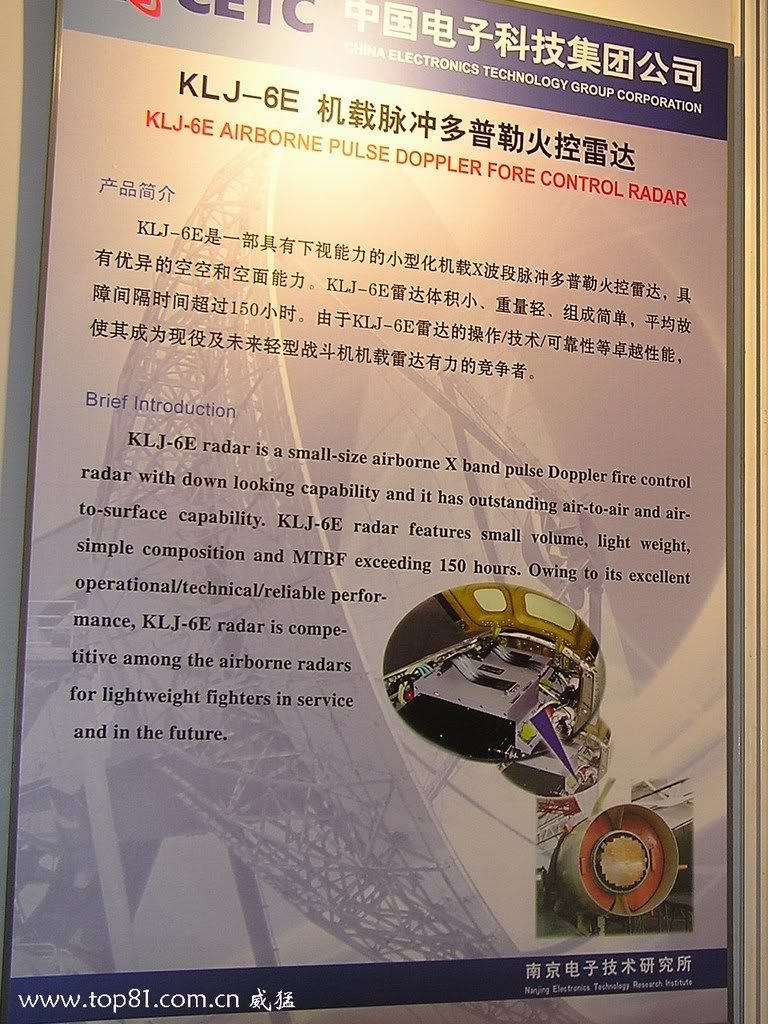
The radar is likely to be the KLJ-6E for the planes used in the PLAAF. But for export purposes it may either be the SY-80 or the KLJ-6E, the -6F offered as an option. The SY-80 is also notable for being a Ku band radar, which means it has a very high resolution and tracking rate.
Oops 😀 Well…..I forgot the [Sarcasm][/Sarcasm] tag for the “1st look, 1st shoot, 1st kill…… Sorry couldn’t resist that…” 😀
That’s why there is a term called EMCON.
In reality, the first guy who uses his radar is the first guy that gets seen and shot at.
crobatoyou are mistaken. Can you show me a single test firing from FC-1? and the others are pretty old project.
I’m pretty sure they were firetesting the FC-1 at least since 2006.
So do you think this Person is Chinese? In USSR and Russia those names are not revealed . They called them Core group. not indvidiuals. Only in West you can see those names.
Like the way you attributed Israeli developers with Intel as some product of Russian electronics technology? Jews left Russia because of the antisemitism, and its doubtful they ever worked with scientific establishments there; the technology they learned are from Intel.
so do u think 30KM is less than your 22 KM when the missile is 15kg lighter? and i ask about burn time. that will show who has better speed and sustain range.
when Su-25SM was inducted into Ruaf they put range excess of 40KM and R-73 has alot customers they dont need to be that specific. why should Vietnam get the same missile as China?
I seriously doubt the 40km range. The Chinese knew that the Russians were cheating on missile specs by firing the missiles at very high altitudes and at very high launch speeds.
MIG-21 has external fuel tank and can come and go for many spread out airbases. or ur assuming that they all has to airborne at same time?
Coordination requires that you have to be airborne at the same time.
In that case J-7 will lose its way anyway.
Not really. There is navigation.
I considered all enviornments. Even in Africa they have airports for Civillian control and those who can afford BVR MIG-21 can certainly afford few million dollar of Ground Radar. Africa is very rich now. Just ask Mr South Africa in Russia.
Long range AEW radar costs a lot more than a few million. Even civil radar for airports cost a lot more than a few million.
Can you show me KLG-6E range in real J-7 tests in news report?
That information still appears classified. The number of J-7Gs in the PLAAF though might be around 30 to 60 planes but hasn’t gone higher since production has shifted to the J-10. J-7Gs will be built for export purposes only.
crobatoBut how much can you cram into the tiny J-7G/G2 nose? The RADAR size? MiG-21Bis has much more room.
I don’t see anything there smaller than the nose and radome of an F-5E. Some of the after market radars for the F-5E like the ELTA 2032 and Grifo has been marketed for the J-7.
Who can detect whom 1st?
1st look, 1st shoot, 1st kill……:eek::D Sorry couldn’t resist that…:o
Having longer ranged radar does not mean first look first kill. Just remember that.
In fact, the longer ranged radar can set off the other plane’s RWRs before the other plane can be detected. There are also ways to break off radar tracking, such as “notching”.
Range of detecting the radar > range of target detected by said radar. And it can go as far as at least twice.
Finally, in Fishbed vs. Fishbed battle, the issue of IFF is paramount, especially when you have aircraft with very similar radar signatures and IFF equipment in the same battlespace. Even if you detect a target at range its going to be useless if you cannot identify friend or foe fast or far enough—some distance will pass and close before IFF gets the proper ID.
crobatokopyo is derived from Zhuk but it does not mean R-77 is automatically integrated into every Kopyo platform. Ew sutie/BVR missile integration into aircraft avionic system is not easy for limited space fighter like J-7.
No but it short cuts the integration. The PL-12/SD-10 integration on the J-10, J-8F, J-11B and JF-17 occur successively over in short years.
so all the seekers has the same weight and motors thrust does not improve or do u want me to show who are pioneers in missile propellent technolgy.
The Russians didn’t pioneer missile propellent certainly.
when TMC can double and triple the ranges of just about every missile than why not R-73 which is the most produced new genertaion missile in the world.
What double or triple? There has never been factory stated figures about any increase in range or kinetic performance since the figures for the R-73E.
Twin seat MKI are good for Strike and command& control. MKI supported by 8 to 10 BVR capable MIG-21 can produce alot better result.
Bad strategy, since the MKI would have to be limited in range and speed for the MiG-21s to keep up.
So MIG-21 has thousands of km range that it go outside Radar coverage which sent it the first time to location.
You cannot be assured that the radar sets would be destroyed or disabled by other means, or simply fail to work due to bad maintenance.
You can never make plans based on best conditions.
I can 100% gurantee that external sensors will always be there for J-7 class fighter to find its target.
Sorry but real world conditions are contrary. Consider for example, third world environments like Africa.
J-7 radar field of view with small nose is at most 10 to 20 degree. Kopyo on Bison is 40 degree. or do u think it can do random search.
The KLJ-6E is a gimballing planar radar set. On a fixed position, any planar can achieve at least 45 degrees, if you gimball, as much as 60 degrees.
latest kopyo can easily go up to 80km. BVR shot at 20 to 30km is far better than 10 KM wvr shot.
That certainly is true.
crobatohas it been integrated into J-7 along with test firing of BVR missile? it takes couple of years for realization of BVR project.
That information is not clear. However, the radar is a sibling version to those already integrated with the PL-12, like the KLJ-3, KLJ-4, KLJ-7 and KLJ-10.
Where i said that Python 3 should have same range as PL-9C? In 25 years since Python 3 electronics and materials has been alot lighter so same motor will give slightly more range but it does not mean PL-9C has anything revolutionary.
Electronics don’t necessarily become lighter in time because most of the weight are in transformers anyway and that doesn’t change. Performance improvements are more apt in propellant improvements.
Surely there are no new R-73. They have been exporting and producing the the same R-73 what they produce in 1983.:rolleyes: TMC export reveunes alone are over $1b per year alone.
I have not seen any publicly released information about any performance improvement on the R-73E.
Acceleration is not important for WVR missiles?
Very much so actually. However, BVRAAM out does it even for WVR missiles. In some cases, the greater acceleration of BVRAAM actually gives the missile an edge over SRAAM even in close range situations.
Expect low altitude Fight? do u think J-7 and MIG-21 with there tiny radars can find each other by themselves:rolleyes:. Both J-7 and MIG-21 would need to be guided by either AWACS/Ground radar/or MKI class fighter to be at the position where it can use its fire control radar for BVR shot
Its a waste of time, since if you have an MKI class fighter, the MKI class fighter might as well do it (BVR engagement) by itself.
Never, never assume that you will always have AWACS, other fighter or ground radar support. In fact, combat flight training often builds around the worst case scenarios.
There is some RCS reduction applied to IAF MIG-21 to make it below 1sqm. I mention there will be only BVR fight in presense of external sensors. MIG-21 neither has the range nor the radar power to find target by itself.
Once again, you cannot guarantee that external sensors will always be there.
Nope. MIG-21 with missiles and external tanks will be seen from very long range by other sensors. they can use the radar at last moment.
They are still limited by radar look down and missile shoot up limits which still handicaps BVRAAM use.
crobatoWhat year those radars belong to? because Kopyo of 2008 is vastly different than what is fitted to IAF MIG-21 Kopyo-21 from early 90s , which is agian superseded in 2004 by Kopya-M and further refined for Su-25SM pod.
10 track, 2 engage from 1998. Now there is joint venure of Phazotron with India.
KLJ-6E/F radars are dated from 2004 and above.
So PL-9C has Mach 4 speed and 22 Km range so what is the burn time of the missile? or do u think missile travels at constant speed with no time for acceleartion and deceleration.
Mach 2.5 is the effective intercept target speed that R-73 can handle and that is 20 years old figure.
V-3S is Python 3 with Mach 3.5 speed. And V-3P is R-73. So if south african trails of early 90s put R-73 ahead of every other missile they had or in development so dont u think R-73 alteast has Mach 3.5 Speed if not more? they put range of R-73 and Python 3 the same.
So you are assuming that the PL-9C didn’t have modifications in the meantime? Python 8 has a range of 15km; the PL-9C extends that up to 22km.
You don’t know the burn time of the R-73. PL-9C outweighs R-73, 115kg vs. 85kg. The weight difference is likely on extra propellant. Israeli missiles are also known to use dual burn mode, a fast initial trust, followed by a prolonged burn.
PL-9C is same airframe as Pyhon 3 category. Old R-73 pull 40g. Newer are in 60g category. BVR missiles usually has lower Gs.
There are no new R-73. There are however, electronic upgrades to the seeker.
Acceleration is more important for BVRAAM than turning Gs as it means achieving peak speed early, which actually gives you higher PK % in closer ranges.
A BVRAAM made to turn on its maximum G will also sacrifice energy and speed to do that turn, and reduces the PK %. Its more important that the BVRAAM is not made into a position to even turn at all.
If you are facing J-7 why would you need Supersonic speed and high altitude for BVR shot? J-7 is not MIG-31 that travels at 70,000 feet.
So what altitude fights you expect from MIG-21 with there tiny fuel capacities and deficient engines exteernal fuel tank and missiles that are not semirecessed. BVR missile gives the ultimate chance for MIG-21 to shot down another MIG-21 as the missile itself has greater energy and seeker has much greater acquisition range so u can safely turn around and leave the missile for its own. If BVR missile in todays age cannot shot down a MIG-21 which can hardly pull more than 7g and have no fuel capacity to enter the fight again that BVR missile pretty much useless.
Expect low altitude fight. However, to spot a low altitude target, radar must be in look down mode if you are flying higher than the target, and that generally causes a significant—sometimes more than half the range drop. So if you can track at 70km, hypothetically you may be down to 30km or so. At such ranges you are likely to be in WVR anyway.
If you are flying under the target, your radar is in look up mode, which offers the optimum range (lack of ground clutter). However, the missile has to travel upward, which means less energy for it and less range. So again, you will probably just fight in WVR anyway.
MiG-21 type fighters also generally have lower RCS compared to other fighters of the same era. Add radar reduction measures, and MiG-21 vs. MiG-21 battles will end up in WVR, since these aircraft lack radar powerful enough to detect their own small radar cross sections at range and further more deal with it alongside low altitude ground clutter.
crobatoThere are two radars being offered for the J-7G/G2. The first is the KLJ-6E. The second is the KLJ-6F, and F in Chinese parlance represents a character that stands for air defense and interception. Hence why the J-8II with the PL-12 capability is called J-8F.
The KLJ-6F is the KLJ-6E with the added SD-10 option.
As an added note, PL-9C has much greater speed than the R-73, under Mach 4 vs. Mach 2.5+. Full range is up to 22km.
BVRAAMs have superior acceleration over SRAAMs though. SD-10 can accelerate up to 40G, while the PL-9C up to 35G. We can assume similar ballparks for R-77 vs R-73.
For BVRAAM to be used at full advantage, you have to have the launch platform flying past supersonic speeds and at high altitude. Unfortunately, MiG-21 types will run out of juice fast and just isn’t likely to be able to exploit BVRAAM to their full range and NEZ. For the cost of the missile, PLAAF has decided its better used on the J-8F and above.
Typically MiG-21 types also tend to battle at lower altitudes. Here ground clutter tends to reduce radar range. Air density also increases air drag that also reduces the launching speed of the aircraft, the flight range and speed of the missile—while at the same time, the air density also makes the aircraft more maneuverable and easier to evade the missile.
crobato“we”?
As in we have seen…
crobatoFor the KJ-2000, we have one flight of experimental aircraft (bort no. 792, B4041/2/3; 792 being the original plane that flew to Israel to originally have the Phalcon fitted). The next flight comprises of operational aircraft (30071/2/3/4). If there is a shortage (I don’t see why, these are built from procuring second hand civilian IL-76s and there’s plenty in the market), they could also go to the KJ-200 Y-8 balance beam, which also recently turned operational.
crobato* Note: 3rd Party Info
According to Hui Tong: http://cnair.top81.cn/missile.htm
So, don’t think it matches up to some of the R-73M2/RDM2 speces I have seen online.
Maximum range: 40 km
+/-60′ before launch, +/-90 after
Close to Mach 4Official specs for the R-73 would be nice…
SRAAM is much more than just range and bore sight. Far more important is its locking sensitivity (how fast it can lock and how cool the objects it can still lock on) and its flare/decoy resistance. PL-9C uses InSb elements, which are extremely thermal sensitive, made sensitive further by liquid nitrogen cooling (why the missile seeker eye is cloudy or milky). The elements are multispectral, which means its looks at the signatures simultaneously at different spectrums. In order for the decoy to fool it, the decoy has to match the proper signatures at all the classified spectrums the seeker is using, kind of like a key.


 Sign In