crobato
Crobato
I have given you enough sources from Russia to back up my position, however you have only given your opinions and you have not backed up your sources beyond a personal held belief, Russian sources are more reliable than your personal opinion since basicly they are saying they sold the Ye-152A documentation.;) you won`t change the fact they have been written such accounts where they say the Ye-152A was the aerodynamic base for the J-8I niether it makes your opinion an authority in the J-8I History because you deny the Russian sources in fact you have not proven your version and hardly you can deny the Russians who in fact are the designers of the Ye-152A and who have many authors who were cold war pilots and engineers
In fact i give you yet another Russian source that claims the same:
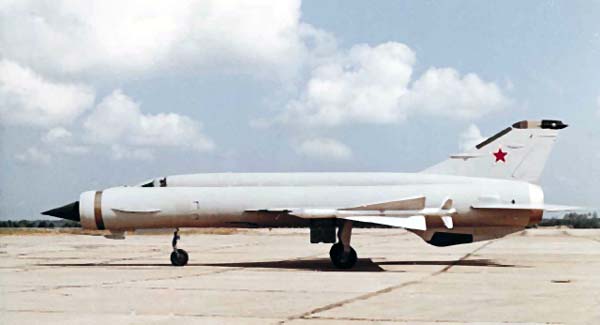
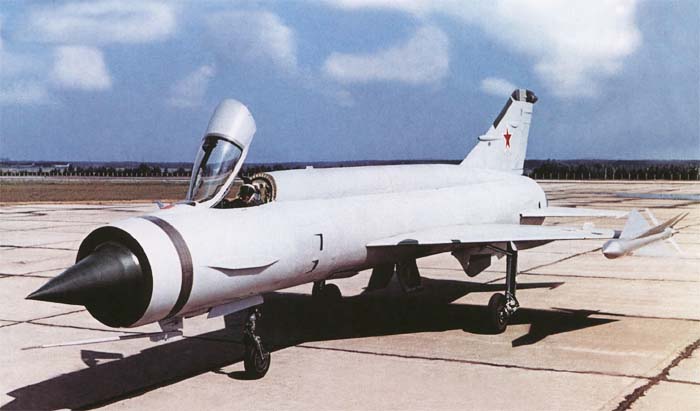
the Ye-152A was first flown in 1959 by the Test pilot Molosov and that the Ye-152A has two R-11F-300 which also powered the Yak-28 and MiG-21, later on the technical documentation without engines, radar and missiles was sent to China to allow them to build and develop the J-8I fighter interceptorв 1959 году лётчик-испытатель Г.К. Мосолов осуществил первый полёт истребителя-перехватчика Е-152А, с двумя двигателями Р11Ф-300 (устанавливались на МиГ-21 и Як-28). Позже документация по Е-152А (без двигателей, ракет и РЛС) была передана Китаю, который использовал её при создании истребителя-перехватчика J-8.
http://www.liveinternet.ru/users/kakula/post44317331/
here in fact they have another source saying the same
Документация по Е-152А (без двигателей, ракет и РЛС) была передана Китаю, который использовал ее при создании истребителя-перехватчика J-8.
It simply says the documentation for the Ye-152A was transfered to China which in turn the chinese used it to build their own J-8I fighter interceptor
http://airbase.ru/hangar/russia/mikoyan/e/152/a/index.htm
Those are not authoritative sources. Those are just one innuendo after another, trying to gain credit for something that cannot be historically and technically proven. You are quoting biased hearsay—all without proof, all without unquestioned authority—that is being repeated from one fansite after another. Repeating one lie after another does not make it a truth.
You still cannot reconcile the historical inaccuracies and contradictions.
The fact that the Soviet Union does not SELL but GIVES.
The fact that the fighter is an experimental project that is far from conclusion, and no one in the world, not the least the Soviet Union, would just give away or blueprints to anyone.
The fact that you have no precedent of similar cases, before and after this.
The fact that there are many similar designs in this world, which has no direct design relationship with each other (Mirage III vs. Delta Dagger, Boeing SST vs. Concorde).
The fact that even at that time, there were already tensions with Chinese.
The fact why closer allies never got a hold of the project instead.
The fact that the Soviet Union would give away the blueprints of a strategic
asset to someone it already knows is building the BOMB.
The fact that you cannot “sell” or give away such blueprints without the permission of the General Staff.
And the fact that what you claim amounts to Mikoyan OKB committing High Treason.
Madrat,
The J-8 was originally canceled in 1960 or ’61 yet when Chinese aerospace engineers caught up to the technology they had in their mitts they suddenly gave it a rebirth towards the end of the decade. Obviously something changed their minds about the project. The J-8I got its life back the same time as the Q-5 program. The timing would lead me to suspect they suddenly had new information to forward both programs.
How the hell can a program be canceled years before it was actually initiated?
You really have no sense of the timeline and history of what happened. The Q-5 is based on an aircraft that has an earlier history than the MiG-21, the MiG-19, and the information to build that aircraft was furnished in the early 50s. China only got the blueprints to the MiG-21F around 1962 and never got that plane flying until 1966 due to some gaps in the documentation.
What does a T-62 have to do with China? If I remember the time-line right then their tank industry at the time was stuck with T-54/55 knockoffs called maybe Type 62. I’m not a tank buff so I don’t know. The Soviets always kept China dumbed down so T-54 is probably the right one.
It has everything to do with it because the principle is identical. You are supposedly furnishing a weapons system to another Communist as part of your global revolution. The T-62 was a more advanced tank design than the T-54/55, and if the SU was so generous in furnishing their state of the art fighter design to China why not also provide their state of the art tank design as well? The fact is, if you want to allude that the SU is providing state of the art blueprints of weapons systems to China, you need to show a GENERAL and CONSISTENT PATTERN of this behavior across a whole spectrum of examples. Much like today, India getting a lot of stuff from Russia, from subs to missiles to the latest tanks and fighter jets, and for that understandably they are getting a hand in the PAK-FA project. The behavior cannot be an isolated one, it has to be an entire spectrum, as that is how it is demonstrated in actual HISTORY.
China was getting a whole spectrum of designs in the early to mid fifties, but every SU design after that representing their next generation pretty much dried up. The T-62 would have been to tanks and the T-54 like the MiG-21 is to fightes and the MiG-19. And the T-64 would have been like the Ye-152.
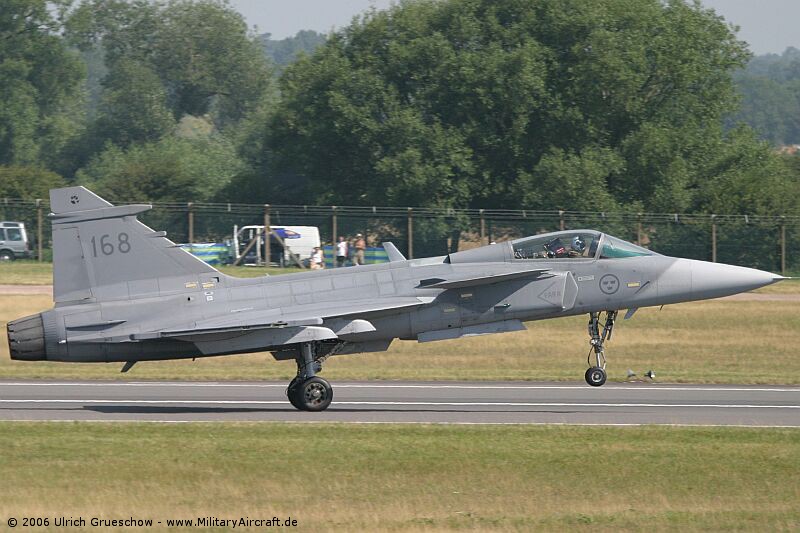
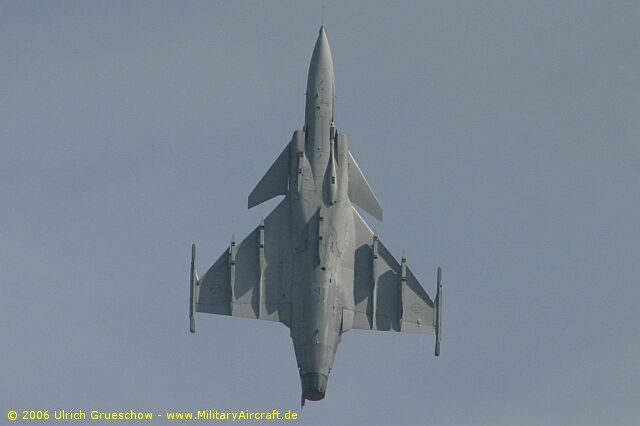
crobatointake does not matter as it part of Gripen overall width. Gripen is much sleeker aircraft from nose, cockpit design, canards with thinner fuselage etc.
I don’t really see how the Gripen is sleeker and it certainly has its share of bumps. Furthermore that kind of non assisted intake is not helpful for high AoA.
The width of intake does matter because it affects the plane’s frontal cross section and that affects drag. Then as you see from the bottom, it goes quickly from fat to thin, and that’s not good for the airflow. The Gripen is thinner at the butt because it has a much more smaller, and weaker, engine with much less internal fuel capacity.
crobatoThe Chengdu J-10 is empty equipped is 9730 kg (see Chinese realistic engine-weight about that!) and the MTOW can reach 24650 kg.
What? Are you saying the J-10 weighs more than the early J-8I, even though the latter plane is much longer, has two engines, has little to no composites, uses an older form of aluminum alloy and has a greater wingspan? AFM and the Sinodefence website now reporting 8300kg which I think is reasonable.
I have never seen any proof or claim that the MTOW can reach nearly 25,000kg.
The original 9700kg something weight was something that was spec’ed for the J-9 project.
crobatoAnother denial position man be first an adult, i have posted what is written in some Russian sources, what some people think in Russia and what is thought or consider as veridic, now insults won`t change the opinions of the Russians or the reports written in Russia as You and Crobato have done, the only reason why you and Crobato insult is simply because both of you know your case is lost, not because i have proven my position 100%, but simply because i am supporting an account with the same level of veracity and more likeliness than yours.
Why i do believe the Russian sources simple? because many Russian websites do have historical accounts which come from the people that flew or was involved in some events during the Cold war.
The Chinese also were uncapable for almost 25 years either of creating a domestic engine or a truely 100% domestic design, in fact until now China is uncapable of creating a 100% domestic aircraft, perhaps the only aircraft i know is close to that is the J-8II with Kunlun engines but still this aircraft has weaponry based upon foreigh technology and some traits based upon the MiG-23.
china has progresed but is not looks what the russians say is what makes them similar but the fact the russians claim they sold the technical documentation of their Ye-152A to China
You, claim to act like an adult?
You blatantly lie to make your case. You don’t have real sources at all to prove that claim. Even the moderators are stating you need to back up your claims, which you are not doing at all.
You have not answered the historical, technical and political contradictions that fill up your claim.
Back up that claim because it literally means MiG OKB would have done an act that would be HIGH TREASON.
crobatoSince the Chinese aviation industry was as lame as their tank builders then it was either built off Soviet assistance or it never happened. The Chinese leaders of that period didn’t take such risks. They wanted something simple and proven – nobody in the Chinese hierarchy would of stuck their neck out on a unique creation.
You are contradicting yourself. The Ye-152A wasn’t simple or proven by any means in the early sixties.
The Chinese didn’t even get plans for T-62 which was already in the boards in the late fifties, so what makes you think they can even get their hands on an experimental STRATEGIC project.
.
crobatoI don’t know the capabilities of the avionics in the J-10 or its range (and I think most people only have educated guesses on it), or the J-11B..
but in general, the J-11/Flanker, due to its large range and speed.. has the ability to dictate the engagement over a smaller aircraft with less fuel. In the case with the MiG-29 at least, a Flanker can simply bingo fuel the enemy.
I’m not too sure, but I believe that was the situation in Eritrea-Ethiopian war where the MiG-29s were operating at the extent of their range when facing opposing Su-27s. The larger aircraft will also have the larger radar and more room for counter measures while its down side will be the larger RCS.
The same can be said of F-15 vs. F-16 DACT, but as you can see the F-16s have often more than hold off on their own.
crobatoMan all your excuses are the typical excuses found in people who do not want any influence in Chinese early programs but in fact all your reasons are flawed
A) the twin engine Ye-152A first flew in 1959 and was in the design boards in 1957-1958 so that is several years before beyond any Soviet Chinese rift,
Irrelevant BS. The project was just starting and far from being considered a failure.
Even in 1958, the tensions have already sprung up.
Everything given to the Chinese have to go through the General Staff first, which is very conservative what is given out and what is not.
in fact just a few months after the MiG-21 had its first flight, of course you are going to get excuses like the Ye-166 or Ye-150 or Ye-152-1 in order to confuse your self more
MIG gave China blueprints to the first MiG-21 version, when it is already clear that this version had serious inadequecies and already a second version is at the works.
The same cannot be said of the Ye-152, because the project is far from over, and it does not share the same inadequecies.
Now you have to ask your self what Mikoyan wanted with the Ye-152 and Ye-150? well they were looking for the MiG-23, like in the case of China, the Soviet Union wanted to replace the MiG-21 with a scaled up MiG-21 they designed even the K-9 air to air missiles for the program and the Orugan 5 radar system , however contrary to China, the Soviet Union had a very advanced chemestry and jet engine industry, when the Soviet Union copied the Nene jet engine the problem they had at that time was of metalurgical nature, however the Chinese were not able to copy the R-29, the Russians in fact got some metal samples from the Rolls-Royce company and a few Nenes to copy thanks to that they could analyse the alloys needed for better engines than the had before the Nene.
Irrelevant.
however the Ye-152 was not really a very advanced aircraft as you want to portrait, the K-9 was not a very advanced missile, it was years behind the R-23 and R-40 and basicly the Ye-152A was a large twin engine MiG-21.
LOL
At 1958-59 it certanily was quite an advanced aircraft, and in fact a few years later, it would break some speed records. AAM Missile technology at that time was overall still in an infancy stage.
The Russians were also experimenting with more powerful engines, the R-15, this engine was an economical option to the less powerful R-11s fitted to the Ye-152A, however the Ye-152-1/Ye-166 and Ye-152M had small crampted nose radome inlet cones, this did not allow them to house large radars like the Smerch or guide missiles like the AA-6/R-40 and achieving Mach 3 as later the specifications demanded for the MiG-25, China suffered the same troubles with the J-8I, they need to fit a larger nose radome and side inlets to cure the same troubles the Ye-152-1, MiG-21, Ye-150 and ye-152A had.
So by 1964 the Soviet Union Started the development of MiG-25 and MiG-23.
Now why the Ye-152 was important well simply, engines, the R-15 jet engine to be specific, for the Russians the R-15 was the most important aspect of the design since the K-9 missile never entered service.
Did the Russians deliver the engine of the Ye-152M to China, the R-15 that also powers the MiG-25? no they did not, in fact the Ye-152A was not as important as you claim it was basicly an interim design to study the Ye-152-1 configuration before the R-15 was ready.
So basicly China got the interim design and not the main aircraft and the Russians knew the Ye-152-1/Ye-166/Ye-152M were far ahead of what China could built because the Chinese were at least 30 years behind in engine design in 1959.
The single engined Ye-152M with K-80 Nato name ASH or AA-5
[/quote]
ALL COMPLETELY IRRELEVANT. WHERE IS YOUR PROOF?
Even if the MiG-25 project started in 1965 it does not mean it will be in service in 1965.
No matter how much irrelevant WALL OF TEXT tactics you put out to obscure the issue, NONE OF IT represents any proof that MIG OKB did which literally amounts to HIGH TREASON.
crobatoJ-10 can beat the J-11 and J-11A in favorable ratios but J-11B maybe a different matter. So no one is sounding or leaking any results of any DACT action yet. No need to hold your breath, it will come sooner or later. it is now confirmed that the J-11B is now equipping the 1st Regiment of the 1st Division of the PLAAF. That’s the same unit General Pace visited last year.
And at the same time, it now appears that the 2nd Regiment of the 1st Division is now being equipped with J-10s.
So there is going to be plenty of local opportunity for a match.
crobatoThe opinions of idiots like you and those you use as reference cannot be considered worth considering.
Up to now, you cannot reconcile the fundamental logical, historical, political, and technical problems of your argument which you up to now, refuses to answer.
Like you claim that the blueprints of the YE-152A was bought by China after the project was considered a failure.
Except that.
1.) The Soviet Union never sold blueprints. When they provided assistance, it was whole heartedly free for the glory of the Proletarian.
2.) The YE-152A continued to fly testing all the way up to 1965. China and the Soviet Union were already feuding years before that.
3.) The YE-152 program was not considered a failure. It was only superceded by something better. The program had a number of speed records to boot.
4.) The Soviet Union would not sell or give away plans of a strategic interceptor to any country, especially not one it has a major feud over with, and especially with someone it has a border conflict with. If the Soviet Union would give away blueprints to anyone, why not India or Warsaw Pact? China would be at the bottom of the list.
5.) The Soviet Union would not give away such plans to a country it knows is developing nuclear weapons because such a plane can be a nuclear delivery platform. Especially when such a plane is breaking speed records. In fact, China successfully tested its A-bomb well before the Ye-152 project was terminated.
6.) It you have given away the blueprints to a project that was finished and terminated, you would expect that the blueprints would include the latest and final versions of the aircraft. Sorry but no deal when you post pictures of the earlier YE-152. If the SU gave away the blueprints after the project was done, it would have included the final design of the aircraft. Unfortunately to your argument, the J-8I lacks features of the final Ye-152.
7. ) The twin engined Ye-152A is nothing but the single engined aircraft hacked for twin engines. Internally that would be fundamentally different in design from an aircraft that was built from the start and end to have twin engines like the J-8I.
So for all the idiots trying to prove the J-8I was from the Ye-152, you must also prove that Soviet Union must be EXTREMELY STUPID, not to mention virtually accusing the powers at be and Mikoyan Guvenich OKB of an outstandingly TREASONOUS action.
crobatoIn fact in page 19 of this article they say that the Shengyang aircraft factory did build several aircraft among them several licensed Russian models such as the Yak-18, MiG-15, MiG-17, Mi-4 and some engines and later in page 20 they say с конца 70-х гг. выпускает J-8 (на основе Е-152А) or in few words they started building in the late 1970s the J-8I aircraft based upon the Ye-152A
http://orel3.rsl.ru/enciklop/avia/sh-ya.pdf
So as you can see Crobato there is a common perception in Russia that the Ye-152A was the base of the J-8I
Another document that is full of holes. Shenyang never made the Yak-18. It was a company in the south called Nanchang. And neither did Shenyang ever made any helicopters.
crobatoCrobato
what did build China in 1969 was behind what Russian built in 1969, the Soviet Unoin built MIG-25s and Su-24s, China built scarsely 100 J-8I and Russia built 1200 MiG-25s for the SU the Ye-152 was already obsolete, your theory is foolish because for the Chinese the J-8I was high tech however for the Soviets the Ye-152 was only an experimental aircraft, passing documentaion of an old design without even future in the Soviet air force was deemed really not a top secret as you claim they had knowledge to build better things than the Ye-152A
Irrelevant
You absolutely have NO SENSE OF HISTORY AT ALL. Don’t try to rewrite and revise history.
Do you actually have any IDEA what a SPLIT is? Do you have any idea what CONFRONTATION is?
You keep on arguing and arguing with NO SENSE OF HISTORY. Here read some history.
By the time the Ye-152 was obsolete, which was after the mid sixties only, not the split had long occurred in spirit and in formality, and the PRC and the SU were actively engaged in ARMED conflict in the Amur.
So how the ******* in your crazy LALALAND will and why the SU would help the PRC on a top level strategic interceptor requirement when at the start of the project, there were already serious bitterness between the two, and when the project had finished, they were practically enemies. Much less give out the plans for a Strategic Interceptor. Anyone who would be sending blueprints to an active enemy would have been SHOT AS A TRAITOR.
Furthermore to do that [i]knowing that the PRC detonated a nuclear device in 1964[/i] would mean the strategic interceptor in question can also be made to carry nuclear weapons. So explain to me what would the Russians gain from giving the blueprints to China? The Russians already knew that China was already developing a nuclear weapon well even before that event. One of the fundamental reasons why they want to keep strategic interceptors in house is because of the fear these planes can be used to carry nuclear bombs against Russia. This was in fact one of the reasons why the Russians did not allow the MiG-31 to be sold to China in the early 90s.
http://en.wikipedia.org/wiki/Sino-Soviet_split
Khrushchev’s policies began to irritate Mao. Mao did not openly dissent when Khrushchev denounced Stalin in his Secret Speech at the Twentieth Congress of the Communist Party of the Soviet Union in 1956 or when he restored relations with Tito’s government in Yugoslavia, which Stalin had renounced in 1947. Mao had supported Stalin both ideologically and politically, and Khrushchev had dismantled that support in a series of public and private speeches, deliberately rejecting virtually all of Stalin’s leadership, announcing the end of the Cominform, and, most troublingly to Mao, downplaying the core Marxist-Leninist thesis of inevitable armed conflict between capitalism and socialism. As a result, Khrushchev had been championing the idea of “peaceful coexistence” between communist and capitalist nations. This, however, posed a direct challenge to the “lean-to-one-side” foreign policy Mao had adopted after the Chinese Civil War, when there was fear of direct American or Japanese military involvement in China which had made an alliance with the Soviet Union vital. Khrushchev attempted to dissolve the very condition which had made the 1950 Sino-Soviet Treaty of Friendship so attractive to Mao in the first place. Mao, infuriated at these actions, increasingly felt that the Soviet leadership retreating not only on the ideological front, from Marxist-Leninism and from the struggle for the worldwide triumph of communism, but on the military front by no longer appearing to guarantee support to China should it ever find itself at war with the United States. By 1959, the stage was set for a rupture between the two Communist powers.
[edit] Onset of the split
In 1959, Khrushchev held a summit meeting with United States President Dwight Eisenhower. The Soviets were alarmed by the Great Leap Forward, and Khrushchev sought to decrease tensions with the West during a period of the Cold War known as Détente. The Soviets reneged on their earlier commitment to help China develop nuclear weapons. They also refused to support China in the Sino-Indian War in 1962, maintaining a moderately friendly stance towards India.
These events greatly offended Mao and the other Chinese Communist leaders. Mao saw Khrushchev as too conciliatory to the West. From the Soviet point of view, however, they were taking prudent measures in light of the existing international situation and the threat of nuclear war. By the late 1950s, both the United States and the Soviet Union had massive nuclear arsenals, and the Soviet leadership was engaged in a strategy that balanced confrontations over issues such as Berlin with negotiations to avoid an outbreak of war.
Also contributing to the split was Chinese domestic politics. The Great Leap Forward had failed to meet its objectives and resulted in millions of deaths. For this, Mao’s rivals in the Communist Party, Liu Shaoqi and Deng Xiaoping, who held the positions of State Chairman and Communist Party General Secretary, respectively, plotted to remove him from a position of power. The opportunity of a split with the Soviets allowed Mao to portray his rivals as agents of a foreign power, mobilising Chinese nationalist sentiment behind his leadership.
For a time, the polemics between the two parties remained indirect, with the Chinese denouncing Tito and the Soviets denouncing China’s ally, Enver Hoxha of Albania, in a war of words by proxy. But in June 1960, the split became public, at the congress of the Romanian Communist Party, when Khrushchev and China’s Peng Zhen openly clashed. Khrushchev called Mao “a nationalist, an adventurist, and a deviationist”. The Chinese called Khrushchev a revisionist and criticized his “patriarchal, arbitrary and tyrannical” behavior. Khrushchev followed his verbal attack by delivering an eighty-page letter to the conference, denouncing China.
At a meeting of 81 Communist parties in Moscow in November 1960, the Chinese delegation clashed heatedly with the Soviets and with most of the other party delegations, but eventually a compromise resolution was agreed, preventing a formal rupture. At the 22nd Congress of the Communist Party of the Soviet Union in October 1961, however, disagreement flared again. In December, the Soviet Union severed diplomatic relations with Albania, expanding the dispute from one between parties to one between states.
During 1962, international events caused a final rupture between the Soviet Union and China. Mao criticised Khrushchev for backing down in the Cuban missile crisis (“Khrushchev has moved from adventurism to capitulationism”), to which Khrushchev responded that Mao’s policies would lead to a nuclear war. At the same time, the Soviets openly supported India in its brief war with China. These events were followed by formal statements of each side’s ideological positions: the Chinese published The Chinese Communist Party’s Proposal Concerning the General Line of the International Communist Movement[1] in June 1963. The Soviets responded with Open Letter of the Communist Party of the Soviet Union.[2] This was the last formal communication between the two parties.
The Red states represent Communist governments aligned with the Soviet Union. The Yellow states represents Communist governments aligned with the People’s Republic of China. The Black states (North Korea and Yugoslavia) represent the Communist governments that were not aligned with either.
The Red states represent Communist governments aligned with the Soviet Union. The Yellow states represents Communist governments aligned with the People’s Republic of China. The Black states (North Korea and Yugoslavia) represent the Communist governments that were not aligned with either.
By 1964, Mao was asserting that there had been a counter-revolution in the Soviet Union, and that capitalism had been restored. Relations between the Chinese Communist Party and the Communist Party of the Soviet Union broke off, as did relations with the Communist parties of the Warsaw Pact countries.
There was a brief pause in polemics after the fall of Khrushchev in October 1964. Chinese Prime Minister Zhou Enlai went to Moscow in November to speak with the new leaders, Leonid Brezhnev and Alexei Kosygin, but he returned to report that the Soviets had no intention of changing their position. Mao denounced “Khrushchevism without Khrushchev” and the war of words went on.
[edit] From split to confrontation
Chinese poster from the first stage of Cultural Revolution, saying: “Topple Soviet revisionists. Smash the dog heads of Brezhnev and Kosygin”, 1967
Chinese poster from the first stage of Cultural Revolution, saying: “Topple Soviet revisionists. Smash the dog heads of Brezhnev and Kosygin”, 1967
After 1965, the Sino-Soviet split was an established fact, and the onset of Mao’s Cultural Revolution severed all contact between the two countries, and also between mainland China and most of the rest of the world. The only exception to the freeze was Chinese permission for the transport of Soviet arms and supplies across China to support Communist North Vietnam in its conflict against the South and the United States in the Vietnam War.
After 1967, the Cultural Revolution overthrew the existing structures of state and party in China. The only significant party apart from the Albanians to support the Chinese line was the Communist Party of Indonesia, which was destroyed during a military coup d’état in 1965. Maoist parties were formed in many countries.
The Sino-Soviet confrontation had now become a conflict between states. In January 1967, Red Guards besieged the Soviet Embassy in Beijing. Diplomatic relations were never formally broken, but they went into a deep freeze. The Chinese also chose to raise the issue of the Sino-Soviet border, which was the result of nineteenth century treaties imposed on the weakened Qing Dynasty by Tsarist Russia. China did not make specific territorial demands, but insisted that the Soviets acknowledge that the treaties were unjust. The Soviets flatly refused to discuss the issue.
In the following year, China reached the depths of the Cultural Revolution, with near civil war in some parts of the country, a situation only partly stabilized in August when Mao ordered the Army to restore order. Thereafter, the worst excesses gradually declined. One reason for this was Mao’s realization that China was now strategically isolated and vulnerable.
During 1968, the Soviets massively increased their troop deployments along the Chinese border, particularly the border with Xinjiang, where a Turkic separatist movement could easily be fostered. In 1961, the Soviet Union had around twelve half-strength divisions and 200 aircraft on the border; by the end of 1968 there were 25 divisions, 1,200 aircraft and 120 medium-range missiles. Although China had detonated its first nuclear device in 1964 at Lop Nor, its military power could not compare to that of the Soviet Union. Tensions along the border escalated until March 1969, when armed clashes broke out along the Ussuri River on Damansky Island, followed by more in August.
Many observers predicted war: veteran American journalist Harrison Salisbury published a book called The Coming War Between Russia and China and, in August 1969, Soviet sources hinted at a strike on Lop Nor with nuclear weapons. Soviet documents from the summer of 1969 show that the USSR had more detailed plans for a nuclear attack on China than for a nuclear attack on the United States.[1]
crobatowhy China has MiGs and Tupolevs? your question is a silly one Russia gave all the technology even the MiG-21 so why then the Soviets would had not share more information specially if they were training the buddies to defeat the western powers in 1958 when the Ye-152A was in the design boards, why not if they already gave their best fighters and engine technology to be produced by China ?
LOL. China got the H-6/Tu-16 design from Russia in 1952 That was the height of the Korean War and they were still close allies.
And you have no context of the MiG-21 whatsover that it was nothing more than a short range tactical fighter, not a STRATEGIC INTERCEPTOR. As a matter of fact what the SU gave, they already knowingly know there were serious deficiencies in range and endurance of the MiG-21F design; they were already planning the second generation MiG-21PF etc,. which they DID NOT SHARE WITH THE CHINESE, while they gave a lot of those to Vietnam, the WP, the Arabs and to India.
crobatoYou are the one who can not admit fact, the Ye-152 was the only type of aircraft china could had built that is the reason the J-8I looks like the Ye-152A they did not have better engines than the R-11, no better technology than copies of the MiG-21 in fact the only option and real Historical fact is they built an scaled up MiG-21 but they could not build a Ye-150 because they did not have R-15 equivalents yeah so information on the ye-152 was a must and the Russians say they got it, the J-8 was not started in 1964 as many think but as early as 1958 as the East Wind project
More BS from you. East Wind wasn’t even a Delta. The J-8I does not look the same as the Ye-152. Why man, you are jumping for more revisionism by claiming that the J-8 started from East Wind. They have very different requirements to start with. Read the fact that China needed something to go after the F-105 Thunderchief.
WTF would the Russians give the Chinese the blueprints, when they know it may be used against their own aircraft?
You cannot admit you are totally defeated on this subject.
crobatoSaddly for You China in 1965 did not have engines in the class of the R-15 so as the early Ye-152A they needed an interim engine and China did the same they already had R-11s same happened when they developed the J-8II they could not copy the R-29 of the MiG-23 so they stuck with the R-13 that is Basicly an evolution of the R-11, that isthe reason the J-8II looks MiG-23ish but still retains the J-8I looks.
So their only option was to build a derivative of the Mig-21 that looks like the Ye-152A using according to some Russian sources documents obtained from the program you can not use logic because you can not see historical facts China in the 1960s only could make a Ye-152 look alike becasue of the level of its technology, they needed documentation of the Ye-152A
So you admit now that China only started to develop the J-8 program in 1965—years after they split with the SU?
Right from the beginning they were working for a twin engined design so they started right from the bottom with a twin engined design. That’s altogether a very different context from the Ye-152.
What historical facts are you alluding to? I have already refuted your so called historical facts, and you cannot refute mine. You still cannot refute motivation and the fact that the historical events do not match.
Logic? When did you ever use your logic? You have no understanding whatsover that look alike and actual connection are two very different things.
I don’t give a rats ass with your Russian souces, given that you would lie and present questionable sources and claims of alleged kills in the Middle East context.
ANSWER ME THIS QUESTION. Why would the Soviet Union give the BLUEPRINTS FOR A PVO Interceptor to a potential adversary?
crobatoIs that all you can answer now?
You cannot reconcile the HISTORICAL references and the TIMELINE.
The Ye-152 program was only starting when China and the SU were already having tensions. It was far from over when they actually split. So where is your argument that the Chinese were given plans for a failed project when the decision for it to be a failure was MADE LONG AFTER THE SPLIT.
But do note the Ye-152 program WAS NOT A FAILURE. It was only superceded by the MiG-25 program. By itself, the Ye-152 program would have been a threat to the SU if it was in the wrong hands.
You cannot reconcile the STRATEGIC MOTIVATION.
The fighter is a strategic interceptor for the PVO. The SU does not share that with its allies MUCH LESS GIVE THE BLUEPRINTS FOR FREE.
And to a POTENTIAL ADVERSARY to boot.
You cannot reconcile the DESIGN.
There are fundamental internal differences between a fighter that was designed to be single engined and one that is double engined to begin with. The Ye-152A was a hack job for a twin engined platform, the fact that it was really designed as a single engined fighter explains the many crucial differences.
And your quote of revisionist history is pure BS too, since the Soviet Union does not “sell’ to another Communist state. That is against Communist philosophy to start with.


 Sign In