 Stonewall
I like the “China does not have a Navy” comment…
some brazilians I know are laughing their hearts out at the stupidity of the comment…
StonewallIndia to get delivery of first nuclear submarine by year end
Wed, May 13 01:33 PM
Vinay Shukla Khabarovsk (Russia), May 13 (PTI) India is all set to get its first new generation Akula-II class nuclear attack submarine by the year end, which would bolster the Navy’s undersea capability manifold. Russian Prime Minister Vladimir Putin has ordered the delivery of the submarine to the Indian Navy and has sanctioned USD 300 million for successful completion of the project.
Russia was to deliver the Akula-II class submarine to the Indian Navy on a 10-year lease in June. But the project suffered delay as in the course of sea trials the submarine, earmarked for India, met with an accident on November eight last year killing 20 sailors and injuring 17 others.
But the shipyard has repaired the damage caused by the mishap during sea trials. “The repairs are complete and the vessel is technically ready for the resumption of sea trials,” an official of the Amur Shipyard was quoted as saying by Interfax.
Putin visited the shipyard on Monday and Presidential Envoy Viktor Ishayev latyer told PTI that during the visit “Putin had discussed in detail the Indian submarine project and ordered new trials be completed speedy and the vessel delivered to Indian Navy by the end of this year.” PTI.
http://in.news.yahoo.com/20/20090513/1420/twl-india-to-get-delivery-of-first-nucle.html
StonewallInteresting…
BRAZIL and CHINA NAVIES cooperate:
original text in Portuguese, interview with Brazilian defense minister here:
http://www.defesanet.com.br/md1/jobim_11.htm
interesting part:
Defesa@Net – Há uma série de aproximações militares com a China. Como o Senhor vê essa aproximações com a China no âmbito do Ministério da Defesa?
Min Jobim – A aproximação com a China está mais voltada para a Marinha. Eles (os chineses) querem que a Marinha do Brasil seja o elemento de ligação para a criação da Marinha Chinesa. A China não tem uma marinha. Inclusive nós vamos trazer oficiais chineses para cá. Eles farão estágio. Lógico que terão de aprender português.Eles farão estágio no porta-aviões São Paulo. Os chineses já estão adquirindo porta-aviões para projeção de poder na região, que é uma situação completamente diferente da nossa. Estou indo à China entre setembro ou outubro.
free google translation:
Defense @ Net – A range of military approaches to China. As you see this approach with China under the Ministry of Defense?
Min Jobim – The rapprochement with China is more directed toward the Navy. They (the Chinese) want the Navy of Brazil is the point of connection for the creation of the Chinese Navy. China has no navy. Also we will bring Chinese official here. They will stage. Of course they have to learn Portuguese.They will stage the aircraft carrier São Paulo. The Chinese are acquiring aircraft carriers to project power in the region, a situation completely different from ours. I am going to China from September or October.
StonewallNEW Zealand is claiming two Australian-built frigates are unseaworthy
what “frigates”??? those are OPVs!!!!
jornalists….:rolleyes:
StonewallStill a useful and flexible platform………...I wonder if somebody will pick her up secondhand from the French. With a major refit of course…..:D
I honestly hope so…a pity if she goes for scrap 🙁
She is in Lisbon btw, until tomorrow , here you can find some nice pics
http://lmcshipsandthesea.blogspot.com/2009/04/jeanne-darc-em-lisboa.html
http://lmcshipsandthesea.blogspot.com/2009/04/forca-naval-francesa-no-tejo.html
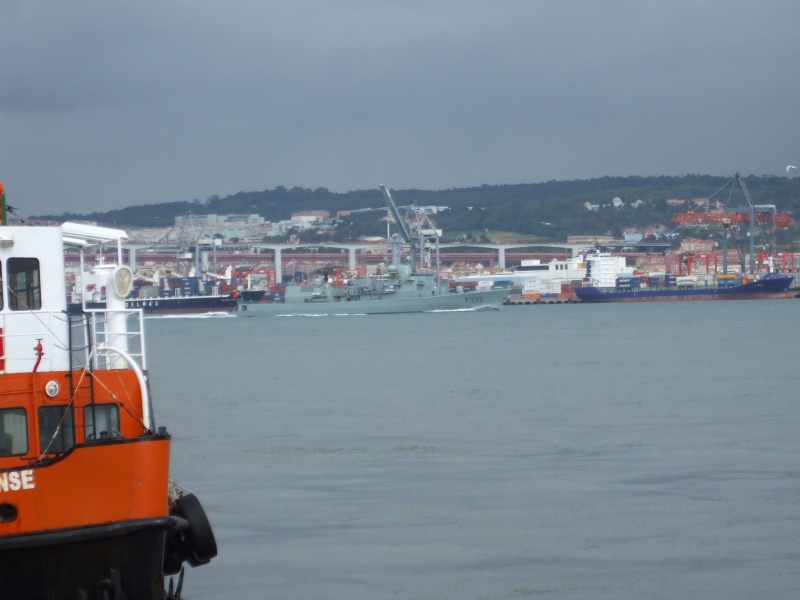
and as additional news, the Frigate NRP Bartolomeu Dias (former dutch Van Nes) arrived yesterday for the 1st time to her new home base, in Lisbon:
StonewallNATO SNMG-1 in Pakistan

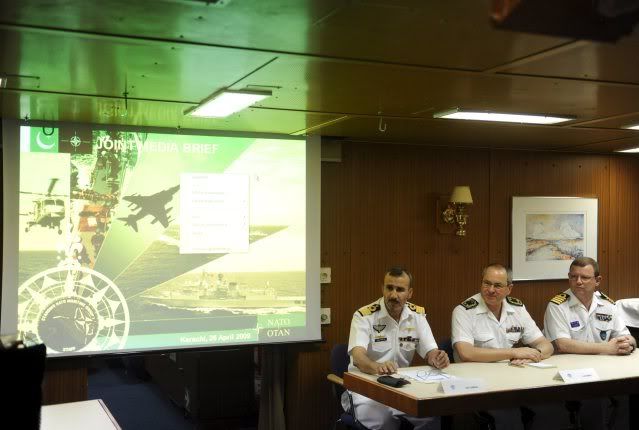
(L-R) Chief staff officer of the Pakistan fleet Commander Jamel Akhtar, Commander standing NATO Maritime Group One Rear Admiral Jose Domingos Pereira Da Cunha and Commander standing NATO Maritime Group One Capitan Carlo Rijkart hold a press conference in Karachi on April 26, 2009. NATO will begin two days of joint naval exercises with Pakistan on Monday as part of an effort to enhance cooperation in counter-terrorism and anti-piracy measures. Reuters
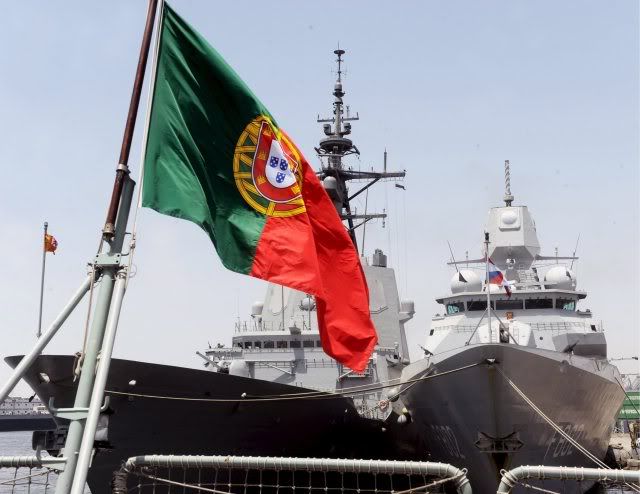
Ships of NATO Maritime Group One, are parked at a harbour in Karachi Pakistan on 26 April 2009. Five ships, of the Standing NATO Maritime Group 1, consisting of Portuguese, Canadian, Spanish, Dutch frigates and a German tanker will participate in a two-day exercise with Pakistan Navy vessels in the open sea from April 27
Stonewall6 Kilo subs for Vietnam according to official translate here:
Russia to build 6 Kilo-class diesel submarines for Vietnam
Agence France-Presse
Moscow, April 27, 2009
First Published: 12:54 IST(27/4/2009)
Last Updated: 12:57 IST(27/4/2009)
Russia to build six submarines for Vietnam: Report
Russia will build six submarines for the Vietnamese navy, the daily Kommersant reported on Monday.
The St Petersburg naval dockyard Admiralteyskye verfi and Vietnam will shortly sign the contract, worth 1.8 billion dollars, the report said, quoting sources close to Russian arms export agency Rosoboronexport. It gave no time frame.
“Initially it was expected that the submarines would be bought by Venezuela, but Rosoboronexport refused to clinch the deal with that country, largely due to a recent meeting between Venezuelan President Hugo Chavez and his American counterpart Barack Obama,” Kommersant said.
Chavez, a ferocious foe of the United States under the George W Bush presidency, showed signs of warming to Obama during the Americas conference earlier this month, telling the new US president: “I want to be your friend.”
http://www.hindustantimes.com/StoryPage/Print.aspx?ID=6562b7ee-8125-49a9-8070-6869b0508412
Stonewallwhat could be had new for the same price? (at least 2 hulls)
yep, only crazy people would buy 2 ships from the beggining of the 80’s that would cost the same as almost brand new ships
StonewallDon’t forget that the ships are inoperative since the beginning of the decade, so reactivating them would indeed cost a lot, and for sure the longer it gets, the more expensive it is.
Honestly I doubt that the 12 and 14 will ever sail again.
StonewallFFG-12 and -14 were cleared to be transferred to Turkey, but the offer was rejected because of the high costs for transfer, refit and turning the cold ships to hot status.
thanks!
Yeah, for what I’ve heard the costs of reactivating both would have been more or less the same as Portugal paid for the 2 M-type frigates = 240 M€
Stonewallbtw,
does anyone know if the FFG-12 George Philip and the FFG-14 Sides , that are at Bremerton and were supposed to be sold to Portugal before we switched for the Dutch M-type (fortunately :diablo: ) , are confirmed to go to Turkey?
I read about that possibility some time ago but never herad of confirmation.
or maybe they will go to Ukraine, since they are the only 2 OHPs still in the USN with Mk-13 launcher?

StonewallDid PN seek to acquire the 2 Belgian Wielingen class ships? Never heard that before… Sounds like madness, given the Wielingen class dates from 1978 and is essentially as old as the Type 21 Amazon ships from the UK.
I can also add that the 2 M-class Dutch frigates “Van Nes” and “Van Galen” would most likely have gone for Pakistan, hadn´t Portugal jump into the “race”
StonewallIs that the Admiral Ushakov (ex Kirov) in the background?
it’s a Kirov , that´s for sure
StonewallUS Freezes Engine Supply, Navy in a Fix
(Source: Times of India; issued March 17, 2009)
NEW DELHI — Strange are the ways of the US. Just when India had shed its long-standing opinion of the US being an unreliable arms supplier, given its propensity to impose sanctions at the drop of a hat, Washington has let loose a strange missile.
The Navy was all set to launch sea trials of the first of the three Shivalik-class stealth frigates being built at Mazagon Docks (MDL) when it got a rude shock on learning the new Obama administration had directed American company General Electric (GE) to stop all work on the gas turbine engines which power the warships.
Sources said MDL and Navy are now scrambling to get Italian company Fiat Avio to oversee the “operationalisation” of the two GE LM-2500 gas turbines of the 4,900-tonne frigate, named INS Shivalik, to ensure its sea trials can begin within a month or two.
GE, on its part, told Indian authorities that the US state department had asked it to freeze all work on the turbines it has supplied till the Obama administration reviewed its military ties with different countries.
Though the direction is not India-specific and includes other countries, it will hit the already delayed plans to induct INS Shivalik — the other two, INS Satpura and INS Sahyadri, are now slated for delivery by 2010 — within “a few months”.
Interestingly, this is the first time American engines have been used in an Indian-built frigate. The engines earmarked for the ambitious 37,500-tonne IAC (indigenous aircraft carrier) being built at Cochin Shipyard, incidentally, are also the LM-2500 gas turbines.
Though GE has told Indian authorities that it will take three months or so to resolve the export control imbroglio, the episode has put a big question mark on US as a reliable long-term defence supplier.
Moreover, New Delhi and Washington are yet to resolve their differences over pacts like End-Use Monitoring Agreement (EUMA) and Communication Interoperability and Security Memorandum Agreement (CISMOA), which basically govern sensitive technology control requirements to “minimise” security risks to US and its allies, as required under its domestic laws.
This comes at a time when India has just inked the biggest-ever defence deal with US in the shape of the $2.1 billion contract between the Indian defence ministry and Boeing for eight P-8I long-range maritime reconnaissance aircraft in January.
India’s main objection to EUMA and its “enhanced version” relates to periodic “onsite physical verification” by American inspectors, which it contends are “intrusive” in nature.
With no overarching EUMA in place, India and US have been reduced to signing specific end-use agreements for different defence deals like the $962-million contract signed in 2007 for six C-130J `Super Hercules’ aircraft for Indian special forces.
Domestic political sensitivities have also acted as a stumbling block for India to sign the contentious Logistics Support Agreement (LSA). On the lines of the Access and Cross-Servicing Agreement the US has signed with over 60 countries, the LSA envisages Indian and American militaries providing logistic support, berthing and refuelling facilities for each other’s warships and aircraft on a barter or equal-value exchange basis.
-ends-
StonewallUS export curbs driving away business news
06 March 2009
Extensive and irritating export regulations are pushing the US space and defence-related industries to the wall in a time of recession. When will the Americans learn, asks Radhakrishna Rao.
The news that the US has stalled the supply of two gas turbines by General Electric Corp (GE) for India’s new stealth warship ‘Shivalik’ should not really come as a big surprise, as America has a history of imposing last-minute sanctions on defence deals. The reason cited in this instance is that America is ”reviewing its defence relationship” with several countries including India.
The US could end up destroying its once booming space, defence and high tech industries through the sustained implementation of export control regulations. The so-called International Traffic in Arms Regulation (ITAR) managed by the US state department is proving to be an albatross around the neck of these enterprises.
The highly controversial ITAR was originally conceived as an instrument to prevent the proliferation of weapons by curbing the export of sensitive components of space technology, which by its very nature is a dual use system.
The technological subsystems developed for a launch vehicle meant to put a civilian satellite into orbit can with some modification be adopted for a long range missile capable of carrying a destructive warhead. Similarly, a satellite featuring an earth imaging system designed to monitor natural resources can also be deployed for surveillance and reconnaissance.
It would seem that the US wants to maintain its position as the unchallenged global defence leader by blocking the flow of technology to other countries. But the process is proving be counter-productive, as it has hit the profitability of American space hardware manufacturers hard in terms of business lost in a time of recession.
This in turn means that the American space industry has fewer funds to invest in research and development of new technologies which would strengthen the already dominant US position as the global technology powerhouse.
Significantly, during his election campaign, President Obama while referring to the successful Indian lunar probe Chandrayaan-1 and the spectacular Chinese space walk had expressed his concern over the US losing its dominance in the exploration of the final frontier.
President Obama had also pointed out that ITAR, with its exasperating and tedious rules, had inflicted huge damage on the once vibrant American space industry. He said ITAR has also put defence and associated high industrial ventures into a ”downward spiral”.
America is the loser
It was the stringent export regulation that spelled doom for the American supercomputer outfit Cray. The company was prevented from exporting its high end super computing machines on the ground that it could be diverted for military use, and had not option but to shut shop. This is just one example of what ITAR had done to the American high tech industry.
The American obsession with the possibility of sensitive technologies getting ‘misused’ has driven countries and organizations from across the world source their needs from elsewhere, where there are no such roadblocks.
A clear indication of the falling fortunes of the American space industry is that its share of commercial satellite production has plummeted to 50 per cent from more than 80 per cent in the first half of the last decade.
Countries are realising that they can buy whatever they need from elsewhere without going through the cumbersome, costly and complicated export regulation formalities. For instance, the Indian Space Research Organisation found easier to get the radiation hardened circuits for use in its INSAT satellite system from European sources.
Counter-productive strategy
On another plane, the American export restrictions have prompted countries like India and China to develop the hardware they need indigenously. To a large extent, the spirit of self reliance and confidence permeating the Indian and Chinese space efforts are a result of the American export control regime.
Following the US sanctions after India’s nuclear tests in 1998, ISRO was denied many of the critical components it need for its projects. However, ISRO managed to either develop the components it needed in-house or to get them from Western Europe.
The fully home-made cryogenic engine stage developed by ISRO, which will replace the Russian-supplied upper stage of the three-stage geosynchronous satellite launch vehicle (GSLV) during its flight planned for July 2009, can be attributed to America’s technological bullying.
In the early 1990s, the US had coerced an emaciated and politically turbulent Russia into going back on its commitment of transferring the critical cryogenic engine technology to India. It now finds, no doubt to its dismay, that India’s own cryogenic engine is ready to fly.
A spokesman of the Nevada-based Bigelow Aerospace has caustically pointed out, ”If the purpose of ITAR is to lose billions of dollars of business, ship jobs overseas and the Iranians and the Chinese get the same technology anyway, then mission accomplished.”
In fact, a survey of companies supplying space hardware carried out in 2007 by the US Air Force Research Laboratory showed that export control was the biggest barrier to accessing the overseas market.
Recently, P S Subramanyam, director of the Bangalore-based Aeronautical Development Agency (ADA), which has developed and light-tested India’s light combat aircraft Tejas, made the point that the 1998 US sanctions was the best thing that could have happened to India’s scientific efforts, as it spurred Indian scientists and engineers to develop these technologies and systems by themselves.
”When officials from BAE Systems, the third largest defence manufacturer in the world and part of the Eurojet consortium that makes the Typhoon fighter, came to see Tejas, they were amazed. For it has the latest configuration and it is completely indigenous,” said Subramanyam.
US killing its space dominance
Despite US export restrictions, both India and China have made some ground in promoting their launch vehicles to put the satellite payloads of international customers into space.
The American policy that a satellite built in USA or a satellite carrying US made components cannot be launched from countries like India and China has contributed in a big way to the declining orders for American satellite manufacturing outfits; Indian and Chinese space vehicles are far more cost effective than their American and European counterparts.
Developed countries too have been irritated by IRTA sanctions. The leading European space technology outfit Thales Alenia has made it clear that it would build spacecraft without any American hardware or components. Similarly, the European Space Agency (ESA) has decided to promote the production of many components it needs in Europe, and build ”ITAR Free” launch vehicles and satellites.
In particular, the cost and delay involved in importing high tech components from the US continues to drive away global customers from approaching American companies. Even for the American companies keen on exporting space related components and hardware, it is a troublesome and costly procedure to go through ITAR formalities.
The progressive decline in the fortunes of the American space industry as a result of zealous application of export control act could result in the termination of many product lines that have a limited domestic demand. This could in the long run force the US itself to source components required for its space programme from outside the country, spelling the death of its dominance in space exploration.
Unreliable defence partner
And of course, the US track record in dealing with the export of defence hardware and technology has made it a notoriously unreliable defence partner. The US insistence on the End User Certification agreement has been particularly galling to buyers of the American defence hardware.
India has already told the US, which aims to replace Russia as the world’s largest supplier of defence equipment, that the annual physical verification of the defence hardware, which has already been purchased at a great cost, should end.
For instance, as per the existing US defence trade regulations, three jets bought from Boeing to fly Indian leaders would be annually inspected by the American officials. New Delhi considers this a clear infringement of national sovereignty.
In fact, the Comptroller and Auditor General (CAG) in his report to the Indian Parliament had come down heavily on the Ministry of Defence for agreeing to the end user verification while buying the US warship ‘Trenton’ renamed INS Jalashwa.
There is also every indication that India would succumb to US pressure for the end user verification agreement in the supply of eight P-81 long range maritime reconnaissance aircraft from Boeing and six C-130 J transport helicopters from Lockheed Martin.
Both Boeing and Lockheed are in the race for the 126 medium, multi role combat aircraft for the Indian Air Force. But as things stand now, the US companies stand little chance as its government does not seem inclined to doing away with this clause covering arms purchases.
Similarly, the restrictions on the resale of US defence hardware could prove a big impediment in the way of American emerging as a favoured defence partner of India. Boeing vice-president of international strategy for integrated defence systems business development Jeffrey Kohler says, ”There will be a serious blow to the relationships and obviously, it would be virtually impossible to US defence companies to walk with the Indians.”
The much-hyped Indo-US civilian nuclear agreement has so far not helped matters in smoothening Indo-US defence ties. Nonetheless, Ravi Vohra, director of the New Delhi-based National Maritime Foundation, believes that in its own interest, the US will take steps to remove the irritants in the way of defence hardware export. But then it is always difficult to read the mind of the American bureaucratic and political set-up.


 Sign In







