Stonewall
Australia’s future Air Warfare Destroyers are derived from the Spanish Navy’s F101 frigate design, whose lead ship, Alvaro de Bazan, is seen here. (US Navy photo)Construction of Air Warfare Destroyers Underway
(Source: Australian Department of Defence; issued April 15, 2010)
Greg Combet, Minister for Defence Materiel and Science, announced today that full production of Australia’s three Hobart-Class Air Warfare Destroyers (AWD) is now underway.
In a ceremony at the BAE Systems shipyard in Melbourne, Mr Combet announced that full production of hull blocks has now commenced at three shipyards: ASC in Adelaide, BAE Systems in Melbourne and Forgacs in Newcastle.
“More than 500 people are now working on building hull blocks for the AWDs, and this will grow to a total workforce in the three shipyards of over 1,000 people,” said Mr Combet.
“Overall, more than 3,000 people will be working to build these warships around Australia and importantly, about 200 apprentices will join the project in the next few years.
“Each ship will be made up of 31 blocks fabricated at the three shipyards. The construction of each ship will require 51 kilometres of piping, 427 kilometres of electrical cable, 4,700 tonnes of steel, 138,000 litres of paint, 4,700 mechanical valves and 1.5 million fasteners.
“By mid-2011, completed hull blocks will begin to arrive in Adelaide for consolidation into the complete warship at the Government of South Australia’s Common User Facility.
“Successful completion of pilot fabrication work and production readiness reviews has finalised the transition of the project from detailed design into full production of the ships.
“This is an important milestone for this national project, and I wish to congratulate everyone involved in helping us reach this point,” Mr Combet said.
The project is on track to deliver the first AWD, HMAS Hobart, in December 2014. HMAS Brisbane is scheduled for delivery in the first quarter of 2016 and HMAS Sydney in mid 2017. (ends)
AWD Construction Commences in Victoria, NSW and South Australia
(Source: ASC; issued April 15, 2010)
Construction of Australia’s air warfare destroyer (AWD) capability is underway, with three Australian shipyards simultaneously building destroyer blocks.
Adelaide-based ASC, shipbuilder for the AWD Project, has congratulated its block subcontractors – BAE Systems (Williamstown, Victoria) and FORGACS (Newcastle, New South Wales) – for commencing their build programs on time.
ASC Managing Director and Chief Executive Officer Steve Ludlam said the simultaneous construction of AWD blocks in multiple Australian shipyards reflected a truly national commitment to building the three AWDs.
“A critical part of ASC’s AWD bid in 2005 was to share block construction with other companies across Australia that have the capability to build blocks for three AWDs,” Mr Ludlam said.
“This vision is now a reality with shipyards in South Australia, Victoria and New South Wales simultaneously building blocks for the largest defence project in the nation’s history.”
ASC has subcontracted the construction of 65 blocks to BAE Systems and FORGACS over the life of the AWD Project. ASC will build 28 blocks, and integrate and consolidate all 93 blocks into three next generation warships.
ASC will undertake its own fabrication and construction of ship blocks in its dedicated AWD shipyard, which was officially opened in January 2010.
The $120 million shipyard will also be home to the assembly of the AWDs (including handling and transport), outfitting work, set-to-work of equipment and systems, and trial activities.
AWD BLOCKS
The AWDs will be constructed using the block build method.
Thirty per cent of the blocks will be constructed by ASC at its Osborne, South Australia shipyard with the other 70 per cent to be built by BAE Systems in Williamstown, Victoria and FORGACS in Newcastle, New South Wales.
The blocks constructed off site will be transported by sea to Adelaide for block erection and integration by ASC.
Blocks will average 15 metres by 12 metres by 9 metres, and weigh around 200 tonnes each.
ASC (formerly known as Australian Submarine Corporation) is the nation’s last remaining Australian-owned prime defence contractor. The company constructed the Collins Class submarines and today delivers design, upgrade and maintenance services for the submarines through-life. ASC is also the shipbuilder of Australia’s next generation warships – the Hobart Class air warfare destroyers. ASC employs over 1,600 personnel in South Australia and Western Australia, including 280 engineering and technical specialists.
-ends-
StonewallAbu Dhai MAR and ThyssenKrupp Marine Systems Establish Strategic Partnership
(Source: Joint Abu Dhabi MAR and ThyssenKrupp release; issued April 14, 2010)
Abu Dhabi MAR, the international shipbuilding group based in Abu Dhabi, and ThyssenKrupp Marine Systems have signed a contract for the sale of Blohm + Voss to Abu Dhabi MAR.
The contract includes the acquisition of Blohm + Voss Shipyards in Hamburg and the civil shipbuilding facilities of the former HDW Gaarden including employees in Kiel. Abu Dhabi MAR will also acquire an 80% stake in each of Blohm + Voss Repair and Blohm + Voss Industries, both of Hamburg.
The parties also agreed on the formation of a 50:50 strategic partnership for the design and program management of naval vessels.
The two companies had already signed a memorandum of understanding on this in October 2009.
His Excellency Ahmad Darwish Al Marar, Chairman of Abu Dhabi MAR, said: “This agreement is an important milestone for Abu Dhabi MAR in the implementation of our strategy to position ourselves as a world leading shipbuilding company. The aim of this transaction is to generate long-term growth, strengthen the international market position of the company, expand our product range and gain access to new customers.”
“In Abu Dhabi MAR we have found a suitable partner for a highly promising long-term relationship. This strategic partnership represents a solid foundation for the future of the shipyard and will make it possible to attract new customers,” said Dr. Olaf Berlien, member of the Executive Board of ThyssenKrupp AG.
The transaction is subject to clearance required under merger control laws. For the naval activities, the transaction is also subject to the approval of the German government under the provisions of the Foreign Trade Act (Außenwirtschaftsgesetz). The closing is expected to take place by the end of June 2010.
Abu Dhabi MAR was advised by International Investment House, the investment company headquartered in Abu Dhabi, as well as Corporate Finance Advisor Hans Lotter, the international law firm Allen & Overy LLP and Deloitte & Touche GmbH, the accounting firm.
Abu Dhabi MAR, a holding company based in Abu Dhabi, is a fast-growing international shipbuilding group. The company has capacity for the construction of naval ships and civil ships up to a length of 200 meters. The holding company is jointly owned by the Al Ain International Group (70%) and Privinvest (30%). H.E. Ahmed Darwish Al Marar is Chairman of the Abu Dhabi MAR Group and Iskandar Safa its Managing Director. The company has orders in hand of more than 1 billion euros. The shipbuilding group currently has 2,000 employees worldwide.
ThyssenKrupp’s Marine Systems business area is a leading European systems house supplying submarines, naval surface ships and premium segment yachts to customers globally. The company’s outstanding shipbuilding competence includes repairs, services and ships’ components. The roughly 8,000 employees of ThyssenKrupp Marine Systems in Germany, Greece and Sweden are committed to meeting a broad range of challenges.
-ends-
StonewallRussia’s Pyotr Veliky nuclear-powered cruiser plies English Channel
The Russian nuclear-powered cruiser Pyotr Veliky, deployed to participate in the largest Russian Navy drills in the Indian Ocean, has crossed the English Channel for the first time in her history.
“The ship has indeed passed through the channel for the first time,” the commander of the cruiser, Capt. 2nd Rank Felix Menkov, told a RIA Novosti correspondent on board the vessel.“The English Channel is shallow…and has a great deal of potential risks, including heavy marine traffic both to the south and the north,” Menkov said.
Six days after leaving Russia’s Northern Fleet headquarters of Severomorsk, Pyotr Veliky (Peter the Great) traveled around 4,000 kilometers (2,160 nautical miles) and entered the Atlantic Ocean.
During her six-month tour of duty, the warship is to pass through the Atlantic Ocean and the Mediterranean Sea before entering the Indian Ocean via the Suez Canal.
The Pyotr Veliky will conduct maneuvers in the Indian Ocean with other ships from the Black Sea Fleet and will make port calls in the Mediterranean Sea and Indian Ocean, the Russian Navy said.
Russia’s largest and most powerful surface combatant warship, Pyotr Veliky has a displacement of between 24,000 and 26,000 tons, and a speed of up to 31 knots (almost 57 km/h). The ship is 251 meters in length and has a crew of more than 700 sailors.
PYOTR VELIKY (Atlantic Ocean), April 5 (RIA Novosti)
StonewallKirov has been repainted. . .
Rumor is that all 3 remaining un-operational Kirovs can be repaired, but Kirov himself would be extremely expensive due to a decay of the shafts and engine.
Any official explanation why it was re-named Kirov , instead of Admiral Ushakov?
Stonewall
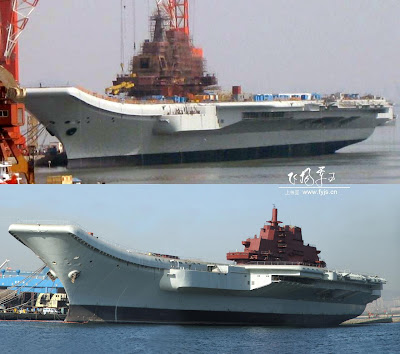
Varyag before and after its drydock stay.http://china-defense.blogspot.com/2010/03/degaussing-varyag.html
Am I wrong or is it the top pic the After (See Mast and open squares for radars) and the bottom the Before?
StonewallReport: South Korean navy ship sinks
March 27, 2010 — Updated 0303 GMT (1103 HKT)
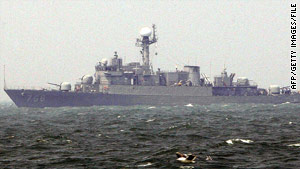
The South Korean navy corvette Cheonan, similar to this ship, sunk after an explosion, Yonhap News Agency reports.(CNN) — A South Korean navy ship sank in the Yellow Sea near North Korea late Friday, and the navy shot at an unidentified ship toward the north, according to reports quoting South Korean government officials.
Yon-hap News Agency quoted Navy officials saying Friday that a ship carrying 104 crew members sank off the Seoul-controlled island of Baengnyeong in a flashpoint maritime border area between the Koreas.
The 1,500-ton Cheonan went down at 9:45 p.m. near the island, but the cause of the incident was not immediately known, the officials said.
South Korean President Lee Myung-bak ordered a “quick and thorough” investigation Saturday into what caused the ship to sink, keeping in mind “all possibilities,” his office said, according to Yonhap.
A rescue operation was under way, with the Navy telling Yonhap it had rescued 58 crew members but it feared others may be dead.
The South Korean government issued a statement saying the reason for the incident remains unclear, but it wasn’t ruling out some sort of military engagement. An explosion had occurred in the rear of the ship, leaving a large hole in the ship’s underwater hull, officials told Yonhap.
A U.S. State Department spokesman said Friday that there was no evidence North Korea was behind the incident.
“Let’s not jump to conclusions here,” said the spokesman, Philip J. Crowley, when asked about possible North Korean involvement. “I’m not aware of any evidence to that effect, but I think the authoritative source here would be the South Korean government.”
Yonhap quoted South Korean naval officials as saying a South Korean vessel fired at a ship toward the north later.
However, South Korean government officials said it isn’t certain whether North Korea was involved in the incident. Yonhap said local residents reported hearing gunfire for about 10 minutes.
As a result of the incident, South Korean government officials held an emergency meeting of ministers handling security-related matters, officials told Yonhap.
South Korea’s Korean Broadcasting System said Navy vessels and helicopters were rescuing crew members, some of whom reportedly jumped into the sea after the blast, the KBS report said.
The official said the Sockcho, another South Korean navy vessel patrolling nearby, fired at unidentified ships north of the area.
U.S. military officials told CNN a South Korean vessel sank.
North Korea has said recently it is bulking up its defenses in response to recent joint South Korean-U.S. military drills, Yonhap reported. The news agency also quoted South Korean military officials saying North Korea conducted dozens of artillery firing drills Friday.
http://edition.cnn.com/2010/WORLD/asiapcf/03/26/south.korea.ship.sinking/index.html
StonewallThe last F-100 Spanish frigate, F-105 “Cristobal Colon” will be lauched on the 1st Week of november 2010
Details (In spanish)
http://www.infodefensa.com/esp/noticias/noticias.asp?cod=2325&n=Navantia%20botar%E1%20la%20F-105%20Crist%F3bal%20Col%F3n%20la%20primera%20semana%20de%20noviembre%20de%202010
StonewallBIG SIZE pics of the Varyag after moving out of dry dock
StonewallBrahmos Missile Proves Its Mettle Once Again
(Source: Indian Press Information Bureau; dated March 21, web-posted March 22, 2010)
India today successfully test fired BRAHMOS supersonic cruise missile from a vertical launcher fitted in a moving warship INS Ranvir off Orissa coast. The missile performed supersonic manoeuvring following the exact flight path and homed on to the decommissioned target ship INS Meen.
“The launch met all mission requirements and was 100 per cent successful,” Dr. A S Pillai, CEO and MD of BrahMos Aerospace, confirmed.
The missile, which has a range of 290-km and flies at a speed of 2.8 Mach, can take on a target lying anywhere in the 360-degree range of the ship. Senior Naval officials who witnessed the launch termed it a “landmark event.”
DRDO along with Russia’s NPO Mashinostroyenia has jointly designed and developed the BrahMos missiles which are capable of carrying conventional warheads up to 200 -300 kg and a range of 290-km.
The state-of-the-art Universal Vertical Launcher from which the missile was test fired has been designed, developed and patented by BrahMos Aerospace. The launcher is designed to be fitted under the warship’s deck, thereby protecting it from atmospheric conditions and imparting stealth to the weapon system.
Three 15 A Alpha-class ships being built at Mazagon Docks in Mumbai and three more Talwar class ships (known as 1135.6 class in Russia) built at Kaliningrad in Russia will be fitted with similar Vertical Launcher modules.
With the latest launch, BrahMos has once again proved its mettle to be launched from both Vertical and Inclined configurations from Naval platforms. The Army has plans to induct three regiments of BrahMos in near future to use the missile as a “precision first strike weapon.”
President Smt. Pratibha Patil and Defence Minister Shri AK Antony congratulated the missile scientists and naval officers for the successful launch of the supersonic cruise missile.
-ends-
StonewallThanks 😉
meanwhile found another on
http://china-defense.blogspot.com/
Stonewallladies and gentlemen, the VAryag has left the drydock 😮
http://www.defence.pk/forums/china-defence/51169-varyag-out-dry-dock.html
on the pakistani forum there’s a link for a pic, but it does not give acess
someone got that pic?
StonewallIt seems she is finishing major overhaull and will be back soon to sea
StonewallJoint Strike Fighter: Additional Costs and Delays Risk Not Meeting Warfighter Requirements on Time
(Source: Government Accountability Office; issued March 19, 2010)
The F-35 Lightning II, also known as the Joint Strike Fighter (JSF), is the Department of Defense’s (DOD) most costly and ambitious aircraft acquisition, seeking to simultaneously develop and field three aircraft variants for the Air Force, Navy, Marine Corps, and eight international partners. The JSF is critical for recapitalizing tactical air forces and will require a long-term commitment to very large annual funding outlays.
The current estimated investment is $323 billion to develop and procure 2,457 aircraft. (GAO’s previous annual report on JSF, released in March 2009, estimated development and procurement cost at $300 billion for 2,456 DoD aircraft. GAO’s latest estimate means the program’s cost increased by almost 8% in one year—Ed.)
As required by law, this report discusses (1) program cost, schedule, and performance; (2) manufacturing results; and (3) test plans and progress. GAO’s work includes interviews, cost data, test plans, production measures, and analyses by defense and contractor officials.
The JSF program continues to struggle with increased costs and slowed progress–negative outcomes that were foreseeable as events have unfolded over several years. Total estimated acquisition costs have increased $46 billion and development extended 2 more years, compared to the program baseline approved in 2007.
DOD leadership is now taking some positive steps which, if effectively implemented, should improve outcomes and provide more realistic cost and schedule estimates. Officials increased time and funding for system development, added 4 aircraft to the flight test program, and reduced near-term procurement quantities.
Restructuring is not finished and further cost growth and schedule extensions are likely.
The program is at risk for not delivering aircraft quantities and capabilities on time.
Dates for achieving initial operational capabilities may have to be extended or some requirements deferred to future upgrades.
Aircraft unit costs will likely exceed the thresholds established by the statutory provision commonly referred to as Nunn-McCurdy and may require DOD to certify the need for the JSF to Congress.
Program setbacks in costs, deliveries, and performance directly affect modernization plans and retirement schedules of the legacy aircraft the JSF is slated to replace.
Manufacturing JSF test aircraft continues to take more time, money, and effort than budgeted. By December 2009, only 4 of 13 test aircraft had been delivered and labor hours to build the aircraft had increased more than 50 percent above earlier estimates. Late deliveries hamper the development flight test program and affect work on production aircraft, even as plans proceed to significantly ramp-up annual procurement rates.
Some improvement is noted, but continuing manufacturing inefficiencies, parts problems, and engineering technical changes indicate that design and production processes may lack the maturity needed to efficiently produce aircraft at planned rates. The independent manufacturing review team determined that the planned production ramp rate was unachievable absent significant improvements.
Although restructuring actions should help, there is still substantial overlap of development, test, and production activities while DOD continues to invest in large quantities of production aircraft before variant designs are proven and performance verified.
Slowed by late aircraft deliveries, technical problems, and low productivity, the flight test program only completed 10 percent of the sorties planned during 2009.
Other technical challenges include (1) relying on an extensive but largely unproven and unaccredited network of ground test laboratories and simulation models to evaluate system performance; (2) developing and integrating very large and complex software requirements; and (3) maturing several critical technologies essential to meet operational performance and logistical support requirements.
Collectively, testing and technical challenges will likely add more costs and time to development, affecting delivery of warfighter requirements and hampering start up of pilot and maintainer training and initial operational testing.
Selected Excerpts
— Steadily lengthening schedules to complete key system developefforts further exacerbates the already extreme overlap among development, test, and production activities.
— The program office currently estimates total life-cycle costs for operating, sustaining, and maintaining JSF fleets at $764 billion, substantially higher than earlier estimates. The cost per flying hour of the CTOL variant is projected to be higher than the F-16, one of the Air Force aircraft it is slated to replace. NAVAIR officials recently projected total life-cycle costs even higher, at more than $1 trillion.
— In addition to ongoing software challenges, the program continues to address several technical issues:
* The carrier variant requires significant design modifications to the keel web, a key structural joint to enable catapult takeoffs. Proposed design changes are still being reviewed and cost and schedule impacts are unknown at this time.
* The program continues to address significant technical and design challenges with the F135 engine. The STOVL engine’s lift fan has required design changes in response to damages incurred during testing which will limit flight test efficiency and will likely require additional modifications, time, and resources.
* Logistic support: NAVAIR reported that the software to support the system’s communication with legacy information systems is currently not planned and may affect interoperability. In addition, the Air Force Operational Test and Evaluation Center (AFOTEC) reported that the current integrated support system for the JSF prohibits operating two detachments from one squadron simultaneously. This limitation will severely affect current operating practices.
* Helmet Mounted Display. Critical to information integration and situational awareness, issues with the helmet mounted display continue to impact system effectiveness and air system integration.
* Damage to flight deck and runways. The F-35 engine and integrated power package exhaust may cause excessive damage to the flight deck environment and runway surfaces that may result in operating limits or drive costly upgrades and repairs of JSF basing options.
* Thermal management. Heat build-up and exhaust impedes the aircraft’s ability to conduct missions in hot environments. The program has made design changes to address this issue, but those changes are not expected to go into effect until the third low-rate procurement lot and are likely to affect operational testing. The development of a fuel pump to mitigate excessive heat is not expected to fully achieve requirements. As a result, the program has instituted restrictions on how the aircraft can be used [which] will limit flight test efficiency and may not be feasible for operational deployment.
Click here for the full report (53 pages in PDF format) on the GAO website.
http://www.gao.gov/new.items/d10382.pdf
-ends-
StonewallAustralian Submarines ‘Poor Value for Money’ DAN OAKES
(Source: Australian Strategic Policy Institute; issued March 19, 2010)
Australia’s insistence on maintaining a strong defence industry means it pays vastly more than other nations for its equipment, a study has found.
Conducted in the United States by McKinsey consultants, the study raises further concerns about the Rudd government’s plans to acquire 12 submarines to replace the trouble-plagued Collins class vessels.
The report ranked the US and Australia equal last out of 33 countries on a measure of defence equipment output versus expenditure. Brazil, Poland and Russia headed the table.
”In general, countries that make it a point to support their domestic defence industries have higher procurement costs than those that rely on imports,” the report says. ”Countries that procure older equipment from the global market tend to have very capable fleets for less money.”
The new submarine fleet for Australia was proposed in a defence white paper last year.
The Australian Strategic Policy Institute (ASPI), in a study last year, put a price tag of $9 billion on buying off-the-shelf European submarines, and $36 billion on an Australian design and build.
”My understanding is that [build or buy] is still an open question,” Andrew Davies, one of the ASPI study’s authors, has told The Age.
”The government has been quite supportive of the submarine as it’s been described in the white paper in all of its public discussions, but they have also stressed that no decision has been made yet. ”
Defence Materiel Minister Greg Combet told a conference in January the choices were between an off-the-shelf submarine, a reworked Collins or one designed from the ground up. But Mr Combet said an Australian design-and-build could provide ”significant potential industrial and military capability opportunities because of its size and duration, among other things”.
In the white paper, the government declared it was ”committed to ensuring that certain strategic industry capabilities remain resident in Australia”.
Dr Davies said that, despite the submarines controversy, Australia was inexorably moving towards buy, rather than build.
He said that the thought of supporting a local defence industry was often more attractive than the reality, despite the lure of retaining technology and creating jobs. ”There was no thought of assembling the Joint Strike Fighter or Super Hornet here,” Dr Davies said. ”I think that trend has been a very clear one over the last 60 years but is only going to accelerate.”
-ends-
StonewallGreece to resell German submarine: minister
by Staff Writers
Athens (AFP) March 17, 2010
Greece hopes to earn some 350 million euros (480 million dollars) by reselling a German-built submarine whose delivery was dogged by technical concerns, the Greek defence minister said on Wednesday.
“The Germans are pricing the Papanikolis submarine at 300 million, let us calculate 350 million without being over-optimistic,” Defence Minister Evangelos Venizelos told a news conference.
Athens in 2006 had refused to accept delivery of the submarine built by German contractors ThyssenKrupp after Greek Navy inspectors declared it defective during test runs off the port of Kiel.
But Venizelos on Wednesday insisted that “improvements” had been carried out at ThyssenKrupp’s HDW shipyards and that the Greek Navy was now prepared to declare the vessel seaworthy.
“This is what (the Navy) have told us, this is what they will tell Greek parliament as well,” he said
He added: “This discussion about a listing submarine which we are trying to sell… is harmful to the public interest.”
Greece in 2000 had ordered four new 214-class submarines and an overhaul for three of its older 209-class submarines from HDW. Most of the order was to have been carried out at Hellenic Shipyards near Athens, which were acquired by HDW in 2002, three years before it merged with ThyssenKrupp.
Athens has already paid out 2.03 billion euros on the project out of a total estimated cost of 2.84 billion in current prices with nothing to show for it, the minister said.
Venizelos on Wednesday said plans to overhaul two of the older submarines would now be scrapped and that two new submarines would be ordered instead at a cost of 500 million euros apiece.
The Greek government, struggling with a debt crisis and facing a huge effort to restructure the economy, hopes that the submarine deal will smooth the way for ThyssenKrupp to shed 75 percent of its stake in the struggling Greek shipyards to the Abu Dhabi Mar group.
It has said the sale offers a chance to save the jobs of 1,300 workers.
Venizelos also said another “major” project to purchase French frigates would also be carried out.
“A difficult and long negotiation at state and commercial level is ongoing (on the issue),” he said.
http://www.spacewar.com/reports/Greece_to_resell_German_submarine_minister_999.html


 Sign In