 thobbes
I don’t see anything ultra nationalistic about Teer’s post, even if he is overly pro-Indian generally. You care to actually dispute it?
Given he seems to think iIndia is the be-all and end-all of national development and rich and peaceful countries such as Australia and USA are rubbish, I’d say he’s very ultra nationalistic.
thobbesAnd no, Russia did not have significant numbers of troops prepositioned.
All they had was two reinforced motorized rifle battalions on the Ossetian border and these are the forces that had to rush to stabilize the situation.
There was also the Abkhazian military, which according to above article provided the heavy equipment for second front.
Part of the explanation for some of the problems encountered by Russian forces during the war was exactly the fact that there was no many month long process of picking out who would strike where, and where all the Georgian targets were.
If your intelligence services did their job, you would’ve known where the key targets were. Militaries usually spend a far time on contingency planning – e.g. the US had a “just-in-case” invasion plan of Saudi Arabia in 1970s. This involves key target identification.
Without these, military operations are a potential disaster.
Though Russian troops did have some intel. After all an Iskander was used to destroy a tank depot and radar sites were taken out (albeit on day 3 but they weren’t that important given Georgian lack of AD).
The lack of intel regarding navigation channel not being navigable anymore was poor though – but then so was the topographic intel the US used in Grenada which was often based on Spanish 19th century maps (and one can imagine things such as street plans, coastal features and topographical features change extensively over the course of a century).
And Teer has the nerve to call me a US worshipper!
thobbesThen you just aren’t thinking.
The F-117 gave the US decades of experience operating, training with, and training against stealth aircraft. Even if relatively little of its technology was carried over into subsequent designs it certainly informed the decisions and priorities of the aircraft that followed it.
This is why I’m not sold on Chinese and Russian designs in terms of VLO capability or modern avionics. They might look the part but are all the systems, building materials and even airframe paint up to the same VLO level as US work on F-35 or even F-22?
thobbesThe North European F-16A/Bs will be very long in the tooth by the time they’re retired in the 2020s. Apparently there’s not many other airframes left right now, unless there are more cutbacks.
USAF F-16C/D Blk 25/30 with upgrades would be a better bet.
Though Gripen would be the best choice.
thobbesA fat wallet is prestige and a weapon in itself
Look at the Swiss!
Money makes the world go round and probably even more so in the 21st century!
thobbesThis is in effect only during the time when Iran develops nukes. After that, they would recognize Iran as a nuke power and sanctions would vanish.
Like they did with North Korea? Oh wait they didn’t.
Also Iran creates more problems for Russia in Caspian region. If Russia needed Iran, Iran would not be in the poo it is today.
thobbesTeer, I’m not even going to bother going through your posts.
What I see is a rich Indian (who may or may not live in India) who cares little for the benefit of the average Indian living in abject poverty, and spouts the same Non-Aligned anti-American/anti-Western tosh that the likes of Tito and Nasser used to babble on about.
Comments such as these really show it too:
India’s political integration and stability is more grounded in reality and cultural commonality in many respects than an artificial nation like Australia…built on the backs of displacing aboriginals and a land grab in the process..
For an artificial country, we’ve never had internal strife (save for a single union protest gone wrong in 1854 and that was before there was an Australia), we are filthy rich and we have some of the best living standards in the world and have done since Federation in 1901!
And now to troll, you’re just jealous that even the vast majority of even our poor people live in conditions that the Indian middle class only dream of. It was said that a kid my impoverished parents could only afford a Sega Master System and not a Megadrive. 🙁
thobbesYou are the one who claimed at first that the Russian Army had numerical superiority, and not the TR1. Therefore, you should’ve brought up the evidence (the ORBAT or whatever credible info).
Have you ever read this? http://www.cast.ru/files/The_Tanks_of_August_sm_eng.pdf
In case you didn’t, please read it. It is the most detailed and credible publication on the 08/08/08 conflict so far.
There, you will see which Russian troops were present at the time of the attack (peacekeeping forces and their equipment). Which Georgian units conducted the assault, which Russian units first came to help… and what is most important for this conversation, you will see when the Georgians started to flee (and who had numerical superiority at that moment).
That’s a superb article – fact that David Glantz is involved immediately makes it a good source in my mind. His WWII stuff is superb.
So we can also see:
– Most of Georgia’s best brigade (1st) in Iraq
– 2 brigades out of 5 had only just finished restructure (4th) or where being estabilished (5th).
– No ability to maintain any level of air defence – no fighters and mainly obsolete systems (S125 (SA-3) or Osa K (SA-8)).
– No air transport/rapid redeployment capability
– Rapid remobilisation meant shortage of critical junior officers (i.e. platoon/company commanders)
– Rapid remobilisation meant most junior officers lacked experience
– Junior officers often given command of higher level elemtns – e.g. Majors/Captains in charge of Brigades as opposed to a full fledged colonel
– Older more experienced officers shuffled off to retirment for political reasons.
– National Guard batallions were completely deficient in training, weapons and officers.
– Lack of discipline, nepotism and corruption
– Lack of organisational culture that promoted learning
– Overall lack of professionalism and cultural barriers to effective modern military professionalism.
– Also training emphasised offensive action and not defensive action. This causes a problem as soon as a counter attack is formed or the offensive stalls. The Japanese at Khalkin Gol had the same problem.
– Training did not involve use of combined arms in large operations.
4th Infantry Brigade that led fighting at Tshiknvali had significant deficiencies:
– It had just finished restructuring from an internal security unit with some conscripts to full professional army service
– It had not participated in NATO training.
So overall:
– Georgian Army was lacking in quality especially in terms of command, control and coordination (C3)
– It lacked adequate reserves – assault on Tshinvali involved nearly all combat ready forces. This meant no reserves to counter Russian actions.
– As such any numerial superiority in initial clashes was irrelevant
– Large chunks of initial Georgian assault forces ran on basis of rumours as well as Su-24/-25 strikes .
These are called QUALITIATIVE FACTORS. They’re what I’ve been harping on about this whole thread. Just owning a T-90 or F-35 or S300 means little if your qualitative factors are poor
Russian Forces
– Preparations had been made for mobilising troops and deploying to front prior to combat. This included deployment of TBMs as well as troops, repairs to transporty infrastructure etc.
– Absolute air superiority – in the region there were a total of 8 fixed wing combat regiments (3 fighter, 2 Su-24, 3 Su-25), 3 helicopter regiments and one transport airbase.
– RuAF in action since day 1, flying both CA, interdiction and CAP roles. This effectively neutralised any Georgian CAS/interdiction ops and gave Russia absolute air superiority.
– By 10/08/13, Russia had deployed over 9,000 troops to Georgia plus Abkhazian heavy units.
One thing I was always surprised is that the Russians never drove to Tblisi. An occupation of the country was not necessary, but storming Tblisi, destroying the government and military command infrastrucutre, then pulling out would’ve served Russian interests well especially if Georgia entered a state of political uncertainty due to lack of government.
In fact a Georgian civil war would’ve helped Russia firm up it’s grip on South Ossetia as well as remove the NATO incursion into the Causasus..
Also I suspect that despite Georgia’s best efforts, Russia could roll over it’s army in 5 days again if it wanted to. The absolute advantages Russia has in terms of naval, air and logistics is more than enough to pulverise the Georgians.
thobbesshow me single islamic country that can survive without external aid. (non Oil ). It is very simple criteria. Algeria could not have defeated islamic insurgency without Oil/Gas money. Egypt would not survive without external aid.
Government is complete success it stayed for 3 years after USSR left and its dissolution didnot blow back.
Malaysia, Indonesia and Turkey are all relatively successful predominantly Islamic countries which survive without external aid and which are realtveily successful economically.
And bare in mind, mighty India and China are still in the top 20 of foreign aid receipients on the planet because these countries prefer to spend money on military toys than looking after poorer elements of their socieities (and in India, extreme poverty is what the vast majority of the people live in).
thobbesSounds like saner heads prevail in Kuwait.
The current arms race in Middle East is somewhat insane as it’s an arms race against an opponent that is not engaging in it! There has been no real change to Iranian capability for decades and nothing indicates any change in direction.
thobbesSo you ******** off out of Afghanistan and left a weak government with no backing with the people and with the countryside in control of the muhajadeen. The country was still in state of war. And even you state that the government lasted a mere 3 years before collapsing.
I’d call that an epic fail just like Vietnam War was an epic fail in preserving South Vietnam.
thobbesI agree with Jungle Boy.
Talk and no action is a waste of time.
They’ve been talking about a specific highway bypass for 40 years in my city – it’s even marked in street atlases as “proposed northern bypass.” But it’s really just a waste of breath until someone actually builds the thing!
thobbesTo be fair I suspect the Navy will buy a few more squadrons of F-35Cs. But I don’t think it’ll be a wholesale F/A-18E/F replacement.
Unless F/A-XX falls flat on it’s face.
thobbesAs for Australian defence spending being too much.
And here is how typical poor people from the poor Australian suburb I grew up in live – these are generally government houses provided to poor people on unemployment benefits.
The government privatised a lot of them through cheap home loans:
EE9s2uiQRyBR7gLdGOgg~~48_20.JPG)
This one is in my old street:


It’s a bit worse in bigger cities but far better than anything in India/Pakistan:

[u]So given these photos, which country’s defence spending is probably inappropriate?[/u]
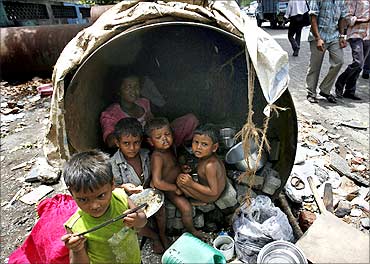
thobbesFor anyone that thinks that SSNs, carrier groups are justified, remember that this is how the vast majority of Indians live:





 Sign In







