 Rodolfo
In the engine was used the quick-burning powder in 4 seconds of the work of engine rocket it were accelerated to the maximum speed.
—-
In this case axial overloads reached 300 g.
—-
Task stood extremely complex. It was necessary to drive away rocket for several seconds to speed on the order of 4 km/s.
More guessing numbers. If the acceleration stage last for 4 seconds and the final speed is around 4 km/s, the average acceleration is around 1 km/sec2. That means just over 100 g (like the Sprint). Therefore, the 300 g value should not be sustained, and probably is an instantaneous one near the flight start.
RodolfoAccording some draws, the first stage of the gazelle is cylindrical and larger than the second conical stage. This may explain mass differences. Propellant differences should also count. After all, Sprint was developed and tested during sixties (it is still, forty years later, an awesome rocket) and Gazelle during the eighties.
Her is a pick showing mock-ups of PRS-1, Galosh and V-1000 (from left to right). Unfortunately, the Gazelle is still “missing”. 😡

RodolfoComparative technical data
Data for Sprint:
Length: 8.20 m (26 ft 11 in)
Diameter: 1.35 m (4 ft 5 in)
Weight: 3500 kg (7700 lb)
Speed: Mach 10+ (3+ km/s)
Ceiling: 30000 m (100000 ft)
Range : 40 km (25 miles)
Propulsion:
1st stage: Hercules X-265 solid-fueled rocket; 2900 kN (650000 lb) for 1.2 s
2nd stage: Hercules X-271 solid-fueled rocket
Warhead: W-66 thermonuclear (1 kT)
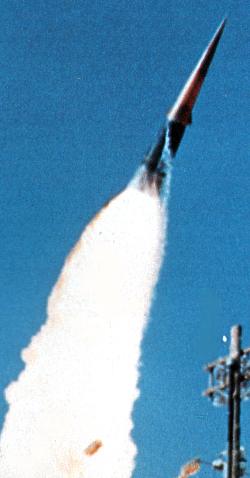
Data for Gazelle:
Total Length: 10.00 m (32.00 ft).
Core Diameter: 1.00 m (3.20 ft).
Span: 1.00 m (3.20 ft).
Weight: 10,000 kg (22,000 lb).
Ceiling: 30000 m (100000 ft)
Maximum range: 80 km (49 mi).
Boost Propulsion: Solid rocket.
Guidance: Command Link.
Warhead: Nuclear (10 Kt)
Main diferences: Weight (3:1), Range (2:1), Warhead yield (10:1). Speed and g loads are, so far, guessed.
RodolfoFaster than this?
http://srmsc.org/video/004204m0.mpg
http://srmsc.org/video/005017m0.wmv
Yep, The (scarce) information seems to indicate that 53T6 is faster than Sprint.
RodolfoYeah, I tend to agree with you. Another guy (see http://www.russianforces.org) claim that the average speed is 5.5 km/s, so the terminal speed can be around 6 km/s. This is more plausible. My guess is that the reporter “rounded up” the altitude and “rounded down” the travelling time, so the quotient gives a disproportionate figure.
But, even considering this exaggeration, the 53T6 seems anyway as a wild beast. I seriously doubt the S-400 or S-300VM rockets can effectively replace the “gazelles”. Kinetics are of paramount importance when you have a very short detection time. May be the S-400 or S-300VM rockets will act in a sub-strategic role.
Thoughts?
RodolfoSome guessing numbers. Let us consider two scenarios to describe the flight to reach 30 km in 5s.
a- A flight with constant acceleration during the whole interval [0 s, 5 s]. In such a case the constant acceleration will be 2.4 km/s2 (245 g) and the terminal speed will be 12 km/s. It will not be possible because the rocket simply will burn in the air at such speeds.
b- A flight with an initial accelerating phase of 2 s plus a sustaining phase of 3 s at constant speed. This will be more probable but indicates and acceleration of 4 km/s2 (more than 400 g) and a terminal speed of almost 8 km/s (over mach 20).
I think the flight profile is closer to the second scenario, but the numbers are really awesome. This missile will be a “wild beast” and I can’t imagine its control mechanisms.
RodolfoTha article in English talk about 30 km in 5 secs. Impresive anyway
Russia extends service life of old missile interceptors
On Tuesday, the Russian military launched a short-range PRS-1 missile interceptor from the Sary Shagan firing range in Kazakhstan.
The PRS-1 reached an altitude of 30km in five seconds, and was subsequently detonated. The latest tests show that this missile interceptor can still fly – but it is unclear whether it can destroy nuclear-tipped enemy warheads.
Previously, the Russian Defense Ministry planned to hold large-scale ABM (Anti-Ballistic Missile) system tests similar to those in the United States. It had intended to launch a missile with a special-purpose warhead from the Kapustin Yar range (Astrakhan Region) in the direction of Sary Shagan.
Such tests could have produced dual results. Had the missile interceptor destroyed the missile, Moscow could say the existing ABM system is effective. Otherwise it could say Russian warheads are invulnerable.
However, the missile could not be assembled on time. The military therefore decided to fire the PRS-1 because the launch, carried out under the service life extension program, could not be put off.
Consequently, the PRS-1 missile interceptor’s service life will now be extended by another two-a-half years to reach 20 years.
The A-135 ABM system of Russia’s Central industrial district only has PRS-1 missile interceptors, but its aging long-range A-925 missile interceptors are being scrapped. Three such missiles will be destroyed this year.
A Defense Ministry source said the ABM system will subsequently develop under an April 2006 plan for expanding the aerospace defense system until 2016 and beyond.
There are no plans to upgrade available missile interceptors or to develop new ones. They are to be replaced by the advanced Antei-2500 and S-400 Triumph surface-to-air missile systems.
RodolfoSo, these performances might be possible. 😮
Basistov revealed that the trials had demonstrates substantial reserves in all parameters compared to the specification. The 53T6 demonstrated 2.5x greater range and triple the velocity capability required.
It’s worth noting that SH-08 is three times heavier than Sprint (10 tn. vs 3.5 tn.). Any way, although probable, we should put a grain of salt on this claim.
RodolfoI saw an article from RIA Novosti (Spanish language) with some interesting claims:
1- Long range interceptors are being retired. The A-135 system will use just the short range ones.
2- Future developments and modernizations include the use of missiles from Antey-2500 and S-400 in some kind of NMD.
3- Detonation point was located at 39 km altitude and the missiles reached this point in a 5 s flight.
These points raise some questions:
1- If the rocket travelled 39 km in 5 s, it would have a terminal speed of 8 km/s and an acceleration over 200 g (!!!!). Is that possible? If the answer is yes, PRS-1 will be a really awesome weapon.
2- Can missiles from the Antey-2500 and S-400 systems be used to down strategic warheads or they are talking to just intercept short-range missiles whit the aid of the Don-2NP radar?
3- What mean a Russian “national” ABM system? It seems near impossible to cover the whole Russian territory. Or they refer to protect just some important regions?
Link: http://sp.rian.ru/onlinenews/20061206/56563307.html
Regards
RodolfoOff-course the sat are maintained in an inert camera or something like this. Nevertheless, this is a proof of robustness. But electronics should have evolved “centuries” in the last 15 years. When should they start to launch the announced new generation sats?
RodolfoBut should not be surprising to expect a failure of that old satellite. It’s really awesome that they were able to preserve a sat such a long time.
Rodolfothe US is a democracy, but Iran is a theocracy, North Korea is an autocracy, and Venezuela is bordering on autocracy with Chavez’s suppression of political opposition.
😮
As far I know, Chavez won clean elections. Or at least cleaner than the American one at year 2000. The same that the “democratic” Bush “won”. 😀
RodolfoSomeone knows also about the expansion of the A-135 system. Run-run about this is persistent. Talks about “increase the number of vector” and so on. May be the deployment of mobile Gazelles?
RodolfoAs far I know they are S-300 updated to the PMU-2 standard that were “freed” from the Moscow region and that will be relocated in outer zones of the Common Defense Space. S-400 now being deployed have a bigger footprint and will “liberate” numerous S-300.
RodolfoProtection for Belarus from the western threat:
Belarus has deployed Russian-made S-300 air/missile defense interceptors in the city of Brzesc near the Polish border, according to a report by Radio Polonia on May 31. Relations between the two countries have been tense ever since authorities in Belarus accused Poland of interfering into its internal affairs by supporting the Belarusian “democratic” opposition movement in Belarus. In addition, Poland is a top choice for the Pentagon’s European missile defense site, which has angered Russian authorities. In response, Russia and Belarus signed a joint air defense pact, and Moscow began arranging for the deployment of S-300 units in Belarus, thus extending the effective range of Russia’s western air-defense by at least 150 km (90 miles), and the detection of air targets by 400 km (250 miles). Poland currently has no equivalent air/missile defense interceptors.


 Sign In







