 Scorpion82
@Wilde,
that was the package price (without weapons), but initial training, simulator and other stuff required to operate the aircraft. The original price for Austrias planned 18 T2 was 1.132 bln € (62.9 mln € per ac), the 1.959 bln € was the package price translating into ~109 mln € per ac.
Scorpion82I know it’s not that easy, but you sure need to think twice before scanning the skies with such big radars now. Even if you don’t allow for a passive shot for EW, you give a lot of options to the opponent, including the one to lock you very quickly with radar or IRST since he knows where you are, or ask an AWACS/ground radar to provide him a lock, or even get your wingman into position to either lock or shoot him, or if it’s bomb ladden to avoid the fighters and continue their strike mission.
Air combat has always been about who sees the other one first, and that isn’t about to change. It beats me why everyone keeps talking about how the bigger the radar and so on. I’m completely sold on the theory that your radar only needs to be big enough to bear your longest range weapon.
Nic
It certainly depends on the mission and requirements. In some situations it might be useful to stay silent, in others it is probably better to go active. If you have sufficient support (AWACS or similar means) staying silent is certainly a better option to cope with at least until you switch it on for a missile launch (could be a sensor in the background passing data to the shooter in the front). For strike missions it’s most likely better to keep the radar silent and avoid a contact, in an air defence or air superiority mission you are required to go offensive. If the RWR alone could offer a good enough range estimate the pilot could decide to stay silent, but if its range estimate is too inaccurate, you have no 3rd part support and your IR/EO system have still no contact you could be in deep trouble, as the enemy may already track you and even launch a missile whereas you may believe that he’s possibly still far away.
Scorpion82India has to pay for it alone!
That’s thus fat speculation and albeit it may turn out to be true it’s not a must. The current unwillingness to order T3B or pay for the AESA development right now (which isn’t entirely true as the UK demonstrates with its AESA demonstrator contract award to Selex) doesn’t mean that the partner nations won’t fund any upgrades or weapons integration at all. That’s a misrepresentation of the situation.
even further upgrade developments were started, like GaN AESA radar, improved damocles and IRST…
Is a GaN AESA upgrade for the RBE2AA and Spectra and the OSF-NG really approved and funded right now? Any sources which confirm a commitment? Thus far I have seen proposals of what could be part of batch 5, but not an announcement of contracts being awarded!?
Some reports said that the first EF squadron would not have AESA radar and would be retrofitted later, this hints that this would be the T3A that the EF partners had ordered as well. This version has the provisions for later upgrades, but that doesn’t meant that they all will come for sure and might be offered as options only on customer demands.
The question was about the offer to India, not what the core nations will get with their T3A examples.
Btw, the Russian AAMs will be replaced in future, R27 and 77 mainly by Astra, no matter if Mig 29 SMT/K, Su 30 MKI, or LCA Tejas. Derby is now on integration into Tejas as an stop gap and because IN NLCAs will use them as well. Python V and Assram are the frontrunners for Jags and there are reports that Tejas will get it too, but I think there could be an indigenous, or co-development as well, maybe even based on the SR SAM co-development with MBDA.
That’s a sensible option (replacing R-27 & R-77 with ASTRA). It will be interesting what weapon will be chosen for the FGFA? I thought that the ASRAAM was already selected for the Jaguar, but I could be wrong on that. As it’s already stated that the Python 5 will be integrated on Tejas, this would rule out the ASRAAM as an option for the Jaguar, IMHO.
Scorpion82In this day and age having a big radar is not necessarily a huge advantage. SPECTRA or DASS will pick up the signals from a F15 / MKI radar much earlier than those radars will get a lock or even detect them, and they will do it accurately enough to shoot a Meteor up its radome.
Nic
It’s not necessarily as easy as that. Ranging a moving emitter is a quite tricky task, especially aircraft which are quite fast and at long ranges even a slight deviance will produce an error margin, which might be unacceptable and how do you support the weapon at such long range? The pk is going to be quite small if launching a Meteor at let’s say some 150 km and don’t provide MCG. That’s why at least 3rd party support is required if you don’t want to use your own radar. Long range shots without MCG have a high probability of flying blind straight into nowhere. It would be interesting whether MCG could be provided by the AESA radar for example, without it being active spare for occasional updates, that might be a solution to live with. At the end the radar is still useful and important as it offers greater accuracy at range and as it can gather much more data than passive sensors could (altitude, speed, closure rate, accurate range, heading of the target…). These data are necessary to generate a good firing solution, like ever there is no perfect solution and the “if it emits it dies” claim is somewhat exaggerated. The circumstances must be right and the conditions must be met, otherwise you maybe aware of an enemy and his direction, but not much more and that’s not enough to set up a missile launch.
@EELightning
Can something be done about this user because he has nothing what so ever to contribute.
Yes edit your ignore list and add him instead of replying…
The “rumour” that Air International reported a short while back, I’ve mentioned a couple of times, of Eurofighter offering a favourable price in India could possibly be true.
What’s favourable in this case, in which relation does it stand etc. Thus far that statement alone doesn’t tell you much, if anything.
Scorpion82@Teer,
it’s a good question I don’t know about the exact offer of Eurofighter to India. The IAF would receive Tranche 3 aircraft which will be similar to the Tranche 2 with the Phase 1 Enhancement upgrades (new radios, GPS, improved DASS etc.), plus the T3A specific hardware modifications including full provisions for CFTs, a fuel dumping system, upgraded electrical generation systems, new computers and the Captor-E AESA radar. The weapon options would depend on what the Indians demand and it remains yet to be seen whether all weapon options would be available or whether the IAF accepts an initial weapons fit, with further weapons being added. I could well imagine that CFTs are at least optionally offered, possibly among other details but I don’t know.
@Ero_Senin,
is the sale of the MICA IR confirmed and are there any other weapons offered?
Scorpion82That table appears to show the costs are from 2000, thus not represent for virtually any of the contenders now. Gripen NG didn’t exist back then, not even on paper.;)
@PELICANO
The MMRCA winner will use Meteor/Mica (depending if is EF or Rafale) or will get the indigenous Astra Bvraam?
That’s an interesting question, I could well imagine that the IAF will purchase the Meteor and will supplant it with the ASTRA instead of MICA EM or AMRAAM (depending on which platform is chosen). Would make sense for me at least.
It’s already quite confusing how many weapons they will operate. R-73 for its Russian fighters, ASRAAM for the Jaguar if I’m not mistaken and Python 5 for the Tejas. So will they introduce another SRAAM with the MMRCA?
The same is true for the BVR department where they have R-27 and R-77 for the Russian fighters, Derby for the Tejas, ASTRA for possibly most of the IAF’s fighters and probably at least one additional BVR AAM for the MMRCA (I think Meteor is most likely here).
Scorpion82I was just saying that doing through such a program is much better than adding RAM and RCS absorbing paint as an afterthought, so it’s no suprising that the Eurocanards have a lower RCS than other planes (VLO planes excluded).
I do believe that the Rafale has a lower RCS than the EF, for the same reasons that bluewings does (pilots accounts etc).
Also I do believe it benefited from the Rafale D program (or at least from every feature from the Rafale D that was cost effective). Besides, there must be good reason that an anechoic chamber was built especially for the Rafale/Spectra program, and that it spent quite some time in there 🙂
Was there such research during the development of the EF?
Nic
Well as said before I believe that the Rafale has a lower RCS as well, what I question is the margin as presented here by some.
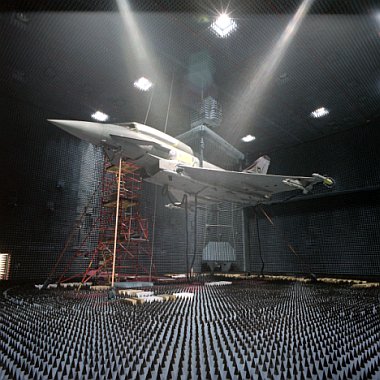
DA4 was tested in an anechoic chamber back in the 90s, this was related to DASS development and testing, dunno whether RCS testing was conducted as well. RCS testing and material development was conducted in Germany with EADS using a radar signature measurement system to test DA5’s RCS.
There appear to have been additional tests with production aircraft.
Some related images:

Scorpion82Please, let’s not get into the radar performance comparison, i beg you !! 😉
Don’t worry that’s not my intention. Just wanted to point out something which is obviously lost in times of great claims. 😉
Scorpion82Actually the Rafale was designed in a way to “concentrate” the RCS in a few tiny spots that are THEN treated (be it by RAM/electronically… I don’t know).
I don’t know anything about RCS, but maybe it can be concentrated to those places and then dispersed by the sawtooth patterns + RAM?
Basically RCS reduction was there a major feature of the design of the Rafale.
Nic
It’s basically the way it’s done, minimize the reflections at relevant angles and either direct the waves somewhere else or in the ideal condition split them up, weaken them by using absorbing structures and materials and direct the remaining reflections to somewhere else.
No doubt that RCS reduction was a requirement, but like any design it’s a compromise which is found on the Rafale and given some obvious counter productive features it sounds somewhat dubious what some people want to sell us as facts.
Scorpion82Scorpion :
It is 1/10th , the number I believe to be correct . The 1/20th was only a very wild guess of mine .
You believe it to be 1/10th and that’s it, whether it’s true or not is yet a different story. And interestingly you left out the “data base” part of my question, leads me to believe you used the “very wild guess of your self” as a data base.
Based on various known French pilots but you seems to discard them while it is all we have . Nothing I can do here …
Cheers .
Oh it’s “various”. I would really like to know how many of them, what was their exact wording, at what occasions and how they did know that they wasn’t being detected themselves at that range! Most of you chaps were whining and complaining about the “evil” Mr. Lake for quoting unnamed sources, yourself do the very same, what kind of double standard. And why do I have the feeling that the 40-50 km earlier is at best based on the unreliable RCS figures, without taking the performance difference between the radars into account…:confused:
Scorpion82Scorpion:
EADS said that the Typhoon ‘s RCS is 1/8 of the Tornado ‘s , who has a rather big RCS , around 5 to 10 square meter depending on its wings position .
It was the requirement not the actual figure.
Dassault said that the Rafale ‘ s RCS was 10 to 20 times smaller than the M2000 , depending on the position of the aircraft . The M2000 ‘s RCS is said to be around 2 square meters .
Interesting how much lower the RCS value claims become over time isn’t it. Other sources suggests the M2ks RCS is 3 sqm so who knows.
Do the math .
If I stick to your own data Rafale’s RCS would be 0.1 to 0.2 sqm whereas Typhoon’s would be 0.625 to 1.25 sqm. Depending on the values this is hardly working out as 1/20th of the RCS in either case.
By the fact that an AtoA Rafale detect an AtoA Typhoon first and every time (with a 40km margin , so it seems from my own math) .
And that’s based on what? What’s the data base for the calculation? The most favourable one you could find I guess!? And what’s the source for Rafales detecting Typhoons first every time? You just twist the numbers in the best possible way to suite the Rafale and declare your OPINION to be fact, very convincing…
Well , you agreed with many of my points . So , I agreed to disagree on the other points . 🙂
I agreed with some and the fact that you obviously ignored the rest indicates something else than just disagreeing… But I’ll leave it at that.
Scorpion82That’s where the disputes begin, mainly because both aircrafts (Rafale and Eurofighter) look similar at first glance. Gap sealing or planform alignment are almost irrelevant because we’re not talking about VLO designs. The benefits would not be significant compared to the overall RCS.
Efforts were made instead on major contributors of RCS (intakes, for instance, or smoother blending of some elements). But there’s a distinctive feature that anyone can see on a Rafale : the sawtooth patterns placed almost everywhere (I should say “where that matters” because that’s usually where the radiations bounce back to the illuminating radar). That’s certainly not as effective as gaps sealing, but the net effect must be significant otherwise it wouldn’t make sense to put them there, adding to maintenance costs. So when you write “There isn’t much if anything which would indicate a significantly lower frontal RCS.“, that’s a bit far fetched, don’t you think ?
The sawtooth patterns have without doubt an effect I agree, otherwise they wouldn’t be there, but I seriously doubt that the effect is THAT big as suggested. In the end of the day I’m open for more information and don’t exclude the possibility that this may have a greater effect than I think it may have. Who knows. I don’t think that the sawtooth patterns add much to the maintainance workload at all, though it somewhat looks like they are just thicker layers of RAM paint and not part of the structure, I could be wrong on this but that was my impression when looking at it close up.
Scorpion82It’s a wrong perception that capabilities are tied to the tranches as such, ordering T3B or not doesn’t mean that we’ll see no further development and addition of capabilities and what some people seem to overlook these days is the fact that the development progress can’t be measured by the number of weapon options alone. The P1E will bring new radios, GPS, enhanced DASS and MIDS with vastly increased data transfer capability, albeit the latter might be less relevant for the Indians, as they seem to opt for their own data link solution. This is particularly interesting and might mean that the winning MMRCA contender will not be fitted with a DL at the beginning and it remains yet to be seen what the Indian ODL (I think that was its designation) will be capable of and how well it will be integrated on the winning MMRCA contender.
Scorpion82@Eagle,
agreed thus far there are more proposals than actual developments, but one shouldn’t confuse the lacking commitment for AESA radar thus far with the overall development efforts. The RAF and Luftwaffe have a clear requirement for AG capabilities and are subsequently forced to push ahead. At the moment the question is how the partner nations will proceed, everything points into the direction that major block upgrades will be given up in favour of incremental developments, not unlike what we have seen wrt the weapons integration on the F3 Rafales. But we’ll see, given the pace of the programme up to date I’m not overly optimistic, though hope dies last.
Scorpion82From the NAO report:
So the 2018 timeline is clearly aimed on weapon integration and not on further capabilities of the AESA radar, that is not even close to be in production now.
That’s a somewhat unlucky expression, PW IV being integrated right now and will be available with the P1E upgrade as will be GBU-48 EPW II. Weapons like Storm Shadow and Brimstone are currently slated for SRP 14 which is due to emerge around 2014, albeit exact time lines remain yet to be seen. The NAO report indeed suggests Storm Shadow by 2018, we’ll see. Until something gets contracted all these dates are somewhat indefinitive.


 Sign In







