topspeed
Why the lend-lease fighters were so welcome for the Russian pilots. The American ones like the Aircobra came with excellent radios f.e. 😉
Without a doubt the 39 mm Olbsmobile cannon also prohibited movement. Such a projectile tear arms and limbs in the cockpit and spills all the guts into windscreen ! Hard to fly when you cannot see forward…I bet.
The kill ratio with 109s was “only” 27/1 because russkies had better weapons and better tactics and 20/1 outnumbered in the skies.
But I want to remind that also in Continuation war USSR was aggressor toward Finland as in Winter War.
topspeedBefore you claim something you have to understand the enviroment of warfare I claimed.
Two main wars between the SU and Finland.
The first one from 1939-40
http://en.wikipedia.org/wiki/Winter_War
The second one from 1941-1944In both wars the Finnish fought within their borders of 1939. When the fighters in that theater differ not much in flying performance in the first war the SU enjoyed a nummerical superiority always. The Finnish noted soon the lacking capability of the Russians to make real use of that.
Right like they killed lietenant Pallasvesa and his Me-109 G-6 by ordering everyone to follow the leader and while lt Pallasvesa was shooting down the last ones of this “snake” the head snake bit him fatally ! One on fifty Airacobras is dangerous always..radios or not.
topspeedNot true. Levkov has started L-1 hovercraft tests just in 1934.
And first idea was by Emanuel Swedenborg in 1718..
Toivo Kaario he invented his in 1932; http://tutkielmat.uta.fi/pdf/gradu01659.pdf
Anyway called it surface glider..since no WIG was known by then.
Any info on that Swedenborg invention ?
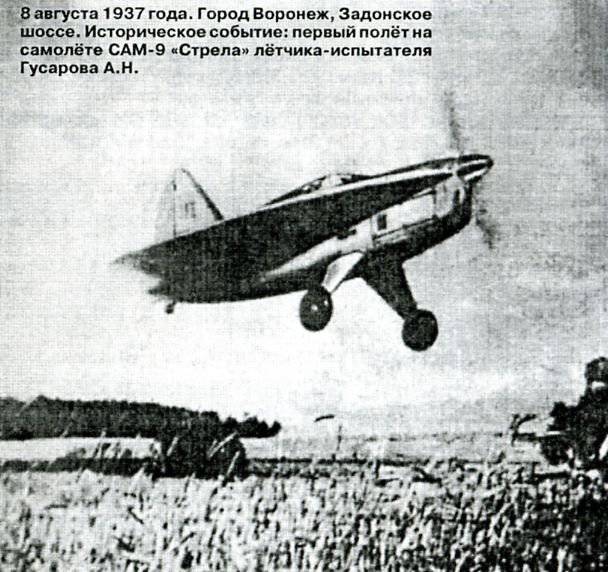
topspeedSAM-9, Moskalew.
Flew the aircraft is not very good because of the low aspect ratio wing
Awesome SAM-9 Moskalew…thanks for the pic. The prop must turn that thing around when throttle applied in slow speed ?
No this is tuned for higher speed with Spitfire wingloading.
The wing form is called cranked arrow delta…this is not flatiron !
Most interesting feature might be the mach 2+ dive capability when in engine out situation.
topspeedGive specifics to a cartoon dream that ignores the laws of physics?
Yeah right.This entire site is pretty much paper plans fighting dream wars with paper airplane ignoring the reality of politics and how paper designs will function when exposed to the parameters of real war climate that ignore what all the political paper warriors sitting behind their desks spew forth.
Yours wishful thinking just takes it to the extreme.
So are ya saying also D-21 ignored all physics ? Is politics same as ignoring that also small countries might need to defend themselves ?
I am glad you don’t keep repeating the flying coffin phrase again.
I might be inventing an universal stealth fighter which even the future radars cannot detect. This migh need the MLU like every 20 years till about 2100..and still burns only 600-800 liters / hr ( on economy drive ) and goes supersonic on supercruise. Not diamond nor gold plated but still ( and stings like a bee ).
:rolleyes:
topspeedNEW WING
Here is the new wing and I think the ailerons will work more efficiently now.
This has around 1.39 m2 frontal area ( 16.5 times less than on SR-71…6 times less than on a J-20 and 7.1 times less than on T-50 PAK-FA ).
topspeedI like the concept but why are the wings so oddly shaped? Wouldnt you get more lift and equal drag if they where flat? + lower RCS from the sides…
Care to elaborate further ?
Draw on this how you want them.
topspeedA properly designed intake uses several oblique shocks and a final normal shock to slow airflow to subsonic and provide pressure recovery.
The more problematic issue is spillage drag at high speed for an inlet sized for low speed takeoff performance.
Exactly and for 100% RCS you need to also hide the fan blades.
topspeedD-21 was launched from the SR-71 in flight, needed to reach MAch3 to be able to fly on its engine (ramjet) that provided its thrust at high speeds only (or it wouldn’t even ignite). With 6.65t of thrust it provided it had to just maintain flight. Your aircraft will have to make do with an engine that will have to accelerate it past the sound barrier, maintain supersonic flight, and yet all that while loosing somewhere about 80% of its thrust once up there at altitude (not much air for a turbofan that high up)
oh, and by the way, it was a single use, reconnaissance drone filled with fuel and one single camera. It would fly in a straight line and self destruct once back
your engine will have to breathe (not easy in your concept, as there’s not much space for air to enter inside, increasing difficulty with thin air at altitude), you’ll have to have a cockpit with plenty of nice stuff (heavy) in order for your pilot to sit there and stay alive (for the beginning at least), you’ll need to have landing structure (gear and solid structure to stand landings at least during trials… as once in service it may not land all that often ^^ ), you’ll need to have space for weapons with supporting structure (heavy again), etc..
ah, as for rockets you want to use, the D-21 when launched from a B-52 needed a booster bigger than the ship itself to reach sufficient speed (highly supersonic) to start its own engine… what do you think your two small rockets (where will you place them?) will be able to do?
again, there’s no free lunch… it just doesn’t happen
Yes ramjet is pretty inefficient for this.
I think the 7.2 kN engine that lifts this up to 40 – 50 000 ft ( at supercruise on mach 1.4 ) where the rockets are ignited is the best change to get to meet anyone flying really high…even an SR-71 ( if one is resurrected from moth balls and for some reason not identified beforehand ).
This flys at half wing loading ( compared to SR-71 ) so it ought to go to 100 000 ft at least.
Rockets fits nicely…and a really small biz-jet turbofan. There has to be doors for inlets to be closed with.
I just practically redesigned this with 21 m2 wing and fully faceted fuselage and canopy.
topspeedV-Raptor Sport
Here is what happens if 2 AAMs are removed from concealed bays and engine lifted higher….over all size goes down by 8-10 %. Wing is now 5.2 % thick at midwing.
Topspeed mach 1.8 using supercruise. 😀
Rocket version at mach 2.2 tops.
Still operated at 90 000 ft.
With the size ratio I’d need only 27 kN to be even…but SR-71 is actually slicker and flies at higher re number…so I’d be doomed if tried to follow it. Unless titanium fuse and ramjet engine ( and still couldn’t catch it ). Also the AAM ejection would cause immediate meltdown at mach 3.5.
I buy the one a cup of coffee who tells me how thick the SR-71 wing is…I get 2% from my measurements.
topspeedHere is good example what good STEALTH design means… a SR-71 is much faster than a PAKFA or J-20 yet it is double sized..and it has even less engine power.
topspeeder, “size”… not really. look at the radar reflectors on the F-22 or similzr devices on leisure sail boats… even small, they strogly reflect radarwaves to make the thing visible.
Certainly the other 2 factors shall not be forgotten.
1/10 size F-22 would yield 1/100 of the F-22 radar signature.
That would mean total invisibly in battle field conditions.
:rolleyes:
topspeedYoung fella, your velocicraptor is balsa wood model airplane that simply physics shows may work in a cartoon world but no where else.
Give me an example or something spesified !
topspeedYes, it seems 🙂
Is this your own design ?
Pretty interesting.
topspeedWork on low observable aircraft started a decade before Ufimstev’s work was published.
Ufimstev’s work allowed the creation of computer models to predict the RCS of complex shapes. This occurred at the same time when finite element modeling for structures and computational fluid dynamics for aerodynamic modeling was also in its infancy. The Soviet Union had not yet started using computers to crunch through the calculations for mesh models, so Ufimstev’s work was not seen to be important.
Lockheed used IBM360s to crunch the calculations for Have Blue and F-117. Northrop used a Cray supercomputer for B-2 and YF-23 calculations. And Lockheed also used a Cray for F-22 calculations.
Computers cannot do thing for you unless someone knows what to do with them ( I would not switch to hand drawing after computers ).
US has been doing research early on; http://en.wikipedia.org/wiki/Tacit_Blue and http://en.wikipedia.org/wiki/Lockheed_Have_Blue


 Sign In