topspeed
F-14 was a great plane and an absolute classic, but influential – how?
It was influential via TOP GUN movie and millions of plastic models ?
topspeedHere we can see that lifting body when correctly applied can save us lotsa frontal area and downsizing pays off.
Big difference is that you can fly ecomically to 15 km and start the rockets there.
topspeedI think I am there now…so next the flying model.
I sum up the features here so you can study it better.
I hate to say it but this is a green fighter aircraft.
1. Lifting body ( increases the lift and makes a lite core structure ).
2. Engines in tandem lay out brings it phenomenally low frontal area ( 24% less than in Pond Racer with double sized engines ).
3. Forward sweep increases lift but also makes it stall free by giving extra low stalling speed.
4. Using hybrid power plant gives unpresedented advantages ( stealth by low heat emission when on piston power ) like versatility and economy and M3 top speed at 65 km.
5. Material used ( super plywood aka “panzer holz” ) gives naturally a structure blended bullet proof shield in the cockpit area..and 50% shield elsewere ( slows the bullet/shrapnels so that no harm is done to metal pieces ).
Most of all you can fly this 99% of the time on piston engines ( or just one if the other heats up ) and save sh*tloads of fuel and emissions.
Down side is that this cannot operate alone effectively in BVR environment, but is hard to shoot down due to + 10 G structure and nimble aerodynamics.
Below you see I scaled the PR too small in initial calculation.
topspeedBy increasing the wingspan I get lotsa more stuff carried with this…ammo, fuel, ordnance.
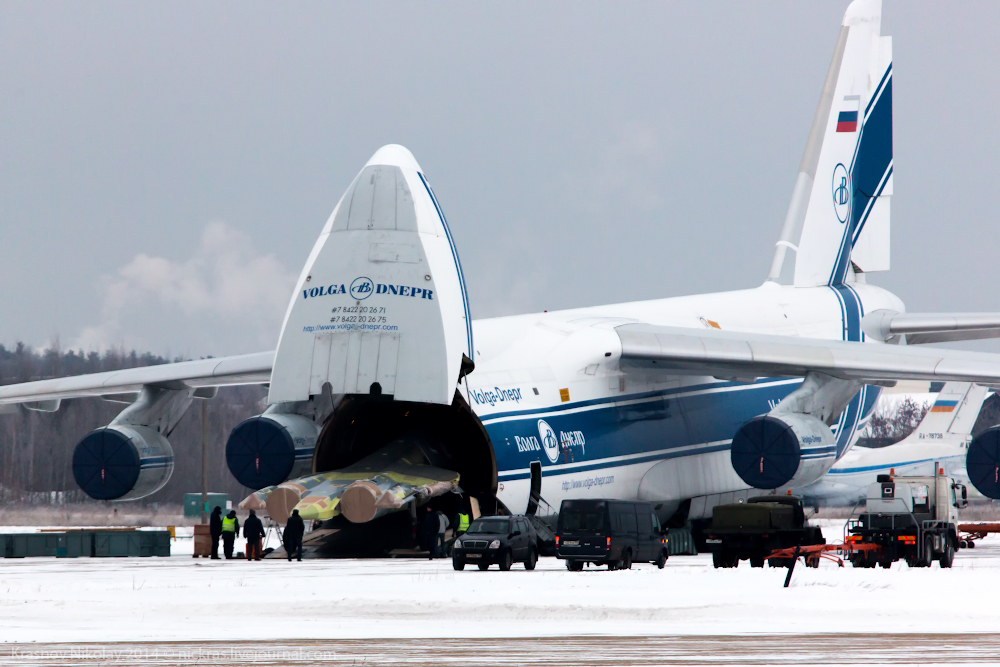
topspeedStatic tester T-50-7 arrives @ LII (bye-bye metal cowlings)
C/o Господин Paralay.
Awesome photograph…big plane eating a little one without wings. Look a bit roundish those nacelles. Do you agree ?
topspeedHere are the two seater trainer version 3-views.
Newer version has 8 m span.
topspeedOne way to look at this would be of buying for istance 10 state of the art fighters at 150 000 000 € price tag with good radars and a data link to a MINIKITE.
Then the price for high tech MINIKITE around 10 mio €. Engines are 150 000 usd a piece ( roughly ; http://www.airpowerinc.com/productcart/pc/TLEngineDetail.asp?catID=33&prodID=9460 ). It is less than one engine on F-22; http://www.bga-aeroweb.com/Engines/PW-F119.html. Based on that the MK price could reach 15 mio too.
With rocket assist system it could speed up to Mach 2 four times per sortie ( if necessary ). It could carry in stealth mode 2 x BK27 and 2 x AMRAAM AIM-120.
Let’s say a nation needs 200 fighters and you just spend 1,5 billion to 10 top fihters with AESA, IRST etc. You still need 28,5 billions to spend….or just 2,85 billions if it is the MINIKITE..and you get away with just little over 4 billions….and future maintenance costs are just a fraction.
Does this make any sense ?
You could also buy just 2 SOLAR EAGLE battle control units with 1 billion those have then the radars the MK:s need…and can escape to space if needed. Any combo is also possible….4 SEs and 60 MKs makes 2.9 billions.
One great advantage in forward sweep craft is that it can land at 100-120 km/h…so it could actually substitute the jet trainer as well ( as a two seater )…and for its 5-15 hrs loitering capability and tramendous lift feature also the CAS is handled. Having also small arms bullet proof cockpit ( with BRS ) and twin engines ( 4 engines actually if the boosters are counted ) you get the reliability the battle field demands.
Maybe a new kinda radar could be developed that needs no huge nosecone…and you have the 7th gen fighter in your arsenal ( practically for free ).
Please feel free to comment !
topspeedI admire your creativity and persistence, but…
Also, 4 AIM-120s carried by a plane those small wings?? I love the idea, don’t get me wrong, but it looks so wrong when it comes to wing area/weight/size/internal volume, and I have pretty good sense for forces and mechanics.
Even if the trust was sufficient, the wing area and size of the body would not fly well with such armament. Aerodynamics of the plane would be destroyed as soon as those missiles are attached to the body. Just imagine how much the whole plane would suffer if one of the four AIM-120s was launched only due to weight distribution within such small craft.
sorry to be negative. Like I said, I love the design, and I always check in here to see what new you come up with with pleasure, but plane is shrunk too much.
best regards
No harm done…I just realized how to work it out.
Keeping just 2 semiburied AIM-120 missiles in it.
What do you think about it now Wanderlei ?
It is also a bit bigger now.
topspeedI found Taichis frontal projection too of the Pond Racer.
MINIKITE can have double sized engines and still the frontal is smaller.
topspeedSee how efficient this carrier / battle control unit is.
It has to be since it is electrically operated and driven to 45 km ( at least ) and able to fly to space.
It beats the H-4 hands down even ( with 15% ) when having 17 m less span. It also weighs 1/3 of the Spruce Goose ( which btw weighs 1/3 of the Boeing 747 and Airbus A380 ).
Check out also how much more efficient the P-51H was than the He-162.
topspeedHere is Hughes H-4 and you see that the WARE number is quantitative ( as it is also qualitative ).
It is 128 times bigger than in MINIKITE…as it should be as it was supposed to carry 750 soldiers.
It makes easier to compare designs and to see if they are efficient or not.
Wetted aspect ratio is 2.06 in H-4 which is remarkable as well.
topspeedHere is another example of the efficiency which seems to make sense.
He-162 that has no lifting body and a jet engine a top has enermous amount of wetted area.
I claim that is has 31% less efficiency as it is than the MINIKITE ( and one notch more interference drag due to engine lay out ).
topspeedMy suggestion to aerodynamists is as follows;
In order to measure the effciency of the concept lift forces
is to multiply the wetted aspect ratio with the lift area !
Here is the lift efficiency ratio for Tsunami: WARE = lift area(b^2/wetted area ) = [ 6.35( wing ) + 6( booms ) + 1.6 ( cockpit ) ] x ( 7.74^2 )/49 = 17.577 [ b= span ]
Here is the lift efficiency ratio for MINIKITE = ( 16,8 + 0.6 ) x 1.25 = 21.75
This would make some sense at least. Who agrees ?
Vincent Burnelli stated that his ACs have 50% more lift at the same span as regular aeroplanes ( inventor of the lifting body concept ).
Pond Racer is not an ideal object to compare with ( and study my formula ) since it does have three lifting bodies with enermous amount of interference drag.
WARE = wetted area ratio efficiency
This formula I made up only gives MINIKITE 21 % more efficiency/lift compared to Tsunami.
topspeedWonder if there are any 1000 hp flat 6 engines for airracing ( air cooled ).
http://en.wikipedia.org/wiki/Scaled_Composites_Pond_Racer
MINIKITE went through a face lift.
The wing area is 6.35 m2 for Pond racer and 16.8 m2 for M-KITE.
What is amazing is that PR had 47 m2 of wetted area ( + double amount of interference points ) and MK just 39 m2.
I wonder also if mathematics ought to be rewritten; http://en.wikipedia.org/wiki/Aspect_ratio_(aerodynamics)
Cause Tsunami has still better wetted aspect ratio of 1.26 and MK just 1.14 ?
topspeedHere is another forward sweep winged ac in comparison.
Wouldn’t it be cool in Reno if the new lap time was clocked beyond 700 mph with a small inexpensive piston driven prop plane ?
You can also check the cockpit size ( I know it is in par with Me-109 G )…it could be tuned for racing purposes further.
Anyone interested to work and/or fund on this super plywood based aircraft design ( bullet proof 1400 kg/m3 dense material ).


 Sign In