Malcolm McKay
Guys,
the tracks under the airplane, were part of experiments with different landing gear configurations.
I do not have the books at hand to quote specifically, but I distinctly recall having seen and read on the subject.
More recently, here was either a Boeing or a Northrop transport aircraft (experimental IIRC) that was tested with an inflatable bag in lieu of a landing gear.
Saludos,
Tulio
No B17 was ever fitted with that tank combination. That photo? is just a montage.
Malcolm McKayThe Tank on the B17 photo may well be a joke (a retouched photo to give someone the idea anyway) but the M22 Locust WAS designed to be carried like that (albeit with the turrent carried seperatly inside the aircraft!). The UK being the only nation to send that tank into battle just stuck it inside the Hamilcar glider.
I can imagine a B17C trundling down a runway for eternity trying to get up enough speed to get off the the ground with that load. 😀
A bit like it’s grandchild the B47 – would probably have relied on the curvature of the Earth to gain altitude.
Malcolm McKayNumber 6, the B17 with the tank is clearly somebody’s idea of a joke, as I suspect is number 4.
Malcolm McKayOn the contrary, Saunders Roe had developed a multi-cable system which would have allowed the boats to be winched into a cushioned landing dock.
The passengers woud then have boarded the aeroplane via what look remarkably like the ‘air gates’ we use today.
I stand corrected – I was unaware that they had done that 🙂
Looks like it might have worked – the Princess was a lovely aircraft.
Malcolm McKayI imagine that docking scenario as pictured would have been a nighmare in real life. Flying boat hulls are not of the thickness and strength of ship hulls and the constant bumping against the “wharf” would have holed it pretty quick.
Normal flying boat mooring was to buoys so that they could swing around the buoy with wind changes and loading of passengers was by launch. The swinging with the wind is caused by the inbuilt weathercocking effect of the vertical tail.
That pictured system could only have been used in an absolutely flat calm and even then tidal effects would have to be accounted for.
Malcolm McKayIt’s definately a Whiffer or Bitsa – the undercarriage is actually off a Polikarpov I-16. But it’s been swapped over so that it retracts outwards rather than inwards – the geometry of the doors attached to the legs is quite distinctive.
Overall fuselage shape is redolent of the Klemm but the leading edge of the fin is very similar to the Bf-108.
Malcolm McKayInteresting indeed James and XN923. I think that it is true that chivalry in the idealised though probably, in actuality, non-existent medieval tradition did not exist in the WW1 air combats. That is a clumsy sentence but what I am saying that much of the chivalry of the Medieval period which involved letting a beaten opponent live was due in reality to the fact that as hostages they were worth a lot of money. Ransom payments funded many an extension to the manor.
The WW1 airmen lived a life so utterly apart, in combat terms, from the foot sloggers in the trenches and their individual combats may have seemed for fleeting moments for those in the meat grinder to be somehow preferable. Yet a bullet in the head is a bullet in the head whether it’s from a pilot or a muddy scared infantryman.
To me the Germans seem to have engrained the mythic element of knightly combat into their military philosophy to a much greater extent than most with the possible exception of the French. And it is apparent that this ethic survived into the WW2 Luftwaffe. XN923 cites the status accorded the Experten, and this status is unparalleled in the Allied forces. But the price was heavy because by creating those mythic warriors they also created a system where the very best had no respite other than death or incapacitation from constant combat.
The Allies were much more pedestrian and rotated pilots out of combat so that they could instruct or put their leadership skills to tactical and strategic use. In Germany in WW2 the leadership was striving to recreate the myth of the Teutonic Knight – the knights who had first come to prominence in the expansion into the pagan parts of Eastern Europe and from which the Prussian national identity grew. A knight cannot retire he is always on a quest or he ceases to be that mythic figure – for want of a better example its like the man of La Mancha Don Quixote. The quest is always there but in the end no Knight can be immortal.
This creation of a myth was necessary to legitimise what was essentially a working class right wing party that had taken over from the WW1 and pre-WW1 aristocratic German leadership.
But that is a digression. Like James, I see precious little of the myth of knightly behaviour in WW1 air combat. Lanoe Hawker was killed after he had run out of ammunition and was trying to escape. In the Medieval period he would have possibly been captured and held for ransom, but that is not an option in the air. Also the reality was that an enemy who survives and escapes will come back to try and kill you.
A very interesting discussion.
Malcolm McKayI might add to my previous post that there is a clear distinction between the “warrior” ethic and the “knight” ethic. The first seems to be more basic in fighting terms in that it is defined by what one might loosely call the greatest numbers of victories.
To me the second is defined around a combination of virtues – recognition of the weakest and their protection, sacrifice to a higher ideal (the Morte d’Arthur epic, or the traditions as depicted by the Wagnerian Seigfried idyll seem to be the best parallel. The Grail legends also fit in this) and recognition of the other “civilised” cultural aspects of human society. As an example the troubador tradition in middle and late Medieval society.
Few if any WW1 “Knights of the Air” seem to me to fit within the second group. I feel that we are in fact dealing with a more basic warrior tradition than the complex Medieval tradition of the knight.
It was important for the propagandists on both sides in WW1 to select some point which seemed cleaner and more honourable in European traditions than being blown to atoms in the mud and as the aviators flew so far above this reality then they were the perfect example. Couple this with the one to one combat and a legend is developed, however despite that attempt by the propagandists the reality of the published material is that it was actual scores that counted not the other ideals of the knight tradition.
Malcolm McKayExcellent post Malcolm, not much to disagree with. And yet… and yet… there seem to be some characteristics of the scout pilots of the first world war that make the ‘knights’ analogy easier to apply, if not entirely appropriate. For example, many RFC pilots claimed to feel no animosity to the Germans (though some certainly did) and even felt an affinity with them because they were also airmen. Many of the worst horrors of the Western Front were not immediately apparent to the aircrews so this undoubtedly allowed RFC men the luxury of not needing to hate their adversaries. There are also stories that reinforce the ‘affinity’ idea even between adversaries who were fighting to the death. Von Richtofen reported that as he was locked in a turning battle with Lanoe Hawker, the two men gaily waved at each other (neither could bring their guns to bear and all they could do was try to hold the turn. Eventually, running out of altitude and fuel, Hawker had to make a bolt for the lines and Von Richtofen used his Albatros’ superior speed to chase down Hawker’s DH2 and shoot him down). Admittedly, MVR’s ‘honouring’ of his foes often took the form of rather grisly trophy hunting. It’s a fascinating mixture of cold ruthlessness and respect for one’s enemy’s humanity.
Well it was a very condensed history and that tends to leave out one essential thing of the human condition and that is that we do, even in mortal combat, have the capacity to recognise the humanity of others, or their bravery. Of course that is not always the case more’s the pity. We are also capable of horrific cruelty and inhumanity – but that also is a product of a myth creation process.
For example how else are we conditioned to commit acts of genocide e.g. extermination of Jews, or Ruandans etc. except by demonising them so that they lose their humanity. War invokes a complex psychological process in us and demogogues and dictators like Hitler and Stalin are masters at conditioning their subjects to abandon their humanity.
The knightly spirit is a way to sanitise the killing act while the operation of a gas chamber is another. Both achieve the same end but we view them as diametrically opposed. We are complex creatures and yet it is our humanity that causes this strange dichotomy in our rational process. Both extremes are seen as “good” yet both in the end are the same.
Malcolm McKayCare to expand on that? Do you refer to ‘the age of chivalry’, or W.W.I?
Love to.
The “Age of Chivalry” which is basically the middle to late Middle Ages was a period of colonial expansion into eastern Europe. This was a period when the central part of Europe were becoming over populated and the land owning nobility had to find the means of settling their male children on new land. Remember that the tradition of primogeniture meant that apart from the eldest son and heir there was no place on the family estate for the rest of the males.
It was the younger siblings who had to carve out (pardon the pun) new estates in either unsettled land or in non-Christian areas which in that period, prior to the expansion into the Americas only existed in Eastern Europe or in the Holy Lands.
The “knightly ethic” was basically a church backed philosphy which enabled people to conquer new land and people without incurring the eternal punishment that killing fellow Christians would incur in Medieval Christian theology. I know this is a bit condensed but I think the basic meaning is clear.
The romanticising of the ethic by people like Chretien de Troyes with the Grail epic created a body of literature which turned simple conquest into a sort of religious and spiritual quest. So we see the birth of the ‘parfait knighte’. Before that trend conquest was conquest along the lines of the Roman expansion. The Church and its adherents needed some assurance that their mortal deeds would not result in some form of eternal punishment. Hence the dispensation for Crusaders. The first crusades as such were actually into Eastern Europe.
The reality of war and the pragmatism of the Renaissance magnates killed off the noble quest business but in popular literature it became enshrined until in the 19th Century with the colonial expansion of Europe it once again became a guiding ethic for younger siblings needing new land to farm.
Come WW1 the reality of war was so horrific that a new breed of knight, in this case aerial aces had to be created to somehow convince an increasingly sceptical civilian population that war was fun – not just a meat grinder.
Very condensed I admit but I hope you see my drift.
Malcolm McKayThis book http://www.amazon.co.uk/Brief-History-Royal-Flying-Histories/dp/1841194700/sr=8-3/qid=1164274063/ref=sr_1_3/026-5310586-4078044?ie=UTF8&s=books has a few things to say about the different attitudes of Germany and Britain on the cult of the ‘Ace’ and the new knights – in a nutshell, the British Army wasn’t so keen on it (eventually bowing to popular newspaper creation of indiividual heroes) while the Germans seemed to encourage it. Stephen Bungay also discusses how the first war values were reflected in the Battle of Britain in ‘The Most Dangerous Enemy’ – more on individual ‘champions’ rather than fighter aces being ‘verray, parfit, gentil knights’. In essence, not so different from the Middle Ages then where the ‘knightly ideal’ had more to do with literature then reality…
Knightly reality was, in any age, being carved up or shredded painfully and fatally with whatever the best weapon to hand was. In a fight you either survive or die, so you use whatever skill or equipment advantage you have to win.
Just because you are flying an aeroplane, riding a horse, sailing a ship, sitting in a tank or just plain walking and carrying a rifle all these are, in reality, only a means to bring the instrument of execution to your opponent and none alter the ethics of the bloody business in any way.
The “knightly myth” was invented as a means to make it palatable to the squeamish civilians.
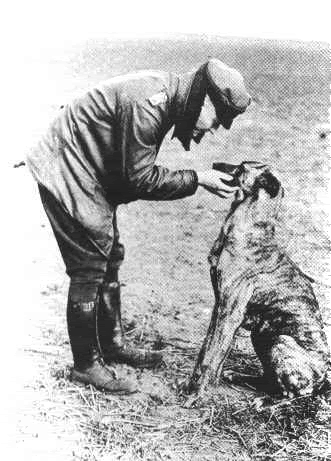
Malcolm McKayMoritz definitely had no complex about being short!
As you see, Manfred is subjecting Moritz to a very violent tickle, the sort that would send any dog mad enough to go out in the midday sun.
Manfred is not actually that short, he is bending down. Moritz IS that big. He was part Irish Wolfhound and after V R’s death he went to live with another squadron member, survived the war and lived to a very good doggy age. (all go “Ahh”)
So if Moritz got really pissed off Manfred would then have a real dogfight 😀
Alright alright I’ll stop the Manfred von Richthofen jokes apart from one last –
What’s all red and go sputter sputter kerplonk? 🙂
Malcolm McKayI remember reviewing that one and it is the only book in literally hundreds that I reviewed that I used a pencil to make notes on the book about how bad it was.
For example “Richthofen mistreated Moritz (his dog) because he had a complex about being short.”
Was that Manfred von Richthofen who had the complex or the dog? And were there canine psychologists in the German forces in WW1?
😀
Malcolm McKayThey are called French, not frog, thank you very much!
Actually I thought he was referring to the Frog kit of the Lancaster. Frog = Flys Right Off the Ground.
🙂
Malcolm McKayIn its war against Fireants the USAF has introduced new recon techniques.


 Sign In