 JangBoGo
You wont get a 40-45 % range increase with the same missile
Yes, it can if the missile performance is limited due to the illuminator. Take the case of Shtil-I itself, it has got anti-shipping capability and the range is 25Km, where as the same missile have an anti-air capability out to 50Km. The limiting factor in this case is the horizon for the same illuminator which can other wise guide the missile out to a max of 50Km.
This same small illuminator is the one which have limited the Shtil-I missile to that 45-50Km range. Change that guidance unit to more of what the 22350 have and I’m sure we will be seeing an increased range for the same missile.
On Talwar class
http://media2.intoday.in/indiatoday/images/stories/sandeep_650_071914021958.jpg
BUK-M2 OTH has a range of 50 km and 15 km altitude that is the same specs with Shtil-1 VLS or Single Arm Launcher , what they did was redesigned the control surface and move it to rear to accomodate in VLS Launcher , A Small Rear control surface indicated they are relying on TVC as well besides the control surface they kept the same guidance SARH
I don’t think that was the case, even without it removal of the long control surfaces the same unit can be used in VLS. The diagonal dimension (at the base) is almost the same. It is certinaly not a limiting factor but yes, it would have helped to make slightly smaller dia VL cells than what the 9M38 would have needed.
The variants.
Here the Chinese variant HQ16, which is based on the 9M38
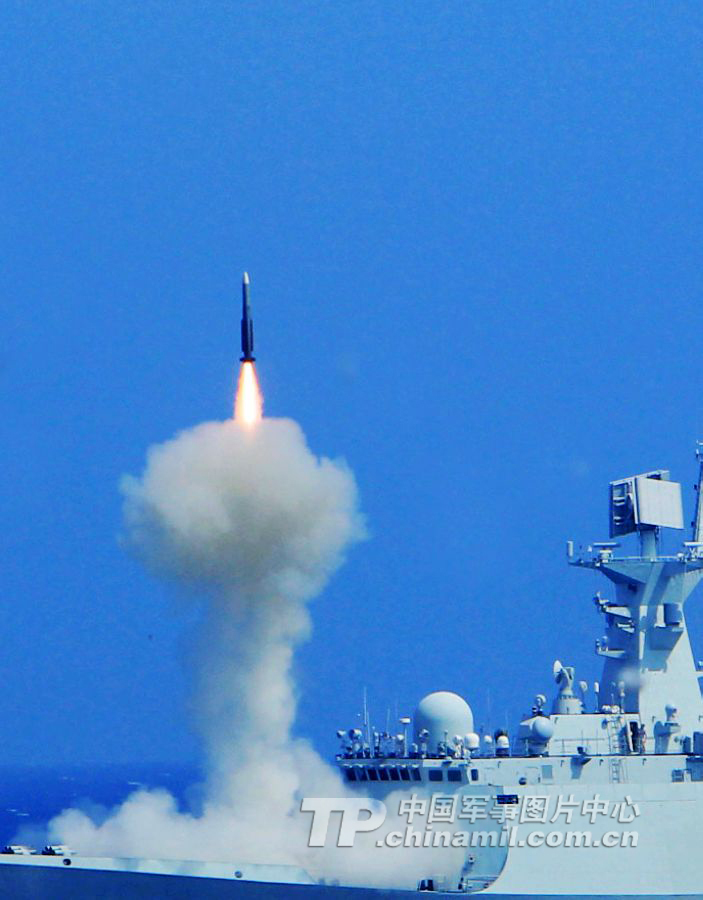
Its the one used for land based units.
https://farm6.staticflickr.com/5609/15141262994_9fbc0dbfdf_b.jpg
https://s-media-cache-ak0.pinimg.com/564x/00/75/f6/0075f68c76fb3c5595fd215dd3bbd6fd.jpg
http://2.bp.blogspot.com/-_IDbkY_ccGw/VHfqENkEbwI/AAAAAAAAkv8/pRMJCK_LwzA/s1600/%2BChinese%2BHQ-16%2B%2BLY-80%2BMedium%2BRange%2BSurface%2BTo%2BAir%2BMissile%2B%28SAM%29%2BSystem%2B%281%29.jpg
Shtil-1 though suffer from horizion limit of its FC radar hence its engagement range of target is 45 Km even though the broucher claim range is 50 km
Yes. Change the illuminator/FC, we are likely to see an increased range.
JangBoGoFour out of six Il-78MKIs are reportedly grounded due to lack of spare parts.. What exactly does it mean? Are Russians unable to produce/provide those or is India unable to buy them?
To the question of if Russia is not able to produce/provide them or India not able to buy them the problem is both. Funds allocation is a problem and so does the timely movement of files.
Look at the C-17 and C-130 deals, after the deals have been done, another mandatory (which PR converts into “India requested”) 5-year support deal was signed for the aircraft. Which means at least for the next 5 years the fleet wont be grounded for lack of spares/support. This process is likely to repeat itself for the entire service life of the aircraft. Its good business for the OEM in addition to keeping their aircraft and brand image fly clean. Such a supplementary package deal gives the OEMs precise quantity requirement of the specific customer and they can have a production run accordingly. It completely negates the chaos of a customer knocking your door in the middle of the night asking for emergency supplies for his product.
And… If a customer (who have not taken this mandatory package) yells at the OEM that your aircraft is grounded for lack of spares/support, the OEM can put the blame squarely on the customer for not subscribing to the support package advised by the OEM.
That is the way to go! Russia needs to come out of that stupid business model currently employed and employ the same business model to avoid issues related to spares/support of their aircraft. Have you seen any such supplementary deal/support package after an aircraft is sold by the Russians? I have not or maybe I missed. And that is the fault with the Russian manufacturers. You cannot let the image of your product at the mercy of customers, you have to take certain responsibility for the product you sold even if it is harsh on the customers in terms of additional financial burden. Customers vary in their financial status and character and that will reflect on the products they use. Its a common phenomenon.
In almost all the cases the operator buys some aircraft (say a dozen) and few spares/support needed to operate it, which may last for months. This extra spares ordered might not be for the entire fleet to operate for say 12 months or 24 months. But once the inventory starts depleting, instead of replenishing (additional funding/finance) the stocks needed for the entire fleet, the already available stocks are used up to a point when no more spares/support is available off the shelf due to non-procurement. At this stage if there is still no funds requested/allocated for topping up the inventory, cannibalizing starts with the obvious grounding of some aircraft. Even during this phase if there is still no procurement, there is no other way than to ground the entire fleet.
JangBoGoIf the IAF are flying within the territory of India, i.e from one IAF airfield to another IAF airfield, the flight distance flown will not need to be that far (India is a compact sized country relatively speaking) so the internal fuel needed on board for the return leg will only be a small amount, which will help to reduce the C-17 landing weight at the remote austere field. Besides, a 70 tonne payload would be more than enough, a typical payload for a C-17 would rarely be any more than that. Isn’t that already close to the maximum payload of the C-17 anyway?
I’ll take your quote for highlighting the non-critical requirement that is the A330MRTT. When you look at the bolded part you will see why this co called critical necessity of new long range tankers is a farce.
At the most the Indian takers will only operate 1,000Km from its base, and more likely and more often in the 500-750Km range from their base.
The IL-78MKI specs for transferable fuel is like this –
74tons @ 1,000Km radius,
85tons (max transferable fuel load) @ sub-1000Km, probably in 500-750Km radius.
The above was with the two fuselage tanks. Without the fuselage tanks, IL-78 have a max transferable fuel load of 57 tons, probably for a 500+Km radius. Even if we get 40-50 tons of transferable fuel from these tankers at a distance of 500Km, it would be like tanking up 5-7 x Su-30MKI with say approx 8 tons of fuel.
Now there are nearly 17 x IL-76 and 10 x C-17 transport aircraft in Indian service, in addition there is a fleet of 6 x IL-78MKI dedicated tankers.
Now my though on a cost effective solution is for utilizing the already available platforms and converting/plumbing those transport aircraft for a secondary tanker role with 2 x refueling/transferring pods per aircraft.
What we get is an additional 27 x Transport-tanker aircraft with 40-50 tons from an IL-76 and 50-60 tons from a C-17. In total IAF will be having 33 x tankers at its disposal – dedicated and on-call tankers.
And just in case the A330 is too hard to resist, take the older frames operating in India itself and convert them to MRTT, it would be cheaper. If I’m not wrong only Jet Airways is currently using A330 in India which numbers around 12 aircraft.
Just signed an $1 bn order for 4 more P-8Is last week (bringing the total value of US defence imports since 2005 to about $15 bn IIRC). Also issued an RFP for 22 Reapers and one EMALS. They’re long past the stage of warranted wariness with respect to weapons purchases from the US.
It felt like an internal statement by a US department reporting on their successful sales campaign in India over the years utilizing the efforts of the Indians residing in the US and in India working for their respective US companies through direct employment, media, blogs and forums.
We in India usually look deal in terms of number of aircraft and how cheap/cost effective it was for the Govt treasury which is made up by taxes collected directly and indirectly from the people (& services/business) living and working in India. Even beggars & prostitutes (most of who are anyway forced into trade including the hapless Nepali girls who are smuggled into India) in India pays their dues through indirect taxes when they buy stuffs from shop or utilizing any service.
And this is the loot the various promoters take from India with their multi-billion contracts.
JangBoGoThe usual stuffs…. decisions which should have been made earlier comes only after an accident. I sometimes find it hard to believe the stupidity in thought process. These cost cutting and on-a-budget upgrades is usual with non-western aircraft upgrades even though they cost much lower than any western upgrades. Hope they fit the beacons on the entire range of aircrafts.
PCN is not an absolute limit, it simply specify levels at which the runway will degrade much faster (i.e. at PCN level xxx the runway can sustain yyy movements before requiring maintenance).
I don’t think IAF is yet ready to degrade their runways casually like that and the reason why they are still operating inside those limits.
JangBoGoSome Russian assets in Syria

The moderate terrorists have set conditions for returning the bodies of the dead crew, which involve stopping the airstrike and withdrawing the forces from Aleppo. Below one of the $cums with a dead crew, another body is behind him whose leg is visible.
https://pbs.twimg.com/media/CpGL1lCWEAAy_p3.jpg:large
Russia need to learn some lessons from the US in terms of bombing the crap out of a crash site. Russia should have cluster $****** that entire area immediately after the reports of shoot down, at least 50 of those would have met their 72s.
JangBoGoRussia TV report on the Mi-8 shoot down. The report also have a good footage of a Mi-8 filmed earlier from a drone.
JangBoGoSyrian ‘moderate rebels’ used toxic gas in Aleppo attack – Russian military
The moderate toxic gas attack did not make it into the news rooms of the English language Jihadi supporting media while they had stories about the Ebil Russians and Syrians using highly toxic gas on civilians.
ANNA News from the site when victims were brought….
JangBoGoThat’s not a fault of the aircraft, but how it’s used.
Yes. Thats why I put that diamond necklace in the hands of ladies case. Due to the price tag they will be very careful with it and will mostly reserve it for special occasion or in safe situation or for show off.
The way IAF employed C-17 in Yemen operation falls in that above said space.
In addition there could also be the operating cost factor involved in limiting its utility. Its nearly 4 and half hours from Aden to Mumbai and C-17s made 4 trips (or 8 flights to-n-fro) per flight in that 2 day mission.
C-17 is the single costliest aircraft in the IAF inventory currently, bar the A-50, and a damage or loss of a single C-17 will be high in terms of monetary and psychologicay. It would be like loosing 5-6 x Su-30MKI in a go to an accident. So no doubt IAF is using it with utmost care, not taking any risks.
I’ve not heard of a tanker C-17. It doesn’t make sense. Who’d want it? Why convert perfectly good freighters, which are limited in number, no more of which are being made & which nobody is selling secondhand, when better aircraft for tanker conversion are plentiful, cheaper, easily available secondhand, & being made in large numbers? An A330 MRTT is a few percent lighter than a C-17 with a few percent more fuel capacity than a C-17 (without hold tanks, which I think could be added if a customer wants), & a considerably greater range (more aerodynamically efficient). Starting its take off run with just 2% more fuel, it should be able to give away quite a lot more. 767 tankers are also more efficient than the C-17.
If India’s C-17s aren’t used & aren’t wanted, it’d be better to sell them & use the money to buy tankers which are cheaper to operate & have higher performance as tankers, rather than convert the C-17s to tankers.
I thought I read it somewhere. Whatever leave it.
I’m talking about plumbing the C-17s that is in service with the IAF so that it can be used as a tanker in addition to being a transport.
Not something which is not doable (I guess so). I’m not suggesting installing any extra fuselage tanks like that on IL-78s, but saying to make the plumbing required so that the two wings can carry refueling pods for refueling two aircrafts. I’m not even suggesting a rear fuselage refueling pod as it might require more plumbing from the wings as C-17 don’t have any fuselage tanks (if I’m not wrong).
I was saying the same stuff for IL-76 (not IL-78) sometime back in another discussion. To make it available as a tanker with refuelling pods. Without the extra fuselage tanks, the transferable fuel in IL-78 is 58 tons (if I remember it right) and with those tanks, the transferrable fuel is 85 tons.
C-17 is having in excess of 110 tons of internal fuel, in the range of 130 tons which is more than A330MRTT internal,…. and if atleast 60 tons of that can be made available for refueling, it would be good. This is what I’m suggesting.
JangBoGoasking Iraqi helicopters to intervene is a nonsense, they are several hundreds km away, even if ecquipped with fuel tanks they would not get enough autonomy to stay there for the time needed to have an impact.
Its not about asking Iraqi helos to intervene from Iraq. Its about seeking the help of Iraqi Govt to deploy their Mi-35M & 28 in Syria to support the SAA and allies including the various Iraqi paramilitaries and Iranians.
Russians only work with Syrians coz its the SAA with whom Russian personal is embedded with. VKS has not been carrying out much of any strikes where other groups are on the frontlines and the main reason is, without any embedded personal, there are chances of VKS wrongly hitting the allies fighting against the terrorists. Some analyst already shot off this lack of Russian air support for other groups as a Russia-Iran internal problem.
Even in this Aleppo fight, VKS probably did not start their aerial campaign in South Aleppo until the terrorists made their first contact with the SAA.
After Russia, the only player who have enough capable attack helos in their arsenal is Iraq, so my thought is SAA and allies will greatly benefit from Iraqi gunships.
JangBoGoAre the names available?
As per internet sources….the helo crew were – Pilot Captain Roman Pavlov (33), Pilot-Navigator Senior Lieutenant Oleg Shalamov (29), Flight Engineer Captain Alexey Shorohov (41)…… and the two officers from the Russian Centre for reconciliation who were being transported back to the base.
The propaganda is building up of a Russia/Syrian “chemical attack” on the “rescuers” near the helo crash site. The Russians bombed the crash site yesterday, but they were pretty late and even the Jihadi media were able to report from the site in full comfort….Russia should have cluster fu$ked those terrorits….
The Jihadi attack failed yesterday and now they have launched their 3rd phase of the attack to encircle Aleppo again.
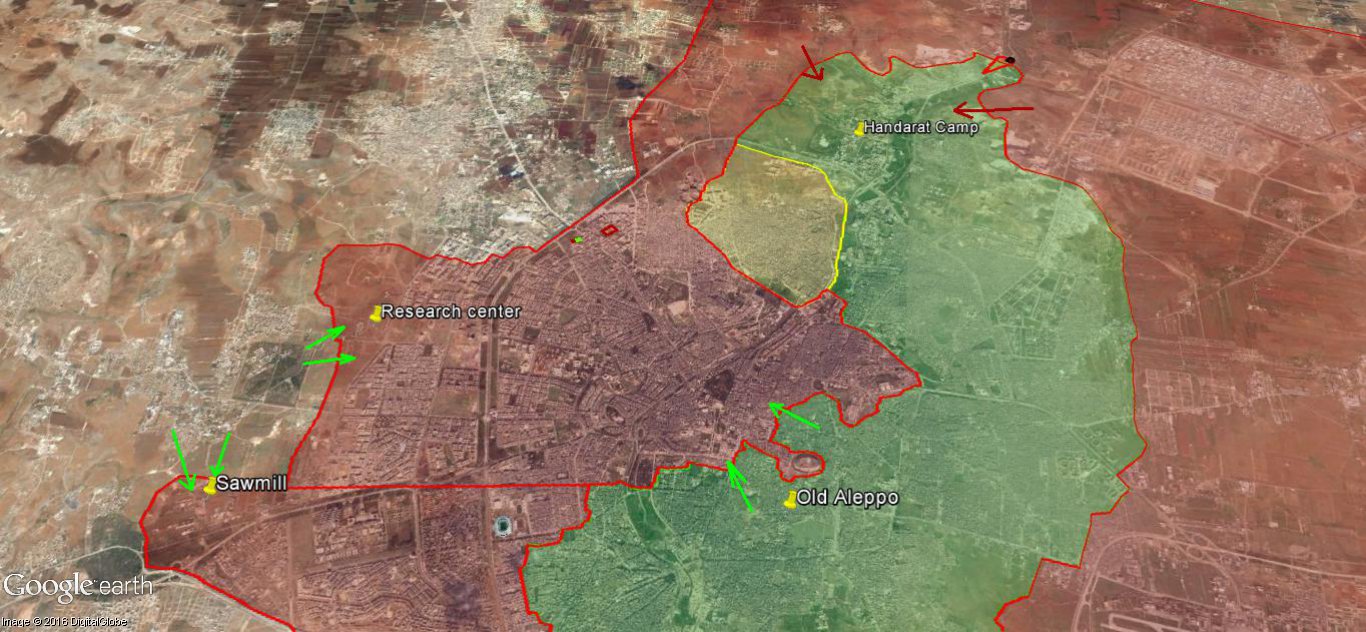
The terrorits have (as expected) opened up fronts near the Russia-Syrian humanitarian corridors for civilians. Below map from MoD press briefing shows the 8 corridors provided by Russia/Syria for evacuating the civilians. 7 for civilians and 1 up north for terrorist to leave Aleppo through Castello road.

Shameless propaganda outlets have been bitching about Russia and Syria for Aleppo siege when in reality its been the other way round. Aleppo was under siege by the terrorists since 2012 and all these “humanitarian” guys were calling in for a no-fly zone and military strike on the Syrian positions.
This is how Aleppo looked like in
March 2013
June 2013
January 2014
And now when the Syrians are regaining their land from the terrorists, propaganda is in full swing. Terrorists know that majority of the population is with the SAA and would love to flee the conflict area, so they will in all capacity prevent the civilians from leaving so as to make it hard for the SAA to ouverrun their positions.
Few snaps of Aleppo reports over the years
2011, pro Govt rallies
https://pbs.twimg.com/media/CoiIgK_UEAAsV_1.jpg:large
Glimpse of what Indian mission saw in Syria
https://pbs.twimg.com/media/CoiIeVuVUAAKNcb.jpg:large
Aug 2012, terrorists from the country side take over Aleppo
https://pbs.twimg.com/media/CoiImMrUAAE8Xqy.jpg:large
2016, terrorists prevent civilians from fleeing
https://pbs.twimg.com/media/CoiJIPPUkAAakxa.jpg:large
JangBoGoDon’t now where you are getting all of this information. The C-17 is designed to operate from rough airstrips down to minimum length of 3,500 feet depending on airfield altitude and air temperature.
1.3. Airfield Types. The C-17 can operate on paved or semi-prepared airfields and
matting. Paved airfields consist of conventional rigid and flexible pavements and are
generally used for routine operations. A “semi-prepared” airfield refers to an unpaved
airfield. The amount of engineering effort required to develop a semi-prepared airfield
depends on the planned operation, the service life needed to support these operations,
and the existing soil and weather conditions. Semi-prepared construction/maintenance
preparations may range from those sufficient for limited use to those required for
continuous routine operations. Options for surface preparation may include
stabilization, addition of an aggregate course, compaction of in-place soils, or matting.3.2.1. Length. For a semi-prepared runway located between sea level and 6,000 feet
pressure altitude, the minimum length requirement for C-17 operations is 3,500 feet
with 300-foot overruns on each end. This length requirement, based upon an RCR of
20, assumes an ambient temperature equal Standard (1962) plus 31 ºF, and a landing
gross weight of 447,000 pounds.
What do you make of the C-17 capability for rough and unprepared runways from the below experience?
Non exploitation of capabilities of C-17 due to inadequate runways
C-17 aircraft is capable of conveying payload of 70 tonnes with short field landing capability on 3500 feet runways including its capability to operate from high altitude austere airfield. However, for its effective operations at higher loads, it requires runway pavement to be of certain minimum quality. The quality of pavement is indicated through its pavement classification number (PCN). For operation of C-17 aircraft, runway was upgraded with PCN value to 75 at AFS, Hindan.
In order to operate C-17 aircraft with full pay load, Head Quarter Western Air Command (HQ WAC) decided (December 2014) for PCN evaluation during 2015-16 in respect of five Air Force bases (Sirsa, Sarsawa, Jammu, Pathankot, Udhampur) where runway resurfacing was planned for 2016-17. HQ WAC also decided (December 2014) for PCN evaluation in respect of four other airfields (Hindan, Awantipur, Chandigarh and Thoise) which were upgraded/resurfaced during 2015.
Since runways did not possess the required PCN and were not strong enough to withstand full impact, the aircraft was operating with lesser payload being carried. Although, the Maximum All Up Weight (AUW) of C-17 aircraft was 265 tonnes however aircraft was operating with average AUW of 216 tonnes.
Thus, IAF had not assessed suitability of its runways before induction of C-17 fleet and as a result of runways with lower PCN, C-17 aircraft was operating with lesser payload. Air HQ stated (April 2016) that the C-17 aircraft is capable of operating from runways with lesser PCN value in case situation demands such operation. Air HQ further added that the Audit statement holds good partially in respect of 14 airfields which were found unsuitable for operation of C-17 because of low PCN values and ground manoeuvring requirements.
Reply of Air HQ may be seen in perspective that the C-17 fleet had been operating with the reduced payload.
Thus, there were delays in completion of specialist infrastructure and simulators required for training to pilots and loadmasters. Further, there was under-utilisation of operational capabilities of C-17 aircraft due to non-availability of runway with appropriate PCN and lack of ground equipment at various bases.
JangBoGoYes me too. IL-112V project was neglected all these years and IMHO it was foolish and shortsighted…… I still cant digest that 50 billion rubles allocated for IL-114.
JangBoGoIs India at war? You define the size of your logistic according to war not peace time. I don’t understand the remarks of some here.
And in war time C-17 wont be able to land in most of the forward airbase with its promoted load capacity coz of the PCN classification required. In short, C-17 will be landing in all these airstrips with the same max weight as that permitted for the the IL-76. Fu$ked up, isn’t it??!!
Now we need to add this additional cost, in hundreds of crores of Rupees that is to be incurred for reclassifying all those airstrips for making use of C-17 load capacity, into the C-17 service life cost.
I will post the summary some other time for easy understanding…
Also the C17 being the bulkiest of all transport owned by the IAF, it fly all outsized cargo that they need moving around. Hence the forklift (as their logistics is still organized around lower capacities – what’s the point of having an heavy forklift in every base if you use it once every year?) and the low average tonnage per flight.
When the C17 fly across the globe to repatriate Indian people trapped in a war zone (Yemen), for sure the tonnage will stay low. But then, with its short T.O an landings, rough fields, large capacity, inherent safety and defensive suite, it’s was the plane for the mission.
C-17 is the most expensive aircraft that IAF is using now and with its very high cost, the too big to fail and getting damaged will always revolve around the IAF when ever it is employed. Coz any sort of damage/accident will incurr equally high cot of repair. So they are using it with utter care.
Its like a heavy hitter that diamond necklace provide for ladies. The very rich and affluent will be able to carry it on a daily basis, but not someone below that stata.
I had posted the C-17 utility earlier in this same thread. Here is a re-post of that info-graphic from The Hindu.

During Operation Raahat, C-17 was operating from a safe distance from Aden and flying out citizens from Djibouti. It was the heroic pilots of Air India (always have been like that when the Nation called upon them!) with their 2 x A-320 and 1 x B-777 that plunged into the combat zones to rescue stranded people and flew them out, including to safety of Djibouti.
Aircraft summary of Operation Raahat will look like this.
Air India (Airbis A320- and Boeing B777)
Days in operation – 6 days
Total rescued – 2,968+
Persons/day – 497+/dayC-17
Days in operation – 2 days
Total rescued – 630
Persons/day – 315/day
JangBoGoWhy do you cite the C-130J & C-17? They’re US military freighters, not adapted civil airliners. Their operating costs are likely to be very different.
I quoted it coz ppl think (& some others promote) that an initial high cost will be offset due to its low operational cost through its service life.
C-17 is severely under utilized coz first of all there was no critical requirement for it in the Indian service. It was a requirement created for someones benefit. Now leaving it aside….
I have the opinion that C-17 should be plumbed for being a tanker aircraft. I think I have talked to you in some thread earlier also regarding the same.
I have read somewhere that C-17 (which have in excess of 110 tons of internal fuel) has also tanker variant proposed. So in my view, the C-17 should be modified to be a tanker aircraft as well. Its better than having 2nd hand commercial airliner (which is cheaper than a new 330MRTT) coz C-17 is new with its entire flight hours left and is going to be in service for at least next 30 years. So why not modify it to fill that role as well. I think this is the better option, if Boeing doesn’t demand an arm and a leg. Or maybe India should ask the Isreali’s to convert it?
JangBoGoSu-25s would be useful right now, especially if SAA had semi-competent FAC personnel who could relay targets as they form up to attack. Would be a faster and probably safer (unless Aleppo rebels suddenly have a bunch of manpads) response then helicopters, and better accuracy vs non static targets then Su-24 dropping irons.
Yes. But the problem is manpads and the turn radius of an aircraft.
IMHO, that what makes the helo gunships a better option. They can stay inside the friendly territory and maneuver inside this territory after the weapons usage. So even if the helo gets shot, the crew will be in safe hands on the ground. We saw this extensively in Palmyra operation.


 Sign In







