 JangBoGo
The floating power plant is taking life.
Reactors installed on floating plant
01 October 2013
The two reactors for the first floating nuclear power plant being built in Russia have been installed in the vessel’s hull, marking a major milestone in the plant’s construction.
Floating NPP reactor installation (Rosenergoatom)
The first steam generating unit – comprising the reactor, steam generators and pressurizer – is lowered into the vessel’s reactor compartment (Image: Rosenergoatom)
The first 220-tonne steam generating unit – including a 35 MWe KLT-40S reactor – was installed in the vessel’s reactor compartment on 27 September at the Baltiysky Zavod-Shipbuilding shipyard in St Petersburg. The second one was installed today. The operation to install the reactors, carried out using a special floating crane, was held in the presence of Rosenergoatom and the Russian Maritime Register of Shipping.
Russia’s OKBM Afrikantov completed the assembly of the two reactors for the country’s first floating nuclear power plant, the Akademik Lomonosov, in 2009. The assembly and acceptance testing of the reactors was conducted at the Nizhniy Novgorod AtomEnergoProekt (NN-AEP). OKBM Afrikantov designed and provided technical support for the manufacture of the reactors, while Izhorskiye Zavody produced the reactor vessels and NN-AEP manufactured parts for the reactors and assembled them. They have been stored at Baltiysky Zavod while the hull of the vessel was completed.
Deputy general director of Rosenergoatom’s directorate for building floating nuclear power plants Sergey Zavyalov commented, “We, as the customer, can see that work on the project has intensified in the past months, which gives us strong confidence that the floating unit will be ready in time.”
The keel of the Akademik Lomonosov was laid in April 2007 at Sevmash in Severodvinsk, but the project was subsequently transferred to the Baltiysky Zavod. The 21,500 tonne hull was launched in 2010, although construction work was frozen in mid-2011 amid bankruptcy proceedings against the shipyard. The company was subsequently acquired by state-owned United Shipbuilding Corporation and Rosenergoatom signed a new contract in December 2012 with Baltiysky Zavod shipyard for the completion of the first floating nuclear power plant.
The plant is now scheduled for delivery on 9 September 2016 and will be deployed near the port of Pevek on Russia’s Chukotka peninsula on the East Siberian Sea.
Researched and written
by World Nuclear News
This 35MWe unit might be suitable for new N-powered destroyers & cruisers and could be the ones used?
Megayacht transferred to the customer
November 29, 2013Cevmash handed oceanic mega-yacht customer. Signatures on the act of reception and transmission of vessel set production manager marine engineering and civil shipbuilding enterprise Valery Borodin and customer representative Valery Tsypluhin.
Now megayacht headed for Italy, where it will be interior. Recall, the ship was launched from the slipway Sevmash in September this year, and then successfully tested. For Russian company, which produces the most complex high-tech products – nuclear submarines, the first experience in building ships of this class. As experts say, it is with megayachts built at Sevmash, Russia began mastering the production of a new class of luxury vessels.
Press service of “PO” Sevmash “.
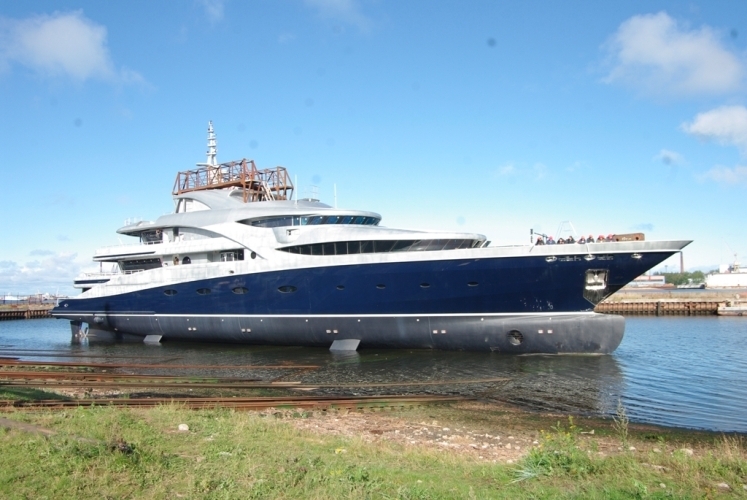
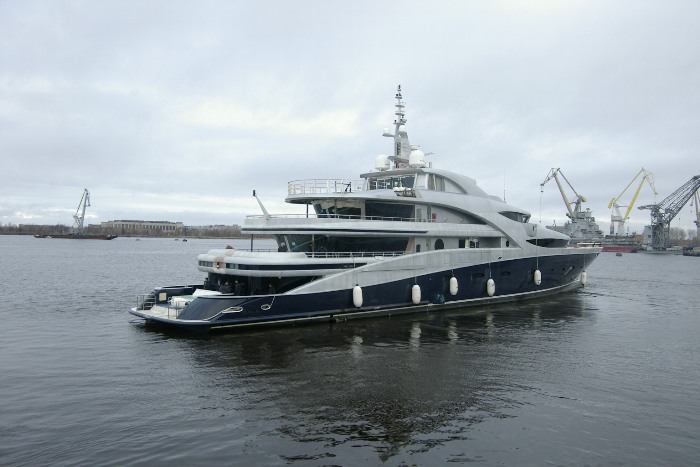
Now the Russian Oligarches need to look into ordering domestic Yachts rather than spending their stolen money abroad. Project A1331 was designed (outer & interior) by H2 Yatch Design and Agat Design Bureau, Ltd with Naval architecture.
Good pictures of the yacth exterior & interior in the below link
H2 Yacht Designed 71m Motor yacht ‘AGAT’ in build by Sevmash
Motor Yacht Baltika (Project A1331) – a Sevmash Superyacht
Yacht Description
Launched in 2013, the 71m motor yacht Baltika (Project A1331) is a spectacular vessel, built by the Russian shipyard Sevmash. Baltika superyacht boasts both radical and aggressive exterior as well as more traditional Art Deco – inspired interior by renowned H2 Yacht Design.
JangBoGo
Heading Murmansk
December 2, 2013Aircraft carrier “Vikramaditya” tonight starred anchorage in the White Sea and headed to Murmansk.
Project 11430 ship on board which, together with the Indian crew are 177 Russian specialists of JSC “PO” Sevmash “and the enterprise counterparty successfully refueling and passed all the necessary customs and border procedures. On the night of December 2, 1 aircraft carrier headed for Murmansk. It is planned that “Vikramaditya” will arrive at the port of the northern city on December 3. Here the ship will be held again refueling and go through the Arctic, the Arctic and the Indian Ocean to the shores of India.
Press service of “PO” Sevmash “.
Navy Day might be celebrated there…
JangBoGoAny info on when the 4 x MiG-29K/KUb are to have their first deck landings? If they were delivered earlier, they could have made use of INS Vikramaditya deck and also involved in the ships sea trials…… and by a long shot…..any chance for these new 4 MiG-29K/KUB and the two RAC-MiG aircraft to be based on INS Vikramaditya’s voyage? Atleast 2-6 fighters on board is better than an empty deck and it will help the crew to practice scrambling the jets on intruders its way home.
On Russian Navy support ships, the 2nd unit of the Pr.18280 intelligence/recc ship have been laid. The first unit was launched on 30 Sep 13.
Severnaya Verf lays down first serial communication vessel of project 18280 and frigate of project 22350
News
2013 November 14 17:49Severnaya Verf Shipyard has laid down the first serial communication vessel of project 18280 for RF Navy and the third serial frigate of project 22350, Admiral Isakov, the shipyard has announced today.
The lead vessel of project 22350, Admiral Gorshkov (designed by FSUE Severnoye Design Bureau) is undergoing mooring trials, while the first and the second serial frigates of this project, Admiral Kasatonov and Admiral Golovko are being built by Severnaya Verf according to the schedule. The shipyard has signed a contract with the Defence Ministry for construction of 6 frigates of this project.
Communication vessel Ivan Khurs (designed by Central Design Bureau Iceberg) is the first serial vessel of the project being built for RF Navy.
The ship’s major characteristics:
displacement — some 4,000 t,
length – 95 m,
width – 16 m,
range – at least 8,000 miles,
crew – about 120 persons.
The lead communication vessel, Yury Ivanov, was launched by Severnaya Verf on September 30, 2013.The St. Petersburg-based Severnaya Verf Shipyard’s history dates back to 1912. Now it is a leading shipbuilding company of the Russian defense industry. The shipyard specializes in building cruisers, destroyers, minesweepers, patrol vessels and submarines destroyers, research and passenger vessels, timber cargo carriers, trawlers, container ships and ro-ro vessels for the Russian Defense Ministry and foreign customers.
Russian Gov’t picked Severnaya Verf Shipyard as the main contractor for the frigate and corvette class ships (Project 22350, Project 2038/20385). The company was included in the register of the Federal Service for Defense Contracts (Rosoboronzakaz) of sole suppliers of Russian weapons and military equipment and is the sole contractor for communications ships of Project 18280.
The Shipyard’s backlog of orders to be completed and delivered to RF Navy by 2020 includes 6 frigates of project 22350, 6 corvettes of projects 20380 and 20385, 3 combat logistics ships with high ice class ARC4 based on project 23120, as well as two communications vessels of project 18280.
That is 12 combat ships, 5 support ships by 2020. Not much good compared to what Sevmash & Yantar have been doing.
An earlier article related to Project 18280 reconnaissance ship
Severnaya Verf to Lay Down Second Recon Ship in 2013
Severnaya Verf to Lay Down Second Recon Ship in 2013 22.11.2012
Text: RusNavy.comIn the coming year of 2013, Severnaya Verf shipyard will begin construction of second Project 18280 reconnaissance ship, said the shipyard’s director Alexander Ushakov at press conference on the eve of the company’s centennial.
“Another Project 18280 special-purpose ship will be ordered in 2013”, said the director. “Our shipyard is the only manufacturer of such vessels”, he added.
“It was planned to launch the lead ship of the project, Vice Admiral Yury Ivanov by the jubilee, but subcontractors let us down again. Kolomna Motor Works frustrated delivery of main engines, so the ship will be launched in the next year“, said Ushakov.
Another source of Central Navy Portal in the shipyard said that Severnaya Verf would impose penalty sanctions upon JSC Kolomna Motor Works for exceeded delivery deadlines. “Now we’re mounting shaft lines, continue assembling of hull systems and laying cables”, added the insider.
Designed by Kolomna Motor Works by the order of Iceberg Design Bureau specially for Project 18280 reconnaissance ships, experimental diesel engine 11D42 had successfully passed trials in the summer of 2011 and was recommended for batch production. Main propulsion plant of the ship consists of two geared diesel engines 5DRA and is working with adjustable pitch propeller. It provides smooth increase of power without overloading from fractional to rated operating modes.
Recall that JSC Kolomna Motor Works also manufactures CODAD powerplants DDA-12000 for new Project 20380 corvettes built by Severnaya Verf. As was earlier told Central Navy Portal by a naval officer, this powerplant has a number of defects still uneliminated, namely, high smoke emission at transit modes, inadequate reliability and efficiency. In connection with engine defects found during beta tests of Project 20380 lead corvette Stereguschiy, Russian Navy command and Almaz Design Bureau decided to equip next group of corvettes with German-made propulsion plants MAN. Lead ship of the second batch, Project 20385 corvette Gremyaschiy is being under construction at Severnaya Verf since 2011.
Pr.18280 launch
http://www.wrk.ru/forums/attachment.php?item=350510&download=1
http://www.wrk.ru/forums/attachment.php?item=352501&download=1
http://www.wrk.ru/forums/attachment.php?item=352498&download=1
http://www.wrk.ru/forums/attachment.php?item=352499&download=1
http://www.wrk.ru/forums/attachment.php?item=352500&download=1
http://www.wrk.ru/forums/attachment.php?item=352492&download=1
Pr.18280, Pr.22350, Pr.20380/5
http://www.balancer.ru/sites/me/vk/vk/cs402828/v402828184/aa46/3F63UwUsgxo.jpg
http://www.wrk.ru/forums/attachment.php?item=360487&download=1
http://www.wrk.ru/forums/attachment.php?item=359725&download=1
http://www.balancer.ru/forum/punbb/attachment.php?item=360201&download=2&type=.jpg
Note that these ships in the class of pr.1135. Btw, are there any of these class of ships going for FSB like earlier 1135 units operated by the security services?
JangBoGoFinally consider the fact that Japan has shown no inclination to honor the Chinese ADIZ and has in the last few days sent aloft F-15s supported by tankers and an AWACS some clash will happen.
These are initial reactions and will die down slowly and the status quo will change gradually but for sure with both the Japanese & Chinese aircrafts often meeting in the area. But Japs need to swallow some of their earlier created ridiculous ADIZ… it would be fun to watch the Russians coming out with their own new ADIZ.
JangBoGoA better pic of one of the P-15A ships.
http://i.imgur.com/2tl1KkD.jpg
very nice pic. All the big guns in a confined space. 3 kilos, Viraat, Delhi class, Talwar class and yet to sail P-15A. A 250Kg in the middle would be enough to take them all… no one is in a hurry to decongest and shift to Karwar.
The Spanish offer of their Juan Carlos.
Spain offers India advanced ship building technology : Reports
Hosting a reception on board the visiting Spanish combat supply ship ESPS Cantabria at Goa’s Mormugao Port, he pointed out that Spain’s state-run Navantia had collaborated with the French DCNS to build six Scorpene submarines at Mumbai’s Mazagon Dock Ltd. (MDL).
The Indian Navy, which is expanding with the acquisition of large ships like aircraft carriers, would need supply ships like the Cantabria, which is on a year-long voyage to display its technology and utility.
France Offers 2 Quick Scorpenes, DCNS ‘Worried’ About DRDO’s AIP
PARIS, NOV 28: French shipyard DCNS, creators of the Scorpène-class submarine, have offered the Indian Navy two Scorpène submarines off the shelf as a quick stop-gap to stem dwindling force levels, compounded by the recent INS Sindhurakshak tragedy. The company, cleared by the French government to make the offer, has said it can build two Scorpenes and deliver them to coincide with the induction of the first of six Scorpènes being license built at Mazagon Docks in Mumbai.
Officials at DCNS have also suggested that the DRDO system, being developed by the Naval Materials Research Laboratory in Mumbai, is unlikely to meet timelines given that it will need to be ready (developed fully and then tested in dock, at sea and at depth after integration with the submarine) before 2015 — a “difficult proposition”, according to one official. DRDO officials contest this, and insist that the programme is on track and will meet timelines. DCNS plans to recommend to the Indian Navy that the Plan-B be invoked if the DRDO doesn’t meet a specified timeline (beyond which, delays would impact the submarine build itself) on the indigenous AIP. It also plans to suggest that the DRDO AIP then be retrofitted on the first four submarines, if the Indian Navy wants that.
Read full at the link
JangBoGo^^ I did not touch the lower row, the scaling was just for the top row aircraft carriers with Nimitz taken as the standard.
JangBoGo29th November:
US praise airlines to comply with Chinese new regulations
Japanese officials were less prudent asking Japanese air carriers to not obey the new regulations. Instead they have decided to comply for safety concerns.
Sources:
CNN.com
JapanTimes
US is showing its maturity by asking their airlines to comply with the new ADIZ and provide Chinese with their flight path even though they stopped short of saying it explicitly where as the Japs are acting as if they are desperate to….
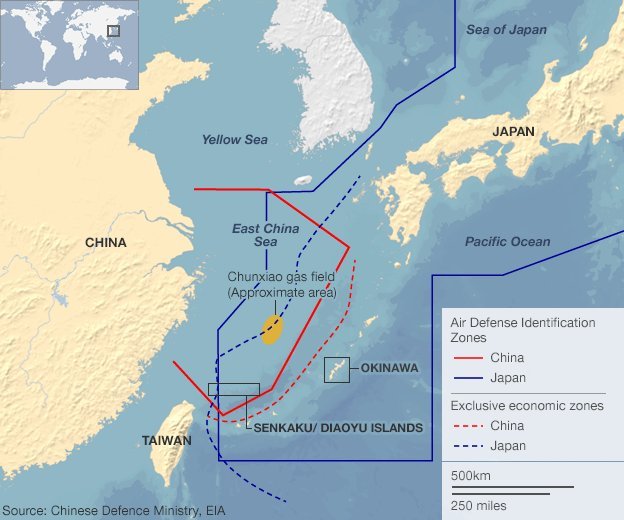
^ Why the hell should the Japnese ADIZ stretch too close to the Chinese mainland, its even further than their (represented) EEZ where as the new Chinese ADIZ is still inside their (represented) EEZ. The Chinese action for a new ADIZ looks more valid and was probably long overdue.
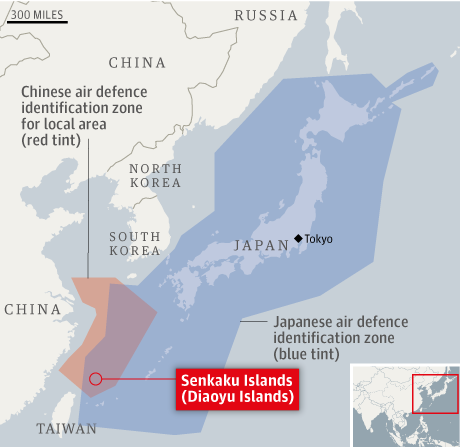
^ what a ridiculous ADIZ that Japs have woven for themselves. No wonder that we hear very often how the Russian entered Japanese airspace etc etc. I hope Russia follow with their new ADIZ.
JangBoGoIt is no secret that Lockheed Martin and Yakovlev worked closely and cooperated in a joint development and research project in the early 90’s on fighter vtol technology with Lockheed even granting money to Yakovlev in return for a technology transfer. Not surprisingly the lift mechanism on the F35B is virtually identical to the Yak141 where the rear engine rotates and pivots downwards in exactly the same way as on the Yak141,the only difference is the Yak141 had two smaller lift jets in the front behind the cockpit vs a single larger lift jet for the F35B.
Also the aerodynamic configuration and layout of the F35 is extremelly similar to the Yak141,the vertical stabilizer and wing shape is also very similar as is the shape of the fuselage. Yak141 wingspan is 33ft vs 35ft for the F35B and F35A. Both have quite small wings except the F35 wingloading is even heavier as its much heavier than the Yak141.
The length of the F35 at just 51ft is very similar to Yak141 if its massive rear fin extensions are not included.
It shouldn’t come as a surprise if the “consulting” actually involved design documentation of Yak-141 and Yakovlev indeed helping in designing the new liftfan + engine setup. The other main thing is the propulsion and the Rolls Royce engine is most probably a “licence” produced R79 engine, but without the credit being given in public to the original designer and no royalty fee for license. They acquired the tech for peanuts in the early 90s like many other techs that came out of Russian bureaus.
The most important solution however, the one that helped speed up the project significantly, was the use of two Aerojet AJ-26 liquid-fuel engines. In the early 1990s, the US rocket and mission propulsion house Aerojet General had acquired the right to use two rocket motor designs by Samara-based NPO Trud (now known as JSC Kuznetsov, a member of Russia’s United Engine Corporation (UEC)) in the engine tender under the Lockheed Martin Atlas-3 launch vehicle program. The tender was eventually won by another Russian engine, the NPO Energomash RD-180, but the Samara motors also found their market niche. Aerojet had purchased 70 NK-33 and 18 NK-43 engines; 36 NK-33s and 10 NK-43s were subsequently delivered to the USA, priced at between $1 million and $4 million per unit, along with a complete set of design documentation for both models and a license to build the NK-33 in America.
The Aerojet upgrade of the NK-33, known as the AJ26-62, slightly differs from the Soviet baseline: it now has thrust-vectoring capability; changes have been made to the layout of feed lines; the powder charges in the electro-explosive devices and the rubber components have been replaced. But the core technology is essentially of Soviet design.
The potential of Antares proved to be so high that NASA decided not to wait for the testing phase: on December 23, 2008, OSC was awarded with the $1.9 billion Commercial Resupply Services contract to provide eight resupply missions to the ISS.
The first Antares launch became a milestone event for the Russian rocket propulsion industry. “The Russian NK-33 design has found its US customer,” said UEC General Director Vladislav Masalov. “In the near future it will be installed on a Russian light rocket. The Soviet-era designers left us so massive a reserve of research and technology solutions that even now, four decades on, we use powerplants from that era on modern launch vehicles. Apart from utilizing the existing motors, we are working to resume their production at a whole new level of technology. I am convinced that our designers and engineers are capable of achieving this.”
Also, few words on Russian research on EM catapult, so nothing to get surprised at if in the future someone comes and says that we had sold them our early research woks for peanuts in the 90s. The Russian work on EM is understandable as steam cats would have been troublesome in the Northern winter and would have freezed up where as an EM cat would not have faced such a problem.
In this context it would be relevant to develop electromagnetic catapult, which is more advanced than steam one. Take note that development work on such catapult started in our country as early as 80’s, well before the U.S. The Institute of High Temperatures in cooperation with Central Aerohydrodynamics Institute and Mikoyan Design Bureau had been holding research project named Shampun (lasted almost 15 years) oriented on electromagnetic takeoff and landing system. Supposedly, that system was designed for future aircraft-carrying ships and ground-based mobile airfields.
JangBoGoWorked upon rescaling the carriers and here is what it will look like. It need not be 100% accurate, but I’m sure it is better than the original one.
The QE for its size have lots of free deck space but this is going to disappear once they are convert for barrier arrested recovery with a landing strip. The penalty for VTOL will be the the payload and the bring back capacity. How much is the current figures for F-35?
[ATTACH=CONFIG]223341[/ATTACH]
JangBoGoSaw this posted @ Kidscorner and thought about giving some sense of better perspective to the comparison.
Worlds arcraft carrier comparison
http://upload.wikimedia.org/wikipedia/commons/2/2e/World_Navy_Aircraft_carries_chart.svg
I’ve not checked each and every single ship represented but what caught my attention was the smaller size of INS Vikramaditya and the 261.5m Charles De Gaulle being as long as 284m Vikie.
From Wiki the overall length and max beam are as follow for the ships below.
CDG – 261.5m / 64.36m
QE – 280m / 70m
Vikramaditya – 284m / 60m
Kuznetsov – 305m / 72m
Nimitz – 332.8m / 76.8m
Either the person who made the chart made some genuine careless mistake or he was a terribly biased and made it for his own little psyop. If it was the later, it does work with the clueless guys who are waiting for a chance.
Little comparison showed that the person who made this have only mistakes with the Vikie & Kuznetsov class. Some funny or rather heap of bias from the comparison can be seen
^ 70m wide QE is wider than 72m Kuz
^ 305m Kuz is very much short in length to 332m Nimitz, where as 280m long QE is just little shorter than Kuz but longer than 284m Vikie.
whatever….
I’ve done a quick insertion of a better scaled (need not be highly precise) image of INS Vikramaditya and the baseline taken was Charles De Gaulle. The comparison is just for Vikie & CDG.
[ATTACH=CONFIG]223298[/ATTACH]
I hope the attached image is within forum guidelines. If not I’ll edit it. This is how the image got attached and not as small thumbnail.
JangBoGoThe Kuznetsov is a product of its heritage and good old Admiral Sergei’s forward defence doctrine. Russia’s next carrier may look something like Kuznetsov but it will be at least a hybrid in the Ul’Yanovsk mould and the STOBAR characteristics will be solely there by legacy of the extant airwing.
No. STOBAR will be there mainly coz it is an almost care-free, no-maintenance and no fuss runway hump to get your fighter airbone! That is the USP and the advantage it have over moving systems like a CAT. Even if your steam cats freezes out or the EMALS stop working, the hump will make surre that you can still get your aircraft airborne.
What stops the MiG-29K using a catapult?. The fact that the airframe is not stressed for catapult shots to the best of my knowledge…a STOBAR fighter needs to be light to be able to do the unassisted takeoff with the maximum fuel/ordnance load possible. Catapult strengthening will eat into that weight margin. You dont, really, want a heavy STOBAR fighter.
MiG-29K was the strike component of the Pr.1143.7 Ulyanovsk carrier and Su-33 the air-defense component and my understanding is that as such the 29K was designed to operate from the waist CATs with strike loads. The nose gear of the 29K is a meaty & heavy unit and only that of the Rafale-M is comparable. A CAT launch is not going to ripoff the 29K. But it would need a structural element for attachment which it currently lacks.
This can be debatable like the earlier one involving 29K where people were rubbishing the 29Ks ability to take off with strike load from the 2nd launch point due to lack of a video. Not even pictures of the same were acceptable to some people.
JangBoGoI thought INS Vikramaditya will only depart after Dec 4 Navy Day. Pictures from Sevmash website of INS Vikramaditya’s departure under Indian command.
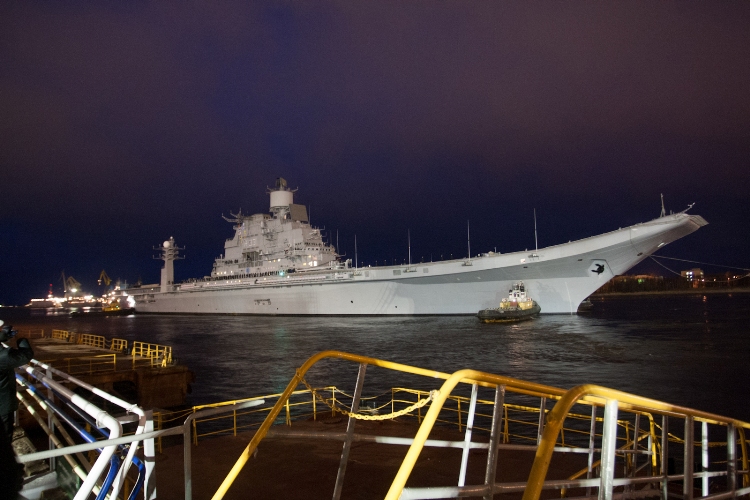
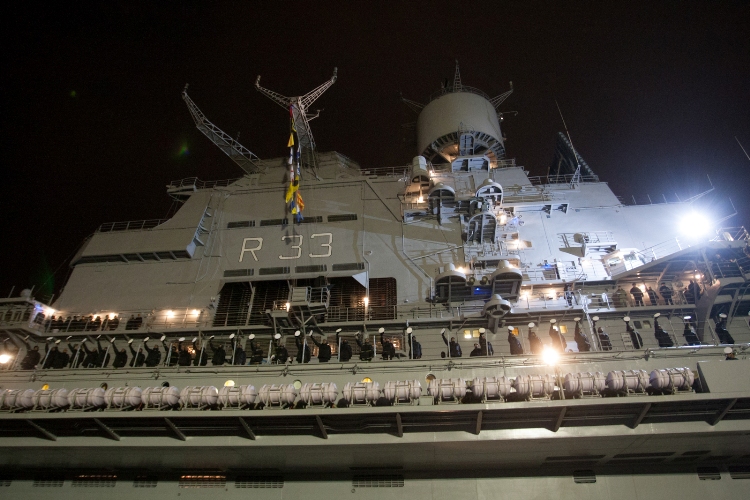
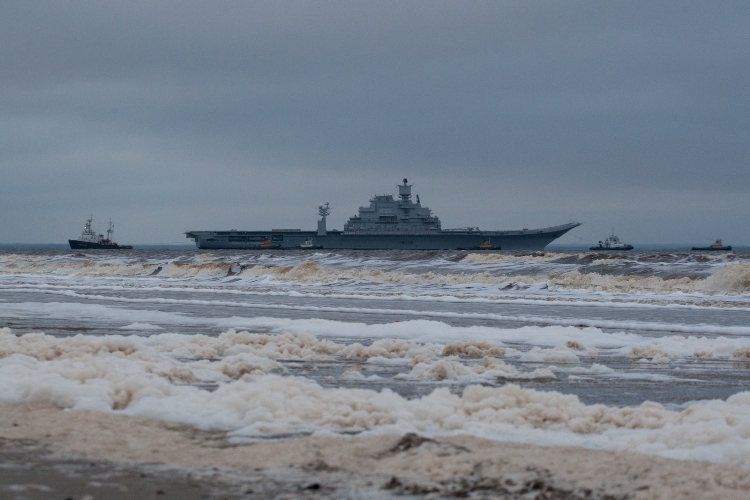
INS Vikramaditya begins voyage to India
November 26, 2013 Alexander Yemelyanenkov, specially for RIR
The Indian Navy’s flagship aircraft carrier will be refuelled at a White Sea port before setting sail for Karwar in south-western India.The Vikramaditya is going out to the sea under the Indian flag for the first time. Source: Sevmash press service
Early Tuesday morning, when it was still dark at Severodvinsk latitude, but the tide had come in, the factory tug boats drove the INS Vikramaditya away from the harbour wall and made a turn heading north. On this occasion the Indian sailors and all those who have gathered on the shore to see them off, solemnly lined up on the aircraft carrier’s flight deck, to experience the symbolic significance of the moment.
The outlines of the large above ship’s superstructures were part of the factory waters for more than a decade. The project itself was a serious challenge for our shipbuilding industry in the framework of military-technical cooperation between India and Russia. The main part the contract signed in 2004 for the repair and renovation of the heavy aircraft carrier Admiral Gorshkov was executed, whereby it was made into a full-fledged aircraft carrier to be used by the Indian Naval Forces. Essentially reborn, the ship was officially handed over to the Indian side on November 16.
Previously, the date of dispatch of the Vikramaditya aircraft carrier to its permanent base was Saturday, November 30, but considering the extent of the ship’s readiness, its exit in the sea was moved a few days ahead at the request of the Indian crew’s commander Commodore Suraj Berry.
“The wiring of the aircraft carrier along the terminal canal was facilitated by the Sevmash water transport department’s specialists and the related services of the Belomorskaya naval base, which provides services for navigation and hydro-meteorological support,” Yekaterina Pilikina, the head of the press service of the Severodvinsk shipyard said this morning over the phone.
After the aircraft carrier is driven out by the tug boats to a conditional location in the White Sea, where the depth of water under the keel allows it to run its own high power plant and the regular supply of diesel fuel to be taken on board, the ship will be anchored and its bunkering will begin. The fuel reception and subsequent border crossing and customs clearance registration can take up to two days – depending on the weather conditions at this location in the White Sea.
Together with the Indian crew, 183 Russian specialists headed by the deliverer in charge Igor Leonov will undergo border control. As previously reported, this group of technical advisers was attached for the transition time at the Indian side’s request, they will oversee the ship mechanisms work, help the Indian crew operate them correctly, quickly eliminate possible faults.
According to the Russian party’s warranty, part of this team of experts will remain in India after the arrival of the aircraft carrier to its permanent base location in Karwar.
two good pictures


^ for those who had doubt that the aft lift cannot accommodate MiG-29K.
JangBoGoIndia don’t have any immediate ambitions beyond our shores or see lines. But there is no denying that it is an offensive platform and we have to justify its cost vs benefit. It is the second most valuable asset for IN after INS Arihant class SSBNs.
Neither do India have. Our objective is to secure our backyard and not to poke someone else **** at someone else command. Anyone can use our backyard and any asset that IN or other services have is there to be let loose when any players actions in our backyard threatens our national security – be it P’stan, US, UK, France or China. That has always been India’s policy and will continue to remain as such in the foreseeable future.
INS Arihant is still not out and the two most valuable asset for IN currently are the INS Chakra and INS Vikramaditya representing the subsurface and surface spearheads. INS Chakra is going to be part of the group during her deployments and its going to be a good fleet once the carrier is made operational. But IN is truly short of surface ships and need to speed up on frigates and destroyers.
The French carrier was hobbled by the political decision to go nuclear when they didnt have a powerplant to do it (salutory lesson for Indians re IAC-2!!!). Their conventional carrier design prior to that was just fine…as any Brazillian naval officer you care to meet.
So you are admitting afterall that boilers and steam circuits are only “dangerous” if the ship(s) are of Russian origin… Or is the concern of superheated steam inside a ship due to British nuclear submarines having dangerous steam-circuits and unreliable steam turbines for propulsion?
The DCN Romeo/Juliette conventional hulls were cited as needin STOBAR IAC-1 or a simplified 50k ton variant of the DCN Romeo would have ballparked around the US$3-3.5bn built in Europe. Built in India you knock 25% off the top straight offg about 2.5bn Euro to deliver from French yards with European build costs and all the systems. A CATOBAR Fincantieri design stretched 10% or so from the current?.
Indian built ships are not cheaper due to the imported contents. The cost of frigates, destroyers and IAC-I will give an idea. The only way to make it more pocket friendly is to change suppliers from Western Europe & US to Eastern Europe/Russia.
The estimate cost of IAC-I mentioned during its launch this year including the aircrafts (deal done in 2010 and are on delivery anyway) is around $5billion or likely to cross it. The final figure will only be known in 2016-17 when the sea trials are likely to happen.
You do seem very willing to overlook a 300% cost increase and 52 month original delivery schedule missed by about 4yrs for Gorshkov though. Not really a fan of the French JSR?.
The 4years dealy can be attributed to our very Indian decision making process. The “problem” was “identified” in 2006 and conveyed to the MoD & IN. That is specifically what the IN overseeing team was there in Sevmash – to facilitate 2-way flow of feedback & “inputs”. We signed the “final” the deal in 2010.
1) Do you honestly think that Russia would have refused to try and sell you military hardware if you pulled out of the carrier and asked for your money back….after it became obvious what they were trying to sell you was far less than they advertised originally?.
2) Theyve just screwed you over on a deal and have done nothing to dispell the fear that they would cut you out of joint technology development deals, key to Indian defence interests, if you dont just stump up the price for the ship. Is this a good bilateral relationship or one that could stand a little adjustment back in your favour?.
1) Indian Navy did not and do not share that view and the reason why they were determined to get the ship and did not let it go even after the cost escalation.
2) Screwing = Sea King helicopters that not just wasn’t worked upon with as per contract but the Brits also refused to return it to India due to Nuclear tests.
JangBoGoThere’s little doubt that had the Indian Navy/MoD known that the Russians would deliver a carrier only by 2013-14 and charge $2.35 billion for they’d have said, thank you but no thank you.
Even if a domestic shipyard was not in a position to deliver a ship in the same class in a similar timeline, there are plenty of shipbuilders (Fincantieri for example) that could have been contracted to deliver a brand new ship with a far superior design under $3 billion.
Mr Expert, would you like to take up the challenge of finding a yard that can sign a contract today for a 45,000t conventionally powered STOBAR carrier for $1.7billion, or maybe even 5 years back?
Having a pause to read the below quotes on Cavour (hope you know when it was completed) would be of help to you. Btw, if you find any yard that meets the criteria that you mentioned and one which can sign a contract to build a Vikramaditya size/class carrier in 2013, please do post your findings.
Just for the records, italian carrier Cavour was paid 1,3 billion Euros just for the ship alone, with all the electronics cost is estimated at almost 2 billion euros, i.e. far more usually stated.
About Cavour price tag, I’m referring to euro without mistakes, as it happens I’m italian and our balance sheets are compiled in Euro only.
Within italian MoD budgets (several years in a row) it has been discovered PAAMS, Aster, CMS, ESM and so on have been paid for in different chapters, mostly along with the similar ones for the Orizzonti’s DDG and a crude repartition od costs producend a round half a billion euros additional costs.
Translating che final cost in US dollars it means far more than 2,5 billion USD.
JangBoGoAdmiral Gorshkov to INS Vikramaditya timeline and photo essay of the commissioning ceremony.
http://bmpd.livejournal.com/665589.html

A google translate of the contents. I’ve rearranged two of the typo errors in list, one being the Nov 2010 deal of $2.33billion and the power-plant going live which had to be in Dec 2011, rather than in 2010. Or maybe the first of the boilers were fired in 2010 itself? Not sure.
The largest in the history of the ship ever delivered for export, officially handed over to the Indian Navy
bmpd
November 18th, 19:42So true!
Last Saturday, November 16, 2013, in Severodvinsk at JSC “Production Association” Sevmash “official handover ceremony of the Indian Navy aircraft carrier Vikramaditya R 33 11430 project – the largest in the history of mankind warship ever delivered for export. Recall the main events of this impressive megaproject.
October 4, 2000 – signing of the Russian-Indian intergovernmental agreement on the transfer of India on a grant basis from the Russian Navy heavy aircraft carrier project 11434 “Admiral Gorshkov” (formerly “Baku”), providing for the payment by the Indian side of its conversion into a full-fledged aircraft carrier as well as procurement for him Russian fighters and helicopters.
January 20, 2004 – Signing of the “Rosoboronexport” (ROE) a contract worth 972 million dollars to India for repair and refurbishment of the ship. Entrusted with the work of FSUE (then OAO) “Production Association” Sevmash “(SMP) in Severodvinsk. Simultaneously of RAC” MiG “has signed with India separate from ESR contract to develop and manufacture 16 deck MiG-29K/KUB (” 9 -41 “/” 9-47 “) cost about $ 570 million
November 30, 2005 – the ship wound up in basin SMP.
2006 – defectation material of the ship over. Surprise, surprise! – It turns out that at the conclusion of the contract scope of work is strongly underestimated.
2007 – a crisis. The Russian side demands increase in the cost of the contract. The Indian side is seriously considering the possibility of termination of the project.
December 4, 2008 – nevertheless, continue work on SMP, the ship afloat, and on the Day of the Indian Navy transferred to the outfitting quay.
November 2010 – The price crisis has been overcome. In Delhi signed an agreement to increase the cost of the contract for repairs and renovations to 2.33 billion dollars
December 27, 2011 – Launch of the first boiler.
March 12, 2012 – served on an aircraft carrier staffing power and started mooring trials of mechanisms and systems.
April 7, 2012 – carrier repositioned with outfitting quay to the stand demagnetization.
June 8, 2012 – Vikramaditya first comes out of the factory in Severodvinsk on sea trials in the White Sea and the Barents Sea.
June 27, 2012 – the first landing of an aircraft on a ship pereobrudovanny. On an aircraft carrier boarded and took off again Ka-27PS.
July 28, 2012 – Mikhail Belyaev and Nikolai Diorditsa make the first landing on an aircraft carrier fighter MiG-29KUB
August 2012 – revealed a problem with the thermal insulation of boilers, whose technology is at the request of the Indian side has been changed. Transfer of aircraft carrier assigned to the December 4, 2012, transferred to the year.
July 3, 2013 – the beginning of the second phase of testing Vikramaditya in the White Sea.
July 28, 2013 – the aircraft carrier sea trials reaches a speed of 29.2 knots.
August 5, 2013 – the beginning of the second phase of flight testing. First time in 14 years, Russian pilots make night landings and takeoffs on an aircraft carrier. Three senior Indian naval officers commit landing on an aircraft carrier as co-pilots.
November 16, 2013 – ship Vikramaditya officially handed over to the Indian Navy.


 Sign In








