 JangBoGoJangBoGo
Oleg’s blogon INS Vikrant…nothing new than whatz already seen. But he did workout with Google earth…
http://kuleshovoleg.livejournal.com/103519.html
As for INS Vikrant itself, the official date of entry is 2018
Ministry of Defence
22-August, 2012 13:33 ISTDelay in Construction of Indigenous Aircraft Carrier
The complexity of the project and this being the first ship of its kind being built in India has led to timelines being extended. As per the Phase-I Contract concluded with M/s. Cochin Shipyard Limited, Kochi, the first launch of the ship was envisaged in October, 2010. However, due to delays in receipt of steel plates and pre-launch equipment like diesel alternators and gearboxes, the launch of the ship is now expected in 2013.
Delivery of the ship is presently envisaged in 2018.
This information was given by Defence Minister Shri AK Antony in a written reply to Shri Rajeev Pratap Rudy in Rajya Sabha today.
HS/RK/NN
(Release ID :86462)
http://pib.nic.in/newsite/erelease.aspx?relid=86462
Ministry of Defence
27-August, 2012 15:40 ISTAircraft Carrier
There has been a slippage in the construction schedule of the indigenous aircraft carrier (approximately 37,500 Metric Tons displacement) being built at Cochin Shipyard Limited, Kochi.
The complexity of the project and this being the first ship of its kind being built in India has led to timelines being extended. AS per the Phase-I Contract concluded with M/s. Cochin Shipyard Limited, Kochi, the first launch of the ship was envisaged in October, 2010. However, due to delays in receipt of steel plates and pre-launch equipment like diesel alternators and gearboxes, the launch of the ship is now expected in 2013. Delivery of the ship is presently envisaged in 2018.
This information was given by Minister of Defence Shri AK Antony in a written reply to Shri Basudeb Acharia and Shri Bansa Gopal Chowdhuryin Lok Sabha today.
HH/NN
(Release ID :86781)
http://pib.nic.in/newsite/erelease.aspx?relid=86781
JangBoGo…
http://i988.photobucket.com/albums/af8/My-Military-Photos/PRC/Sea/CV-CVN/CV16_13.jpg
http://i988.photobucket.com/albums/af8/My-Military-Photos/PRC/Sea/CV-CVN/CV16_14.jpg
Looks very good.
Any news on the aircraft trials or even any speculation of any purchases from Russia?
JangBoGoPr.885 Severodvinsk… Surfers, boats all are around it. Lucky guys.

JangBoGoThe bort nr. looks like one of the SMT.. but i was not aware that the SMT used the UPG humpback designed fuel tank..?
C’mon man…. that, sort of, ugly humpback first came on SMT and UPG just borrowed it.
Algeria should have ordered higher number of SMTs and Russia should have only provided the best of the upgrades. Atleast that way Russia AF would have got good number of multi-role operational MiG-29s.
JangBoGoYou can’t widen the fuselage of the IL-76, not without a total redesign. Also, with a payload of 60 tons, its still theoretically in the same broad class as the C-17.
True. Il-76 is a heavy lifter and hence can be compared to the C-17.
But it does not fall in the “wide-bodied” category. The fuselage of IL-76 is 4.8m in dia where as C-17 is about 6.8m dia. Even the Tu-330 based on the Tu-204 fuselage, which falls in the narrow body segment of commercial airliner, has a floor width of 4m compared to 3.45m of Il-76. As far as I’m concerned the lack of floor width & height is the main negative part to IL-76, in short accommodating over-sized cargo’s.
You’re not going to see any IL-476 orders placed by the IAF. The higher payload is only a result of installing new engines. Since the available floor space remains the same, the actual payload capacity for most operations remains unchanged.
On the contrary, even with the C-17, the IAF is trying to space out deliveries. With its existing IL-76s being upgraded and C-17s set to enter service soon, quick deliveries of the IL-476 would almost certainly result in expensive surplus capacity in the heavy lift segment.
Time will tel if IAF will go for 476 or not.
Its is no fairy tale to buy, operate & maintain a costly beast like C-17. Everything related to it is costly. Only a fool would dream of cheaper spares & support, when its on after-sales services/spares that manufacturers all around the world make a living.
As a rule, we can even say that an aircraft that is cheaper to buy and which comes from a cheaper production/supply line will always be cheaper in its entire operational period compared to a product which is heavy on price and comes from a high cost production/supply line. PR contrary to it is just wishful thinking and rubbish, at-least until hard datas are provided. A good case to study with hard data would be MiG-29/UPG and M2k/-5. But we might not get hard data on these birds unless someone tables that question in Parliament or until these fighters are retired.
The difference is marginal. For all practical purposes, the IL-476 did not meet the IAF’s requirements. Flight trials on the other hand are conducted primarily to verify advertised performance and were therefore unnecessary in this case.
But on the contrary, it was mentioned that the 10 x C-17 would be evaluated after its induction and only after that another order will be placed.
The temperature at Leh goes as high as 35 deg in summer and as low as -25 deg in winter. There can be a world of difference between operations in different seasons, not to mention the possibility of inclement weather at any particular time.
All missions carried out are done so with a significant safety margins factored in. Its possible that in wartime conditions, a similar landing would have been acceptable even with the attendant higher degree of risk. Also we don’t know how many flights were aborted during the 1988 airlift, so we hardly use that as a benchmark of the aircraft’s performance.
In the article, the temperature mentioned during day was close to Zero degree and night halt was not there. Also, the author does not mention any aborted flights.
From the article,
The whole exercise would involve 37 sorties, 7 for the fuel and 30 for the tanks, and @ 2 flights per day, it would take 19 days.
The operation was completed in 15 continuous days with early morning take offs.
In all these 40 odd hours of flying between Agra, Leh and Chandigarh, the operation went off without a hitch. The only aberration was an early touch down at Leh on RW 07 by Wg Cdr RV Kumar (later Air Cmde) due to which about 5 strands of the arrester barrier were damaged and needed repair.
In 1990/91, the 28 tanks and 2 ARV’s were retrieved from Leh by 25 Squadron IL-76’s under command of then Gp Capt R V Kumar.
Each tank was flown out of Leh in two sorties, one for the chassis and the other for the hull and gun. It is not possible to take off from Leh with 43 tons of load.
And even assuming that an engine failure took place, that’s hardly good news for an aircraft’s manufacturer hoping to sell an upgraded variant of the aircraft to the service.
I mentioned that to give an idea on how we can arrive at a 100% performance drop for an aircraft. I was not suggesting it really had one. It could also be due to the fuel availability (you might have read that in the article) and not feeding into Leh’s fuel reserves etc. But the point you missed again is w.r.t the story on that incident. i.e only one instance has been told and the story is incomplete.
Also, it does not give any bad image for the Il-76, rather its praise worthy that it came back safely even after loss of 12tons thrust. 😉
How would that have been for a $410million C-17 with an engine failure?
“The aircraft was chosen after a very detailed study. All the existing and developing aircraft were considered.” – ACM P.V. Naik with respect to the selection of the C-17.
That aside, there is an abundance of evidence suggesting that the IAF is less than enthusiastic about the IL-76 as a platform especially vis-a-vis its western competitors, as well as being unsatisfied with Russian support for the aircraft. There have been issues even with spares supply for the new PS-90 engines.
Its no accident that the IAF has been considering a different platform for the follow-on Phalcon order and that it picked the A-330MRTT over the IL-78MKI, despite a lower bid from the Ilyushin as well as the prospect of logistical commonality.
A-330MRTT does have advantage in payload-range, but with better engines as mentioned with CFM56-5C that advantage will be narrowed very much. Moreover, the production at TAPO is no more so I don’t know from where IAF could have acquired new built IL-78MKI. Probably that also came in as a reason to favor A330.
http://2.bp.blogspot.com/_44d3OT-xI3U/SOyeCN6vhVI/AAAAAAAAAPc/qrkaqNbXFns/s1600-h/IL-76MF-1.jpg
If C-17 are the only ones going to be used for strategic transport, It would be a good & cheaper option to upgrade and convert the older IL-76s to tankers.
The issue with the T-72 was volume as much as it was payload. Quoting from the BR article on the issue –
The reverse heart stopping process is repeated to offload the mighty T-72. The driver now moves in reverse gear, still taking his cues from the fingertips of the outstretched hands of the Load Master. Like a caterpillar, he brings his tank to the loading sill where the cables can be connected, and the tank can be winched out onto the ground. No wonder it took over 3 hours at times to load one T-72, and another 3 hours to off load it. We were learning, along with the tank crew. All this happened in the first few days of Oct 1987.
In the article it is mentioned that 3 hours was needed initially with Jaffna operations and by the time of Leh airlift it came down to 20-30 minutes.
By now the Army – Air Force cooperation in the T-72 and IL-76 match making had reached near perfection. Tanks were prepared for loading with equally tensioned tracks, and the drivers had practiced driving inside the ac. The Flt Gunners were very confident of their ability to convey to the tank drivers their instructions for small movements left or right, forward or backward. So when the airlift started on 27 Jan 88, the loading of each tank took not more than 30 minutes. In contrast, the offloading took less than 20 minutes, except on two occasions.
Now bear in mind the fact that the T-90 is nearly a foot wider than the T-72. Loading a T-90 on a IL-476 is a very improbable event and driving it in to be secured by the crew as with the C-17, is quite simply impossible.
T-90 has the same width as the T-72. The side skirts can be removed anyway so it doesn’t matter much. If they want to have it inside the IL-76, they can have it. But they might not take that pain in the future as the wider C-17 is available into which the tanks can be loaded more easily.
AEW&C aircraft especially those in the A-50/Sentry/Wedgetail class are not expected to operate out of forward air bases or unprepared airstrips.
we can also ask how many airstrips deep inside are of commercial aircraft quality.
JangBoGoYes, it is definitely a squeeze, with mid-size business jet equivalent headroom, but nonetheless all 300 would be seated properly and have adequate emergency evacuation routes.
I hope these are 300 troops and not paratroopers?
I could not see any stairs from the pic you posted. It has to be to the front of the cargo bay. If the troops do not have a passage to the down floor, the exit will require dedicated mobile stair at airports, which I think is too much for a military cargo.
Now, when I see this, I do feel that probably it is for this troop carrying capacity that An-70 is getting in. After all for an overall small transport aircraft, 300 troops capacity is good. If it is able to deploy paratroops form the two floors, the better. The lower speed of the aircraft will also be of help in para dropping.
Because it carries a lot more fuel – only 10 to 15 of the 50 ton increase in MTOW are due to higher empty weight.
IL-76 able to carry a lot more fuel has to be considered as its advantage. But to fully make use of that fuel capacity, it will need to be installed with very good fuel-efficient engines.
Ilyushin site mentions all three variants with 1,09,500 liters of fuel which when converted gives 88,695Kg.
http://www.ilyushin.org/eng/products/cargo/76td.html
http://www.ilyushin.org/eng/products/cargo/76td90.html
http://www.ilyushin.org/eng/products/cargo/76tf.html
http://www.uacrussia.ru/ru/models/transport/il_76/data/
In the UAC site, it is mentioned that IL-76TD modernized/upgraded to IL-76-TD-90 have a MTOW of 195tons where as a new built IL-76TD-90 have 210tons. So maybe 5 tons have gone into strengthening the airframe during modernization?
Also, I don’t think that there is much problem with wing design or its placement. Because from the available data, it does not seem to have any negative effect on the range. On the contrary, over the years IL-76 have increased their performance with better engines. But more fuel-efficient engines will help in increasing range further. IL-76 powered with CFM56-5C is showing excellent range figures. Maybe for same range either PS-90A3 or PD-14 will need to be installed.
http://2.bp.blogspot.com/_44d3OT-xI3U/SOyeCN6vhVI/AAAAAAAAAPc/qrkaqNbXFns/s1600-h/IL-76MF-1.jpg
http://1.bp.blogspot.com/_44d3OT-xI3U/SOeh1PXrrsI/AAAAAAAAAG0/pOp7t3GCZJY/s1600-h/IL-78MKI-90-2.jpg
http://1.bp.blogspot.com/_44d3OT-xI3U/SOehK7FodMI/AAAAAAAAAGk/WXe3m4FSY7I/s1600-h/IL-78MKI-90-5.jpg
http://1.bp.blogspot.com/_44d3OT-xI3U/SOeiUOKb3PI/AAAAAAAAAG8/EPbmR-Rr3C8/s1600-h/IL-78MKI-90-1.jpg
In the case of IL-476, except for the 210tons in MTOW and 5,000km @52tons, other details are not known. So lets wait a little more regarding other figures.
– The Tu-330 with NK-93s indeed looks pretty decent, as JangBoGo mentioned, with better performance at range than the A400M and yet rough field capabilities superior to the XC-2. Overall, I would still prefer the An-70 though, especially since the Tu-330 truly is a paper tiger.
Sorry, I think you misunderstood what I posted. I did not mentioned the Tu-330 to include it in the discussion. My target was NK-93 and the capability it gives to an aircraft. In case of Tu-330 it is giving nearly 44% increase in range over PS-90A equipped variant. So a NK-93 powered IL-76 can also benefit with at lest 15-20% increase in range.
– Bearing in mind that the An-70 is at an early point in its life cycle with growth potential, I could easily see its ferry range increasing to 9000km with fairly minor modifications, as done with the C-17 to remove the max fuel limit. At that point it would truly become a complete Il-76MD replacement – even as is it matches the latter very closely at medium ranges, which are likely to be the most important.
I don’t think An-70 is ever going to IL-76 replacement. Antanov’s target probably was capturing IL-76 market which we can see from its payload figure of 47tons. But IL-76 have since then flown miles ahead over the decades with increased payload.
Also, from what is available now, An-70s greatest drawback seems to be its fuel capacity. How do you think they are likely to increase it??
… which includes an interesting drawing on the right, as it shows a very common load that could not be carried in the Il-476 for want of height – a bog-standard semi-trailer! I can vouch for the accuracy of that depiction BTW, where I work there is a passage of 4m height and the first time I saw a semi-trailer hurtling toward it at 30mph I was half expecting to witness a massive accident 😮 There really is THAT little room between the roof of the trailer and the ceiling of the passage! Now, you can carry semi-trailers in an Il-76 AFAIK, but not load them simply by driving aboard.
It have a very long runway requirements. -2,300m for take-off and 2,400m for landing. Probably they are meant for operations only from commercial airports and not short airstrips.
Likely to be. Its only really sensible applications were the Il-106 and Tu-330 – it was too heavy and bulky to be mounted on the Tu-204, Il-96 and Il-76 (for which it was proposed at various times) without major airframe alterations. On the Tupolev ground clearance would have been marginal at best and lateral separation could have become a problem on the Ilyushin quads, so unfortunately with both aforementioned projects dead I can’t see it going anywhere.
I don’t think installing it on Tu-204 or Il-96 was a serious option even though I’ve seen some CG showing Tu-204 with NK-93. In addition to the IL-76 another real option can be the An-70. Since NK-93 produces more than double the power of each D-27, two engines would suffice and also give better range than current An-70.
It looks like IL-76 might be able to accommodate 4 of these. But not sure. Flanker man might have a better front shot of the aircraft.
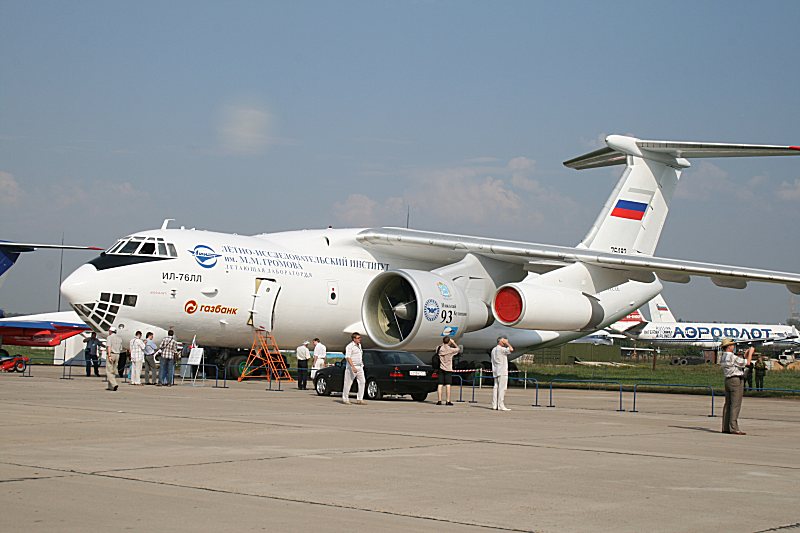
Great achievement though, I’ve seen two of them in person and they’re massive!
I’ve seen a pic of NK-93 somewhere with a guy standing inside that duct during an airshow. Hope it was not you. 😀
It is supposed to be slightly lighter than the Il-76TD-90 and Il-76MF, which puts it at right around 90 tons, give or take. But ok, let’s say it’s 95 tons, for argument’s sake.
The basic weight of the old Il-76 is 90tons and other figures are mentioned in article. Also, at least 5 tons of fuel needs to be maintained in the wing tanks. So for every fuel-load we need to reduce 5 tons.
http://www.bharat-rakshak.com/IAF/History/1990s/Bewoor.html
In the above we also get to see how thirsty the old D-30KP were. Keeping the engines running on ground took about 1tons of fuel/hour and nearly 3tons of fuel per D-30KP for a 35min flight. With what load, I don’t know. But it was not empty as it is mentioned as carrying men and material.
The An-70 will be 66 tons at the very best, no more than 30 tons lighter but its MTOW is 65 tons lower. MTOW-OEW is therefore 35 tons higher for the Il-476, so at equal payload weights it can carry those 35 tons in additional fuel over the An-70. Bearing in mind that the maximum fuel capacity of the An-70 is probably in the 45 ton ball park that is a huge difference – is it any wonder the Il-476 has more range, despite its much higher fuel consumption? If anything it is pretty telling that it doesn’t outrange the An-70 even more clearly!
And that is being very generous to the Il-476, since the An-70 is likely to be somewhat heavier than in the above example while the Il-476 should weigh slightly less, so its fuel capacity advantage is probably about 10 tons higher in reality.
An-70 not having good fuel capacity is Bad.
IL-76 having good fuel capacity is Good.
IL-76 having fuel thirsty engines is bad.
IL-76 getting better fuel-efficient engines is Good.
An-70s greatest flaw and disadvantage is probably its lower fuel capacity and will have to live with it. NK-93 would have definitely helped to increase range.
JangBoGoshifted from 476 vs An-70 thread
What is the status of Ka-92 & Ka-65…
Is Ka-65, a Ka-92 without that tail rotor with Ka-92 – High speed helo & Ka-65 – ‘normal’ helo (?)


JangBoGojust a nice pic :
http://img853.imageshack.us/img853/4126/2011mgae054001001p.jpg
Nice.
Any good pics of deck refueling?
JangBoGoUnlike the Gorshokv saga, the first tranche of 24 Typhoon´s were delivered on time and on the exact contractualized delivery dates, and are flying with active units. Unlike the Gorshkov saga the first 24 Typhoon´s were delivered on the originaly agreed and contractualized price…
The responsability of setting up a production plant was first and foremost on the feet of Alsalam, the Saudi company that was indicated by the Saudi MOD, wich by the way is a Boeing subsidiary… It was never going to be a BAE plant built in Saudi.
How much do all of Typhoons put together weigh… 😉
Compared to Russian industries, BAe did not face any huge financial difficulties or face chaotic period that disrupted supply chains. BAe is a well managed company with good financial weight and still they well managed to send rusted parts along with the costly Hawk jet trainers to India.
Where is the evidence that Russia gets payment in tranches whereas rest get it up front? All vendors receive the payment per agreed upon contracts. These vary from deal to deal, but the basics remain the same, that we pay an initial amount up front, plus TOT fees.
I’ve not heard of that. For all the Western deals I’ve seen information about, payment has been in stages. BAe reported income from selling Tornadoes to Saudi Arabia for years, as it got successive stage payments. Also, payments are usually linked to deliveries, not on a fixed schedule. Customers (mostly) aren’t stupid, & sellers don’t want to lose sales by unreasonable payment schedules.
Not long ago, the Saudi Typhoon deal was in the news. The Saudis hadn’t managed to set up the final assembly line they wanted, so the deal was being renegotiated to take account of it, with all aircraft being assembled in the UK. BAe was reporting that (1) it was expecting additional payments for the extra work it was doing (already) in its own factories, but (2) stage payments were delayed (since resumed: agreement was reached) while the details were being sorted out, while costs were still being incurred. As a publicly quoted company, this affected its short-term results, so couldn’t be hidden. The stage payments were taken for granted by every informed commentator, as being completely standard procedure.
All deals are mainly done in stages only. The difference mainly are on easier credit or lighter upfront payments.
Earlier deals with Russia were mainly barter system when there was no hard currency to spare. It have changed now to more easier payments which also include lighter upfront payments.
JangBoGoFew earlier quotes from Russian aviation that I earlier skipped to save space…
Though I believe IL-476 could have done with little more wider floor width, it still can accommodate (in India’s case) tanks like T-72/90. But airlifting of tanks are not going to be the primary requirement for any heavy transport aircraft (unless other options have run out), as its not economical. So airlifts of tanks are likely to happen only once in a while and not going to be the main requirements for a strategic transport. I mentioned it earlier due to the specific deployment that happened in India’s case. So lets keep aside tank lifting capability for heavy lifters as its main requirement. There are better things in larger numbers to lift for these heavies. 🙂
what can 30 MBT do which attack chopper, much longer range tube artellery cannot do. these things are lighter and getting more longer range.
Only an MBT can hold ground which neither an attack chopper, fixed wing aircraft or artillery can. But MBT is not the only component, there are others like APCs that were airlifted. I specifically mentioned MBTs because it represented more challenge due to its width (which gave very little clearance between the fuselage & hull) and more importantly its weight which was equaling the max payload capacity of the IL-76.
That airlift I mentioned is/was specific to Indian operations. It was done in the past and might require in the future. I do agree that airlift is not the best or economical way to transport MBTs, but the geography of the region where Indian Army wanted to deploy T-72s in the late-80s demanded an airlift. There was no other safer way and hence had to be air-lifted. So airlifting of tanks might only come once in a while only.
flying MBT with transport aircraft is myth. 55~70 ton MBT is going consumed fuel at rate greater than anything else. which simply cannot be supported by airlift alone. MBT are for desert/flat grounds not higher elevation.
see below. it is airlifted to much lower elevation on much larger aircraft. and this only happened in air dominance.
IAF is not likely to lift any MBTs weighing over 50tons as Army may not require any tank over 50tons there. In the future deployment, it might only be T-90s weighing a maximum of upto 47-50tons. The T-72s that was airlifted weighed ~43tons and was at the maximum the Il-76 could carry at that time.
True. MBTs are mainly for desert/plains…and the area where those MBTs got airlifted to be deployed (Leh) is a cold desert which have lots of plains.
Those tanks are surely not airlifted by PLA.
http://i41.tinypic.com/e9xgmr.jpg
Unlike China, our politicians care for their own needs so good roads and infrastructure hardly matters to them. Also, the route to the area is treacherous and mostly supplies go by 4×4 or 6×6 or 8×8. Anything else makes it more risky. So transporting MBTs on trailers was simply not an option in addition to other problems. That is how the airlift came.
http://wikitravel.org/en/Leh
http://en.wikipedia.org/wiki/Kushok_Bakula_Rimpochee_Airport (Leh AFS/Airport)
http://www.ourairports.com/airports/VILH/#lat=34.137560996547684,lon=77.55291938781738,zoom=14,type=Satellite,airport=VILH
http://en.wikipedia.org/wiki/Leh%E2%80%93Manali_Highway
It is open for only about four and a half months in a year in summer between May or June, when the snow is cleared by the Border Roads Organisation of Indian army, and mid-October when snowfall again blocks the high passes.
The average elevation of Leh-Manali highway is more than 4,000 m (13,000 feet)[2] and its highest elevation is 5,328 m (17,480 ft) at Tanglang La mountain pass. It is flanked by mountain ranges on both sides featuring some stunning sand and rock natural formations.
JangBoGo brought up the Il-476’s narrow body as a specific disadvantage vis-a-vis the C-17, a capability that probably figured into the IAF’s selection of the latter as the core of its future strategic transport fleet. That fact remains unchanged.
IL-76 with little more fuselage width would have been better. But, C-17 & IL-76 are of different class and the Russian equivalent was supposed to be the IL-106. The older IL-76 can very well transport the T-72 as displayed in the past and the fuselage width did present some problem, but it was probably a minor one when compared to the payload capacity which topped at 44tons.
With employment of new engines like PS-90, that problem was solved earlier. The newer IL-476 (IL-76MD-90A) have taken it further by having not just have more powerful engines, but also two-man crew and with a good payload-range figure of 52tons to 5,000km. Max payload is 60 tons, like the IL-76MF.
C-17 is a very costly beast and it is to remain as such in operations also. So even after acquiring the heavier C-17, we are likely to see IL-76s in the same strategic lifter role that it has been doing all these decades. It would hardly be a surprise if the IL-476 becomes the backbone of the strategic transport fleet once again in the future as it will be far cheaper than the C-17, not just in terms of acquisition cost, but also in terms of operating. With the production now getting concentrated in Russia & Ulyanovsk, we can also look forward to see better spares & support for the IL-476.
The main problem now is how fast they can deliver. The latest orders mentioned 39 for Russian AF and about a 100 for civilian operators. Then there is China which is likely to buy 60 of these.
The IAF did evaluate the IL-476 and there is no rule that says export orders cannot be serviced concurrently with domestic orders.
No chance for IAF to have evaluated IL-476 in 2010, when the aircraft only took to air last month. Though it maybe possible that they might have checked the older IL-76 with PS-90A engines.
The IAF didn’t have to have flight test the Il-476 to make up its mind.
An advanced version of the Il-76 was also considered to meet future requirements, but the defence ministry sources say the C-17 was the preferred choice.
Probably they mean the older IL-76s with PS-90A-76 engine. Since C-17 deal was through FMS, the chance for any comparative evaluation is very low. Or it’s just a manufactured news without mentioning the full context like what we heard about the zero payload story of IL-76s to Leh during summer. In that story, even using little logic one could have asked a genuine question on how an aircraft that airlifted 30 x T-72s weighing 43 tons in Jan-Feb 1988 (winter) to an altitude of over 10,000ft ASL can have a 100% performance drop in summer. For such a 100% performance drop, the aircraft must have at least one engine failure. That is the reason why the story is probably not as simple as it is/was made out to be and it is incomplete.
They evaluated it, even if no formal proposals were made. When the original C-17 orders were announced IAF top brass stated that they evaluated multiple options in the market(needing to justify a single-vendor purchase) and found the C-17 to be the only one that suited them. Multiple options would mean at least two, and the IL-76/476 and An-124 are the only ones besides.
No chance for the IAF to have evaluated the performance of the IL-476 which only flew recently.
Airlifting tanks WAS a factor. The Arjun weighs a few more tonnes than the IL-476’s capacity and in any case neither it nor the T-90 would fit in the 476’s cargo bay. That left the C-17 the only option.
Arjun mk1 might fall within the load capacity of the IL-476, but its width wont allow it in. There wont be any problem w.r.t airlifting T-90s. Its very well inside the 476 margins.
In the earlier case, the payload capacity of the Il-76 was at its edge. It was powered with the D-30KP engines with just 12tons of thrust where as PS-90A gives out 16tons.
Makes no sense. 95% of customers who buy cargo planes don’t do so for an AWACS configuration. As a matter of fact aside from Russia, China and India every AWACS buyer in recent times has preferred commercial airliner platforms.
India, Russia and China, all of them have something in common. That is lots of runways not meeting ‘western standards’ in terms of ‘quality’ & ‘cleanliness’. In real war-time like situations, it is almost impossible to maintain even the best of runways deep inside the territory in perfect conditions. So platforms like IL-76 with high mounted engines are better suited to operation than the commercial airliners based layout that have more chances to have FOD with engines.
Obviously Russian planes will always have a lower price. That still won’t help their sales chances in many Russo-phobic markets. And in those places the C-17 is the only option for strategic lift.
We also see those same customers mostly using An-124 for heavy lift rather than the C-17s. India will be doing the same, IL-76 will be the one doing most of the work like a donkey.
Ultimately, I see the IL-476 and An-124 dominating the heavy transport market for the near future, but that’s only because the C-17 will be out of production soon. It has no bearing on its competitive ability.
I like the IL-476 to be honest, but I wish the RuAF had asked for a lengthened fuselage like on the IL-76MF so that they could make the most of its increased cargo capacity.
IL-476 is a medium-heavy lifter, where as An-124 is a super-heavy with up to 120-124tons payload. The future is An-124-150 with about 150 tons payload probably with PD-30 engines or D-18T-series-5 engine.
JangBoGoThere is an optional full length intermediate floor that can be inserted to give double deck seating. That’s what those emergency exit hatches visible on the external upper fuselage, way above normal floor level, in Wanshan’s picture are for 🙂
So its the double decker which makes the An-70 to carry about 300 troops..
Total cargo height is 4.1 (max aft of wing). A deck partition could vary from 15-30cm..? If it is divided right in half, it gives just under 2 meter on each deck. It is not very good headroom for 6 feet soldiers, but considering that they are going to sit it might not matter much. But it is complicating when disembarking. Does the top level guys only exit through the dedicated hatch or do they also get stairs to come down?
Does A400M have such a capablity?
Why does everybody read that diagram incorrectly (it’s been posted before, and the same thing happened)? It shows fuel consumption in grams per ton of payload and kilometre flown, so lower is *better*! If nothing else, that the old Il-76 with thirsty D-30 engines would otherwise win that comparison should give one pause for thought 😉
But IL-76 does have better range than the An-70.
JangBoGoHalf the forum is one big Sukhoi fanclub, and there are pleeeenty of Kamov fans.
Why wouldn’t there be? Go co-axial or go home. 😀
Indeed. Co-axial, URAAA! 😀
Ka-92 made my heart go co-axial way…but might shift when Rachel comes… 😀
pics shifted to Ru Aviation thread
JangBoGoEurope should’ve just bought the Kawasaki C-2. At 120 million USD, its cheaper than the A400M
The overall profile (not detailed profile) looks like a baby C-17

JangBoGoThey have a table listing An-124 and An-225 that links to their respective graphs and specs.
That is the list of aircraft used for their service. What I’m looking for was which aircraft they usually favor for “over-sized” cargo. IL-76 or An-124 or B-747… (even though my bet is on An-124)
I also could not find their fleet strength for various aircraft, if you can find please do post it…


 Sign In








