JangBoGo
at least we know these ships are in working condition. Too bad only one pr.956 Sovremenny in the flotilla (read operational?).
JangBoGoIAF’s MiG-21 upgrade was definitely not the best possible version MiG could have developed and they intended it as a upgrade with the least cost and as a stop gap measure till the LCA arrived. It is not to say that Bison is not capable. Itz a capable asset now, but they could have gone for much deeper modernization with the likes of phased array and a cockpit layout similar to that of LCA. A similar cockpit layout may have allowed for the pilots from the Bison to convert to the LCA much more easier, when it becomes available.
MiG-21 upgrade options, with google translate
Basic options for upgrading the MiG-21:
MiG-21-93. This option involves the installation of the MiG-21bis of the new weapons control system (VCS) based on multi-function radar, “Lance.” The plane armed with rockets, “air – air,” a family of medium-range R-27 RVV-AE and short-range R-73 e. For operations on land and sea targets – X-25M missiles, guided bombs KAB-500Kr. Set: the display on the windshield, helmet-mounted target designation system (NSC), multifunction displays (MFD), inertial navigation system (INS / CND), a digital air data system (SHS), means of electron beam, the power system, registration, western avionics and weapons ( on request), etc. Possible move to communication standard MIL-1553B.
MiG-21-98-1. In this variant, the MiG-21M pilot and improved review board established by the automated control system and dialogue with the crew of top-level (BASS) and small-size radar “Mosquito”, the power consumption is lower than that of “Lance”. The composition of arms and other equipment close to the MiG-21-93. Refinement of the box installation of new drives and generators are not required.
MiG-21-98-2. This option enables the use of R-73 e on all MiG-21.
MiG-21UM-97. Option modernization of MiG-21UM, providing training and training of pilots of MiG-21 and MiG-93-21-98-1.
For all the MiG-21 offered to reduce the visibility of the work in the radar range, the installation of new communications, navigation, equipment and containers, etc.
also, the combat enhancement given by the upgrade from the MiG-21Bis
The increase combat effectiveness
The effectiveness of the modernization is characterized by the growth of the integral index – ratio of military action potential at air targets, ground targets and the total for the fighters.
Particularly important is the growth of long-range rocket from the battle provided by radar and RVV-AE missiles. At the same time in its capabilities upgraded “MiGs”, especially the MiG-23-98-1, greater than F-16C and “Mirage” 2000-5. Using the NSC, the radar in the “vertical” missile R-73 e and means of electron beam significantly increase the possibility of maneuvering fighter in close combat.
another translate
МиГ-21-93. This version basically means arming MiG-21bis with new weapons control system on the basis of multifunctional radar “Kopye”. Aircraft is armed with mid-range AA missiles R-27 family, RVV-AE and close-range R-73E. For ground and sea targets – missiles H-25M, bombs KAB-500KR.
It is being established: indication on the helmet glass, helmet targeting system, multifunctional displays, inertial navigation system, digital system of air signalling, radio-electronic complex, power supply systems, registration systems, western avionics and weapons ( on the customers request ), etc. Possible switching-on to MIL-1553B contact standards.МиГ-21-98-1. In this version on MiG-21M pilot has better survey, and it is equipped with automated system of control and dialog with upper level crew and small “Moskit” radar, which is less demanding than “Kopye”. Armament and equipment is similar to the one on MiG-21-93. Modification of driver boxes and installation of new generators is not needed.
МиГ-21-98-2. This version ensures the application of R-73E missiles on all MiG-21.
МиГ-21УМ-97. Version of MiG-21UM modification, ensuring pilots preparations and trainings for MiG-21-93 and MiG-21-98-1.
MIKOYAN LAUNCHES MIG-21-98, Upgrade Update
In a parallel development with the MiG-21-93 – an upgrade for the MiG-21bis – the Mikoyan design bureau (ANPK MiG) has revealed it is working on a further modernisation programme aimed at older versions of the MiG-21. The upgrade is called MiG-21-98. The basic difference between the versions is the radar installed. The MiG-21-93 uses the Phazotron Kopyo (Spear) radar which is too large to be installed inside the nose of older versions like MiG-21M/MF, the most widespread of MiG-21s remaining in service. The MiG-21-98 will have an improved and smaller radar unit. Several proposals are now being considered, including Russian NIIP Osa (Wasp) – see JDU, Vol II No.20 p4 – and Phazotron Moskit (Mosquito), as well as the Thomson-CSF/RCM RS-400 Compact. The choice of radar depends on the customer as well as on the availability of the radar (no one of them is ready as yet). The new MiG-21-98 proposal is based on the experience with MiG-29SMT modernisation (see JDU, Vol II Nos.10 and 12). It will have a better man-machine interface (cockpit displays) and avionics than the MiG-21-93, based on the MiG-29M technology of 1980s. Mikhail Korzhuyev, general designer of ANPK MiG, says the first of the two Russian MiG-21-93 test beds is being adapted in the Mikoyan workshop to receive one of the new radars, thus becoming an MiG-21-98 prototype. The work should be completed by spring 1999. It is estimated that there are 4,500 MiG-21s in use (including about 1,000 of Chinese manufacture) in 32 countries around the world. Of these, ANPK MiG has identified 18 potential customers, as a the potential market for modernisation – excluding users with under
The complete article appears in the following publication:
Publication Title Jane’s International Defence Review
Publication date Dec 11, 1998
JangBoGoFrom SP’s aviation (link):-
4 tons of internal fuel is way less than current 4.5 gen fighters, especially when it is expected to fly without drop tanks, but deep down inside I had a feeling that it would either come to this or having a fat bird like JSF.
Has any full-scale external partner been identified or intend to be partnered with?
I hope they don’t mess up this time with overconfidence and take in an established partner and an engine with enough power. Else, we are going to see the LCA story repeating again.
The weight is mentioned as 16-18tons, so we can assume that its going to weight more. No aircraft development have sticked to its initial planned weight limit. Its strange to see the 90kN engine being mentioned and not even looking further for higher thrust engines.
JangBoGoLook Ma, no hands !!!
Good one. But then, MiGs and most of the Soviet aircrafts also had the capability to land on their own without pilot input. Sort of like unmanned combat aircraft landing. 😉
JangBoGoMIG never said that 24.5tons of Maximum takeoff weight of MIG-29K is from an aircraft carrier with 5.5ton external load.Infact we dont know the MTOW with 5.5ton external load of MIG-29K.
I agree.
The 24.5tons mentioned as the MTOW is not specified as being with 5,500Kg from the deck. It might also be the MTOW with the use of longer runway and 6,500Kg payload.
Also a question if any one clear it.
How much does all the weapon/stores pylons (9 nos) weigh in total?
JangBoGoI said nearly the same (but not the same), and thats the MiG-29KUB/M2 version with the two seats, not the older ones as in your picture.
now compare that with the tiny F-16 and F-15
F-16 in that photo is probably at a lower level…
Below pic of MiG-29 & F-15 also doesn’t give correct perspective. But it surely is not ‘nearly’ the same size of F-15. Its smaller.

JangBoGohttp://www.stratpost.com/wp-content/uploads/2012/06/PIX-4-VIKRAMADITYA-…
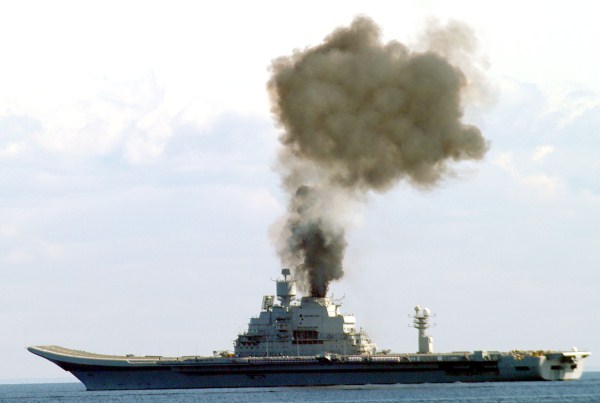
A pity her propulsion systems are still so smoky even after diesel conversion…
Oh com’on Witcha….. not again. Diesels produce lots of smoke when revved hard.
Have you seen VOLVO buses shuttling on busy Indian road? I want fault if some one said that it was just another crap from TATA running on kerosene-diesel mix (mixed to the perfect ratio by the fuel stations :p)
Oh….Spain have slammed the 4th goal into the Italian post.
JangBoGoINS Vikramaditya @Severomorsk Naval Base area with a Kamov on board. This is quite easily among the most beautiful photo till now. The fore and landscape makes the difference. (click for larger photo)
😎
JangBoGoMain propulsion is still boiler and steam turbine based. The installation of six new Italian-made Wärtsilä 1.5 MW diesel generators is purely (and sensibly) to help support the hotel loads of her significant new system and electronics fit. It has the advantages of not having to run up her boilers if she is sitting somewhere in harbour or offshore if they need to run systems like the radars or even the lights. Interestingly the Charles de Gaulle had significant power provision hotel load issues from the nuclear steam plant earlier in her life. They literally couldn’t run hall lights under certain situations, I believe the partial solution was installation of extra diesel generators (somebody please correct me if I am wrong on that).
Yes, as per what I’ve read, the 6 Wartsilla is for power generation only and works as diesel generators and does not belong to the propulsion unit.
Btw, did you meant to point out that the smoke we see are from the diesel generators being eengaged?
larger pictures of the earlier posted (click on pic)


JangBoGomore shots of Vikie from Severomorsk with a single Kamov on the deck.
http://balancer.ru/forum/punbb/attachment.php?item=287867&download=1
http://balancer.ru/forum/punbb/attachment.php?item=287868&download=1
http://balancer.ru/forum/punbb/attachment.php?item=287869&download=1
http://balancer.ru/forum/punbb/attachment.php?item=287872&download=1
JangBoGoTR1,
you mean its the crane at the yard, rite?
That’s probably it. I’m going crazy wondering what it could possibly be used for.:D
The two cranes that you had earlier asked for (installed on the starboard) will be used to embark/disembark the boats we see on the sides and lifting the stores to the flight deck among others.
Wanshan,
After another look, I see six fire fighting units to cover the flight deck. 3 on the island and 3 in the area you mentioned. I think there is one more for a total of 7 units, and one near the aircraft landing aid.
JangBoGoFrom blancers, INS Vikramaditya @Severomorsk Naval Base. click for larger image


JangBoGoThis earlier report related to INS Arihant was not posted.
INS Arihant undergoes sea acceptance trials
Published June 16, 2012 | By admin
SOURCE: INDIAN EXPRESSIn a major step towards achieving allround ability to launch nuclear payload from air, land and water, a miniature 83 MWe pressurised water reactor (PWR), was fitted into INS Arihant and trials were conducted. The PWR is fuelled by highly-enriched uranium, which was developed with the help of Russians. The submarine was launched into the water last year and began its ‘sea acceptance trials’ (SAT) earlier this year wherein it was taken out of the harbour to conduct crucial trials.
“The nuclear reactor was fitted into the submarine for the first time some time back. Since it is the first time that India has built a miniature nuclear reactor for moving platform, it has to be tested when the submarine undergoes various kinds of motion like rolling and pitching,” sources said.
The challenge for Bhabha Atomic Research Centre was to make a compact reactor to fit into the 10-m diameter hull of INS Arihant (literally meaning slayer of enemies). The enriched uranium for the reactor comes from the Rare Materials Project, an undertaking of the Department of Atomic Energy, situated at Ratnahallai, near Mysore. With INS Arihant, India has become the sixth country after the US, Russia, China, France and Britain to have succeeded in constructing a nuclear submarine.At the end of the trial Arihant will be given a nuclear regulatory authority certification before it could be deployed in the open oceans.As India has a policy of ‘no first use’ of nuclear weapons, a robust and survivable retaliatory strike capability is dependent on this nuclear-powered submarine. This makes Arihant a shot in the arm for India’s nuclear triad. With its ability to remain submerged in the waters for infinite time, Arihant with its stealth can remain undetected by the army and can fire its nuclear-tipped missiles from under the sea.
With all due respect, JangBoGo, I find it more likely it’ll be the other way wrong, because Prasun Sengupta’s earlier articles on the ATV program have proven to be far off the mark.
A missile hump is a given for the Arihant to accommodate larger K-series missiles in the future and we’ve all known that from the start, but I for one find a new Delta-IV blueprint design, new propulsion layout and imported VM-4 reactors quite unlikely unless they are planning a different class of submarine altogether.
Dear Witcha, with my post I was not completely endorsing what he said, rather I was putting forth my pov on the matter. I approached the issue with 2 nuclear reactors and the illustration of the submarine with silo as two different cases. Sub illustration I agree due to the fact that Arihant is only a 10m dia sub.
In the twin-reactor case I was just pointing out how they are installed in Russian submarines and that hull dia need not have to be enlarged. It was not meant to say that S5 is definitely going to be with two reactors. From all available info, S2 Arihant is a single-reactor sub and unless Russia have transferred a new modified design based on the Pr.667BDRM (Delta-IV/Delfin) under ‘consultancy’ to India, there is no chance for S5 to be a two reactor submarine.
Another thing to keep in mind is that, if follow-on Arihant class submarines is larger and displaces more than the Arihant and reach the figure of Pr.667BDRM, it will mean the single-reactor sub is going to have a penalty on the max top speed. In such a case, I won’t be too wrong in assuming the sub with a 18-20knots max speed. If such a situation arise/is foreseen, solution to have more power will be looked into and in the current situation, it can only come with the use of two reactors. So having twin reactor design cannot be ruled out at this moment untill we have more info on the S5.
JangBoGoNot sure what you mean by ‘full length hangar extending from the stern to the front flight deck’. This wording suggests the hangar is below the flight deck, while in reality it is located at the level of the flight deck in the main superstructure (serving flight decks at both ends through 2 sets of doors).
Thanks for your watchful eyes. But my mistake that I didn’t mentioned it clearly.
By full length hanger I meant the entire space available on that deck level inside the superstructure to be converted for hanger/stores/aviation related purpose.
Below I’ve attached the drawings. I’m not 100% sure how the hanger looks like, but the red rectangle marked (overlapped by yellow) is how the current hanger looks like most probably and accommodates upto 4 helos. Yellow markings is the proposed conversion I meant.
So briefly, conversion will look like this
1) New flight deck in the front on the same deck level as the aft.
2) Hanger enlargement (as illustrated) will allow for the 6-8 helo capacity that I mentioned.
3) Earlier ramp won’t be needed anymore as the flight deck are on the same level. So additional space will be created beneath, which can be used for accommodating other needs.
Additionally, the front refueling & replenishment space can be done away with a single one, possibly at the rear. Instead I intend to place on board 1-2 trucks (like on Kuz, but smaller GAZ-66 size) for the duty, which can be accommodated inside the new enlarged aviation space inside the super structure.
The below deck boats can be accommodated on to the side with launch arms like that of INS Vikramaditya which takes less space.
I see you’ve raised the forward flight deck by 1 deck, but the space below isn’t at the same level as the original hangar. In the original, there is a ramp forward of the main superstructure going down one deck, from hangar to flight deck. So the hangar is inside the main superstructure, at the level of the rear flight deck. If, in the modified ship, the hangar is below the flight decks and going from stern to just short of the bow, how is transport from the hangar deck to the flight deck organized? Installation of an elevator between the new hangar deck below both the forward and aft flight decks, taking the heli’s up inside the main superstructure into what used to be the hanger (but what is now a staging area). If no elevator solution, I don’t quite see how you’ve increased hangar capacity from 4 to 6-8 as the main superstructure in which it is originally located remains unchanged.
http://www.fas.org/man/dod-101/sys/ship/row/rus/1174.htm
http://www.globalsecurity.org/military/world/russia/images/nk1174mm1.jpg
http://www.fas.org/man/dod-101/sys/ship/row/rus/rogov-DNSN8205957.JPG
All very valid points on good observation and hope my above explanation would have already cleared up that questions.
Somewhere it did cross my mind about an under-deck hanger (as you mistook), which would have allowed the helo capacity to be increased to 12-16 helos. But it would have defeated the main role the ship is meant for. So the under deck helo storage was never an option in the modernization/conversion that I meant. Sorry for the earlier confusion.
For such a scenario, the elevator could have been accommodated to the port/starboard or in the center adjacent to the superstructure. But an under-deck option was never there in the first case. So complicating the conversion with a lift was never on board.
I’ve made the conversion as simple as possible by utilizing the available space to the maximum. This is an upgrade which I believe is doable & practical and if funds be provided, the work can be completed in 2-3 years max. Putting back the two (?) units in reserve would be a good investment and can serve the Black Sea fleet and other areas very well. This can be used effectively in addition to the Mistrals.
JangBoGoTejas completes latest phase of bombing trials in Pokhran
Shown below is an image of the Tejas with 2 Griffin LGBs during its sea level trials off Goa last time around
Photos of the little bird with loaded pylons was long awaited and it looks 😎
A picture with the retracted gears would have looked even better.


 Sign In